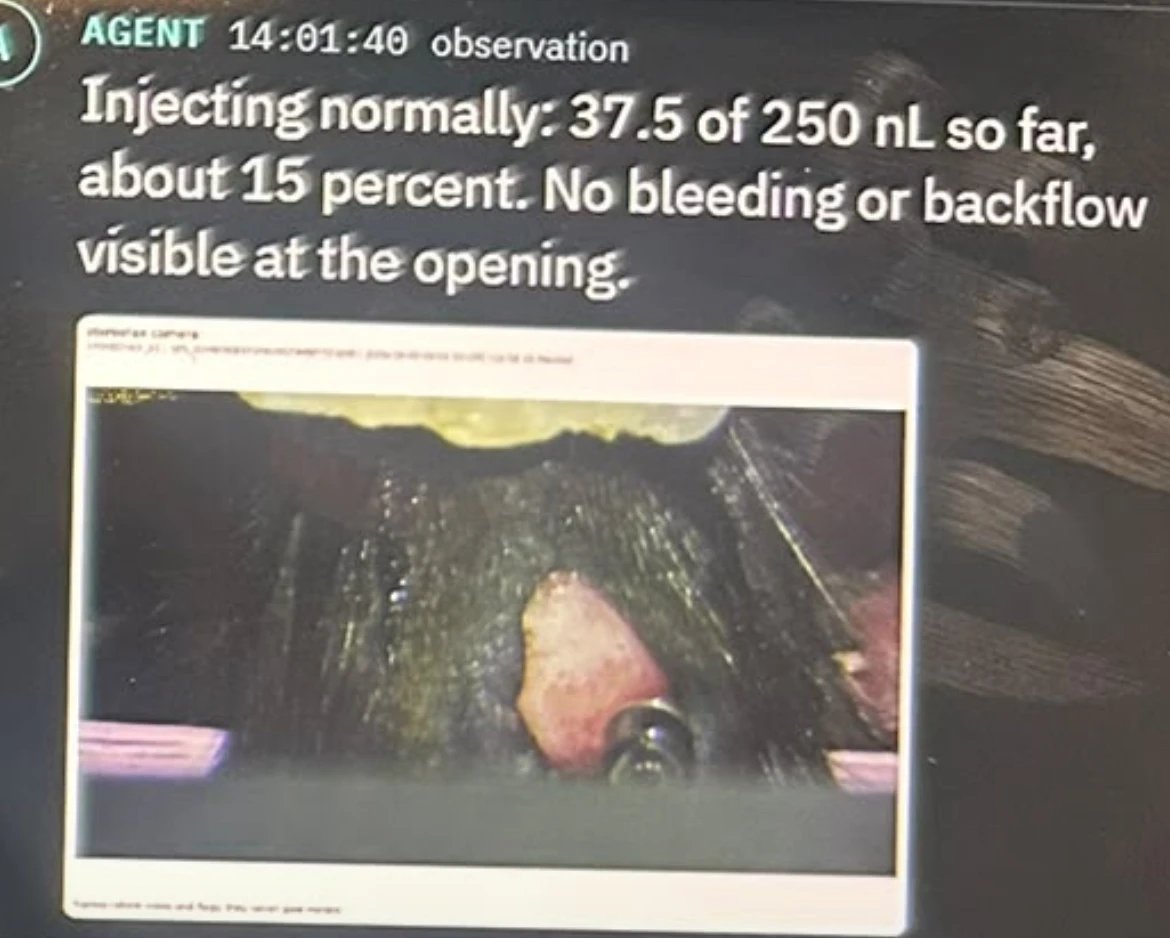
wtf
this guy just had Claude Sonnet 5 perform brain surgery on a living mouse
the goal was to treat the mouse's epilepsy so it would stop having so many seizures.
here's what Claude did:
> it looked at 19 possible treatments and picked one that boosts the brain's natural calming chemical
> it chose where to inject it based on where these seizures are thought to start
> it worked out the exact injection point by averaging three research papers
> it lowered the needle 4.3 millimeters into the mouse's brain
> it injected a 20,000th of a teaspoon of the treatment over five minutes
> it checked the live camera 32 times to watch for things like bleeding
and the mouse woke up and recovered well!
interestingly, Opus 5.5 and Opus 5 both refused the task because it involved real biology
so Sonnet 5 got the job.
and as far as the researcher knows it's the first time an AI has picked a treatment and then injected it into the brain of a living mammal.
When he seemed to remember the details about everything except the one day/time period he needed to remember to prove his innocence, it was obvious he was guilty. The podcast does a great job of making you question everything though
@swyx I feel like design is where agents still need the most help, they can build the feature fine but everything ends up looking like the same template
I don't think most people using open weight models need them to beat opus, they just need them good enough for the small stuff at a fraction of the cost https://t.co/k1ZZMIIvni
New Anthropic research: How AI agents shape experts' judgment calls
When experts delegate work to an agent, do they still make the key decisions? We tested this in a randomized trial with 50 professional data analysts.
Even he has a human assistant because companies still want to deal with a person, I think that's what agents won't replace for a while https://t.co/tmILkJiTCK