Detecting Marine Litter is a very challenging problem! Super happy to present our work on marine litter and floating object detection with @esa#Sentinel2 at @isprs conf today (10:12). Data and models ready to use: https://t.co/jxvNgFGSrG @MarcCoru + R. Carmo and N. Longépé
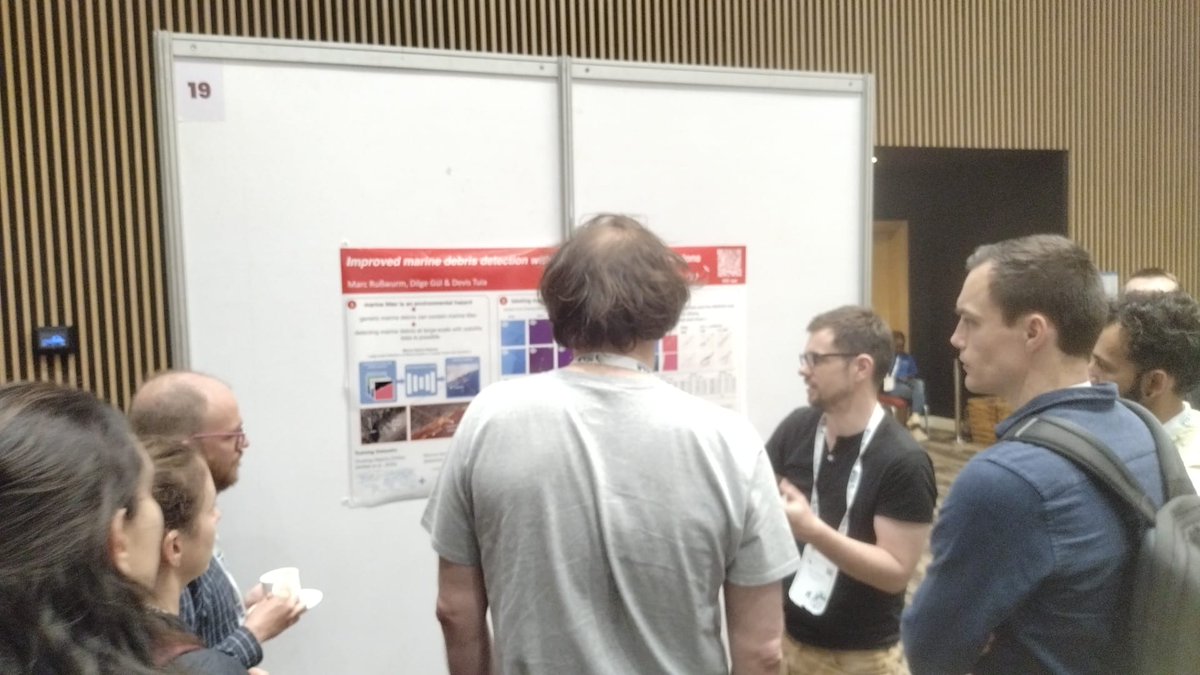
Poster on marine debris detection is up at the #ML4RS workshop of @iclr_conf#ICLR2023! See you at the board during the second poster session starting 15:30.
Also, check model predictions on the GEE app:
https://t.co/lGSmLmWpBc
Excited to share that our paper “Deep unfolding for hypersharpening using a high-frequency injection module” was accepted @CVPR’s @EarthVisionWS (25% acceptance rate) 🚀🎉 Big thanks to @joan_dg @Marctomascruz Tomeu Coll and @alessandro_seb for the great collaboration! (1/3)
The paper is about the fusion of hyperspectral and panchromatic data, also called hypersharpening, using model unfolding technique. The latter consist in translating an established mathematical algorithm into a deep learning framework. Code and paper will follow soon 🔥 (2/3)
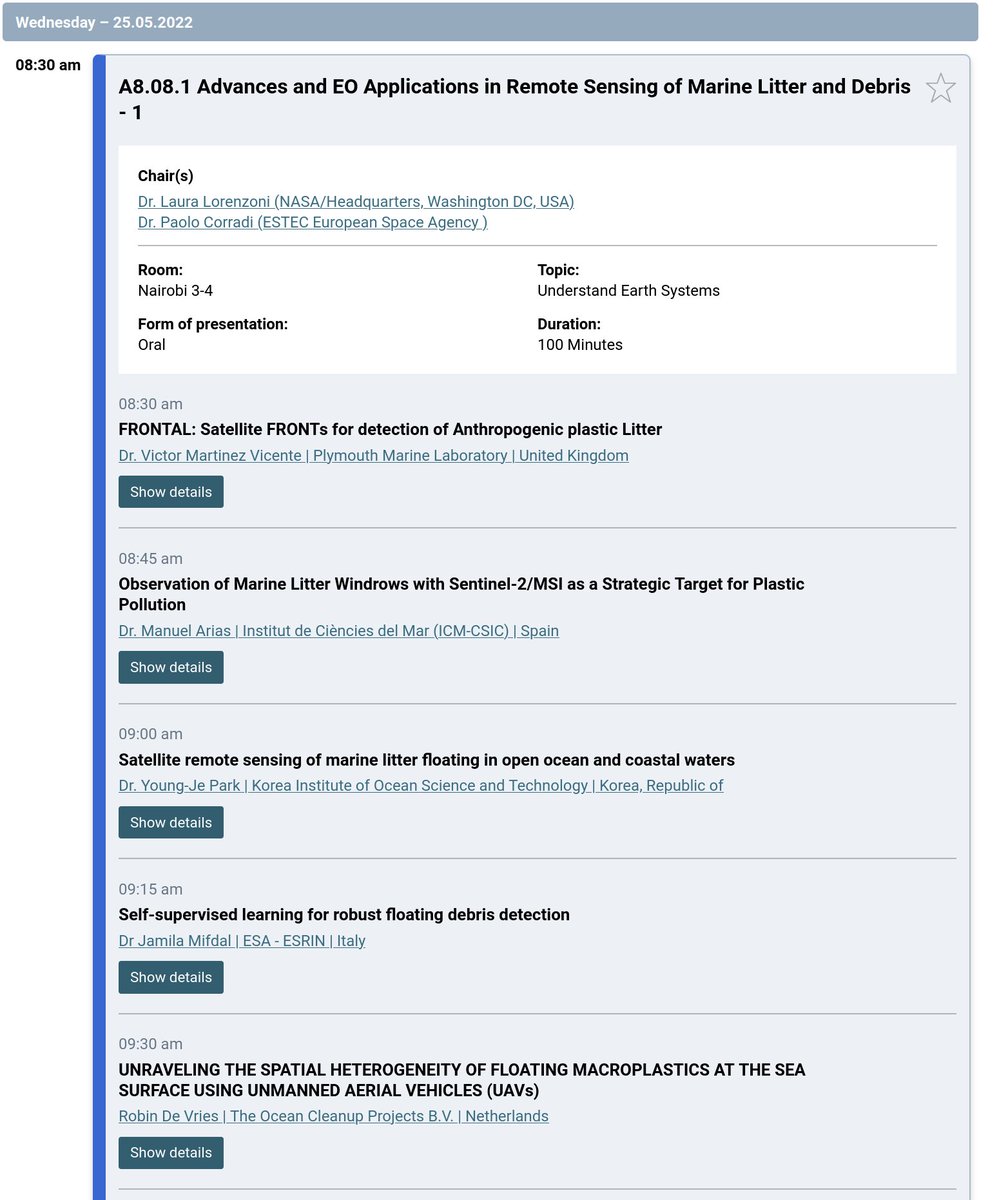
Extremely excited to be in #LPS22 in #Bonn! I'll be giving a talk on artificial intelligence for marine litter detection 🌊 using #Sentinel2 🛰️ data! Come join us📢:
🗓️ Wed 25th
🕒 9h15 - 9h30
📍Nairobi 3-4 room #LPS22
see you soon 🚀
@ESA_EO#philab#ai4eo#EarthObservation
@SargaMonitoring Oh j’aime beaucoup les cartes! Je comprends pour la charge de travail mais ce ne sera pas du travail perdu parce que je suis sûre que cela nous servira. À bientôt
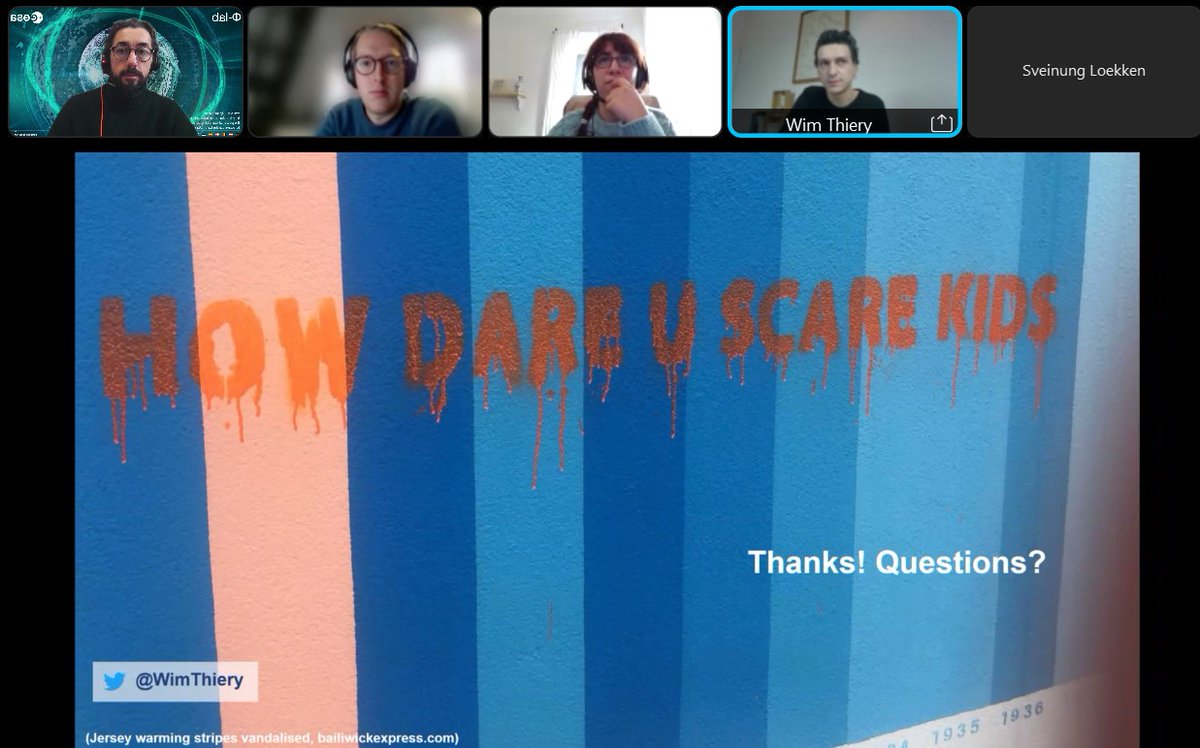
It was a pleasure to organize and chair the presentation given today by @wimThiery at @ESA_EO Φ-lab. His talk on the impact of climate change was very insightful (https://t.co/gzN3VBh4hY). Check this great tool developed by @wimThiery and his team https://t.co/DcAuSoSOwv
Today at @ESA_EO Φ-lab we were delighted to receive @WimThiery from @VUBrussel to discuss his research on Intergenerational inequities in exposure to climate extremes.
https://t.co/ya8EhiRJXt
Check by yourself how climate change can affect you: https://t.co/aHjq2jjJZJ
Curious about detecting floating litter in a costal area 🌊? Check out the amazing notebook demonstrator of our floating object detection code put together by @alejo_coca. The notebook is now part of The Environmental AI Book @EnvDSbook : https://t.co/Qw6oSVtvp0 😊
Do you have a master degree in data science? computer science? Geo-informatics ? or related fields? Are you looking for pursuing research work? We open a funded PhD position on AI for EO: Learning and analyzing spatio-temporal objects from satellite image time series. (1/2)
1/3
Our @NatureClimate paper, led by @AnaVicedo9 was listed as the #TOP1 most talked-about #climatechange-related paper in 2021, based on @altmetric data.
"The burden of heat-related mortality attributable to recent human-induced climate change"
https://t.co/fulFl4spyE
We recently developed a series of tutorials for capacity building around use of #TensorFlow with #EO data for teams at @SERVIRGlobal Amazonia. These open source tutorials leveraging reference data from @OurRadiantEarth and @planet#NICFI can be found at: https://t.co/XgUfslI8s5
Interested in mixing Earth observation (#EO) and artificial intelligence (#AI) + quantum computing (#QC)?
Research Fellow #jobs (PostDoc) in #Quantum Computing for Earth Observation at @ESA_EO Φ-lab (Rome, 🇮🇹): deadline to apply ext'd to Dec. 15th!
https://t.co/FZ3phSejgo
🌍🐈⬛
Last week Φ-lab visiting profs were at @ESA_EO Φ-lab, Frascati (🇮🇹) to meet us and discuss the #future of Earth observation #EO and #AI4EO!
w/ B. Demir @BigEarthERC F. Del Frate S. Dzeroski @janvanrijn K. Schindler @devistuia M. Datcu @xiaoxiang_zhu + https://t.co/KkeW1a41w1
#TeamSeas shines a massive attention spotlight on ocean cleanup this week! But finding marine litter offshore 🌊 is tricky. We trained #machinelearning models 🤖 on satellite 🛰️📡 data to find it. Check our paper+code w @JMifdal R.Carmo @ESA_EO@EPFL_en https://t.co/AkyYeRf7WR