Hay personas que parecen haber tenido mucha suerte.
Cuando uno mira su historia con más detalle, descubre algo diferente.
Detrás de muchas oportunidades hubo preparación, disciplina, estudio, conversaciones, errores y persistencia. Hubo personas que decidieron seguir trabajando cuando todavía no aparecían los resultados.
La suerte existe. Sería ingenuo negarlo.
Pero la suerte no reemplaza el trabajo.
El trabajo aumenta las probabilidades de tener suerte.
No porque garantice el éxito. Nadie puede prometer eso.
Sino porque quien está aprendiendo, construyendo relaciones, resolviendo problemas y desarrollando nuevas capacidades tiene más posibilidades de reconocer una oportunidad cuando aparece y de estar preparado para aprovecharla.
Muchas veces lo que desde afuera parece suerte es, en realidad, preparación encontrándose con una oportunidad.
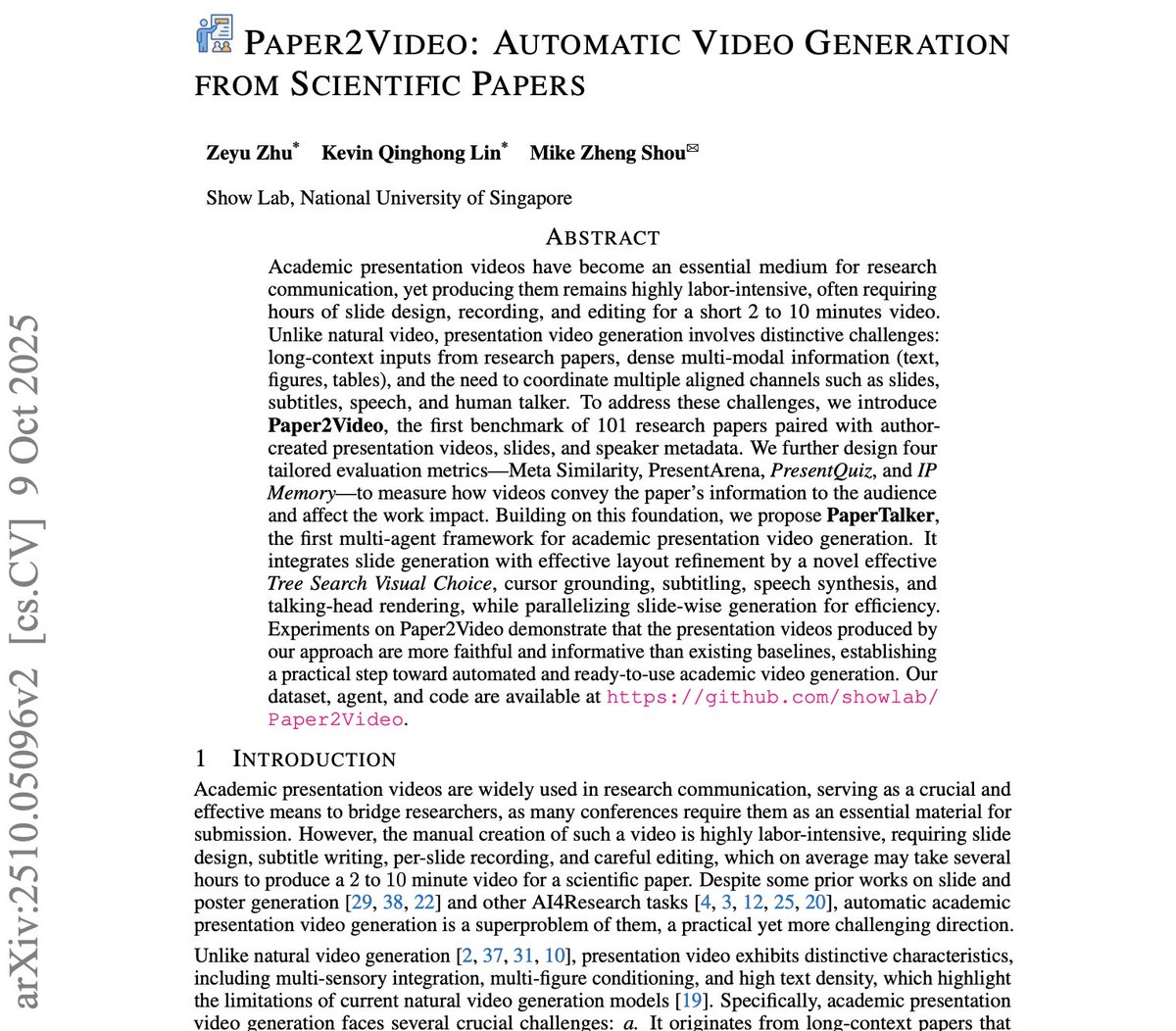
This is insane 🤯
A new system called Paper2Video can read a scientific paper and automatically create a full presentation video slides, narration, subtitles, even a talking head of the author.
It’s called PaperTalker, and it beat human-made videos in comprehension tests.
Hours of academic video editing... gone.
AI now explains your research better than you do.
👉 github. com/showlab/Paper2Video
Building Agentic AI Systems? Let me share a Comprehensive Guide with you.
When designing smarter AI systems, understanding how agents think, act, and collaborate is the key. Here's a breakdown of the essentials:
1) What is an AI Agent?
An AI agent is a system that thinks, plans, and acts independently using LLMs, adapting in real-time with minimal human help.
2) Architectures for Building AI Agents
Start with single agents for simple tasks or build multi-agent systems where different agents collaborate and solve complex problems together.
3) Foundations of Agent Design
Good agents combine powerful models, smart memory, useful tools, structured instructions, and seamless orchestration to work effectively.
4) Building Guardrails for Safety and Control
Safety measures like data privacy, dynamic rules, and human checkpoints keep agents responsible and prevent harmful outcomes.
5) Essential Tools for Building Agentic AI
Successful agents rely on LLMs, memory systems, orchestrators, integration tools, guardrails, and monitoring platforms to operate smartly.
Save this if you're learning about AI Agents and want a solid foundation and follow me @goyalshaliniuk for more such insights :-) !
Almost every software engineer has used Git before, but only a handful know how it works.
To begin with, it's essential to identify where our code is stored. The common assumption is that there are only two locations - one on a remote server like Github and the other on our local machine. However, this isn't entirely accurate. Git maintains three local storages on our machine, which means that our code can be found in four places:
- Working directory: where we edit files
- Staging area: a temporary location where files are kept for the next commit
- Local repository: contains the code that has been committed
- Remote repository: the remote server that stores the code
Most Git commands primarily move files between these four locations.
Over to you: Do you know which storage location the "git tag" command operates on? This command can add annotations to a commit.
—
Subscribe to our weekly newsletter to get a Free System Design PDF (158 pages): https://t.co/uc5M7CdXXC