@GenXTruther72@AlboMP Typical,had to find a way to make it a man’s fault.!!
It wouldnt stop the man haters from femicideville counting it on their tally if it were a father. Their own fine print discloses that they count cases like this for their dead women tally.
@Psikobilim_ There’s no real definitive studies that confirm misogyny/gender equality is a main driver of violence against women. Why are Nordic countries high on the equality scale but still have some of the highest do stats in Europe.??
This bullshit isn’t helping end violence
@Psikobilim_ “Incel” is just another made up word from the femturds who do no wrong. Why are men’s rights activists seen as evil and sinister and women’s rights activists seen as angelic and heroic.?? You’re all fucked in the head you self entitled feminists.!!
@TruthFairy131 This judge should get sacked and his head examined.!!
I’m pretty sure nearly everyone who kills anyone is suffering some sort of mental health problem. No nationwide mass hysteria from the usual outspoken individuals and organisations about this is no surprise.
@wyvernsrose If people knew the history of White Ribbon and how and where this disgraceful organisation got the name and what they did to Erin Pizzey peoples view of them would change. They’ve shows their lack of moral integrity by blatantly lying AGAIN after being called out on this.
@wyvernsrose The way I look at it is if they have to lie,deceive,fudge,cherry pick stats etc. it proves that their argument must be weak. It’s counter productive and does more harm than good. We will never get a correct answer unless we have correct input.
@DavidMaywald@TheCanDec Here’s White Fibbin blatantly lying on their site confirming exactly what you’re saying. They were called out years back for this and eventually changed it to “leading risk” but I see they’ve returned to their original lie. It’s not even in the top 10 causes.
When Advocacy Masquerades as Evidence: Why Australia Needs Higher Standards for Research That Shapes Public Policy
by @DavidMaywald [ANALYSIS]
Good public policy depends on an elementary bargain between citizens, universities and government: evidence should be gathered as impartially as possible, uncertainty should be disclosed, competing explanations should be tested, and conclusions should not outrun the data.
That bargain becomes especially important when taxpayers fund the research and governments subsequently use it to shape school curricula, public campaigns, regulatory powers or legislation.
There are legitimate reasons to study misogyny, violence against women, online radicalisation and harmful online communities. Some manosphere content is plainly degrading or extremist. The problem arises when a particular ideological interpretation becomes embedded in the research design itself and is then presented to policymakers and journalists as neutral empirical fact.
A revealing body of recent research concerns boys, masculinity and the “manosphere”. Across numerous studies, a recurring architecture can be identified: feminist or critical-masculinity theory supplies the interpretative framework; male grievance is frequently interpreted through patriarchy, privilege, entitlement or backlash; manosphere engagement is associated with misogyny or radicalisation; and interventions are recommended for schools, platforms, parents or government (including, for example, critics of feminism being caught in counter-extremist regulations).
The existence of that pattern does not establish that the studies are false. But it makes methodological scrutiny essential.
Fisher et al. (2026), for example, commendably disclose that principal coders align with left-wing political perspectives and are critical of significant aspects of online masculinity content. They acknowledge the subjectivity inherent in coding politically charged material. Yet their donated TikTok dataset found only 5.76% of videos in the two manosphere categories, while 37.74% comprised much broader “cultural touchpoints”. That illustrates how dramatically conclusions can depend upon definitions, sampling and classification.
Baker, Ging and Andreasen instead used artificial accounts and a much broader coding framework, reporting “toxic” content rapidly entering recommendation feeds. Their experimental accounts included interests such as gyms, sport and gaming, while their definition of toxic content encompassed essentially all coded categories other than generic known-actor material. Neither methodology should simply be dismissed. But neither should one result be transformed into a universal description of what boys experience online…
This is where Tom Golden’s provocative concept of the “Femosphere Pipeline” becomes useful, not as established fact, but as a hypothesis about institutional transmission.
Golden proposes a sequence in which ideas emerge from academia or advocacy, are amplified by advocates and journalists, taught by educators, incorporated into government reports and training, and ultimately influence policy, legislation and courts. He also identifies circular validation: academics, advocates, journalists and politicians cite one another until an originating proposition can appear independently corroborated.
Sociologist Murray Straus raised related methodological concerns years earlier in research on intimate-partner violence: selective evidence gathering, selective citation, failure to investigate female perpetration symmetrically and the possibility that theoretical commitments can affect publication and funding.
These are questions worth asking of today’s masculinity scholarship.
Consider the Australian National Research Organisation for Women’s Safety (ANROWS). A current federally funded Monash project explicitly starts from “growing evidence” about misogynistic manosphere discourses, describes influencers including Andrew Tate and Jordan Peterson as challenging feminism’s gains and reasserting patriarchal roles, and aims to develop and evaluate interventions in schools. The project receives $226,188 from the Australian Government Department of Social Services. ANROWS’s resulting 2026 guide describes harmful impacts and pathways into the manosphere and recommends school responses.
Those objectives may be defensible. But taxpayers are entitled to ask whether alternative hypotheses receive equivalent investigation: boys’ genuine educational problems, loneliness, developmental needs, family breakdown, changing employment and relationship markets, positive aspects of male-oriented communities, or evidence that some criticisms of gender policy are substantively correct.
A research programme becomes epistemically fragile if male grievance can be studied only as something requiring correction, rather than something that might sometimes contain information.
The concern is not confined to universities.
The eSafety Commissioner currently tells Australians that a common but “false” manosphere narrative is that feminism and gender equality have come at men’s expense. It describes a pathway in which young men seeking fitness or self-improvement content can be propelled toward blame, resentment and hate. Importantly, the eSafety Commissioner also acknowledges that most boys viewing such material will not enter harmful communities.
Whether feminism or particular “gender equality” policies have ever disadvantaged men is, however, an empirical and political question; not something a regulator should resolve merely by definition…
Victoria provides another example of the scale at which a particular gender framework has become institutionalised. The Victorian Government says more than $19 billion across five successive budgets has been directed toward initiatives assessed through its gender equality framework. Respectful Relationships operates across Victorian government schools and extends into Catholic and independent schools; government materials say more than 1,950 schools participate.
The Victorian Government argues that these programs are evidence-based, promote healthy relationships and arose from the Royal Commission into Family Violence. Those are important counterpoints. Yet Respect Victoria itself says further evaluative evidence is required to establish the potential population-level benefits of the statewide program. That is precisely why disagreement over underlying gender theories should remain scientifically permissible rather than being treated as resistance to equality.
Respect Victoria also recommends that Commonwealth funding, commissioning and evaluation concerning men and boys be grounded in “gender-transformative practice” and links online misogyny and gender-based violent extremism to shared foundations in harmful gender norms and stereotypes.
That demonstrates why theoretical assumptions matter: research frameworks can become funding frameworks, which become intervention frameworks.
Biased or poorly constructed research can cause harm well beyond wasting research grants.
It can misallocate scarce resources. It can direct interventions toward changing boys’ attitudes while neglecting measurable problems in their literacy, mental health, physical activity, employment or family lives. It can pathologise normal male behaviour. It can generate misleading media headlines by converting correlations into causal stories. It can stigmatise legitimate dissent by blurring distinctions between criticism of feminism, misogyny and violent extremism.
And once contested concepts enter regulation, the stakes become greater still.
Australia is already strengthening online-safety enforcement. Parliament’s own analysis records both expanded eSafety powers and human rights questions concerning privacy and children’s rights, while the Government has committed to legislating a broader digital duty of care. Whatever form future legislation takes, restrictions on lawful expression warrant a considerably higher evidentiary threshold than exploratory academic research…
Taxpayer funding makes neutrality particularly important. Government-funded academics need not be politically neutral people; no researcher is devoid of values. But public funding should support methodological pluralism. Governments damage their own credibility when grants appear concentrated among researchers sharing government-preferred assumptions, while universities damage their credibility when advocacy objectives become difficult to distinguish from empirical investigation (here’s looking at you, Monash University).
The solution isn’t conservative research replacing progressive research. It is better research: preregistration where practicable, published codebooks, representative samples, sex-symmetrical comparison groups, transparent funding and positionality statements, competing hypotheses, replication by ideologically diverse teams, separation of correlation from causation, serious engagement with contradictory evidence and clear boundaries between empirical findings and policy advocacy.
Above all, every theoretical framework must be allowed to lose.
A democratic society should be especially suspicious of a closed circuit in which government funds research, researchers validate government-favoured assumptions, funded advocates popularise the findings, media repeat them, and government then cites the apparent consensus to justify further funding or regulation. The way to establish whether such a circuit exists is not rhetoric. It is to follow the citations, funding, methods and policy documents. And Victoria stands out as having been most contaminated by this closed circuit.
As a democratic nation, we desperately need to return to what rigorous scholarship is supposed to do.
>> 20 Sources that Should Anchor the Investigation
These sources do not all “demonstrate harm”; rather, together they allow the claimed harms, methodological weaknesses and institutional pathways to be tested.
Murray A. Straus (2007), “Processes Explaining the Concealment and Distortion of Evidence on Gender Symmetry in Partner Violence” — foundational methodological challenge concerning selective evidence, citation and theoretical commitment.
Murray A. Straus (2006), “Future Research on Gender Symmetry in Physical Assaults on Partners” — useful framework for testing sex-asymmetric research design.
Debbie Ging (2017/2019), “Alphas, Betas, and Incels: Theorizing the Masculinities of the Manosphere” — foundational manosphere theoretical text.
Stu Lucy (2024), “Slippages in the Application of Hegemonic Masculinity: A Case Study of Incels” — important internal criticism of misuse of hegemonic-masculinity theory.
Ann Biedermann (2026), “The ‘toxic masculinity’ trap” — challenges conceptual inconsistency and circularity in masculinity/violence scholarship.
Carian, DiBranco & Kelly (2024), “Intervening in Problematic Research Approaches to Incel Violence” — valuable contrasting argument favouring feminist structural interpretation.
Wescott, Roberts & Zhao (2024), “The problem of anti-feminist ‘manfluencer’ Andrew Tate in Australian schools” — 30 women teachers interpreted through male-supremacy/hegemonic-masculinity concepts.
Roberts et al. (2025), “‘Adolescence’, manufactured outrage and instructed victimhood” — particularly relevant to treatment of claims about boys’ disadvantage.
García-Mingo & Díaz Fernández (2023), “Wounded men of feminism” — conceptualises male-victimhood discourse within the Spanish manosphere.
Hopton & Langer (2022), “‘Kick the XX out of your life’” — feminist psychological/discourse analysis of manosphere Twitter.
Haslop et al. (2024), “Mainstreaming the Manosphere’s Misogyny…” — useful for examining claims about teenage boys and Tate.
Franklin-Paddock, Platow & Ryan (2025), “From Privilege to Threat” — quantitative opportunity to examine constructs of male privilege and feminist threat.
Baker, Ging & Andreasen (2024), Recommending Toxicity — crucial algorithm/sockpuppet study and particularly important for classification methodology.
Fisher et al. (2026), Masculinity Content Classification Framework — especially valuable because of real-user donated data, coder reflexivity and reported base rates.
Sara Meger (2026), Misogyny, Online Radicalisation, and Youth Extremism in Australia — essential for examining movement from gender attitudes toward counter-extremism policy.
Gerrand, Ging, Roose & Flood (2025), “Mapping the Neo-Manosphere(s)” — shows development of the field toward algorithms, mainstreaming and overlapping extremisms.
Pfitzner et al. (2026), An Introductory Guide to the Manosphere and the Impacts for Young People, Teachers and Schools — unusually important because academic ideas become a federally funded intervention resource.
eSafety Commissioner (2026), “The manosphere: What it is and what parents and carers need to know” — demonstrates translation of these concepts into the regulator’s public framework.
Tom Golden (2026), “The Femosphere Pipeline” — not empirical scholarship, but the central hypothesis about academia → advocacy → media → government → law that the investigation can test.
Institute of Public Affairs (2026), Stacking the Deck — an ideologically interested but potentially important audit of government-funded advocacy; its selective methodology means its claims should themselves receive the same scrutiny applied to feminist research.
The strongest eventual analysis would not ask readers to accept that these 20 sources prove an ideological conspiracy. It would do something much more persuasive: trace who funds whom, who cites whom, which propositions change from hypotheses into “facts”, which alternative explanations disappear, and exactly where academic terminology subsequently appears in government programs, media narratives and regulatory proposals.
Read the full piece at https://t.co/aE5WCEtXAX
@Ozwimmsrights The females get paid more than the males on average in the porn industry. Why aren’t you talking this gender inequality.?
Because feminism is about equality isn’t it.???
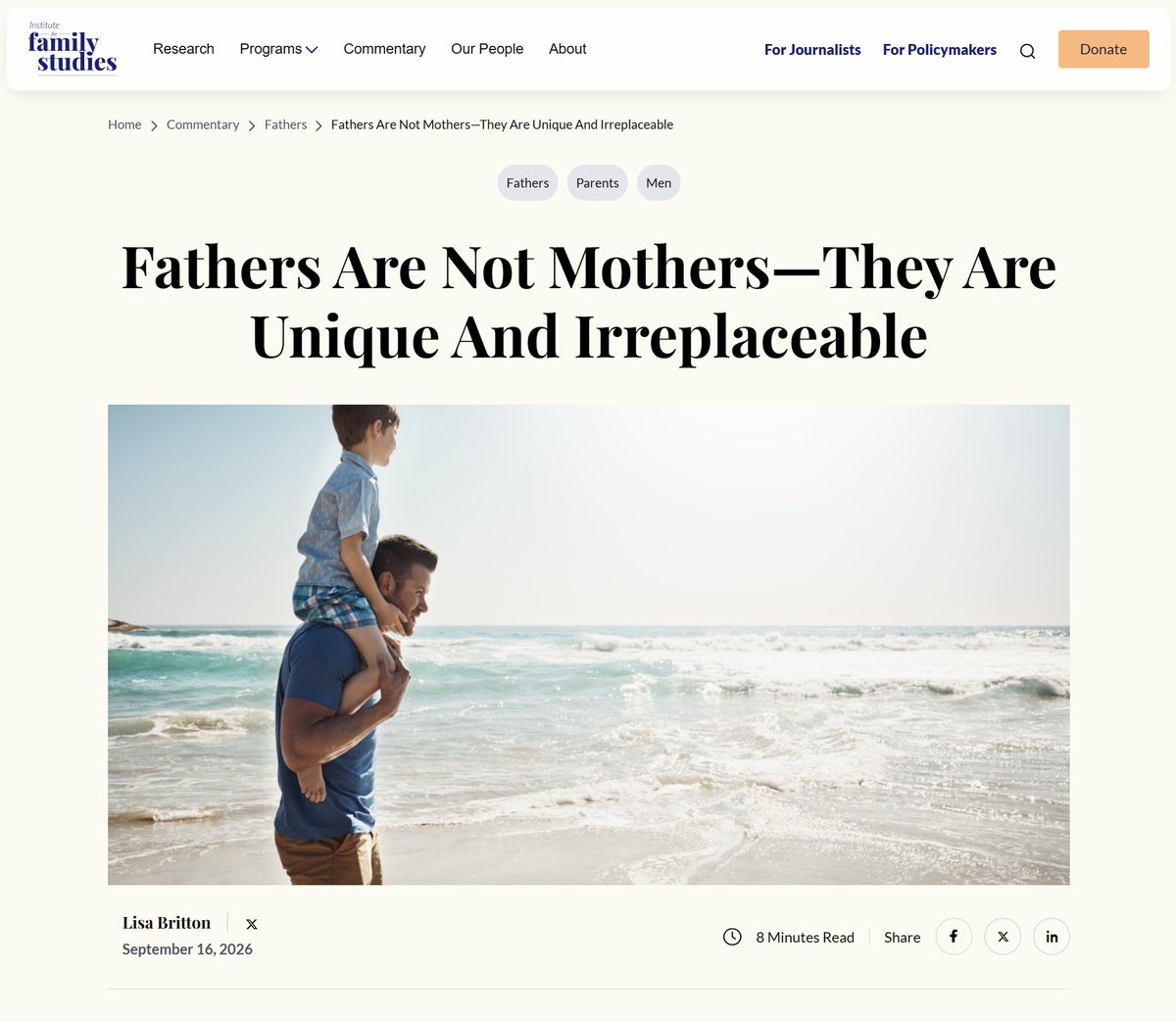
FATHERS AREN'T MOTHERS, AND THAT MATTERS A LOT
Lisa Britton has written an excellent piece for the Institute for Family Studies: Fathers Are Not Mothers—They Are Unique and Irreplaceable.
https://t.co/Kb6EPUYmxz
Her central point is simple but increasingly important: equality doesn't require sameness.
Fathers today are deeply involved in family life. They cook, clean, change nappies, carry babies, attend ballet lessons and football games, help with homework and spend substantially more time caring for their children than fathers did generations ago. That's something worth celebrating.
But celebrating involved fathers shouldn’t require pretending that fathers and mothers are interchangeable... Because they aren't.
Britton points to evidence associating engaged fatherhood with stronger self-regulation, fewer behavioural problems and better language development in children, while father presence can be particularly consequential for boys and girls in different ways.
Fathers parent differently.
They roughhouse. They encourage calculated risk. They challenge children to stretch beyond what they think they can do. They bring protection, playfulness, boundaries, confidence and a distinct masculine presence into family life...
That isn’t inferior parenting. It isn’t superior parenting. It’s fathering.
As Britton argues, families need not be built around two interchangeable adults performing precisely the same functions. Mothers and fathers can have equal dignity while bringing different strengths to the shared work of raising children.
We should want fathers to be more involved. Not by asking them to become like mothers, but by giving them the confidence and freedom to be good fathers...
Men and women needn't be rivals. Mothers and fathers needn't be copies. They’re on the same team.
And children deserve the distinctive love, presence and contribution of both. Different and equal.
Excellent piece, thank you @LisaBritton.
#Fatherhood #FathersMatter #DadsMatter #PositiveMasculinity #Masculinity #Parenting #Family #MenAndBoys #StrongFamilies #InstituteForFamilyStudies
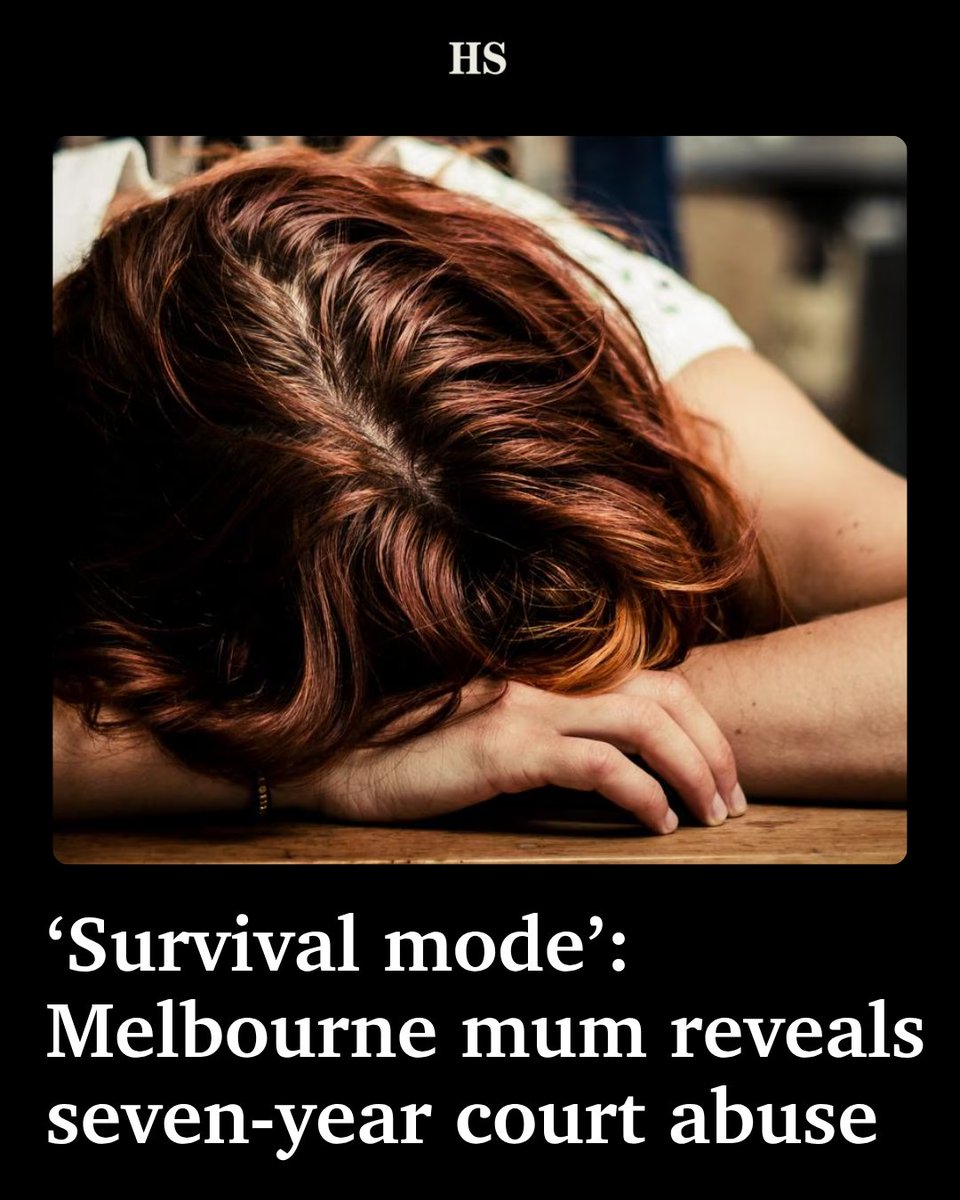
A Melbourne mum was dragged through family court for seven years, leaving her in “survival mode”, as experts warn DV perpetrators can weaponise legal and other systems to maintain control long after a relationship ends > https://t.co/K8X1Yj16hp
@wyvernsrose I was involved in some Facebook pages around 10yrs ago and remember the name. White Fibbin are back openly lying on their page that DV is leading cause of death for women 15-44 in Aust. It’s not even in top 10. called them out,they changed to leading risk,now back to cause.🤬
@AnusOfDoom@theheraldsun Fuck off you putrid fuckin lowlife.!! Show some fuckin respect you filthy fuckin grub.!! An Aussie rock legend has died. 😢 Go play your keyboard warrior childish fuckin games elsewhere you fuckin oxygen thieving cunt.!!!





![TheCanDec's tweet photo. When Advocacy Masquerades as Evidence: Why Australia Needs Higher Standards for Research That Shapes Public Policy
by @DavidMaywald [ANALYSIS]
Good public policy depends on an elementary bargain between citizens, universities and government: evidence should be gathered as impartially as possible, uncertainty should be disclosed, competing explanations should be tested, and conclusions should not outrun the data.
That bargain becomes especially important when taxpayers fund the research and governments subsequently use it to shape school curricula, public campaigns, regulatory powers or legislation.
There are legitimate reasons to study misogyny, violence against women, online radicalisation and harmful online communities. Some manosphere content is plainly degrading or extremist. The problem arises when a particular ideological interpretation becomes embedded in the research design itself and is then presented to policymakers and journalists as neutral empirical fact.
A revealing body of recent research concerns boys, masculinity and the “manosphere”. Across numerous studies, a recurring architecture can be identified: feminist or critical-masculinity theory supplies the interpretative framework; male grievance is frequently interpreted through patriarchy, privilege, entitlement or backlash; manosphere engagement is associated with misogyny or radicalisation; and interventions are recommended for schools, platforms, parents or government (including, for example, critics of feminism being caught in counter-extremist regulations).
The existence of that pattern does not establish that the studies are false. But it makes methodological scrutiny essential.
Fisher et al. (2026), for example, commendably disclose that principal coders align with left-wing political perspectives and are critical of significant aspects of online masculinity content. They acknowledge the subjectivity inherent in coding politically charged material. Yet their donated TikTok dataset found only 5.76% of videos in the two manosphere categories, while 37.74% comprised much broader “cultural touchpoints”. That illustrates how dramatically conclusions can depend upon definitions, sampling and classification.
Baker, Ging and Andreasen instead used artificial accounts and a much broader coding framework, reporting “toxic” content rapidly entering recommendation feeds. Their experimental accounts included interests such as gyms, sport and gaming, while their definition of toxic content encompassed essentially all coded categories other than generic known-actor material. Neither methodology should simply be dismissed. But neither should one result be transformed into a universal description of what boys experience online…
This is where Tom Golden’s provocative concept of the “Femosphere Pipeline” becomes useful, not as established fact, but as a hypothesis about institutional transmission.
Golden proposes a sequence in which ideas emerge from academia or advocacy, are amplified by advocates and journalists, taught by educators, incorporated into government reports and training, and ultimately influence policy, legislation and courts. He also identifies circular validation: academics, advocates, journalists and politicians cite one another until an originating proposition can appear independently corroborated.
Sociologist Murray Straus raised related methodological concerns years earlier in research on intimate-partner violence: selective evidence gathering, selective citation, failure to investigate female perpetration symmetrically and the possibility that theoretical commitments can affect publication and funding.
These are questions worth asking of today’s masculinity scholarship.
Consider the Australian National Research Organisation for Women’s Safety (ANROWS). A current federally funded Monash project explicitly starts from “growing evidence” about misogynistic manosphere discourses, describes influencers including Andrew Tate and Jordan Peterson as challenging feminism’s gains and reasserting patriarchal roles, and aims to develop and evaluate interventions in schools. The project receives $226,188 from the Australian Government Department of Social Services. ANROWS’s resulting 2026 guide describes harmful impacts and pathways into the manosphere and recommends school responses.
Those objectives may be defensible. But taxpayers are entitled to ask whether alternative hypotheses receive equivalent investigation: boys’ genuine educational problems, loneliness, developmental needs, family breakdown, changing employment and relationship markets, positive aspects of male-oriented communities, or evidence that some criticisms of gender policy are substantively correct.
A research programme becomes epistemically fragile if male grievance can be studied only as something requiring correction, rather than something that might sometimes contain information.
The concern is not confined to universities.
The eSafety Commissioner currently tells Australians that a common but “false” manosphere narrative is that feminism and gender equality have come at men’s expense. It describes a pathway in which young men seeking fitness or self-improvement content can be propelled toward blame, resentment and hate. Importantly, the eSafety Commissioner also acknowledges that most boys viewing such material will not enter harmful communities.
Whether feminism or particular “gender equality” policies have ever disadvantaged men is, however, an empirical and political question; not something a regulator should resolve merely by definition…
Victoria provides another example of the scale at which a particular gender framework has become institutionalised. The Victorian Government says more than $19 billion across five successive budgets has been directed toward initiatives assessed through its gender equality framework. Respectful Relationships operates across Victorian government schools and extends into Catholic and independent schools; government materials say more than 1,950 schools participate.
The Victorian Government argues that these programs are evidence-based, promote healthy relationships and arose from the Royal Commission into Family Violence. Those are important counterpoints. Yet Respect Victoria itself says further evaluative evidence is required to establish the potential population-level benefits of the statewide program. That is precisely why disagreement over underlying gender theories should remain scientifically permissible rather than being treated as resistance to equality.
Respect Victoria also recommends that Commonwealth funding, commissioning and evaluation concerning men and boys be grounded in “gender-transformative practice” and links online misogyny and gender-based violent extremism to shared foundations in harmful gender norms and stereotypes.
That demonstrates why theoretical assumptions matter: research frameworks can become funding frameworks, which become intervention frameworks.
Biased or poorly constructed research can cause harm well beyond wasting research grants.
It can misallocate scarce resources. It can direct interventions toward changing boys’ attitudes while neglecting measurable problems in their literacy, mental health, physical activity, employment or family lives. It can pathologise normal male behaviour. It can generate misleading media headlines by converting correlations into causal stories. It can stigmatise legitimate dissent by blurring distinctions between criticism of feminism, misogyny and violent extremism.
And once contested concepts enter regulation, the stakes become greater still.
Australia is already strengthening online-safety enforcement. Parliament’s own analysis records both expanded eSafety powers and human rights questions concerning privacy and children’s rights, while the Government has committed to legislating a broader digital duty of care. Whatever form future legislation takes, restrictions on lawful expression warrant a considerably higher evidentiary threshold than exploratory academic research…
Taxpayer funding makes neutrality particularly important. Government-funded academics need not be politically neutral people; no researcher is devoid of values. But public funding should support methodological pluralism. Governments damage their own credibility when grants appear concentrated among researchers sharing government-preferred assumptions, while universities damage their credibility when advocacy objectives become difficult to distinguish from empirical investigation (here’s looking at you, Monash University).
The solution isn’t conservative research replacing progressive research. It is better research: preregistration where practicable, published codebooks, representative samples, sex-symmetrical comparison groups, transparent funding and positionality statements, competing hypotheses, replication by ideologically diverse teams, separation of correlation from causation, serious engagement with contradictory evidence and clear boundaries between empirical findings and policy advocacy.
Above all, every theoretical framework must be allowed to lose.
A democratic society should be especially suspicious of a closed circuit in which government funds research, researchers validate government-favoured assumptions, funded advocates popularise the findings, media repeat them, and government then cites the apparent consensus to justify further funding or regulation. The way to establish whether such a circuit exists is not rhetoric. It is to follow the citations, funding, methods and policy documents. And Victoria stands out as having been most contaminated by this closed circuit.
As a democratic nation, we desperately need to return to what rigorous scholarship is supposed to do.
>> 20 Sources that Should Anchor the Investigation
These sources do not all “demonstrate harm”; rather, together they allow the claimed harms, methodological weaknesses and institutional pathways to be tested.
Murray A. Straus (2007), “Processes Explaining the Concealment and Distortion of Evidence on Gender Symmetry in Partner Violence” — foundational methodological challenge concerning selective evidence, citation and theoretical commitment.
Murray A. Straus (2006), “Future Research on Gender Symmetry in Physical Assaults on Partners” — useful framework for testing sex-asymmetric research design.
Debbie Ging (2017/2019), “Alphas, Betas, and Incels: Theorizing the Masculinities of the Manosphere” — foundational manosphere theoretical text.
Stu Lucy (2024), “Slippages in the Application of Hegemonic Masculinity: A Case Study of Incels” — important internal criticism of misuse of hegemonic-masculinity theory.
Ann Biedermann (2026), “The ‘toxic masculinity’ trap” — challenges conceptual inconsistency and circularity in masculinity/violence scholarship.
Carian, DiBranco & Kelly (2024), “Intervening in Problematic Research Approaches to Incel Violence” — valuable contrasting argument favouring feminist structural interpretation.
Wescott, Roberts & Zhao (2024), “The problem of anti-feminist ‘manfluencer’ Andrew Tate in Australian schools” — 30 women teachers interpreted through male-supremacy/hegemonic-masculinity concepts.
Roberts et al. (2025), “‘Adolescence’, manufactured outrage and instructed victimhood” — particularly relevant to treatment of claims about boys’ disadvantage.
García-Mingo & Díaz Fernández (2023), “Wounded men of feminism” — conceptualises male-victimhood discourse within the Spanish manosphere.
Hopton & Langer (2022), “‘Kick the XX out of your life’” — feminist psychological/discourse analysis of manosphere Twitter.
Haslop et al. (2024), “Mainstreaming the Manosphere’s Misogyny…” — useful for examining claims about teenage boys and Tate.
Franklin-Paddock, Platow & Ryan (2025), “From Privilege to Threat” — quantitative opportunity to examine constructs of male privilege and feminist threat.
Baker, Ging & Andreasen (2024), Recommending Toxicity — crucial algorithm/sockpuppet study and particularly important for classification methodology.
Fisher et al. (2026), Masculinity Content Classification Framework — especially valuable because of real-user donated data, coder reflexivity and reported base rates.
Sara Meger (2026), Misogyny, Online Radicalisation, and Youth Extremism in Australia — essential for examining movement from gender attitudes toward counter-extremism policy.
Gerrand, Ging, Roose & Flood (2025), “Mapping the Neo-Manosphere(s)” — shows development of the field toward algorithms, mainstreaming and overlapping extremisms.
Pfitzner et al. (2026), An Introductory Guide to the Manosphere and the Impacts for Young People, Teachers and Schools — unusually important because academic ideas become a federally funded intervention resource.
eSafety Commissioner (2026), “The manosphere: What it is and what parents and carers need to know” — demonstrates translation of these concepts into the regulator’s public framework.
Tom Golden (2026), “The Femosphere Pipeline” — not empirical scholarship, but the central hypothesis about academia → advocacy → media → government → law that the investigation can test.
Institute of Public Affairs (2026), Stacking the Deck — an ideologically interested but potentially important audit of government-funded advocacy; its selective methodology means its claims should themselves receive the same scrutiny applied to feminist research.
The strongest eventual analysis would not ask readers to accept that these 20 sources prove an ideological conspiracy. It would do something much more persuasive: trace who funds whom, who cites whom, which propositions change from hypotheses into “facts”, which alternative explanations disappear, and exactly where academic terminology subsequently appears in government programs, media narratives and regulatory proposals.
Read the full piece at https://t.co/aE5WCEtXAX](https://pbs.twimg.com/media/HS3fuCzbMAADcCz.jpg)