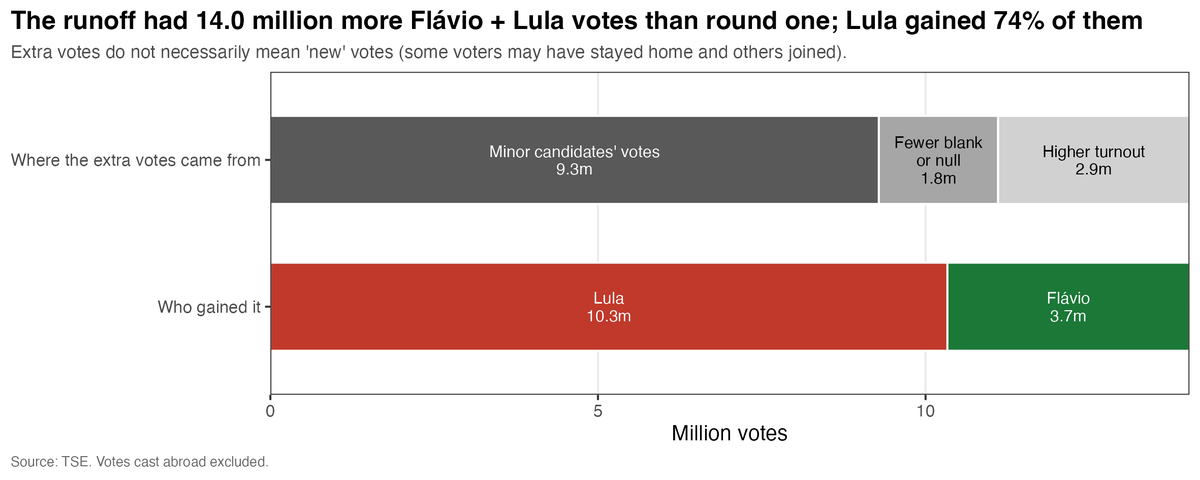
Lula beat the odds yesterday and gained over 10m of the extra second-round votes, for a final result of 51.8% vs 48.2%. Abstention and null/blank votes went down, though this alone wouldn't be enough. Other candidate votes, switchers, differential turnout?
I’m going viral in Brazil right now...
Apparently “talarico” is Brazilian slang for “wife-stealer.” 😂
Olá, Brazil! 🇧🇷 I’m just making good public policy here in Texas — I promise I won’t steal your girl.
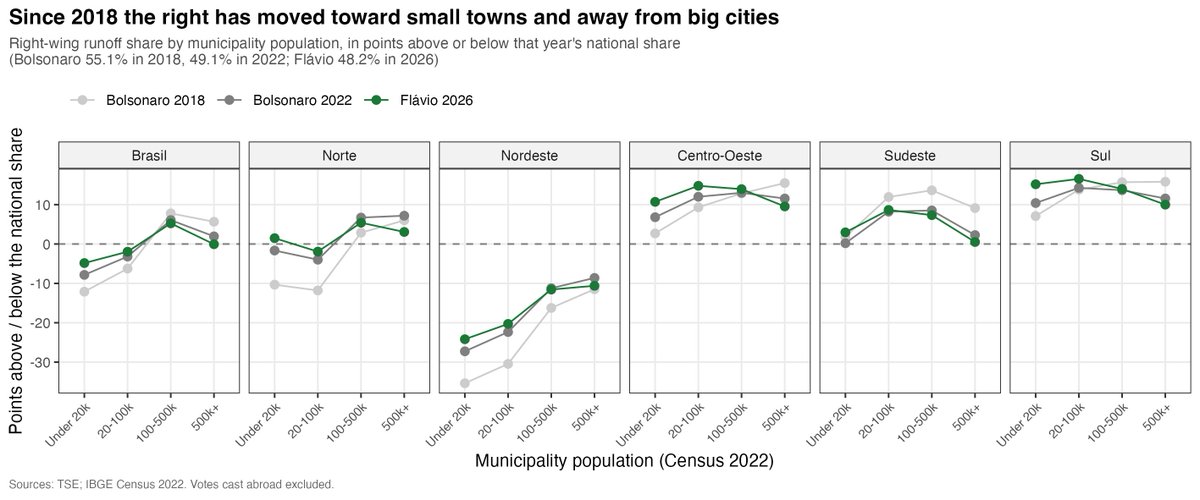
In 2018 the right did better in big cities than in small towns. Measured against its national result, big cities’ edge has shrunk from 18 points to 5, and in the Centre-West, South and South-East it has flipped: towns under 20k now beat cities of 500k+.
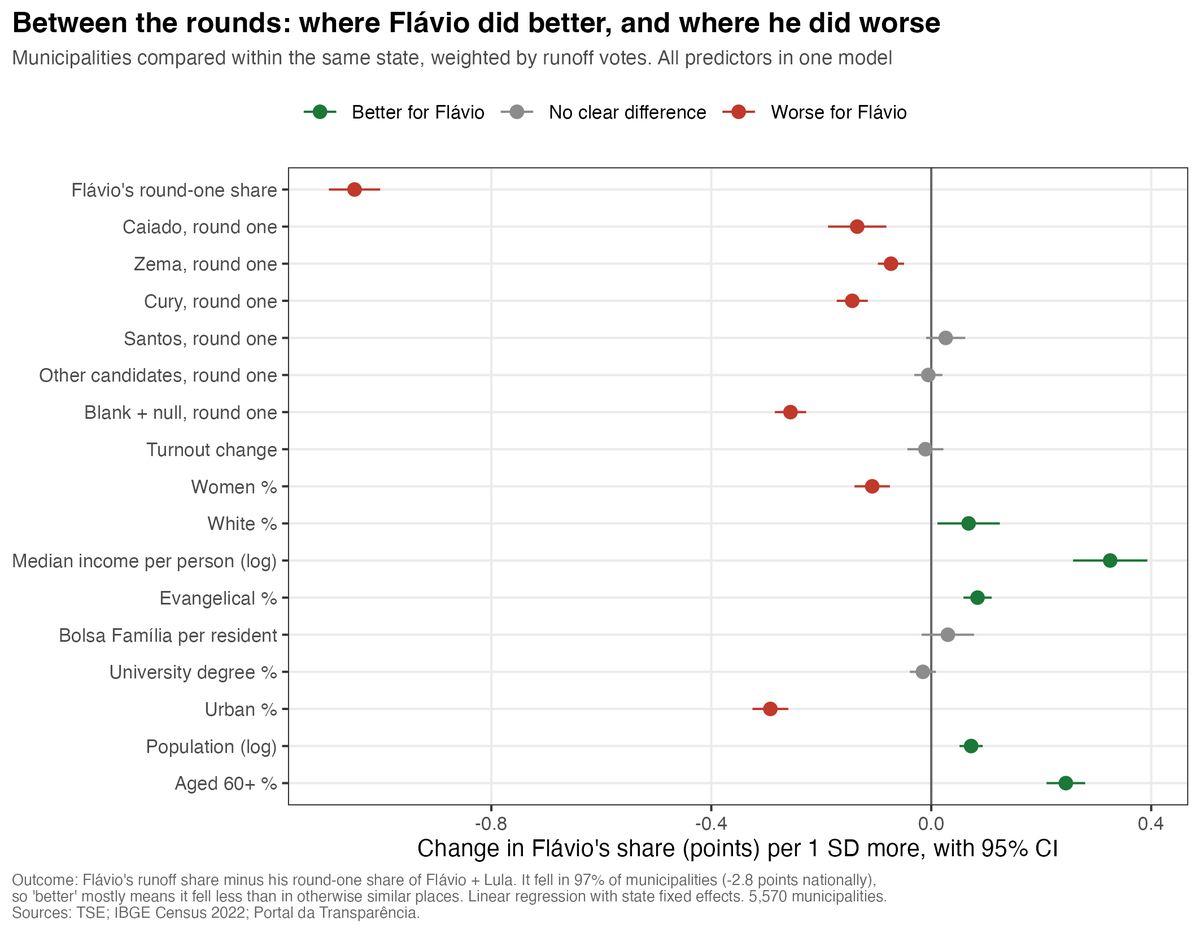
Flávio's share slipped almost everywhere. It held up best in richer, older, whiter and more evangelical places, and fell most where invalid + third-candidate 1st round votes were higher. Turnout changes made no difference. NB: people are not places!
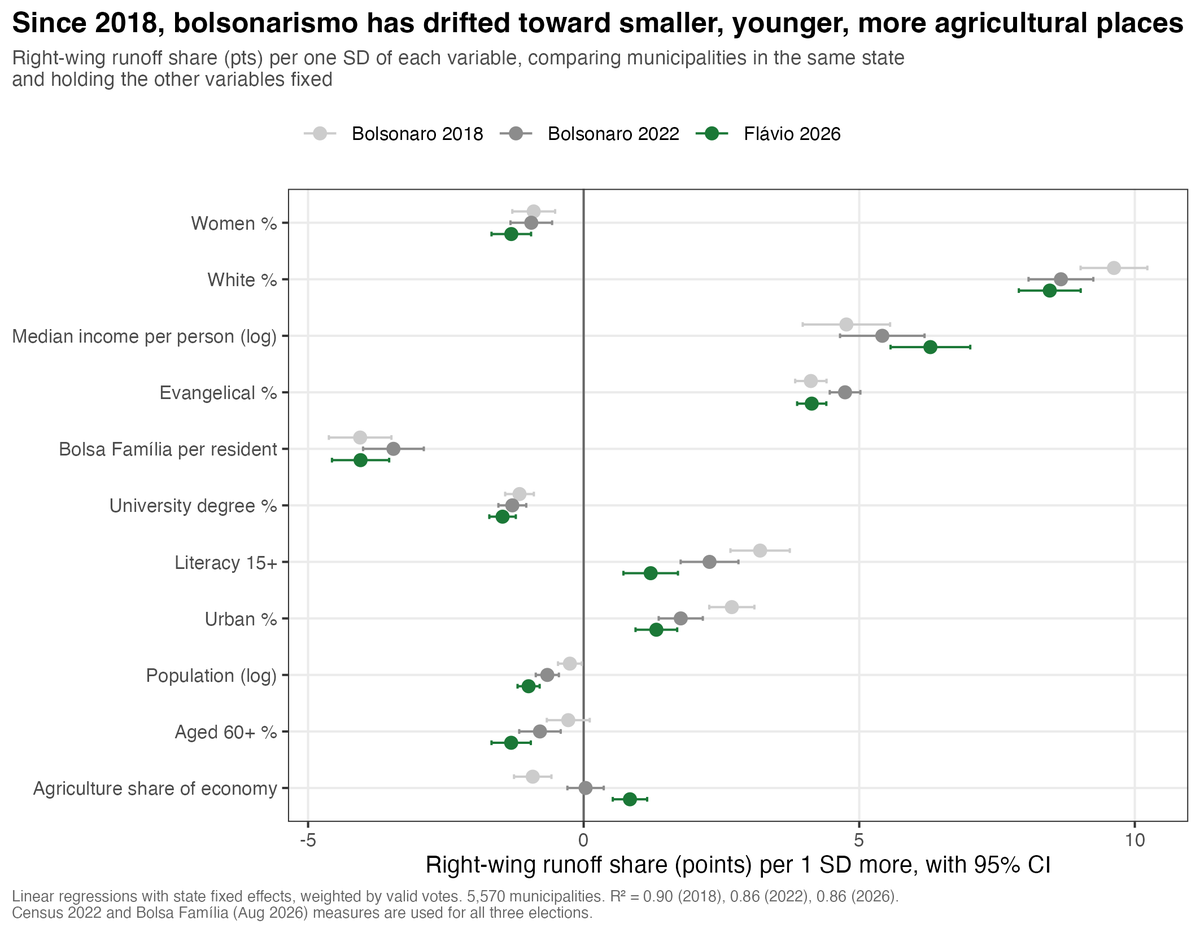
The trajectory of bolsonarismo since 2018: each election it has moved further towards smaller, younger, more agricultural places, and become less tied to literacy and urban centres. Its core hasn’t changed: whiter, richer, more evangelical places. NB: people are not places!
Lula beat the odds yesterday and gained over 10m of the extra second-round votes, for a final result of 51.8% vs 48.2%. Abstention and null/blank votes went down, though this alone wouldn't be enough. Other candidate votes, switchers, differential turnout?
Update with the final data (2,941 interviews, ~200 after Friday's debate). Starting from Flávio slightly ahead, even a big turnout surge, including in the Northeast, barely helps Lula. His likeliest path: winning over just ~1% more of Flávio's first-round voters.
Brazil votes on Sunday. Our Brazil Polarization Panel interviewed 2,746 Brazilians online between the two rounds (14–24 Oct), most of whom we'd also interviewed before round one.
Rather than another prediction, I use the panel to look at the scenarios behind each outcome 🧵
None of this captures last-minute changes of mind (1 in 8 in our panel did something other than what they told us before round one), or Friday's debate.
State of play: Flávio slightly ahead, a Lula win entirely plausible, most likely via first-round Flávio voters, not turnout.
Brazil votes on Sunday. Our Brazil Polarization Panel interviewed 2,746 Brazilians online between the two rounds (14–24 Oct), most of whom we'd also interviewed before round one.
Rather than another prediction, I use the panel to look at the scenarios behind each outcome 🧵
So Lula most likely needs ~2% of Flávio's first-round voters, as @JairoNicolau1 shows https://t.co/scYF9TpH7g
In our panel, 17 of 871 Flávio voters now say Lula (6 of 1,081 go the other way). Too few to derive conclusions from
Democracy, identity or political polarisation?
As Brazil prepares to vote, Oxford's Anna Petherick and João Areal explore what new survey data reveals about the factors shaping voters' decisions.
Read their expert analysis ⬇️
https://t.co/8Fxc4CzybE
What do citizens imagine their political opponents to be like? Polarization is real, but it also lives in our heads, fueled by stereotypes. We asked people in 🇧🇷🇬🇧🇩🇪🇵🇱 to describe opponents in their own words. With @jnareal,@MarkusWagnerAT& @PiotrMarczyski https://t.co/tUEaCQnSrB