🚨 Missing a filing deadline does not always end your case. But an extension of time is not automatic. It must be earned with a credible explanation.
This is Mutungi v Mutungi [2026] KECA 2004, a decision of the Court of Appeal.
A litigant wanted to appeal but missed the deadline to file her Notice of Appeal by 47 days. Three things had gone wrong at once. She had fallen ill with tuberculosis. Her advocate had left private practice to join the Ethics and Anti-Corruption Commission (EACC). And the Judiciary's electronic filing platform, the Case Tracking System, had malfunctioned.
Under Rule 4 of the Court of Appeal Rules, a single judge may extend time where there is good reason. The discretion is wide, but it is guided by settled principles. Justice Ahmed Issack Hassan applied the factors from Leo Sila Mutiso v Rose Hellen Wangari Mwangi: the length of the delay, the reason for it, the chances of the appeal succeeding, and any prejudice to the other party.
The court found the delay satisfactorily explained. Illness is a circumstance beyond a litigant's control, and taken with the advocate's departure and the filing system failure, it accounted for the lost time. The court granted 30 days to file. As the Court of Appeal observed in Andrew Kiplagat Chemaringo v Paul Kipkorir Kibet, a plausible explanation opens the door to the court's discretion.
There is a firm limit. The Supreme Court in Nicholas Kiptoo Arap Korir Salat v Independent Electoral and Boundaries Commission made clear that extension of time is not a right. It is a discretionary favour, earned by explanation, not granted for the asking.
The legal dispute worth noting. On one side is finality. Time limits let the successful party rely on a judgment and bring litigation to an end, and late filing can prejudice the other side. On the other is access to justice. Article 159(2)(d) of the Constitution directs that justice be administered without undue regard to procedural technicalities, and a genuine, explained obstacle such as illness or a court system failure should not permanently lock a litigant out of an appeal that may succeed. The court holds the balance by demanding a credible explanation and weighing prejudice.
Key takeaway: a missed deadline is not necessarily the end, but the cure is discretionary, not guaranteed. File on time where you can, and where you cannot, be ready to explain the delay honestly, promptly, and with evidence.
👉 Follow @Lexken_EMSLaw for practical legal insights on civil procedure and appeals.
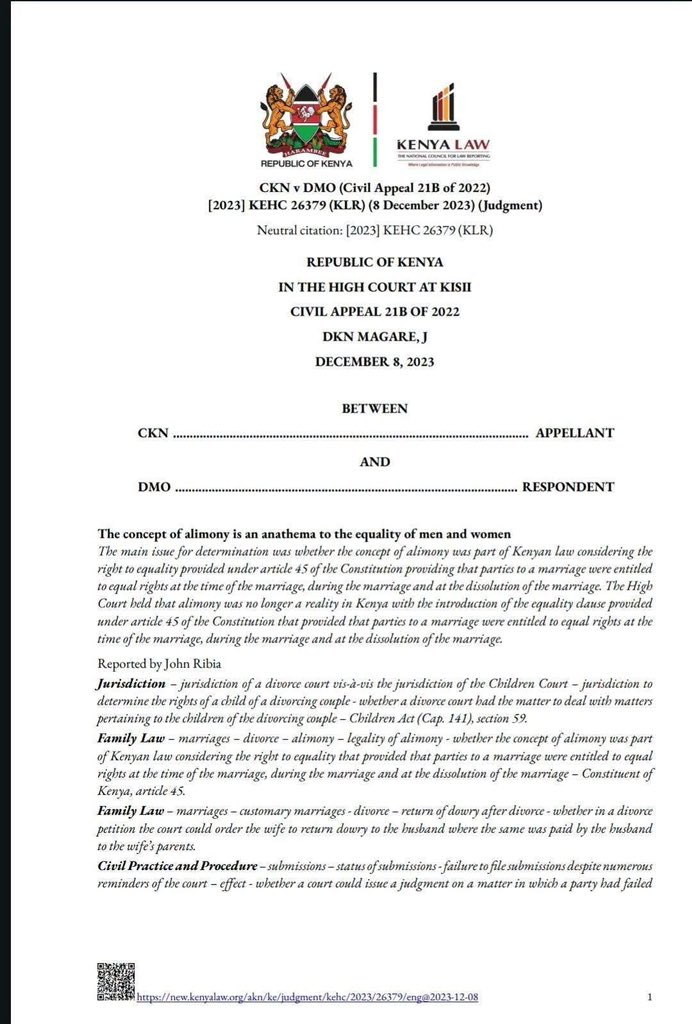
Good News; High Court rules that wives must return dowry after divorce. In a ruling, the court says that even if the dowry was paid to the wife's parents,she must return the dowry to the husband and later demand compensation from her parents.
Since the marriage is over and divorce has been finalised, not returning dowry implies that the wife owes her husband. If the husband paid Ksh 1.2m, the wife must return the money. If he gave them 50 cows and 100 goats the wife must return 50 cows and 100 goats or more depending on the value at that time.
🚨 A buyer who never received a title deed can still become the lawful owner through long occupation. And if that buyer dies, the right does not die with them. Their administrators can enforce it.
This is Kanziwa Limited v Kandie & another. Here is what it means.
The Court of Appeal was dealing with adverse possession, the rule that a person who occupies land openly, continuously and without the owner's permission for twelve years acquires title, while the registered owner loses the right to recover it. This comes from the Limitation of Actions Act, sections 7, 13 and 38.
Two points stand out.
✅ First, an incomplete sale is not a dead end. Where a buyer pays the price and is let into possession, but the transfer is never completed, the vendor holds the title as a constructive trustee, and the buyer's occupation can ripen into adverse possession. The missing title deed does not defeat the claim, because adverse possession rests on possession and the passage of time, not on a perfect transfer.
✅ Second, the right survives death. Once the twelve years have run, the occupier has acquired a proprietary interest. That interest forms part of the estate and passes to the administrators, who stand in the deceased's place. Death interrupts the person, not the accrued right.
On the absence of a written sale agreement, the Court agreed with the High Court. Section 3(3) of the Law of Contract Act requires a sale of land to be in writing, signed and witnessed, but the same section preserves constructive trusts, and equity will not allow that writing rule to be turned into a shield for a vendor against a buyer who has fully performed by paying and taking possession. Part performance answered the missing paperwork.
The legal dispute worth noting. Adverse possession rewards the person who actually used and held the land, and it presses registered owners to assert their rights in good time, which is the policy behind the Limitation of Actions Act. Set against that is the security of registered title, where the register is meant to be the reliable record of who owns what, and a documented owner can lose land to someone who never completed a transfer. The Court held the line for possession and part performance on these facts. Where the balance falls in the next case is left open.
Key takeaway: in a land dispute, occupation and conduct can weigh as heavily as the title deed. A sale never completed on paper can still be completed on the ground, and that right can be inherited.
👉 Follow @Lexken_EMSLaw for practical legal insights on land, adverse possession and property rights.
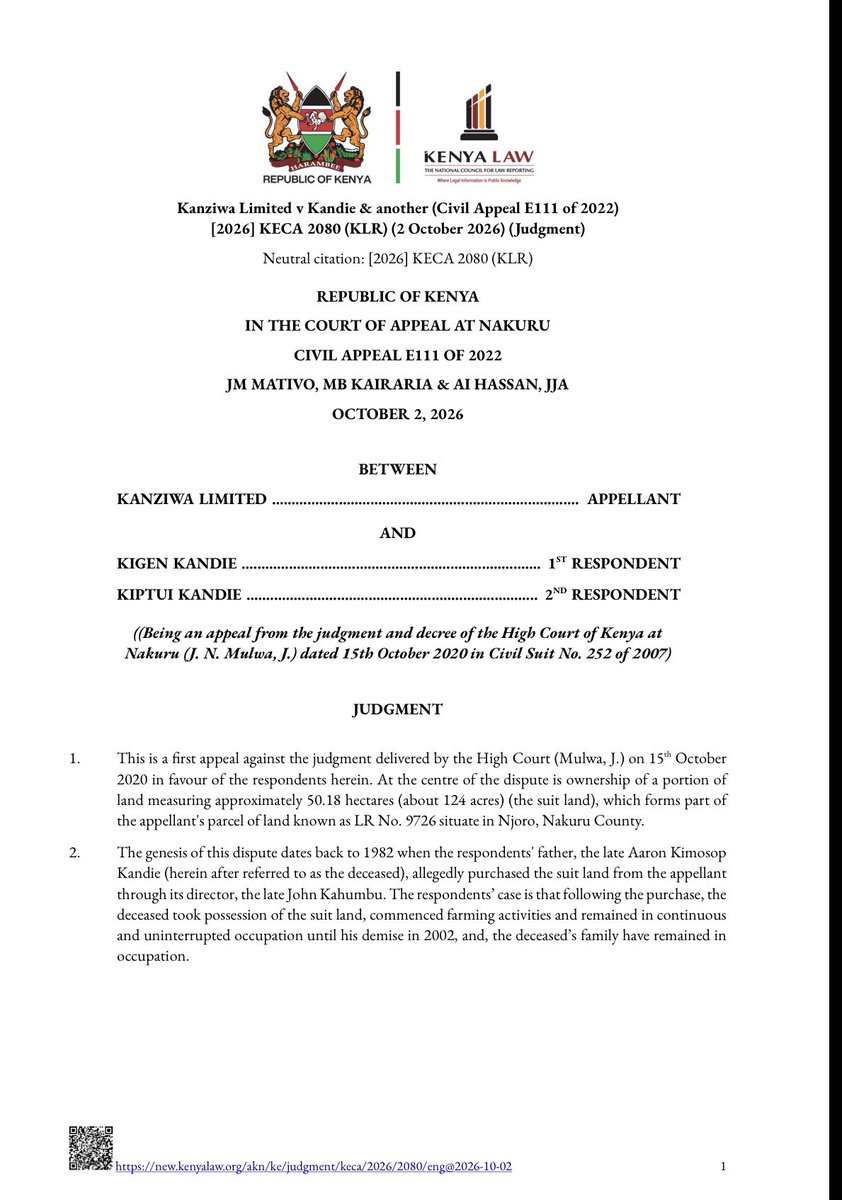
Kanziwa Limited vs Kandie & another KECA 2080_ answers two questions that have troubled Kenyan land law for 20 years in the affirmative.
1. Can a purchaser in possession under an incomplete sale acquire land by adverse possession?
2. Can his administrators enforce it after death?
Answer: YES.
Court of Appeal Nakuru, 2 Oct 2026, dismissed Kanziwa's appeal and gave 50.18 Ha of LR No.9726 Njoro to administrators of Aaron Kimosop Kandie by adverse possession.
BACKGROUND:
1982 purchase from Kanziwa director, LCB application signed by both parties, consent obtained, 1983 vendor letter confirming sale. Purchaser built, fenced, farmed 1982-2002 (20yrs). Family remained. 2004 owner denied sale, subdivided and advertised. Family filed OS 2007. HC Mulwa J 2020 allowed claim. CA affirmed.
FINDINGS:
Wambugu v Njuguna KLR 172 overtaken by Kasuve 1 KLR 184, Gabriel Mbui, Miki Waweru & Ouko v Kageni CA 38 of 2019. Where sale stalls through no fault of purchaser, time runs. 12yrs under S.7,17,38 Limitation of Actions Act.
Alternative pleading allowed. Interruption only by suit or effective re-entry or clear admission - Githu v Ndete, Kimani Ruchine.
Adverts and paper subdivision not enough.
Missing abstract curable under Order 37 Rule 7, Mukisa Biscuit. S.3(3) Law of Contract Act proviso saves oral sale by part performance.
NOTES FOR ADVOCATES:
Plead contract and adverse possession in alternative, cite Ouko v Kageni. Where no agreement, collect LCB Form 1 signed by both, LCB consent, vendor letter. Prove animus by fencing, buildings, trees, graves, control, not daily presence. To defeat, file recovery suit within 12yrs or physically retake with police and inventory
NOTES FOR ADVOCATES:
This case settles 20-year conflict: Purchaser in possession under incomplete sale CAN claim adverse possession.
1. Plead in alternative. Always plead contract of sale + adverse possession in alternative under Order 37. Cite Ouko v Kageni CA 38 of 2019 KECA 60 to overcome Wambugu v Njuguna KLR 172.
2. Save oral sale with part performance. No written agreement? Use proviso to S.3(3) Law of Contract Act. Collect LCB Form 1 signed by BOTH, LCB consent letter, Commissioner approval, vendor letter asking for survey/valuation. See Mwangi v Mwangi KLR 328, Yafesi Ochieng.
3. Prove animus correctly. Don't argue client slept there daily. Lead evidence of fencing, permanent buildings, graves, trees, crops, control of entry. See Mtana Lewa v Kahindi Ngala.
4. To defeat claim, act decisively. Letters, adverts, paper subdivisions do NOT stop time. Per Githu v Ndete KLR 776 & Kimani Ruchine, only suit filed or effective physical re-entry with police, inventory, witnesses, or clear admission stops time.
5. Deceased possessor. Ensure 12yrs accrued before death. Obtain Grant of Letters of Administration first, sue under S.82 Law of Succession Act. Cite Ouko v Kageni & Mbui Mukangu v Gerald Mutwiri.
6. Avoid technical traps. Always annex title/search, even if curable under Order 37 Rule 7 per Mukisa Biscuit EA 696. Raise parcel identity dispute at trial, not on appeal.
WHAT PUBLIC SHOULD NOTE:
Buying and entering land without title can make you owner after 12yrs if seller refuses to transfer.
Keep all LCB forms and seller letters.
Your estate can continue case. Show ownership by building, fencing, farming.
If you are owner, don't delay, sue within 12yrs or retake lawfully.
Citation: Kanziwa Limited v Kandie & another, CA E111/2022, KECA 2080, CA Nakuru 2 Oct 2026.
Ekaterina Handa
Partner
Gitonga, Kinyanjui & Co. Advocates
🚨 Court holds that a spouse's consent to charging the family home is triggered by living in it, not by marriage alone. A proven customary wife lost because she never lived there.
This is Elyjoy Kageni versus Bank of Africa (K) Limited and 3 others.
In 2012, Bank of Africa lent KShs 20.6 million to a company, secured by a charge over land in Chuka owned by one of its directors, Humphrey Mbaka. He and his co-director presented themselves as husband and wife living on the property, and she signed an express spousal consent to the charge. When the loan defaulted and the bank moved to sell, Elyjoy Kageni came forward, claiming to be Mr Mbaka's first wife under Meru customary law and arguing that the charge was void because her consent had never been obtained, as section 79(3) of the Land Act requires.
The first question was whether she was a wife at all. The trial court had said no, reasoning that bearing a man's child does not make a woman his wife. The Court of Appeal disagreed. Guided by the presumption of marriage in VRM v MRM, and relying chiefly on the uncontroverted evidence of Mr Mbaka's own father, who acknowledged both women as his son's wives, the Court held that she had proved a Meru customary marriage. She was indeed a wife.
Yet she still lost, and the reason lies in the exact words of the statute. Section 79(3) protects a charge over a matrimonial home only where it is executed by the chargor and any spouse of the chargor who is living in that matrimonial home. The Court treated living in as the operative phrase. The appellant had never lived on the suit land, where her son lived with his father and the co-director. Her consent was therefore not required. Marital status alone does not trigger the consent requirement. Residence does.
The Court also addressed what a lender must do. The bank obtained consent from the spouse who lived there and presented as wife, and it served the statutory notices as the law requires, including a notice affixed on the property for others entitled to use the land. The appellant was unknown to the bank, and Mr Mbaka never disclosed her. To expect the bank to have discovered her, the Court said, would be unreasonable and unjust. A chargee owes diligence, not clairvoyance.
On one side is the protection of spouses and the family home. Spousal consent laws exist so that a home cannot be charged behind a spouse's back, and that protection matters most for spouses in customary or polygamous unions who may be invisible on paper. A recognised wife lost a home charged without her knowledge, which looks like the very harm the law was meant to prevent.
On the other side is the security of lending. If a bank had to trace every possible undisclosed, non-resident customary spouse before lending, secured credit would seize up. A residence test is one a lender can actually verify, and it places the risk of concealment on the family that concealed it, not on an innocent lender that did its diligence.
Key takeaway: Under section 79(3), the consent that protects a matrimonial home attaches to the spouse living in it, not to marital status in the abstract, so a proven customary or polygamous marriage will not by itself defeat a charge where that spouse never lived on the land. But the ruling is narrow. The Court did not decide whether one consent suffices where several spouses share the home, where its own reasoning points to each resident spouse consenting, and a lender who already knows of another spouse cannot rely on ignorance.
👉 Follow @Lexken_EMSLaw for practical legal insights on land, matrimonial property and spousal consent
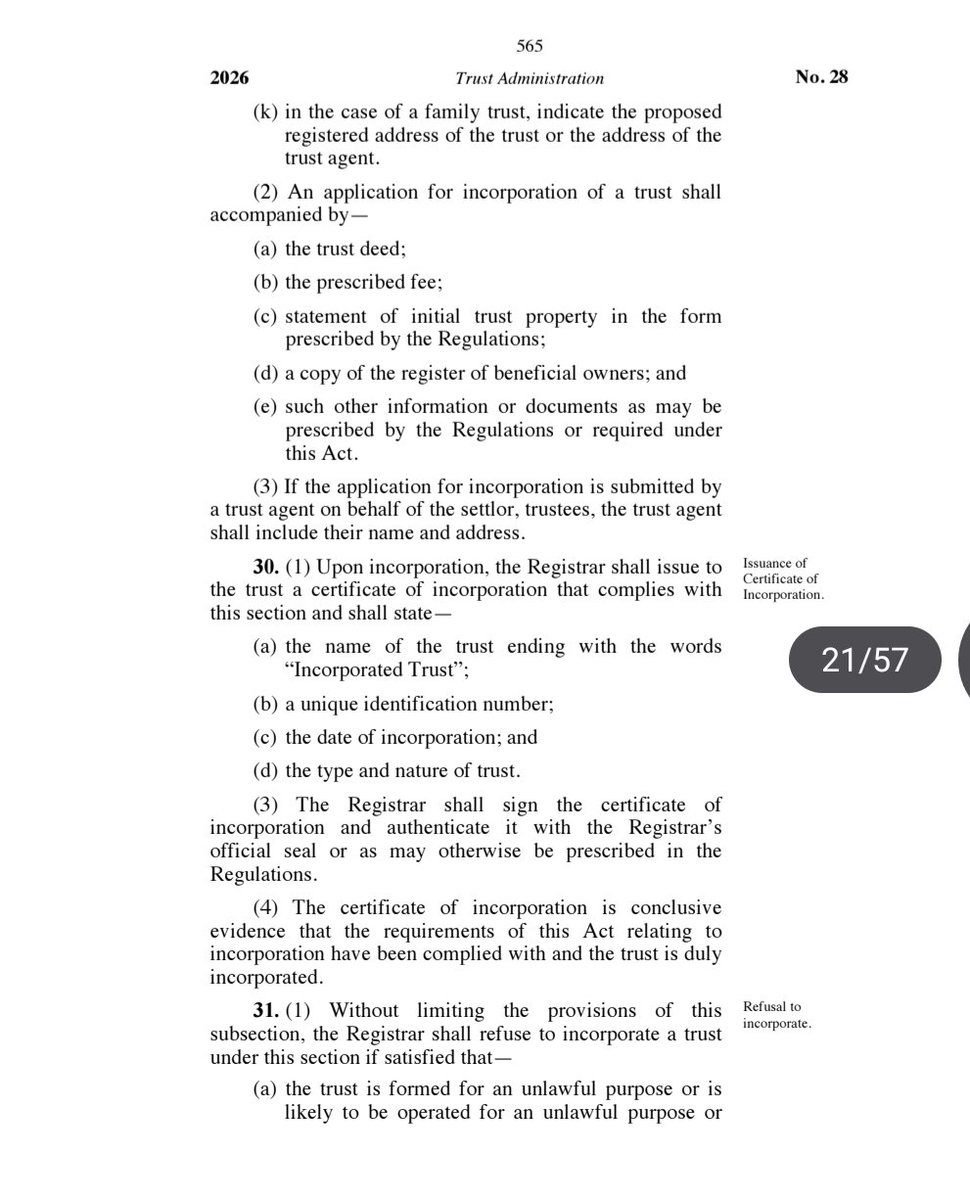
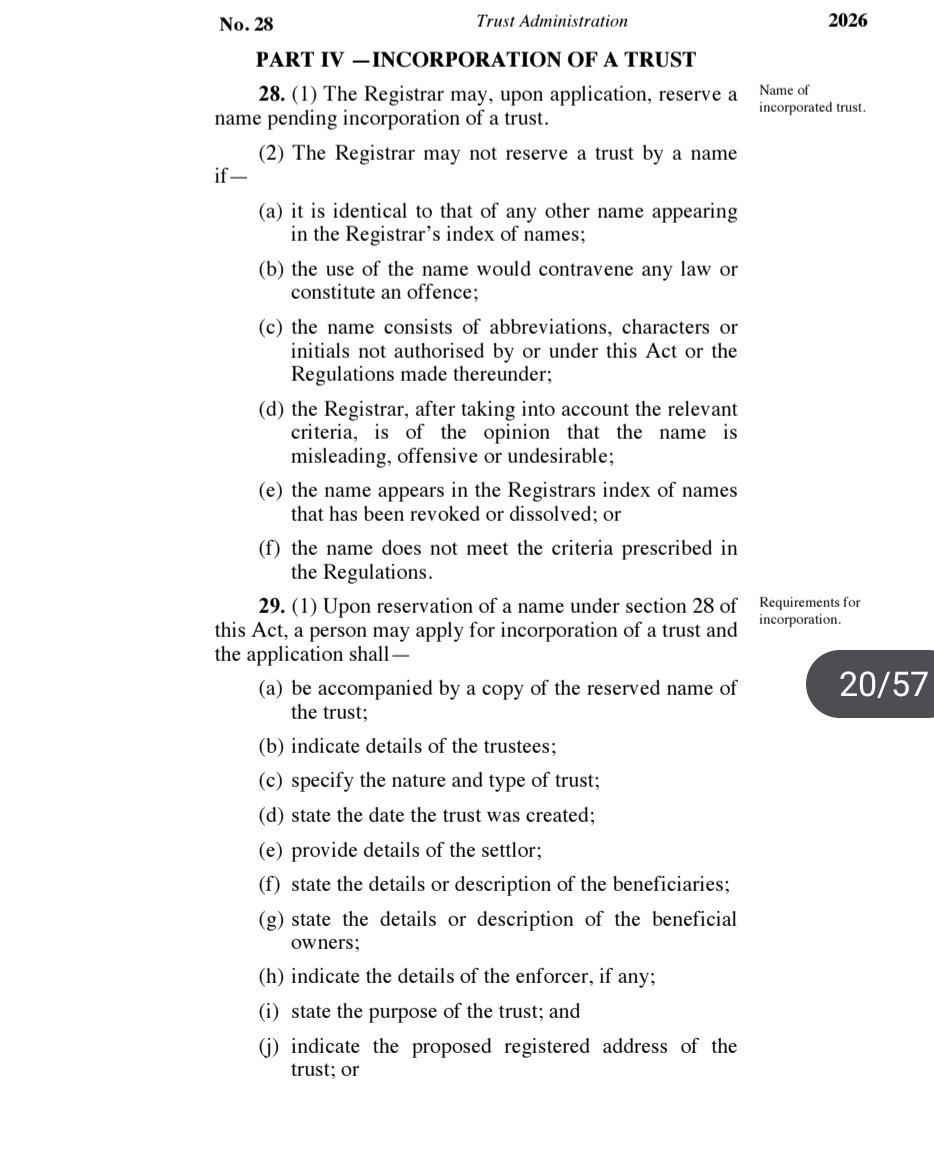
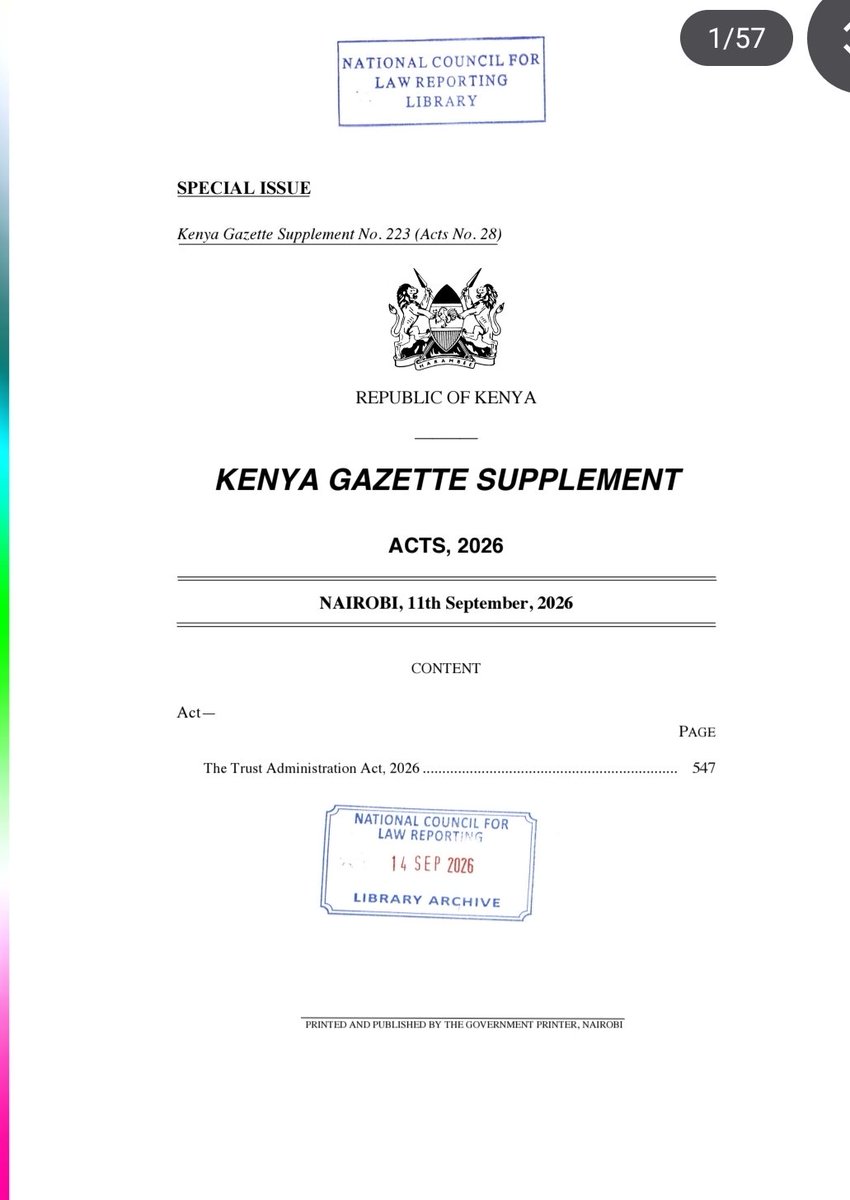
Registering a trust has become very simple because of the new law. You just reserve a name and proceed to incorporate it .
Here are some of the benefits of a Trust:
1. Trust assets are separate from matrimonial property, meaning that upon divorce, property properly held in a Trust will not form part of the matrimonial property available for division.
2. If you go broke and your business fails, Trust assets are protected from creditors. Clever people understand this.
3. Trusts are tax efficient. Beneficiaries receive distributions without being taxed again where the relevant tax has already been paid by the trustee.
4. Upon your death, beneficiaries benefit from Trust assets without having to go through the lengthy succession cases.
There are numerous other benefits of Trusts. That’s why I get excited whenever I’m registering one.Registering a Trust will now take one week!
Law lecturers at KSL, most of whom are seasoned advocates, teach students that a Certificate of Urgency must be precise and straight to the point, such that within a minute, whoever is reading it can already see the urgency.
In practice, these same seasoned advocates draft five-page Certificates of Urgency that are basically a duplication of the Supporting Affidavit. 😅
Kwani mnatupima? 😂😅


![Lexken_EMSLaw's tweet photo. 🚨 Missing a filing deadline does not always end your case. But an extension of time is not automatic. It must be earned with a credible explanation.
This is Mutungi v Mutungi [2026] KECA 2004, a decision of the Court of Appeal.
A litigant wanted to appeal but missed the deadline to file her Notice of Appeal by 47 days. Three things had gone wrong at once. She had fallen ill with tuberculosis. Her advocate had left private practice to join the Ethics and Anti-Corruption Commission (EACC). And the Judiciary's electronic filing platform, the Case Tracking System, had malfunctioned.
Under Rule 4 of the Court of Appeal Rules, a single judge may extend time where there is good reason. The discretion is wide, but it is guided by settled principles. Justice Ahmed Issack Hassan applied the factors from Leo Sila Mutiso v Rose Hellen Wangari Mwangi: the length of the delay, the reason for it, the chances of the appeal succeeding, and any prejudice to the other party.
The court found the delay satisfactorily explained. Illness is a circumstance beyond a litigant's control, and taken with the advocate's departure and the filing system failure, it accounted for the lost time. The court granted 30 days to file. As the Court of Appeal observed in Andrew Kiplagat Chemaringo v Paul Kipkorir Kibet, a plausible explanation opens the door to the court's discretion.
There is a firm limit. The Supreme Court in Nicholas Kiptoo Arap Korir Salat v Independent Electoral and Boundaries Commission made clear that extension of time is not a right. It is a discretionary favour, earned by explanation, not granted for the asking.
The legal dispute worth noting. On one side is finality. Time limits let the successful party rely on a judgment and bring litigation to an end, and late filing can prejudice the other side. On the other is access to justice. Article 159(2)(d) of the Constitution directs that justice be administered without undue regard to procedural technicalities, and a genuine, explained obstacle such as illness or a court system failure should not permanently lock a litigant out of an appeal that may succeed. The court holds the balance by demanding a credible explanation and weighing prejudice.
Key takeaway: a missed deadline is not necessarily the end, but the cure is discretionary, not guaranteed. File on time where you can, and where you cannot, be ready to explain the delay honestly, promptly, and with evidence.
👉 Follow @Lexken_EMSLaw for practical legal insights on civil procedure and appeals.](https://pbs.twimg.com/media/HUu5snBWMAALHn_.jpg)
![Lexken_EMSLaw's tweet photo. 🚨 Missing a filing deadline does not always end your case. But an extension of time is not automatic. It must be earned with a credible explanation.
This is Mutungi v Mutungi [2026] KECA 2004, a decision of the Court of Appeal.
A litigant wanted to appeal but missed the deadline to file her Notice of Appeal by 47 days. Three things had gone wrong at once. She had fallen ill with tuberculosis. Her advocate had left private practice to join the Ethics and Anti-Corruption Commission (EACC). And the Judiciary's electronic filing platform, the Case Tracking System, had malfunctioned.
Under Rule 4 of the Court of Appeal Rules, a single judge may extend time where there is good reason. The discretion is wide, but it is guided by settled principles. Justice Ahmed Issack Hassan applied the factors from Leo Sila Mutiso v Rose Hellen Wangari Mwangi: the length of the delay, the reason for it, the chances of the appeal succeeding, and any prejudice to the other party.
The court found the delay satisfactorily explained. Illness is a circumstance beyond a litigant's control, and taken with the advocate's departure and the filing system failure, it accounted for the lost time. The court granted 30 days to file. As the Court of Appeal observed in Andrew Kiplagat Chemaringo v Paul Kipkorir Kibet, a plausible explanation opens the door to the court's discretion.
There is a firm limit. The Supreme Court in Nicholas Kiptoo Arap Korir Salat v Independent Electoral and Boundaries Commission made clear that extension of time is not a right. It is a discretionary favour, earned by explanation, not granted for the asking.
The legal dispute worth noting. On one side is finality. Time limits let the successful party rely on a judgment and bring litigation to an end, and late filing can prejudice the other side. On the other is access to justice. Article 159(2)(d) of the Constitution directs that justice be administered without undue regard to procedural technicalities, and a genuine, explained obstacle such as illness or a court system failure should not permanently lock a litigant out of an appeal that may succeed. The court holds the balance by demanding a credible explanation and weighing prejudice.
Key takeaway: a missed deadline is not necessarily the end, but the cure is discretionary, not guaranteed. File on time where you can, and where you cannot, be ready to explain the delay honestly, promptly, and with evidence.
👉 Follow @Lexken_EMSLaw for practical legal insights on civil procedure and appeals.](https://pbs.twimg.com/media/HUu5snAXkAAJUyd.jpg)
![Lexken_EMSLaw's tweet photo. 🚨 Missing a filing deadline does not always end your case. But an extension of time is not automatic. It must be earned with a credible explanation.
This is Mutungi v Mutungi [2026] KECA 2004, a decision of the Court of Appeal.
A litigant wanted to appeal but missed the deadline to file her Notice of Appeal by 47 days. Three things had gone wrong at once. She had fallen ill with tuberculosis. Her advocate had left private practice to join the Ethics and Anti-Corruption Commission (EACC). And the Judiciary's electronic filing platform, the Case Tracking System, had malfunctioned.
Under Rule 4 of the Court of Appeal Rules, a single judge may extend time where there is good reason. The discretion is wide, but it is guided by settled principles. Justice Ahmed Issack Hassan applied the factors from Leo Sila Mutiso v Rose Hellen Wangari Mwangi: the length of the delay, the reason for it, the chances of the appeal succeeding, and any prejudice to the other party.
The court found the delay satisfactorily explained. Illness is a circumstance beyond a litigant's control, and taken with the advocate's departure and the filing system failure, it accounted for the lost time. The court granted 30 days to file. As the Court of Appeal observed in Andrew Kiplagat Chemaringo v Paul Kipkorir Kibet, a plausible explanation opens the door to the court's discretion.
There is a firm limit. The Supreme Court in Nicholas Kiptoo Arap Korir Salat v Independent Electoral and Boundaries Commission made clear that extension of time is not a right. It is a discretionary favour, earned by explanation, not granted for the asking.
The legal dispute worth noting. On one side is finality. Time limits let the successful party rely on a judgment and bring litigation to an end, and late filing can prejudice the other side. On the other is access to justice. Article 159(2)(d) of the Constitution directs that justice be administered without undue regard to procedural technicalities, and a genuine, explained obstacle such as illness or a court system failure should not permanently lock a litigant out of an appeal that may succeed. The court holds the balance by demanding a credible explanation and weighing prejudice.
Key takeaway: a missed deadline is not necessarily the end, but the cure is discretionary, not guaranteed. File on time where you can, and where you cannot, be ready to explain the delay honestly, promptly, and with evidence.
👉 Follow @Lexken_EMSLaw for practical legal insights on civil procedure and appeals.](https://pbs.twimg.com/media/HUu5sm-XMAA6Ixj.jpg)













![Lexken_EMSLaw's tweet photo. 🚨 Missing a filing deadline does not always end your case. But an extension of time is not automatic. It must be earned with a credible explanation.
This is Mutungi v Mutungi [2026] KECA 2004, a decision of the Court of Appeal.
A litigant wanted to appeal but missed the deadline to file her Notice of Appeal by 47 days. Three things had gone wrong at once. She had fallen ill with tuberculosis. Her advocate had left private practice to join the Ethics and Anti-Corruption Commission (EACC). And the Judiciary's electronic filing platform, the Case Tracking System, had malfunctioned.
Under Rule 4 of the Court of Appeal Rules, a single judge may extend time where there is good reason. The discretion is wide, but it is guided by settled principles. Justice Ahmed Issack Hassan applied the factors from Leo Sila Mutiso v Rose Hellen Wangari Mwangi: the length of the delay, the reason for it, the chances of the appeal succeeding, and any prejudice to the other party.
The court found the delay satisfactorily explained. Illness is a circumstance beyond a litigant's control, and taken with the advocate's departure and the filing system failure, it accounted for the lost time. The court granted 30 days to file. As the Court of Appeal observed in Andrew Kiplagat Chemaringo v Paul Kipkorir Kibet, a plausible explanation opens the door to the court's discretion.
There is a firm limit. The Supreme Court in Nicholas Kiptoo Arap Korir Salat v Independent Electoral and Boundaries Commission made clear that extension of time is not a right. It is a discretionary favour, earned by explanation, not granted for the asking.
The legal dispute worth noting. On one side is finality. Time limits let the successful party rely on a judgment and bring litigation to an end, and late filing can prejudice the other side. On the other is access to justice. Article 159(2)(d) of the Constitution directs that justice be administered without undue regard to procedural technicalities, and a genuine, explained obstacle such as illness or a court system failure should not permanently lock a litigant out of an appeal that may succeed. The court holds the balance by demanding a credible explanation and weighing prejudice.
Key takeaway: a missed deadline is not necessarily the end, but the cure is discretionary, not guaranteed. File on time where you can, and where you cannot, be ready to explain the delay honestly, promptly, and with evidence.
👉 Follow @Lexken_EMSLaw for practical legal insights on civil procedure and appeals.](https://pbs.twimg.com/media/HUu5snDXcAAGxbW.jpg)