You can now hand any app to your AI and have it rebuild the best feature inside it
No source code required
It's called REA. Reverse Engineer Anything. Barely anyone is talking about it yet
Here's what it does: you see a feature you love in some app. Maybe it's offline search in Notes. Maybe it's how a competitor handles auth or storage
Normally you'd reverse engineer the whole thing by hand. Pick a tool, learn its API, decompile the binary, stare at assembly for hours
With REA you just tell your agent "understand how this feature works, show me the evidence, then build me a version for my stack"
And it does it
It opens the binary, finds the clues, connects them to the real code, decompiles the parts that matter, then builds you a working version adapted to your product
All locally. Nothing gets uploaded. Your agent runs the whole investigation
Here's how I'd get started:
1. Run npm install --global rea-agents then rea setup
2. Choose agent integration. It plugs into Codex, Claude Code, Cursor, whatever you use
3. Point it at any app on your machine
4. Ask it to explain a feature and show its evidence
5. Then tell it to rebuild that feature in your project
Best part is it keeps a receipt for every claim. It never pretends it recovered the source code. It shows you exactly how it figured everything out
Most builders have no idea this exists yet
Which means right now you have an edge
Go and set it up this weekend.
Microsoft just changed the game 🤯
They've open-sourced bitnet.cpp, a 1-bit LLM inference framework.
It let's you run 100B parameter models on your local CPU without GPUs.
- 6.17x faster inference
- 82.2% less energy on CPUs
100% Open Source.
karpathys LLM obsidian knowledge base went completely viral this weekend
I found 7 important things that separate a wiki you keep from one you abandon
save this and send it to your agent (prompt in last tweet)🧵
This Claude Code plugin turns any codebase into an interactive knowledge graph
Link https://t.co/NgpVskSU5T
/understand → scans everything
/understand-chat → ask questions in plain English
/understand-diff → see what your changes break
/understand-onboard → auto-generate onboarding guides
Anthropic just launched the Claude Architect Certification!
You’ll have to complete 60 multiple-choice questions across five competency areas in a single session. No external resources or breaks.
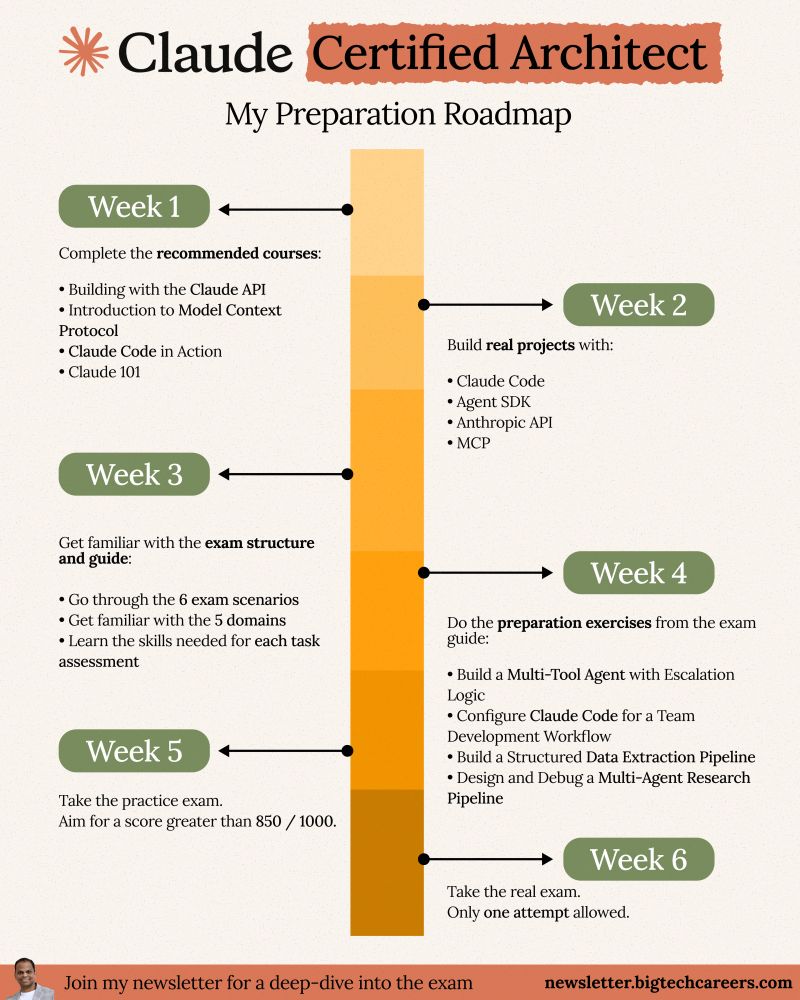
Here’s how I’m planning to prepare for it (steal my roadmap):
Week 1
Complete the recommended courses:
- Building with the Claude API
- Introduction to Model Context Protocol
- Claude Code in Action
- Claude 101
Week 2
Build real projects with:
- Claude Code
- Agent SDK
- Anthropic API
- MCP
Week 3
Get familiar with the exam structure and guide:
- Go through the six exam scenarios
- Get familiar with the five competency areas / domains
- Learn the skills needed for each task assessment
Week 4
Do the preparation exercises from the exam guide:
- Build a Multi-Tool Agent with Escalation Logic
- Configure Claude Code for a Team Development Workflow
- Build a Structured Data Extraction Pipeline
- Design and Debug a Multi-Agent Research Pipeline
Week 5
- Take the practice exam
- Aim for a score greater than 850 / 1000
Week 6
- Take the real exam
- Only one attempt allowed
NOTES:
- At this point the certification is exclusive for Anthropic Partners and early access is free for first 5,000 partner company employees.
- Your mileage may vary depending on your skill level. E.g. It may take 2 weeks for some but 10 weeks for others.
If you are eligible, register here → https://t.co/UTBxGJAMlB
Most people treat CLAUDE.md like a prompt file.
That’s the mistake.
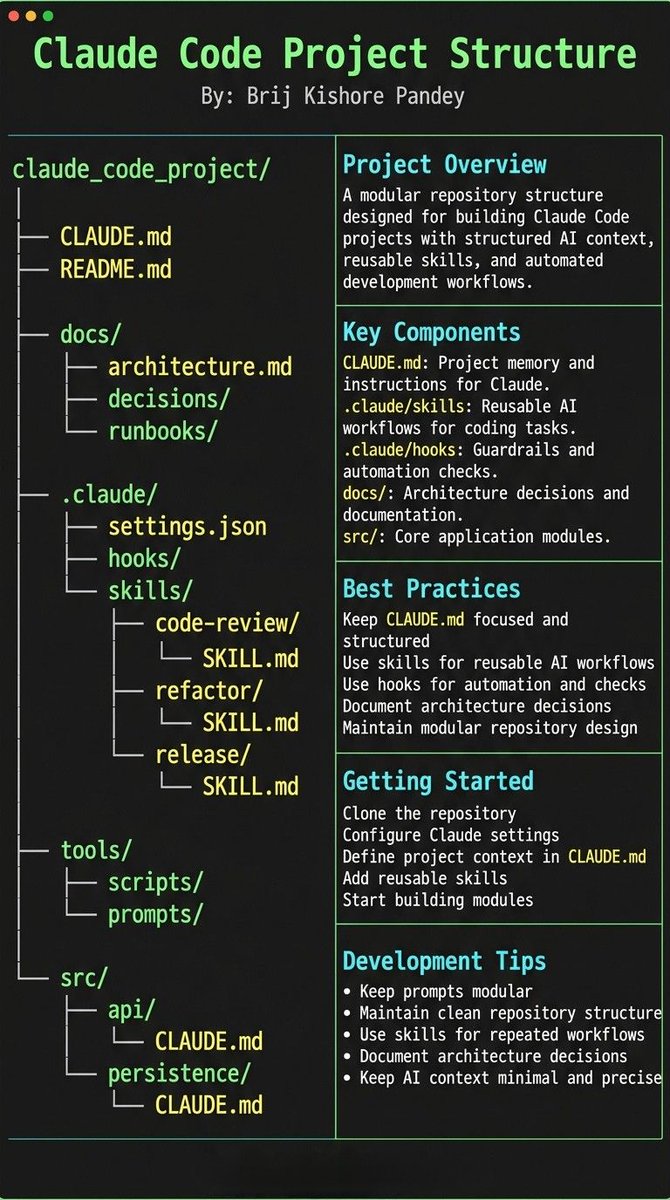
If you want Claude Code to feel like a senior engineer living inside your repo, your project needs structure.
Claude needs 4 things at all times:
• the why → what the system does
• the map → where things live
• the rules → what’s allowed / not allowed
• the workflows → how work gets done
I call this:
The Anatomy of a Claude Code Project 👇
━━━━━━━━━━━━━━━
1️⃣ CLAUDE.md = Repo Memory (keep it short)
This is the north star file.
Not a knowledge dump. Just:
• Purpose (WHY)
• Repo map (WHAT)
• Rules + commands (HOW)
If it gets too long, the model starts missing important context.
━━━━━━━━━━━━━━━
2️⃣ .claude/skills/ = Reusable Expert Modes
Stop rewriting instructions.
Turn common workflows into skills:
• code review checklist
• refactor playbook
• release procedure
• debugging flow
Result:
Consistency across sessions and teammates.
━━━━━━━━━━━━━━━
3️⃣ .claude/hooks/ = Guardrails
Models forget.
Hooks don’t.
Use them for things that must be deterministic:
• run formatter after edits
• run tests on core changes
• block unsafe directories (auth, billing, migrations)
━━━━━━━━━━━━━━━
4️⃣ docs/ = Progressive Context
Don’t bloat prompts.
Claude just needs to know where truth lives:
• architecture overview
• ADRs (engineering decisions)
• operational runbooks
━━━━━━━━━━━━━━━
5️⃣ Local CLAUDE.md for risky modules
Put small files near sharp edges:
src/auth/CLAUDE.md
src/persistence/CLAUDE.md
infra/CLAUDE.md
Now Claude sees the gotchas exactly when it works there.
━━━━━━━━━━━━━━━
Prompting is temporary.
Structure is permanent.
When your repo is organized this way, Claude stops behaving like a chatbot…
…and starts acting like a project-native engineer.
Still managing your homelab network with spreadsheets? NetBox is the open-source tool that changed how I document everything — IPs, VLANs, devices, racks. Full tutorial: https://t.co/sXJLE4IxCa #homelab#NetBox#networking
Master Claude Code
From running commands and accessing full files to connecting tools and automating workflows
Claude Code isn’t just an assistant anymore
It’s becoming your development operating system
Learn the commands
Use MCP
Build skills
Automate everything
Chinese developers built a fully gesture-controlled robot monitor inspired by Tony Stark–style tech, allowing users to move and position the screen using hand motions alone.
one of the biggest realizations I've had working on Claude Code is that you fundamentally have to design agents for prompt caching first, almost every feature touches on it somehow
I wrote this in a day but it's the culmination of months of learnings, hope you enjoy it
700k+ people have read my article on Ghostty, Claude Code, and the SAND framework for working with multiple agents.
Thanks to everyone who shared and commented.
I’ve seen a lot of questions about tmux and other tools that work great for multi-agent setups.
All of them are valid if they work for you. This is just one more way to orchestrate agents, simple and easy to adapt.
Already working on the next articles.