NEW: CBS reports that President Trump is no longer expected to speak with Taiwan President Lai Ching-te before Xi Jinping’s potential fall visit to the United States.
The reported delay comes as the administration weighs a proposed $14B Taiwan arms package and after Trump suggested Taiwan arms sales could be held “in abeyance” pending China’s actions.
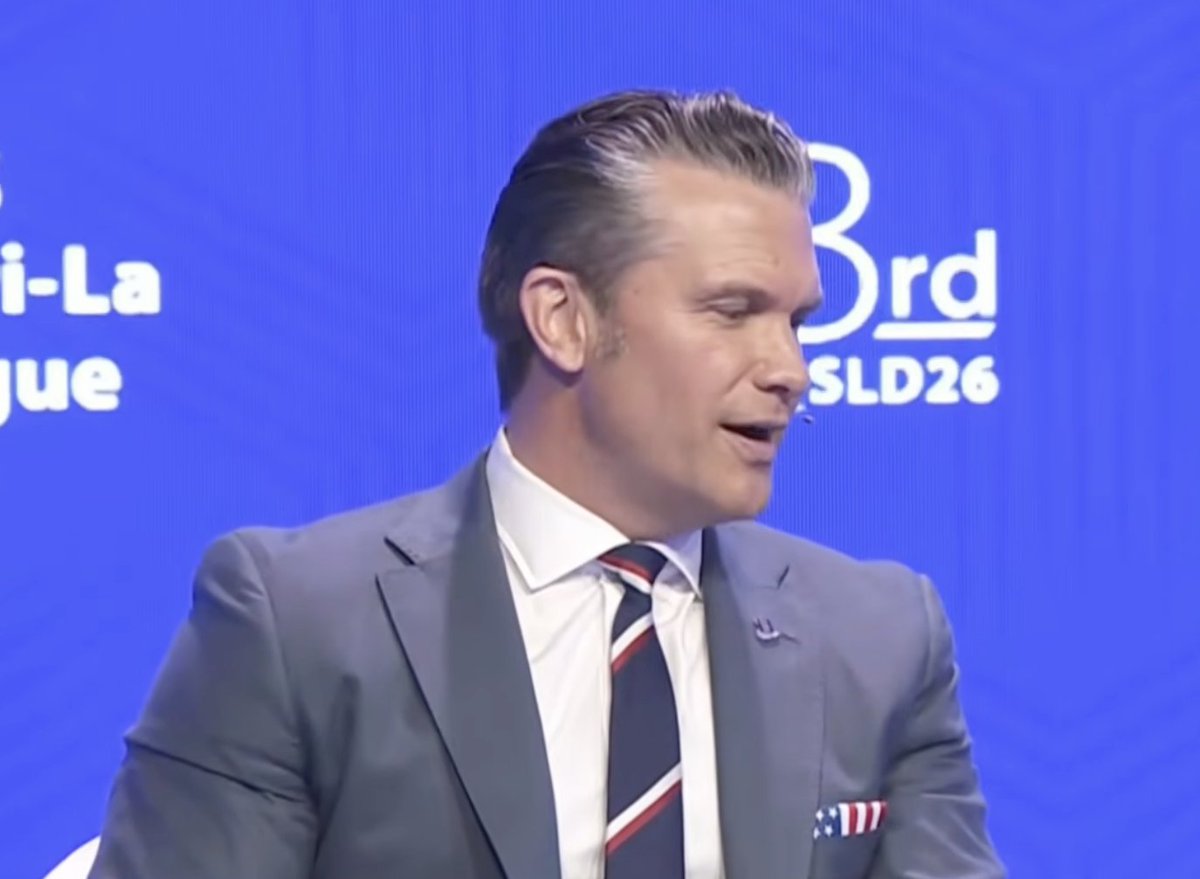
NEW: U.S. Secretary of Defense Pete Hegseth, at the annual Shangri-La Dialogue, just confirmed the pause in Taiwan arms sales is not due to munitions conservation concerns owing to the conflict in the Middle East.
Hegseth: "Yeah, on the Taiwan arms sales I would decouple the two. We feel very good about our stockpiles, both how we use them and in Epic Fury, in this historic moment."
He added that "Hung Cao is fantastic, but I would not couple the two at all."
NEW FROM TSM: Taiwan will inaugurate its new Littoral Combat Command (LCC) on June 1st, integrating the ROCN's naval surveillance and anti-ship missile forces into one unified command.
Read more about the LCC's organization and equipment inventory in our latest analysis piece in The Monitor: https://t.co/6oTbGgvfFF
Proud to shamelessly plug that I was quoted in a @CNN piece this morning explaining how U.S. arms sales to Taiwan work, including their delays and implications of a pause on additional U.S. weapons.
https://t.co/FTKIgRsIhM
NEW: According to The Globe and Mail, the Canadian Halifax-class frigate HMCS Charlottetown (FFH 339) transited the Taiwan Strait from May 22–23.
This marks Canada’s first reported Taiwan Strait transit of 2026, following the most recent transit of HMCS Ville de Quebec (FFH 332) in September 2025.
Yesterday, the U.S. House Armed Services Committee released their preliminary prints of the National Defense Authorization Act (NDAA) for Fiscal Year 2027. The bill would authorize $1 billion for the Taiwan Security Cooperation Initiative, a continuation of FY26 funding at the same levels.
The Subcommittee on Cyber, Information Technologies, and Innovation also notes "resilient communications between the United States and Taiwan" as an "item of special interest" and directs the Secretary of Defense to report on Taiwanese communication networks' ability to support U.S. operational requirements.
Taiwan’s Armaments Bureau says the domestically produced “Cheetah” 105mm wheeled tank is expected to enter production next year after its D3 prototype passed Army evaluation.
The vehicle, part of the CM-34 Clouded Leopard family, reportedly had its height reduced from 3.3m to under 3m to meet Army requirements. It carries a 105mm gun with 33 rounds, hunter-killer fire control system, a 7.62mm coaxial MG, and a 12.7mm remote weapon station.
LTN reports the first production batch may include 178 vehicles.
New in @Diplomat_APAC: @jonathanwalberg and I write about Japan’s growing defense diplomacy and the potential implications for Taiwan.
https://t.co/zpqaM1tlDZ
This post is incorrect.
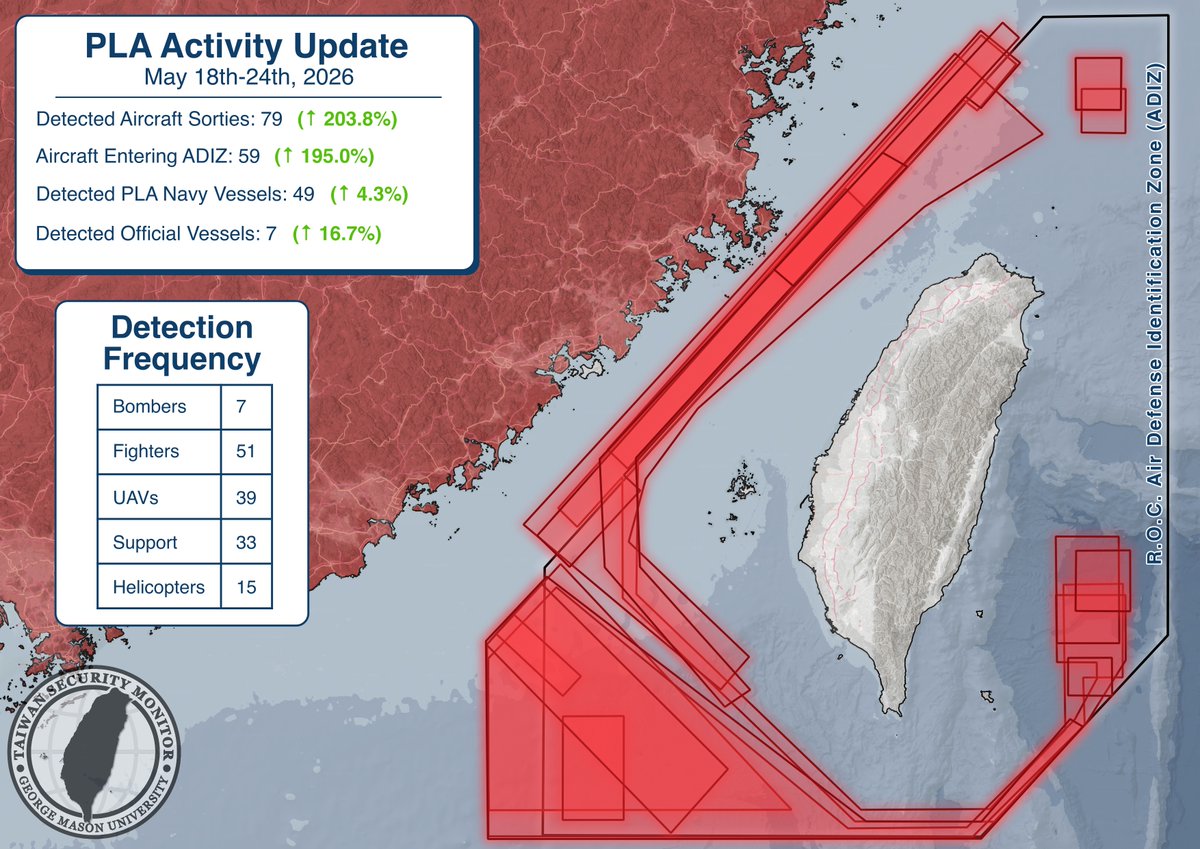
Taiwan’s NSC Secretary-General, (@josephwutw), posted a map earlier today showing 100 PLAN and China Coast Guard vessels deployed across the entire First Island Chain, not around Taiwan alone.
Yesterday, Taiwan’s MND reported only 8 PLAN vessels operating around Taiwan, and no China Coast Guard ships.
Acting Secretary of the Navy Hung Cao, speaking during a Senate Appropriations Defense Subcommittee hearing, informed Congress that the U.S. has reportedly paused a proposed Taiwan arms sale as the Trump administration weighs broader talks with Beijing, including over Iran and the Strait of Hormuz.
The package has been reported elsewhere as worth roughly US$14B and would follow the US$11B sale notified in Dec. 2025.
Taiwan’s first M109A7 Paladin self-propelled howitzers are now expected to begin delivery in 2030, according to Liberty Times.
The delay is reportedly tied to U.S. production capacity, with the U.S. prioritizing upgrades or production for more than 600 M109A6/A7 systems before Taiwan’s order enters the line.
Taiwan’s planned buy includes 60 M109A7s, 60 M992A3 ammunition carriers, 13 M88A2 recovery vehicles, 42 IFATDS systems, and 4,080 PGK precision-guidance kits.
NEW: Moments ago, President Trump told reporters he will speak with Taiwanese President Lai Ching-te via telephone before making a decision on US arms sales to Taiwan.
If it occurs, it would be the first publicly disclosed direct phone call between the US and Taiwanese presidents since 1979. Trump previously called then-President Tsai Ing-wen when he was President-elect in late 2016.
Photo showcasing the varied munitions of a M1A2T Abrams tank in the ROCA's 584th Combined Arms Brigade.
A delegation from Taiwan's Control Yuan inspected the Abrams earlier today, and observed ongoing training efforts.
On May 18, the ROCA's 269th Combined Arms Brigade conducted battalion-level live-fire training simulating a response to an enemy landing.
The drill included CM11 tanks, CM32 command vehicles, CM33/CM34 infantry fighting vehicles, and CM23 mortar carriers conducting beach defense and counterattack.
46 years ago this month, the last soldier of the United States Taiwan Defense Command (USTDC) departed Taiwan following the command’s dissolution in 1979.
At its peak, the USTDC had tens of thousands of personnel and several tactical nuclear weapons stationed in Taiwan.
Using declassified Cold War-era materials, our visualization shows the approximate distribution of major USTDC units in 1973.
The ROCA will re-organize the mechanized and armored battalions belonging to four Area and Defense Commands along Taiwan's eastern coast in 2026, military sources have told Liberty Times. The Guandu Area Command and Taitung Area Command have reportedly already begun this process, with several battalions completing their re-organizations by early 2026.
Once completed, the battalions will be re-designated as combined arms battalions, mirroring changes that occurred in several ROCA brigades between 2019 and 2026.
Our visualization shows the distribution of these commands, their rough geographic areas of responsibility, and the status of their re-organization efforts.