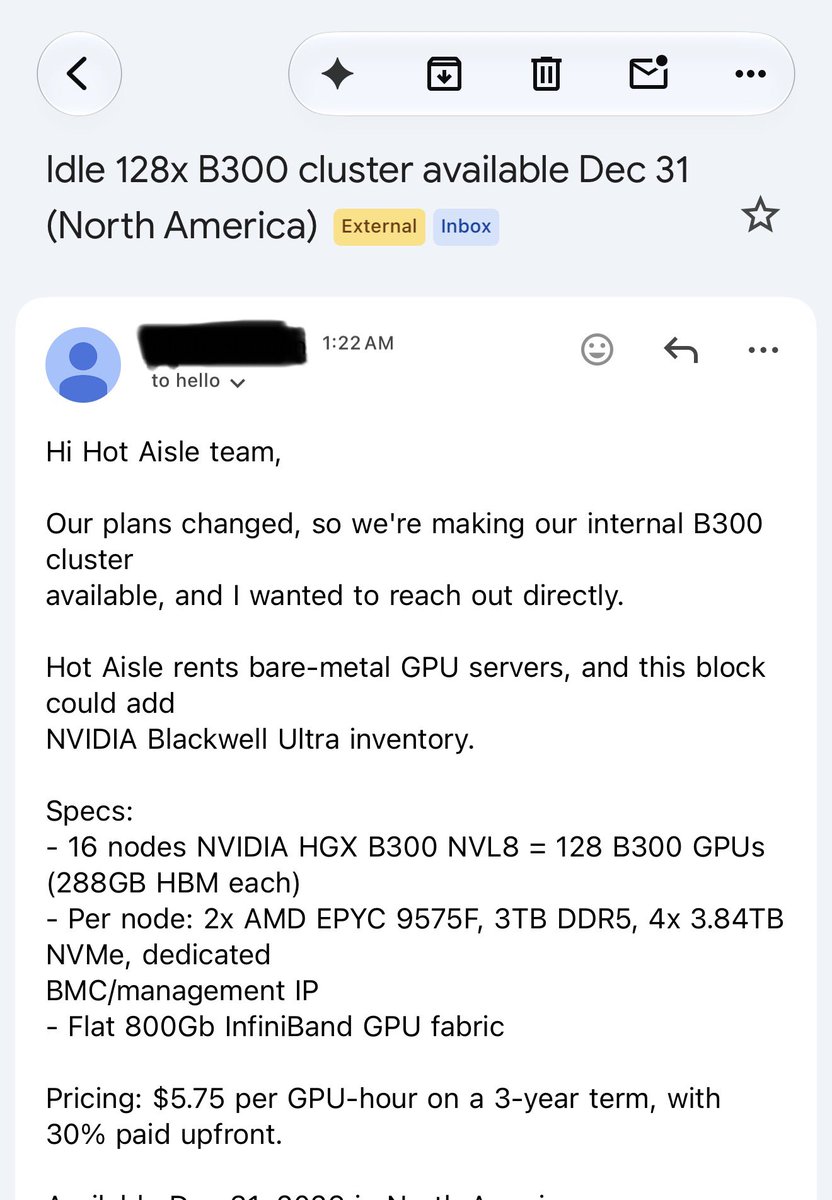
@kermankohli running localllama oss models for yourself is not the same as running a scaled inference business. consider there are nuances to this business you do not know given you don't run a business in it.
@compute_plug I wont tell you the exact number, but it isnt more than a few hundred GPUs and ASICs; we are very good at running them. You arent even talking about monitization, just supply supply supply. You are proving my point.
Part of this bet was a realization: very few companies were capable of profitably monetizing their GPUs.
The majority of non-frontier lab compute was being used on a) VC-funded (and nvidia-funded) neolab training or b) unprofitable startups buying up compute and planning to resell it at a higher price.
In this world you need one of two things:
- To get more out of the GPUs you already have (what Luminal does)
- To price GPUs much lower
Probably both at once.
At some point you need ROI on the compute, and it can’t just come from renting it out to someone else who is losing money.
About 6 months ago when we really started scaling Luminal Cloud, we made a deeply contrarian decision: we won’t buy long term compute rentals.
At the time, and even still today, many people think we’re foolish. We definitely are giving up the higher larger margins we’d be making if we committed to 3-5 yrs.
Fundamentally it comes from 1) a bet on our compiler to move us to a heterogeneous fleet and 2) a belief that the current Blackwell market is extremely skewed.
I believe this position is becoming less contrarian every day.
Everyone selling compute talks about how much money there is being made in inference. The reality is tons of providers are selling tokens at a loss because they overprovisioned compute and need a stop loss
@compute_plug Do you monetize GPUs? Awful lot of noise from people who have only sold them and never used them to make money directly.
The tulips also had great price action for a while…
@kermankohli@stake_jevens My job isn’t to convince you or anyone else. We have firsthand experience with these workloads and know exactly how much compute is needed. Many people are vastly over provisioning relative to how much inference they do.
Again, you are very new to this. A) why would it be contrary to think there’s an oversupply? The world is as it is, my position does not change it. B) inference is not “memory bound”. Some workloads might be for some phase, but that statement is not generally true. You must have heard someone mention that about low batch autoregressive decoding or something.
It does seem like the Chinese are the only ones who have taken Starship’s inevitable success seriously.
Like obviously Ariane C Suite wouldn’t but they’re unserious.
But the other US space co’s also didnt seem to. Even New Glenn is mostly a F9/FH competitor.
Maybe stoke?
@pandaThatGrabs We entirely rent, we run an asset light business and don’t own anything. We can scale better and be light on our feet wrt shifting compute around to different HW
About 6 months ago when we really started scaling Luminal Cloud, we made a deeply contrarian decision: we won’t buy long term compute rentals.
At the time, and even still today, many people think we’re foolish. We definitely are giving up the higher larger margins we’d be making if we committed to 3-5 yrs.
Fundamentally it comes from 1) a bet on our compiler to move us to a heterogeneous fleet and 2) a belief that the current Blackwell market is extremely skewed.
I believe this position is becoming less contrarian every day.
AI companies are already figuring out they don’t need what they signed up for and they are trying to offload it. I can only imagine the underlying debt financing not being paid. Exactly what I have been predicting. This is the tip of the iceberg.
Series A $100m raise. Message from the CEO.
@kermankohli you dont have a very good grasp on the market. a) we obviously arent the only ones who can, but it isnt a super long list b) thats like saying airlines should want the cost of jet fuel to go up c) we dont run on just nv gpus, a lot of our fleet is on trainium and amd
Either you believe the AI buildout is over, that AI was a flash in the pan, and that the need for compute has already peaked... or this a rare buying opportunity.
Reminder: GPU spot prices keep rising and it's hard to secure capacity. HBM and DRAM production is effectively sold out through 2029, with chip and memory supply projected to stay tight until well into the 2030s.
AI research isn't slowing down: frontier training compute is doubling every ~5 months, and model capabilities are scaling over twice as fast as they did pre-reasoning. Inference is profitable with 70-85% margins, and demand is growing geometrically. Each new model generation unlocks new use cases.
I'm not even an AI booster, just being realistic here.
generally inference providers don't do image gen
i get why they don't
customers care greatly about very small details (we have a team of image scientists at luminal) and it requires you to have a pixel deep understanding of your workload
when a customer gives you feedback it generally requires creating histograms and tracing activations to figure out how to improve the product
This is a field where details matter
and that's why it's also the perfect proving ground for our compiler
we have been running workloads on amd & trainium powered by our compiler
Details matter
Our compiler ensures we get it right
https://t.co/NuPkmZAs9r
@yasrabardi890 we use a hybrid approach. compilers can search through orders of magnitude more possibilities than agents can, but agents do a great job building the search space.
Luminal makes the fastest time-to-roofline compiler in the world. It’s an extremely exciting time to work on compilers, and it’s never been more profitable to do so!
to our nvidia friends, we are serving 2-3 trillion tokens a day
if you want to continue your work on the future of inference join us
we work throughout the entire stack:
- writing kernels for Trainium, AMD, and positron devices
- writing collective operations for the patterns these chips come in (and the network transfers required for state of the art kv cache management)
- creating the best routing policies for varied traffic patterns
- creating agents to optimize topology patterns and inference engine scheduler parameters