I don’t like Rees-Mogg at all. But listen, if you bring weak ass sophistry into a knife fight with an old Etonian, Oxford union, parliamentarian you are going to get FUCKED UP.
There’s a bene gesserit breeding program that designed this man for victory in this form of combat. Frankly? Tucker is lucky he didn’t get dismantled in Latin.
@jpodhoretz I don’t need to tell you this, but the problem is Trump’s priorities. If he cared that “the Center stinks as a public venue. It's inconvenient, ugly, and we need a better venue” the whole issue would be different. Instead the tear down is a tantrum over the name.
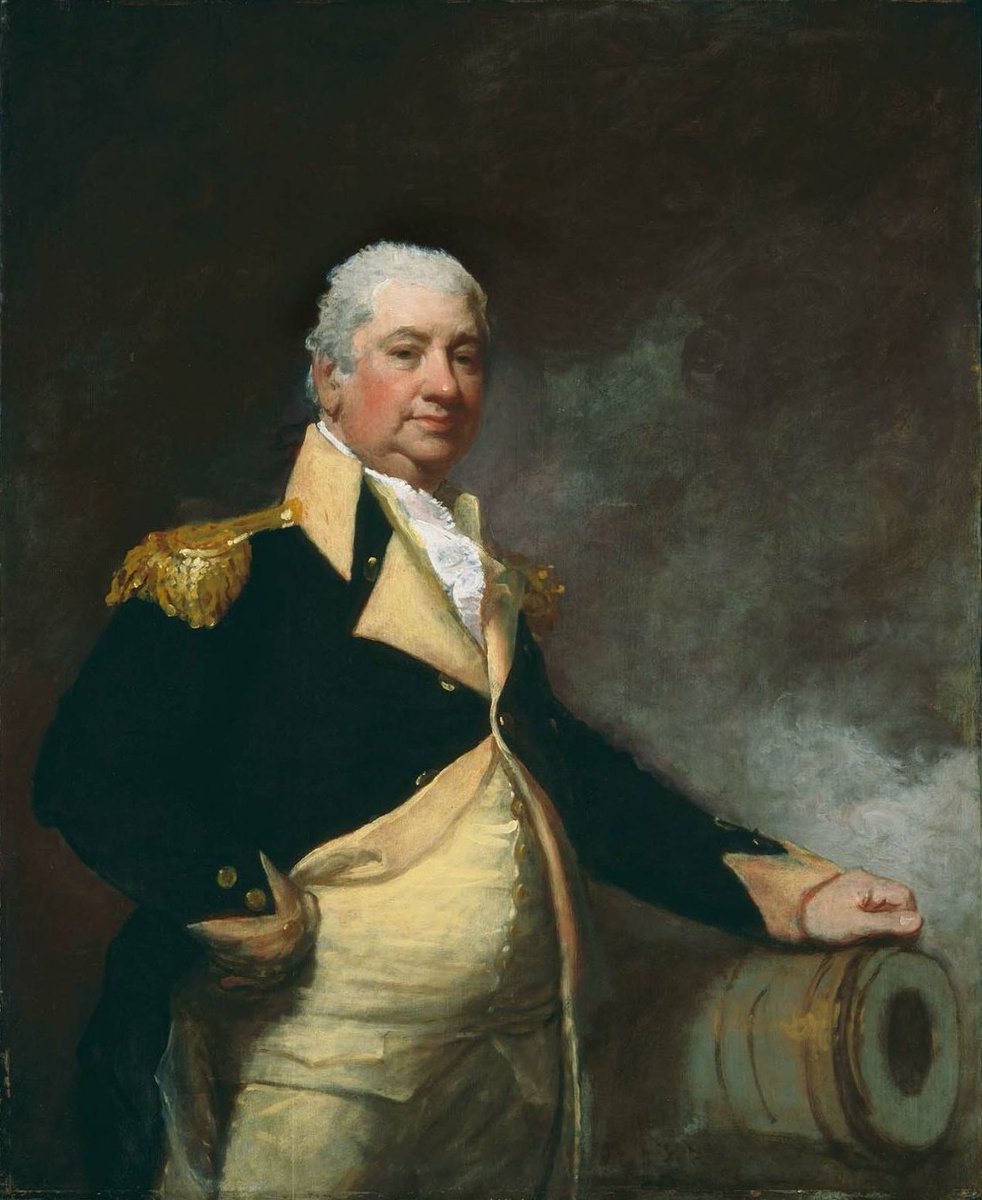
Here is a man who won one of the first great American victories of the Revolution without fighting a battle. He was not a soldier. He was a fat, cheerful Boston bookseller with no military training, and what he pulled off in the winter of 1775 into 1776 is one of the most staggering feats of sheer willpower and logistics in American history. His name was Henry Knox.
Knox learned war the way he learned everything: from books. He ran a fashionable bookshop in Boston, and he devoured the military engineering and artillery treatises on his own shelves. When the Revolution broke out, that self-taught knowledge suddenly mattered, because the American army besieging British-held Boston had a fatal problem. They had the enemy penned in the city, but they had almost no heavy cannon to force them out. It was a stalemate, and stalemates favored the British.
Knox had an audacious idea. Nearly 300 miles away, at Fort Ticonderoga in upstate New York, sat a treasure of captured British artillery, dozens of heavy cannon and mortars taken earlier in the war. What if someone went and got them? Brought the guns to Boston? Everyone could see the problem: it was winter, the route ran through frozen lakes, rivers, forests, and the snowbound Berkshire mountains, and the guns weighed a combined 60 tons. Sixty tons. It sounded impossible. Washington gave the 25-year-old bookseller the job anyway.
And Knox did it. He got to Ticonderoga and set to work dismantling and hauling out around 59 pieces of artillery, some of them massive. He had 40 heavy sledges specially built. He rounded up teams of oxen, dozens and dozens of them, and boats to move the guns across the water before the freeze. And then, through the brutal heart of a New England winter, he dragged 120,000 pounds of iron and brass across a frozen wilderness.
Picture it. Cannon lashed to sleds, oxen straining in the snow, men breaking through ice, hauling the guns up and then carefully down the icy slopes of the Berkshires, where a runaway sled could be a disaster. Guns broke through frozen rivers and had to be fished out. It was backbreaking, dangerous, freezing work, mile after mile, week after week. And this untested bookseller held it all together by force of personality and organization. In under two months, he brought the entire "noble train of artillery" 300 miles through the dead of winter, and in late January 1776 he reported to Washington that the guns had arrived.
Then came the payoff. On a single night in early March, Washington's men quietly hauled Knox's cannon up onto Dorchester Heights, the high ground overlooking Boston and its harbor. When the British woke up, they found the American army suddenly looking down their throats with heavy artillery that could smash their ships and their positions. Their commander realized the city was untenable. And so, rather than fight, the British evacuated Boston entirely on March 17, 1776, and sailed away. The Americans had liberated a major city without a battle, because a bookseller had done the impossible with oxen and sleds and nerve.
Knox never looked back. He became Washington's chief of artillery for the rest of the war, the man whose guns crossed the Delaware to Trenton and pounded the British into surrender at Yorktown, and after the war he became the young nation's first Secretary of War. Fort Knox is named for him. But his greatest monument is that winter journey. Remember Henry Knox, the bookseller who read about artillery in his shop, then went out and dragged 60 tons of it across a frozen wilderness to hand George Washington the guns that freed Boston.
The Encyclopedia of Movie Cats, featuring over 1,000 cats, from household names like Puss in Boots to Mr. Bigglesworth, to unnamed alley cats and scaredy cats that saunter across the silver screen.
(1/2)
#OTDin1985, if you were a baseball fan, you tuned into Mel Allen and “This Week in Baseball” before taking in the #StLCards in the NBC Game of the Week!
Here’s the whole show:
https://t.co/ihdIaTucRz, or if you only have two minutes, check out the portion on the Cardinals in the clip below.
This pic isn't a warning to us. It's a warning to other countries. We will take your smartest, hardest-working citizens and turn them into Americans. We're a machine and you can't stop us. Look upon our soft power and despair.
Look, I think Christianity, in addition to being a good in itself, has been a critical component of America & Western Civilization & always should be. But "convert to Christianity or you're not a real American" was a step too far for George Washington for a reason. We can be a Christian country without demanding that we be an exclusively Christian country.
Gen X defined:
Ages 45-61
Looks 35-40
Will 100% throw hands
Doesn't care about your feelings
Cusses a lot
Will make you cry with words
Great work ethic
Pragmatic
Zero tolerance for stupidity
Skeptical of authority
Doesn't trust anyone at 1st
Extremely loyal friend
Figures shit out
Most likely your boss
Works hard, plays hard
No fear
Sarcastic as fuck
Still listens to the same music
Knows lyrics to Rock, Rap & Country
Proficient in analog & digital tech
Self reliant
Adaptable to any environment
Just wants to be left alone
Somebody, somewhere in NYC for whatever reason recorded the New York 1 morning news broadcast on Sept. 11, 2001.
They wound up recording history. It starts at 8:30 a.m. ET.
You get 15 minutes of news from the Before Times.
Then the world changes.
https://t.co/1N3J5Stf1M
25 years after September 11, 2001, my overwhelming sentiment remains what it was on that day: anger. I still feel pretty much the same level of shock when I see the footage as I did when I saw it for the very first time. I don't think it'll ever change. https://t.co/JaKzWt76ES
#OTD 1998 - Mark McGwire connects off of Cub hurler Steve Trachsel and sends a 341-foot line-drive over the left-field fence for his historic 62nd home run, breaking the single-season home run record set in 1961 by Roger Maris.
🎙️ Mike Shannon
One thing I remember, besides the HR, was Mike Shannon offering Jack Buck "his" inning so if McGwire hit the home run, Buck would have the privilege of calling it.
Buck declined.
Both classy moves.
#STLCards