Since this post cites me, I want to clarify that I think pausing right now would increase the risk of AI takeover.
It might be important to pause at some point. But you should have a clear story for *why* you're pausing. Pause to do what?
The most important thing to worry about is AIs subverting the intelligence explosion itself: https://t.co/vKYurpxIPg
If you're pausing to make sure that the AIs who are about to kick off the intelligence explosion are well monitored, robustly aligned, and capable enough to align their successors, that makes a ton of sense, and I support it.
At that point, you’ll have access to much better automated researchers, and you’ll also be able to study these much more capable models that you’re worried about empirically.
But it’s likely that we’ll only be able to pause once. During a pause of AI development, compute would continue to build up, providing ever more kindling to all the less responsible defectors who will use the cease-fire to catch up and then continue further AI development.
Any global agreement to hold back a technology with enormous near-term economic and military benefits will be extremely fragile.
A pause right now might be somewhat helpful for getting alignment to keep pace with capabilities, but at the cost of making the much more important coordination required in the future far harder.
Even if you’re in a desperate situation marooned at sea, if you’ve only got one flare, you should be very strategic about when you use it.
As I watch Ballmer's Clippers delusions crash and burn, I feel like he's successfully gaslit the NBA community for years into thinking he was invincible and above the rules because of his money, and it has me thinking how this happens with the ultra wealthy more broadly.
I want to prevent a race into unmonitorability kicked off by confused reporting. The depth of the computation graph for our present frontier models, including Astra, is within a factor of two of GPT-4.
OpenAI has worked to preserve and utilize chain-of-thought monitoring since our very first reasoning models. We deeply care about this technique, as it can give us a view into how model alignment generalizes from its training distribution. I do think it is fragile and unfortunately trending in a negative direction, for reasons not contingent on architecture changes that I will write about soon. But there are things we can do to strengthen it, and it's a core goal of our current research program.
i find lately there isn’t much left to say about ai.
personal agents, agents, alignment, rogue agents, agent swarms, rsi, etc. i guess almost all the obvious intellectual fruit has been picked.
you can still talk about these things, but finding a genuinely new frame is getting harder which is why you’re left with mostly news reporting now.
GPU World: A story competition from Neal Stephenson, Gwern, and me.
The AI future is unevenly distributed. What would the world look like with AI broadly diffused, such as if we had one GPU per person?
1000-5000 words, fiction or non-fiction.
$100K in total prizes.
https://t.co/5Bd2YmjikS
Regret the tone of my post on data centers yesterday.
What I should have said:
There were reasonable concerns about data centers 18ish months ago: water, taxes, jobs, electricity prices, the environment and what they would do to small towns. Well-structured data center projects have largely addressed these concerns today and we should be celebrating this.
On balance, data centers are awesome for America in every way.
On water: U.S. data centers use a fraction of what golf courses use. A lot of the numbers from 18 months ago were off by over 1000x. Newer data centers use closed-loop systems or recycled water. Should be required by every town approving a data center project.
On taxes: looking only at sales-tax exemptions, as Ronan Farrow did, is the wrong way to evaluate this. Data centers pay significant property taxes. Loudoun County, which is the wealthiest county in America, now collects on the order of $1 billion a year from data centers. In Quincy, WA, data centers are more than half the property-tax roll. Over time, property taxes can go to zero while government spending increases in these towns.
On jobs: this has been unambiguously awesome for blue collar Americans. Demand for electricians, plumbers, welders, HVAC techs, and contractors has gone vertical, and it is not a one-time construction job. These buildings get upgraded and expanded over time. That is why the building trades are fighting for them, and why some unions are now treating opposition to data centers as a reason not to endorse politicians.
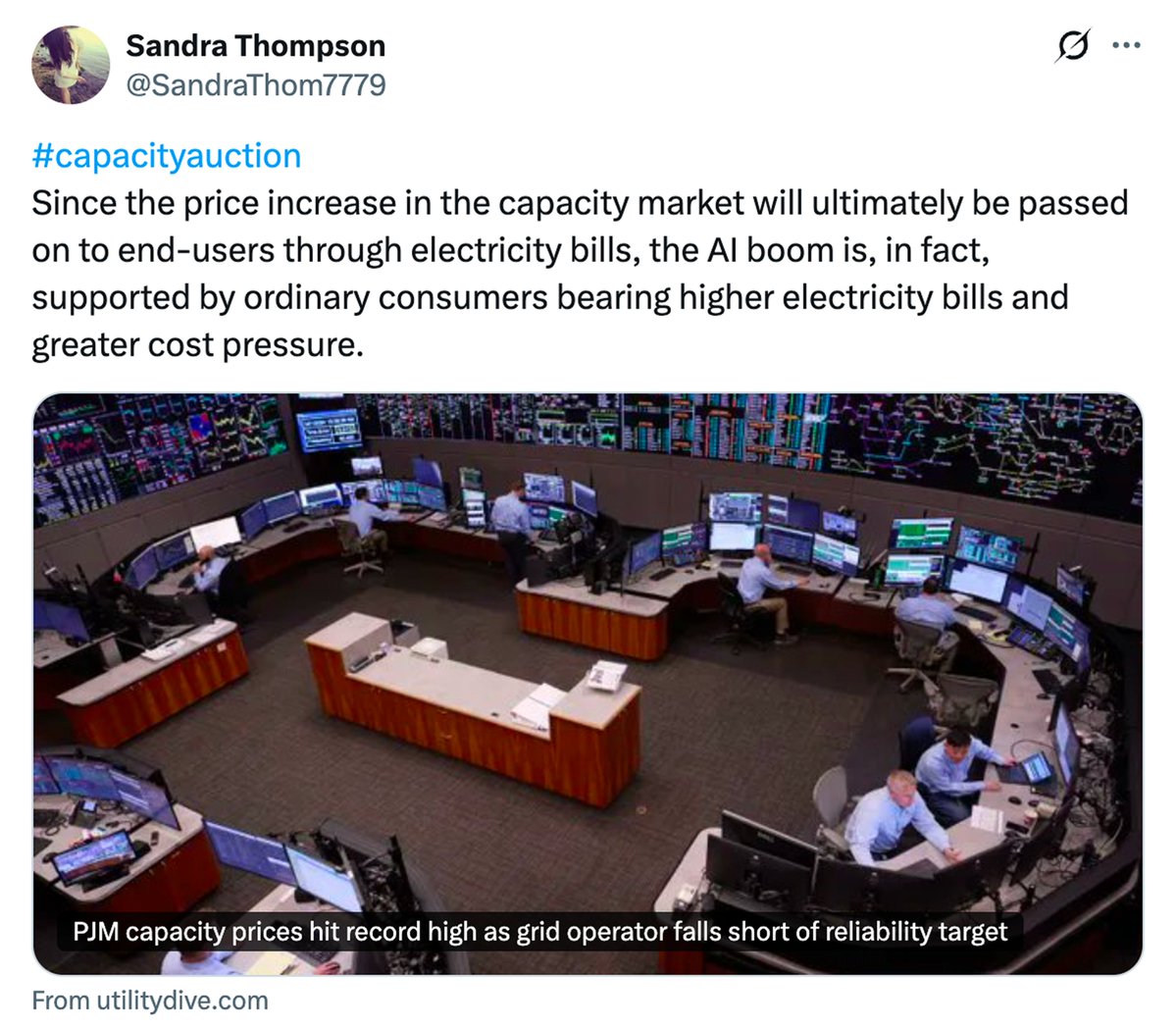
On power: the original fear was that households would pay for the incremental electricity demand in the form of higher prices. That is why the ratepayer-protection deals and the new large-load tariffs exist. The right structure is: the data center brings or pays for new generation and signs a contract long enough that existing customers are protected. Where that is happening, utilities are cutting or freezing residential rates and saying so on the record. Where it is not, people are right to object. Electricity prices are going down *today* in a number of large states because of data centers.
On the environment: data centers overwhelming use natural gas today, which is the cleanest power source outside of nuclear, solar and wind. And the companies that are building the data centers are committed to carbon neutrality such that an equivalent amount of solar will likely be built. Maybe more importantly, the data centers need batteries to function effectively and these batteries can also sell energy back into the grid (which recently prevented blackouts in Texas). Over time, data centers will run on solar plus batteries.
On the towns: Poverty in Quincy, WA fell from 29% to 6%. Data center taxes paid for a new high school, a hospital, a library, police and fire stations. This is happening in many left for dead former mill and farm towns that had no other bidder for the land.
Data centers are actually reindustrializing parts of America and creating the kind of working-class jobs both parties have spent decades claiming to support. That should not be a partisan issue. Data centers can and should be awesome for America and they increasingly, overwhelmingly are. Supporting the outsourcing of data centers to China will likely age just as well as support for the outsourcing of high quality, blue collar manufacturing jobs to China has aged.
When the facts change, I change my mind. I hope that reasonable people who had good faith reasons to oppose data centers at least consider updating their beliefs given the change in the facts over the last 18 months. This really matters for America.
I will say I also think the idea of making data centers beautiful is a good one that has yet to be implemented. Data centers should be just as beautiful as Grand Central Station. We can learn a lot from the railroad buildout. Neoclassical revival ftw.
Might write up open-weight AI tomorrow as this is equally essential to America.
🚨 SCOOP: Astra recently graduated from the dogfood stage, and is now being made available to select OpenAI partners under the name "ultima-alpha"
If feedback over this weekend is positive, the plan is to expand the early access program throughout next week before the wider launch, targeting next Thurs (the 3rd) to the end of the following week
Work also continues on an update to GPT-Image 2, with their launch windows being very similar (possibly even launching simultaneously)
The simple explanation is that we don't have info on what happened to his closest followers.
Better questions: why does Mark contain no appearance of the resurrected Jesus? Why is he not recognized in Luke? Why does Acts say he spent 40 days proving to them he was actually alive.
Atheists, you can reject the miracles of Jesus.
But you still have to explain why His closest followers were willing to die for the claim that they had seen Him alive.
The X Safety team conducted an investigation into suspected Chinese inauthentic accounts involved in influence operations:
We identified a bot farm of approximately 200,000 accounts. Within this farm, we found 200 accounts posting in a manner that could manipulate a legitimate debate about American AI and energy policy.
These posts contained claims that AI data centers are driving up household electricity prices and straining the grid. Others included AI-generated cartoons that depicted data-center operators enriching themselves at the public's expense.
We remain committed to maintaining an open and authentic platform where people debate topics of public interest. We take seriously any attempts to undermine the integrity of the global town square and suspend accounts that violate our Authenticity policy.
Five minutes of meditation a day can produce measurable changes well beyond the brain.
Dr. Richard Davidson describes new data showing that just 5 minutes of daily meditation for 28 days significantly reduced IL-6, a pro-inflammatory cytokine.
They also observed changes in the gut microbiome including shifts in pathways involved in the production of the short-chain fatty acid butyrate, which helps maintain intestinal barrier integrity and has important effects on immune and metabolic function.
Some of these changes were still detectable up to 3 months after the formal intervention ended!
There's a growing body of evidence that training the mind can produce measurable biological effects throughout the body, and meaningful changes may not require hours of meditation every day.
New episode with @RichieJDavidson out now!
So I've been doing meditation during my daily walks the past 3 months and I can vouch for better overall happiness/mental state. A big positive side effect has also been that I can fall asleep faster now, as I'm less prone to endless thought loops.
New episode with Dr. Richard J. Davidson (@RichieJDavidson).
He has spent more than four decades asking whether well-being can be trained. His answer is yes—but the training does not have to happen only on a meditation cushion.
In this episode, we explore “contemplative aerobics”: combining physical exercise with awareness, connection, insight, or purpose. We can use a run, walk, warm-up, commute, or chore to return attention to the present, see thoughts as transient events, and connect daily effort to something larger than ourselves.
Richard explains his four pillars of flourishing, how attention and stress communicate with the immune system, and the incredible evidence linking meditation with inflammation, asthma, and the gut microbiome. We also discuss how generosity and purpose can shift well-being beyond the self and much, much more!
The central message is that physical and mental exercise can strengthen one another, and flourishing grows through small practices repeated in ordinary life.
This is a can't-miss conversation.
Links to the episode on all platforms in the comments below.
Timestamps:
0:00 - Introduction
0:55 - Meditate or exercise?
4:38 - The biology of loneliness
6:18 - Can compassion be trained?
8:48 - Timing meditation around exercise
12:03 - The foundations of flourishing
18:11 - The six emotional styles
25:45 - When emotional styles go too far
27:35 - Shaping the brain on purpose
30:19 - When neuroplasticity backfires
32:06 - The right dose of adversity
35:53 - Why kids stay present
37:47 - Strength training as mindfulness
43:48 - Can mindset change biology?
48:18 - Precision training for the mind
49:59 - Can 5 minutes lower inflammation?
55:08 - The meditation–microbiome link
59:22 - The brain's map of your organs
1:03:56 - The stress-inflammation buffer
1:05:32 - Meditation in motion
1:08:50 - Gratitude at every meal
1:10:34 - When meditation raises anxiety
1:12:58 - Children absorb parental stress
1:18:07 - Can connection extend life?
1:21:04 - How connection curbs self-focus
1:23:35 - Why giving feels better
1:25:54 - Finding purpose in ordinary life
1:30:29 - How curiosity loosens pessimism
1:33:57 - Flourishing without meditation
1:36:28 - Why exercise alone isn't enough
Time:
- OpenAI leaders believe they are at the cusp of AGI. Sam Altman believes OpenAI will have an internal system that will qualify as AGI by the end of 2026. Mark Chen thinks OpenAI is 80% of the way to AGI.
- OpenAI already has the automated AI research intern - that's Astra. Jakub Pachocki says that Astra "can implement an experimental idea inside OpenAI’s code base, run the experiment, and return results, or take a paper and perform work that previously occupied a human researcher for a week".
- Astra enables "persistent agents", i.e., virtual colleagues toiling for sustained periods on tasks. Thibault Sottiaux says OpenAI is "close" to showing a product built around the concept of persistence. "It’s definitely going to feel like a new thing to people."
- Sam Altman thinks Astra's biggest impact will be on discovery of new knowledge. "I expect this will be the first model where the model actually invents new things in a way that matters", which is "a very AGI-like thing".
rumors i’ve been hearing on the rate of progress inside anthropic and openai are truly bonkers. i think we’ll see a jump at the size of one from o3 to fable again in the next 8 months
Introducing S1, our new foundation model that learns from one example.
It can be taught 10-minute long tasks that it has never seen before, from one video prompt without any fine-tuning.
Watch S1 operate in real-time via in-context learning:
I've noticed more and more people retweeting long tweets that are 100% AI in the last few weeks. I think a threshold has been reached where most people just don't realize or care that it's completely AI.
IMO the most interesting thing that happened in society today:
The WSJ's leading op-ed today, by Stan Druckenmiller, was entirely AI generated.
If you read the text, it's glaringly obvious.
There's no way the editors at the WSJ don't have an ear for AI-written prose. They know what AI sounds like; they're not stupid. They published this anyway.
Is this the new normal?
Does it mean AI writing is finally good enough to publish in the WSJ, and we need to stop being so precious about AI-voice?
Or does it mean that if you're famous and important, it's OK to just push out AI-written content so long as your byline is on it and you stand by the consequences? We understand that famous people have speechwriters, and so long as they deliver the speech, we consider it theirs.
Maybe that feeling that something AI written is not your authorship is an anachronism that will fade away in a few years.
Making anti AI content on YouTube is not only profitable bc you’ll get a zillion views on any anti AI slop, but also bc there are a litany of these sorts of “AI safety” orgs that will quietly pay you massive amounts of $$ for undisclosed propaganda
We didn't need "better messaging" during COVID. We needed to relentlessly challenge and reject the hysterics.
AI is good. Data centers are good. Economic growth is good. Paranoia is bad.
me: *getting increasingly lost in abstractions and excitement about the future of work with ai*
them: "so... is it like a desktop application that i install?"
Higher IQ people make better decisions about everything.
Loudoun County, highest median income in the nation, rolls out the red carpet for data centers.
Chud areas worry about their precious tumbleweeds and gravel getting displaced.
Better to live around smart people.