@byAnhtho@GetLago@tom_nguy@Christophepas Few immediate resources come to mind:
- Pretty much anything by @jstanier
who authored "Effective Remote Work"
- There's a lot of gold in https://t.co/69kDyImCM3
- Resource for inspiration https://t.co/m2jNRRKQah
@olivierlacan @mattstaff Had the exact same question and that's a great call out.
The more I thought about it I realized it also makes sense from the speed perspective. In my 1970s home, the drywall was both glued and nailed to studs and demoing sections "cleanly" is super time consuming.
Wearing actual pants instead of pajama pants during remote work does more for my productivity than all my TODO and knowledge management workflows combined.
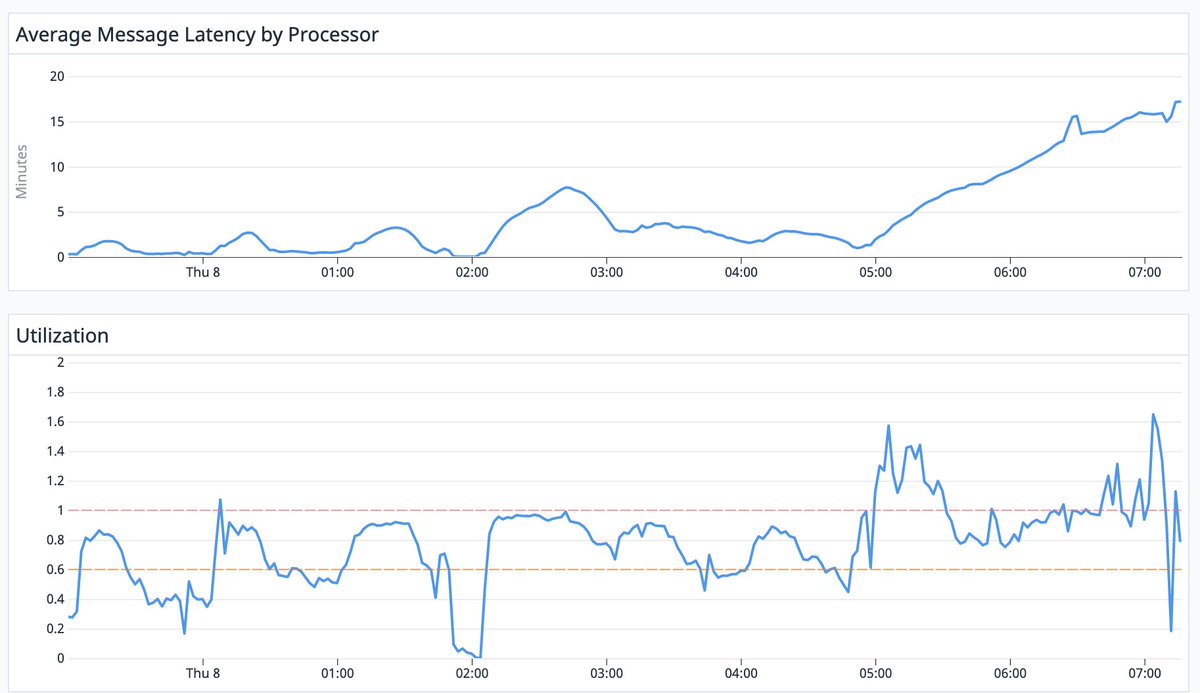
@japborst Great question – utilization can exceed 100% if the arrival rate exceeds the service rate causing the queue to grow infinitely. This chart is a Kafka consumer (should've mentioned that), which is unlike an app server that would likely start rejecting requests as it grows unstable
There's a general rule that M/M/c queues approach instability around 75% utilization. It's interesting to see that in practice – in the image below the queue clearly grows as it crosses 60% into higher territory.
My latest love language is chatting about anything related to M/M/c queues.
What are those? I'm glad you asked because there's a fantastic e-book (free) from VividCortex that's 🫶
https://t.co/CpADZHbzBG
It turns out that I can put together a presentation with one week notice, but my brain won’t like it and it’ll lack typography, fun graphics and possibly coherent thought.
But hey, did that.
👉 Proof our #fintechdevcon agenda is ✅: @joeltaylor from @github will share all that goes into launching a production-ready #payments system. Hands-on exercises will teach you core concepts, common blindspots, and best practices you can apply to your applications. 💪
I find it interesting that these challenges are universal to billing in arrears. However, the pricing model, whether it be usage based, marketplace, etc., drastically changes the story around how to solve for them.
Usage based pricing
🔴 Collecting cash after the service is consumed can be challenging (if you already disputed an invoice that skyrocketed, you know about it!)
🔴 No visibility on revenues, no recurring cash inflows isn’t good
🔴 The end-customer wants visibility on costs
For example, consider end-customer cost visibility:
Uber – calculates price up front
TaskRabbit – has fixed pricing on select tasks, but difficult to estimate "closet organization"
Cloud service – forecast calculators or other predictive models
@kiwicopple@byAnhtho@swyx@amberfloio@getmetronome@GetLago@supabase We also have spend-caps at GitHub for meter based products and it's a heavily used feature. It certainly introduces interesting product and engineering challenges, but erring in the customer's favor tends to ease some of the complexity.
https://t.co/9kbADf0GWf