When fixing your gaze on the grey dot, how many red dots do you see within the green frames? Many people consistently see two, despite only ever being shown one.
Our paper about the new 'Split-Stimulus Effect' is out now in JoV [1/2]
Joe Melling et al. investigate a novel visual illusion in which moving frames cause a single flashed stimulus to be perceived in two locations simultaneously, https://t.co/A26z8wvLL4.
@joemelling@Monash_M3CS@Psychunimelb
Does meditation just happen to address multiple types of suffering, or does its broad effectiveness hint at something deeper about the mechanisms of suffering or well-being itself?
We address this in our new preprint! @RubenLaukkonen
https://t.co/JTZKrVFINU
🎉 Huge congrats to our M3CS PhD candidate
@lars_sandved for winning The 2024 Computational Phenomenology of Pure Awareness Prize! 🏆What an incredible achievement! Check out his award-winning contribution in the 🧵below! 👇#phenomenology#consciousness#activeinference
Excited to share my first preprint: a novel visual illusion discovered by @renrutmailliw and @HinzeHogendoorn, which we call the "Split-Stimulus Effect", in which a single flashed stimulus is perceived to be in two different locations simultaneously. [1/5]
https://t.co/y7IWuJpjuO
When fixing your gaze on the grey dot, how many red dots do you see within the green frames? Many people consistently see two, despite only ever being shown one.
Our paper about the new 'Split-Stimulus Effect' is out now in JoV [1/2]
Joe Melling et al. investigate a novel visual illusion in which moving frames cause a single flashed stimulus to be perceived in two locations simultaneously, https://t.co/A26z8wvLL4.
@joemelling@Monash_M3CS@Psychunimelb
Happy to share the first in-depth analysis investigating how cardiac dynamics & brain-heart communication change with spontaneous fluctuations in arousal & attention -- in collaboration with the great @hohwy (@Monash_M3CS ) & @thandrillon (@ParisBrainInst) !
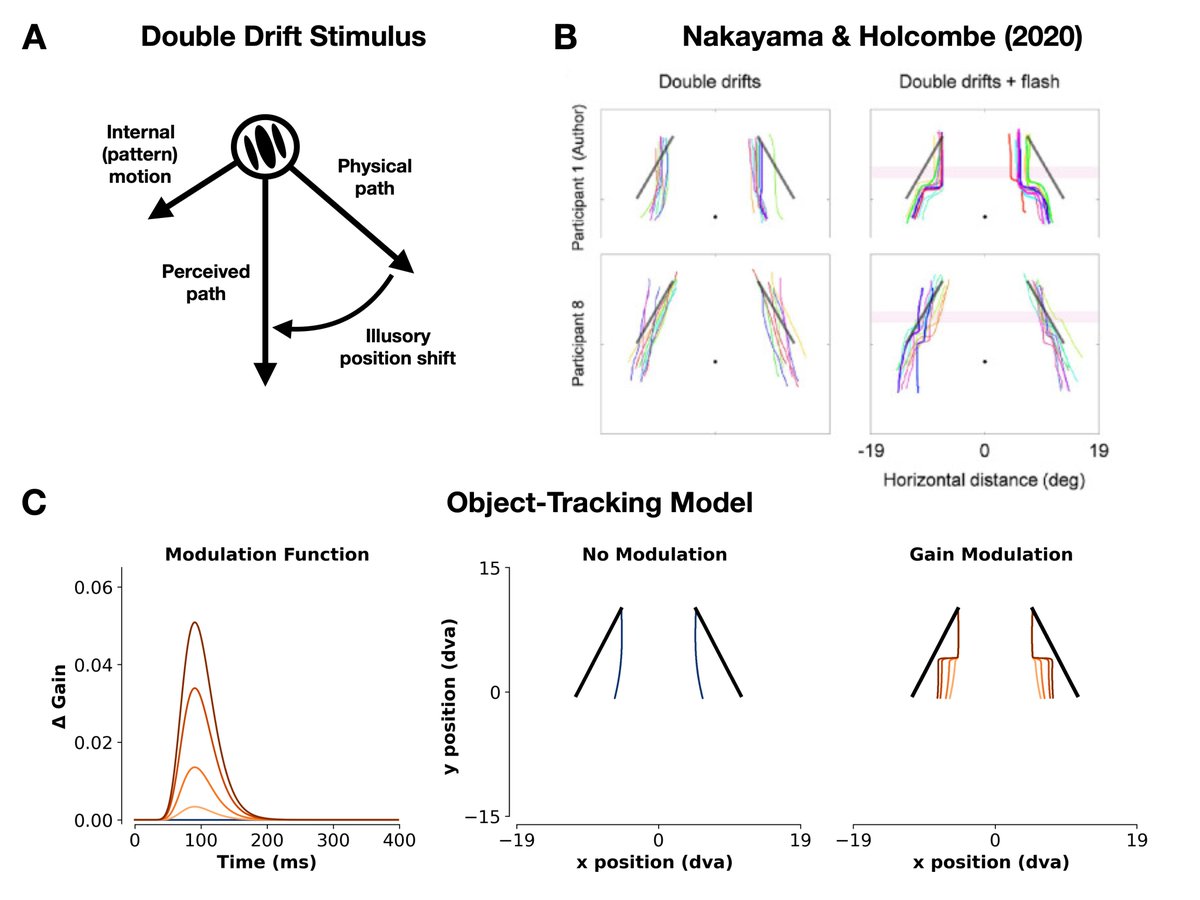
Happy to share this brief preprint w/ Oh-Sang Kwon, Minwoo Kim & @HinzeHogendoorn. We suggest that the brain may be able to rapidly re-weight its inputs and predictions during perceptual inference, explaining the puzzling phenomenon of 'position resets'.
https://t.co/ozxZ85aXPy
🚨New Preprint Alert🚨: 'Progressive multi-stage extrapolation of predictable motion in human visual cortex', with Charlie Sexton, @phil__johnson, @ella_mwil & @HinzeHogendoorn!
Paper: https://t.co/PxhLTO5MKS
Code: https://t.co/mSXycaWg9T
Data: https://t.co/muJHjoHy5I
A superb workshop on *Levels of Explanation in Psychedelic Psychiatry*.
Co-organised by the @Monash_M3CS team and Phil Gerrans from University of Adelaide
See 🧵👇for all the talks
Thanks to Will and Hinze for being great supervisors, and to the rest of the Timing Lab for their support, particularly @CottierTimothy for helping set up the testing room itself and @brainboyben for code troubleshooting #BenWasHere
Excited to share my first preprint: a novel visual illusion discovered by @renrutmailliw and @HinzeHogendoorn, which we call the "Split-Stimulus Effect", in which a single flashed stimulus is perceived to be in two different locations simultaneously. [1/5]
https://t.co/y7IWuJpjuO
This illusion has a number of unique properties when compared to other motion illusions, but we also argue, using a predictive processing framework, that it has important implications for how the brain constructs visual experience in space and time more generally.
New episode! ✨ This week we spoke to @anilkseth about all things #consciousness ! From controlled hallucinations to implications for #AI Anil shares with us his ideas on where the field is currently at 🤔🧠
https://t.co/XBZ5xu1RV9
Thrilled to see this is out today! A truly Herculean effort from @CottierTimothy with 400+ hrs (!!) of in person data collection and 8 (!) different tasks. And some interesting, unexpected (in a good way!) results.
https://t.co/H9F6PoWWob