"Are Multimodal Embeddings Truly Beneficial for Recommendation?" Research with - Yu Ye, Junchen Fu, Yu Song, and Kaiwen Zheng- found that majority of multimodal models are not using non-textual modality- If you are attending to @ECIR2026, listen to Junchen Fu
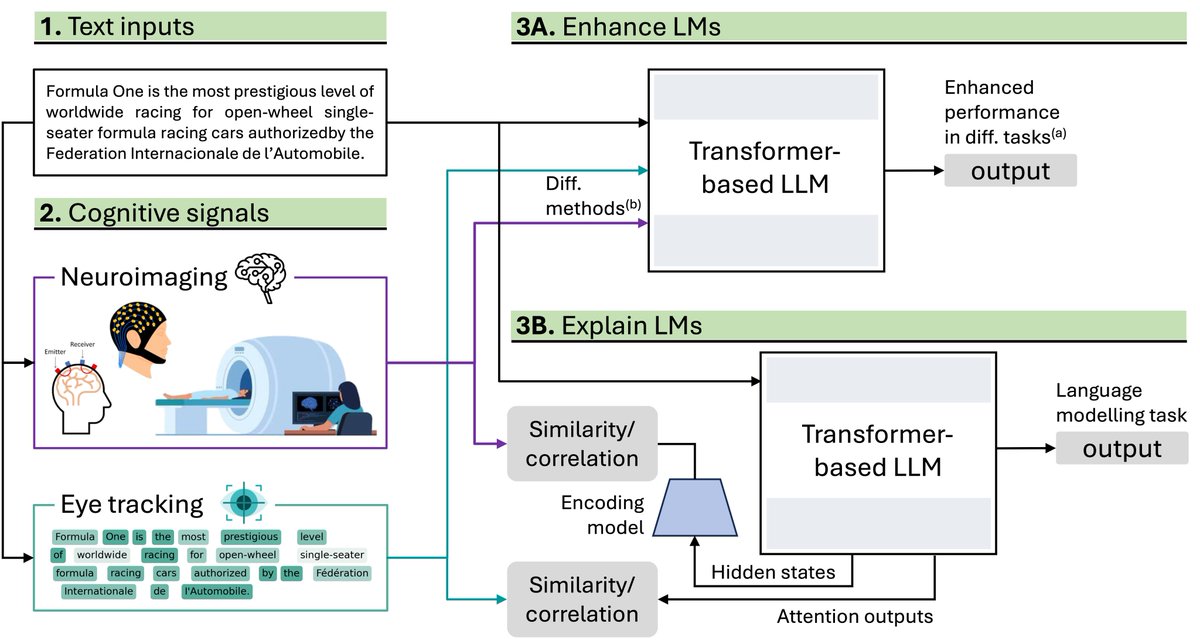
Big congrats to Ángela López Cardona & Sebastian Idesis on our latest IJCNN publication! We review how cognitive signals, esp. eye tracking, enhance language & image understanding in LLMs & VQA. Preprint: https://t.co/vuYYkAhus1
#AI#NLP#eyetracking#LLMs#IJCNN#TID
"An Instruction-Response Perspective on Large Language Models in Information Retrieval Tasks" by @hideo_joho and @joemonj (Glasgow) has been accepted at #sigir2025 as a perspective paper.
New short course: Attention in Transformers: Concepts and Code in PyTorch.
Last week we released a course on how LLM transformers work. This week, go deeper and learn about the technical ideas behind the attention mechanism, and see how to code it in PyTorch. This course is built with @joshuastarmer, Founder and CEO of StatQuest.
The attention mechanism was a breakthrough that led to transformers, the architecture powering large language models like ChatGPT. Transformers, introduced in the 2017 paper: "Attention is All You Need" by Viswani and others, took off because of its highly scalable design.
In this course, you’ll learn how the attention mechanism, a key element of transformer-based LLMs, works and implement it in PyTorch. You'll develop deep intuition about building reliable, functional, and scalable AI applications.
What you will do:
- Understand the evolution of the attention mechanism, a key breakthrough that led to transformers.
- Learn the relationships between word embeddings, positional embeddings, and attention.
- Learn about the Query, Key, and Value matrices, and how to produce and use them in attention.
- Walk through the math required to calculate self-attention and masked self-attention to learn why and how they work.
- Understand the difference between self-attention and masked self-attention and how one is used in the encoder to build context-aware embeddings and the other is used in the decoder for generative outputs.
- Learn the details of the encoder-decoder architecture, cross-attention, and multi-head attention and how they are all incorporated into a transformer.
- Use PyTorch to code a class that implements self-attention, masked self-attention, and multi-head attention.
There're lots of exciting technical details in this course. Please sign up here: https://t.co/aAeNblXcYo
📣 📣 The #sigir2025 LiveRAG Challenge is open at:
https://t.co/1lgSaMoXTk
Prizes:
- First Prize: $5000
- Second Prize: $3000
- Third Prize: $2000
Deadlines:
- Application submission deadline: February 24, 2025
More info? Ask [email protected].
I am excited to kick off this year with our first perspectives article, exploring bio-inspired AI and its groundbreaking applications in Telecommunications and Cybersecurity!
https://t.co/uXdUUgdXwE
#telefonicascientificresearch#discovery#tid#ai#neuroscience
@joemonj@alexk_z@iarapakis@XinXin_SDU@YueFeng__@twitoogle@ron_junchen_fu Important Dates
Submission Deadlines: January 1, 2025
Acceptance Notification: 13 January, 2025
Camera-ready: 2 February, 2025
EReL@MIR Workshop: 28-29 April 2025
Deadlines refer to 23:59 (11:59 pm) in the AoE (Anywhere on Earth) time zone.
We (@ZihanWa54274484, @joemonj, HaitaoYu, Weizhi Ma,@zhaochun_ren, @xinxin) are holding the R^3AG workshop(https://t.co/GI1xH4Dmts) on SIGIR-AP2024 (December 9-12, 2024, Tokyo, Japan);
The topics mainly include Reliable RAG-related research.
Submission DDL: October 3, 2024
Beyond a successful submission, it has also been an adrenaline-fueled research sprint positioned on the SoA of Reinforcement Learning-based Recommender Systems with Large Language Models, with @sasxbd, @joemonj and @alexk_z Our paper is available here: https://t.co/DLlU7s8Q09
I really love the idea of MonsterCLEF at #clef2024! https://t.co/2MjO4ZkCst Makes so much sense but also hard to pull off! A meta-challenge organized so that task-specific LLMs run against diverse tasks without adapatation. New test data for each task, so no data leakage!