CREDO
What I want in life is meaningful work and meaningful relationships,
through radical truthfulness and radical transparency,
because they reinforced each other,
and that's what's worked for me.
Former Citadel head of equity quant research Dan Morillo on why AI can't generate alpha yet:
"It is trained on millions of documents, thousands of millions of documents."
"In finance, you would think of this as, it gives you the consensus."
"If you put a prompt in ChatGPT, what you get back is essentially some average of what a typical person might say."
"When you think about alpha generation, you don't make money off of the consensus. You make money off of differences."
"We just don't think it's at that stage at this point."
Indonesia's growing middle class continues to be a steady engine of GDP growth. But almost no one is aware of this basic economic fact because some senior economists inexplicably insist on deflating household consumption expenditure values using the national poverty line.
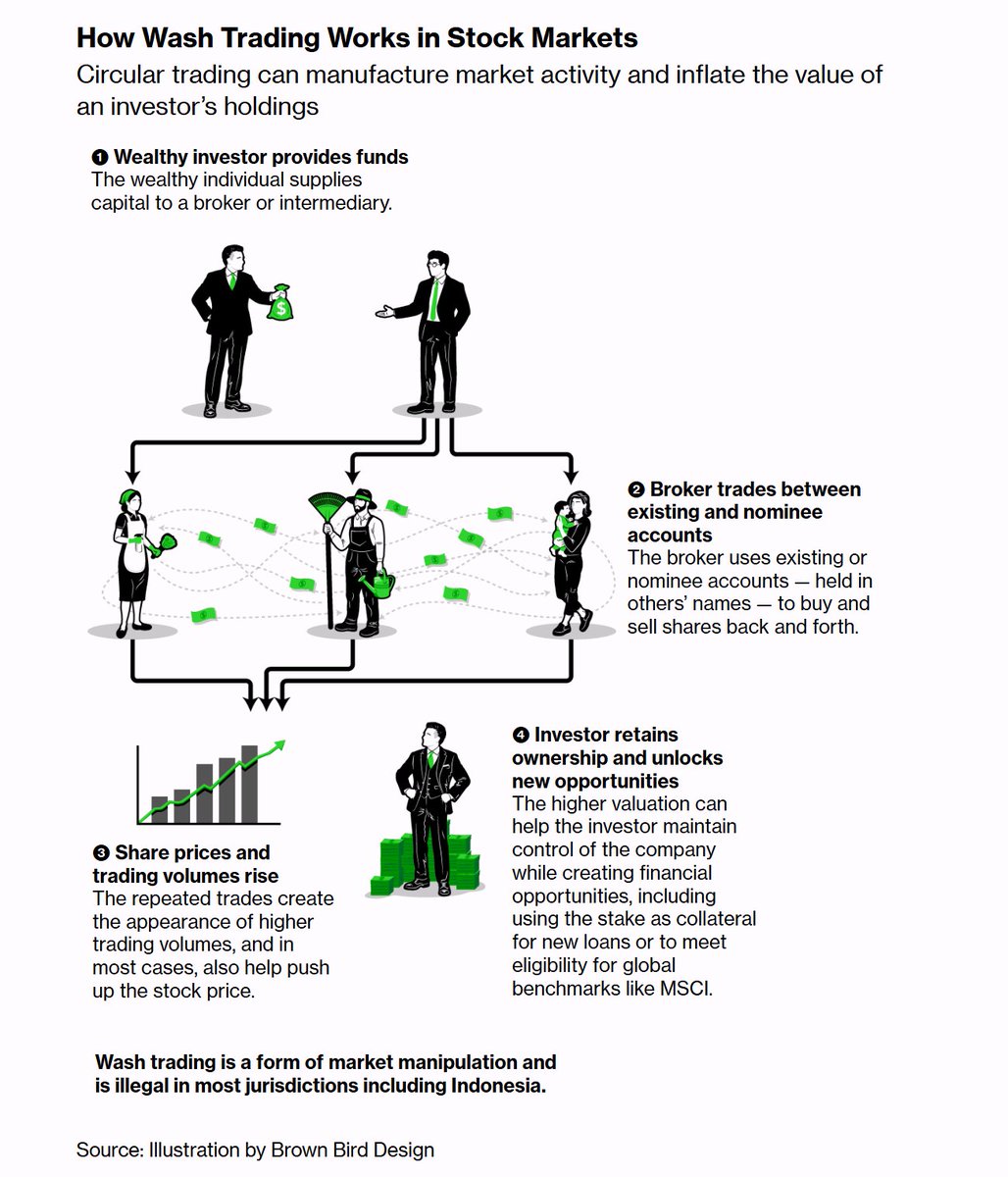
"Wash trading" illustration as published on Bloomberg, explaining what happened in #Indonesia.
Well, it's essentially a pump-and-dump scheme. Apparently a complete surprise to regulators in certain markets.
Ini yang bikin MSCI ngamuk ke Indonesia? 📉
2020–2025:
📈 IHSG +37% (rupiah)
📉 MSCI Indonesia −27% (saham pilihan asing, US$)
Sejak akhir 2019 sampai sekarang:
🌏 Pasar berkembang (MSCI EM) +53%
🇮🇩 MSCI Indonesia −58%
Kok bisa beda jauh?
IHSG berisi semua saham dan dibobot kapitalisasi, jadi saham raksasa yang beredar sedikit tetap berbobot besar. MSCI hanya menghitung saham yang benar-benar beredar dan layak dibeli asing.
Kronologinya:
▪️ 2020: pandemi, IHSG ke 3.937
▪️ 2022: rezeki batu bara, satu-satunya masa Indonesia unggul
▪️ 2023: IPO konglomerat, hanya 3% saham dilepas
▪️ 2024: IHSG −2,7%, MSCI Indonesia −16%
▪️ 2025: IHSG rekor 8.710, tapi asing jual Rp17 T
▪️ Jan 2026: MSCI bekukan bobot, trading halt, pimpinan BEI & OJK mundur
▪️ Okt 2026: usulan status standalone, IHSG −11,57%
Rekor IHSG sempat menutupi kenyataan. MSCI hanya membuka apa yang sudah terlihat di data.
Menurutmu, MSCI terlalu keras atau memang sudah waktunya? 👇
Investasi, lihat datanya, bukan katanya.
Sumber: factsheet MSCI (price return US$, per 30 Sep 2026), BEI, Reuters, ACGA. Sebagian selisih IHSG vs MSCI berasal dari pelemahan rupiah. Bukan rekomendasi beli/jual.
#MSCI #IHSG #SahamIndonesia #PasarModal #InvestasiSaham
BREAKING 🚨: Indonesia
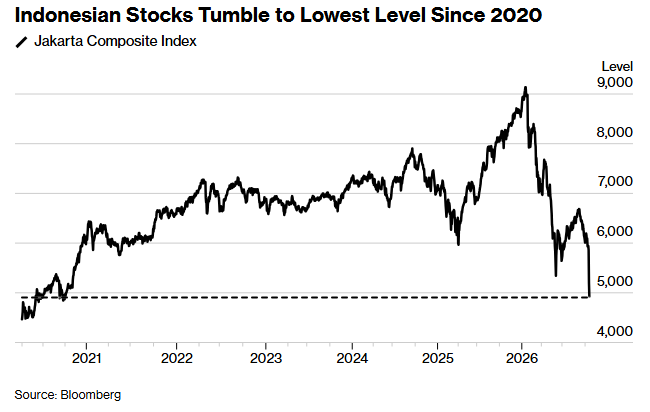
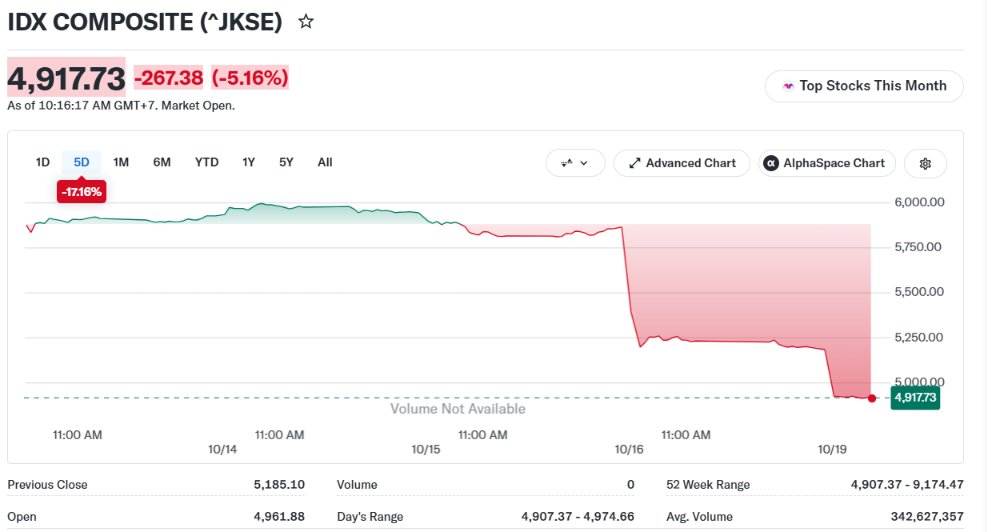
Indonesian Stock Market plunges to lowest level since 2020 after MSCI said it's considering a 2-step downgrade from Emerging Market to Standalone 😱 👀
Indonesian market continue its free fall today down 5%.
The main reasons are:
1. Potential forced selling
Goldman Sachs estimates a downgrade could trigger around US$5.6 billion in passive fund outflows. UBS estimates around US$4 billion in passive outflows, with potentially additional active-fund selling.
2. Market governance concerns
MSCI cited opaque shareholding structures, concentrated ownership and suspected coordinated trading. Investors are questioning whether reforms are sufficient.
3. Foreign investors are already exiting
Foreign investors have sold billions of dollars of Indonesian equities in 2026.
4. Currency weakness
The rupiah has weakened towards 18,040 per US dollar, increasing the losses of foreign investors when converting holdings back into dollars.
What's going on in Indonesia re MSCI? The simple summary is this:
Locals cornered and wash traded a bunch of stocks up, artificially boosting market cap & liquidity with the goal of achieving index inclusion & unloading into passive buying. In other words, they tried to game MSCI.
This went on for years and was succeeding, but it eventually reached utterly egregious levels where almost half the market cap was "saham gorengan" (deep fried shares), and some of the said stocks were trading at P/E ratios of 500x. Retail investors also jumped in, as did local institutions who feared underperforming the local market cap weighted index (JCI).
The market distortions eventually became so blatantly obvious that even blundering MSCI eventually realized they were being gamed, but their blunt processes were not equipped to differentiate between "real" and "fake" prices (pro tip MSCI, real stocks trade at 5-10x PEs and fake ones >100x).
MSCI decided if their systems can't differentiate between the two, the easiest and most bureaucratic option was to just boot Indonesia out of the indices.
The lack of appropriate domestic market supervision & safeguards against market manipulation can be criticized. However, OJK (the local regulator) has already been taking action. The prices of many saham gorengan have already fallen 80% since MSCI announced earlier this year it was freezing new inclusions and considering downgrading Indonesia to FM (frontier). However, manipulation is not always that easy to clamp down on, some of the activity has moved to offshore vehicles, Indo retail and local benchmark hugging institutions also participated, and, it must be said, some of the players are politically connected, putting OJK in a difficult position. But they have been moving in the right direction & progress has been made.
That is what makes MSCI's most recent escalation of threatening to kick Indonesia not just out of EM into FM, but excluding it from FM as well, a little puzzling and draconian. MSCI's behaviour is in a way not that surprising though, as like rating agencies, it is bureaucratic and usually behind the curve. They kicked Nigeria out of the frontier index for instance after years of currency convertibility problems (during which it should have been excluded), but they did so right at the point when a new government had been elected and had just floated the currency.
My take is that while Indonesian conduct bears a meaningful portion of the blame, so does MSCI/passive. With passive growing to become such a large force in financial markets, it was only a matter of time before it was gamed, and what we are also seeing here is some of the stuctural problems/limitations of passive investing. Passive works best when its a small part of the market that can free ride reasonably efficient markets driven by active investors. However, when passive grows to become sufficiently large it can become distortionary, and capable of driving major market inefficiency and being gamed/arbbed.
Recent developments potentially provide a substantial buying opportunity for long term benchmark unaware investors, though it will require a long term focus and volatility tolerance to benefit from. Exclusion from major indices will structurally raise the Indonesian cost of equity and result in a potentially durable valuation discount. Long term investors can benefit from that in the form of higher returns priced into stocks, but that doesn't mean a fast (or even any) recovery in valuations will necessarily occur (though it could). There is still 8mths until MSCI's final decision so the market may be oversold short term (active might not dump until its actually excluded from indices), but there could also be a wall of forced selling coming mid next year.
Indonesia has other problems to be sure (governance under Prabowo), but that is not the proximate cause of the recent sell-off - it is purely fears of downgrade triggering passive and offshore active outflows (if Indonesia is small, off benchmark, and not a good news story, many active instos won't bother with it), and investors are thus front running those anticipated outflows.
I for one am a buyer.
REA steals their CODE. This f*cking prompt steals their EDGE.
paste it into Claude Code and it turns your laptop into a JANE STREET-style quant desk.
You might actually get RICH, because it won’t let you go BROKE first.
Bookmark before it’s buried.
BREAKING: HSBC’s ‘sharia‑compliant’ fund reportedly spent over $100 million on 5 Israeli military‑linked firms.
Most British halal pension funds are invested in HSBC’s Islamic Global Equity Index Fund, which also purchased $38 million worth of Palantir shares.
Dari chart JP Morgan ini kita bisa liat kalau empat indeks saham regional utama dunia sama2 punya saham semikonduktor di daftar 10 terbesarnya.
Yang paling ekstrem emerging market.
TSMC sendirian bobotnya sekitar 15% di indeks MSCI EM, atau sekitar 13x bobot IHSG.
Kalau ditambah Samsung dan SK Hynix, tiga perusahaan chip ini sudah sekitar 30% bobot MSCI EM.
Jadi kalau beli reksa dana atau ETF emerging market untuk diversifikasi dari US, hampir sepertiga uangnya tetap masuk ke perusahaan semikonduktor.
Polanya sama di wilayah lain. Top 10 Jepang ada Tokyo Electron, Advantest dan Kioxia. Saham terbesar di Eropa adalah ASML, pembuat mesin chip.
Diversifikasi antar negara penting, tapi sekarang perlu dicek juga apakah portofolionya betul2 terdiversifikasi dari risiko industri.