Two trends are converging in decentralization tech.
- Proof of Work chains want to do *useful* work on AI computations, namely inference.
- Decentralized AI inference is hard to make cheaper, except for merge mining cryptocurrency.
Bookmark this tweet.
We used to worry that AI models would run out of data. It is now very clear that there is an infinite amount of data for AI — namely, the data that agents generate as they traverse the world.
This data cannot be scraped, cannot be bought. It must be painstakingly collected by running agents and then aggregating the results in some coordinated place.
The battle between centralized and decentralized AI training is now not about compute. It’s very clear we can aggregate a lot of compute in decentralized swarms and now clear that we can train models.
The battle is really about agent data. Can agentic harnesses like @openclaw and Hermes Agent coordinate all the personal agentic data into a decentralized TRAINING process that can compete with @AnthropicAI?
This, singlehandedly, is why I'm still bullish on crypto.
If you don't believe me, listen to Marc Andreessen (founder of a16z - the world's biggest VC).
Crypto x AI is going to be HUGE - and one of the best product-market fits we've ever seen.
"This is the grand unification of AI and crypto. AI agents are going to need money."
This is the future.
Linus Torvalds created Linux at 21 without Claude or any other AI.
- He didn't have a co-founder.
- No VC funding. No office.
- No team.
- Just a personal project
he posted to a mailing list:
"I'm doing a free OS."
33 years later,
it runs 97% of the world's servers, all smartphones, and the International Space Station.
The most important software in history started as someone's side project.
Absolute legend.
My information consumption is now 1/4 X, 1/4 podcast interviews of the smartest practitioners, 1/4 talking to the leading AI models, and 1/4 reading old books. The opportunity cost of anything else is far too high, and rising daily.
Good read, as always, from @DeanEigenmann.
A law of the universe is that most people are not activists; so cypherpunk at scale must negotiate with that fact.
The optimistic view is that this technology should be ubiquitous before its true properties can be unleashed, and this moment in time is the necessary step for such ubiquity.
We often make the mistake of looking for linear growth in a cyclical world. But nature never has and never will move in a straight line and neither does a technological or monetary revolution.
Just as every living organism must survive stress to evolve, Bitcoin goes through necessary cycles of expansion and contraction.
Price is what you pay, value is what you get.
We need to ignore short-term price action and focus on long-term value. We are watching a new asset class evolve in real-time into finance’s biggest use case: capital preservation.
#bitcoin
Co-founder of @AnthropicAI@jackclarkSF writes about how decentralized AI training could disrupt model training economics and that he expects to see 70-100B parameter models by the end of the year.
https://t.co/S4iRiyH6F5
𝗖𝗿𝘆𝗽𝘁𝗼 𝗶𝘀 𝗮𝗯𝗼𝘂𝘁 𝗯𝘂𝗶𝗹𝗱𝗶𝗻𝗴 𝗻𝗲𝘄, 𝗶𝗿𝗿𝗲𝘃𝗲𝗿𝘀𝗶𝗯𝗹𝗲 𝗰𝗼𝗿𝗲 𝗶𝗻𝗳𝗿𝗮𝘀𝘁𝗿𝘂𝗰𝘁𝘂𝗿𝗲 𝗳𝗼𝗿 𝗰𝗶𝘃𝗶𝗹𝗶𝘇𝗮𝘁𝗶𝗼𝗻.
So far, we’ve seen 𝘁𝘄𝗼 𝗽𝗶𝗹𝗹𝗮𝗿𝘀 𝗳𝘂𝗹𝗹𝘆 𝗲𝗺𝗲𝗿𝗴𝗲:
1️⃣ 𝗗𝗲𝗰𝗲𝗻𝘁𝗿𝗮𝗹𝗶𝘇𝗲𝗱 𝗠𝗼𝗻𝗲𝘆 → 𝗕𝗶𝘁𝗰𝗼𝗶𝗻
A credibly neutral monetary system: scarce, permissionless, and non-sovereign.
2️⃣ 𝗗𝗲𝗰𝗲𝗻𝘁𝗿𝗮𝗹𝗶𝘇𝗲𝗱 𝗖𝗼𝗺𝗽𝘂𝘁𝗲 → 𝗘𝘁𝗵𝗲𝗿𝗲𝘂𝗺
A neutral execution layer enabling programmable coordination without centralized intermediaries.
Now, a third pillar is forming:
3️⃣ 𝗗𝗲𝗰𝗲𝗻𝘁𝗿𝗮𝗹𝗶𝘇𝗲𝗱 𝗜𝗻𝘁𝗲𝗹𝗹𝗶𝗴𝗲𝗻𝗰𝗲 → 𝗕𝗶𝘁𝘁𝗲𝗻𝘀𝗼𝗿
AI is rapidly becoming the most important resource of the 21st century.
Yet today, intelligence is:
• centralized
• closed-source
• controlled by a few corporations
Bittensor flips this model entirely.
It creates open markets for intelligence, where:
• anyone can contribute models
• intelligence competes on merit
• rewards flow to what is actually useful
• no single entity controls the system
𝗧𝗵𝗶𝘀 𝗶𝘀 𝗮𝗯𝗼𝘂𝘁 𝘁𝗵𝗲 𝘀𝗲𝗽𝗮𝗿𝗮𝘁𝗶𝗼𝗻 𝗼𝗳 𝗶𝗻𝘁𝗲𝗹𝗹𝗶𝗴𝗲𝗻𝗰𝗲 𝗳𝗿𝗼𝗺 𝗰𝗲𝗻𝘁𝗿𝗮𝗹𝗶𝘇𝗲𝗱 𝗽𝗼𝘄𝗲𝗿.
If Bitcoin decentralized money,
and Ethereum decentralized compute,
then Bittensor is doing the same for intelligence.
Three layers.
One direction.
Power moving away from institutions and toward open networks.
#bitcoin #bittensor #ai #Decentralization
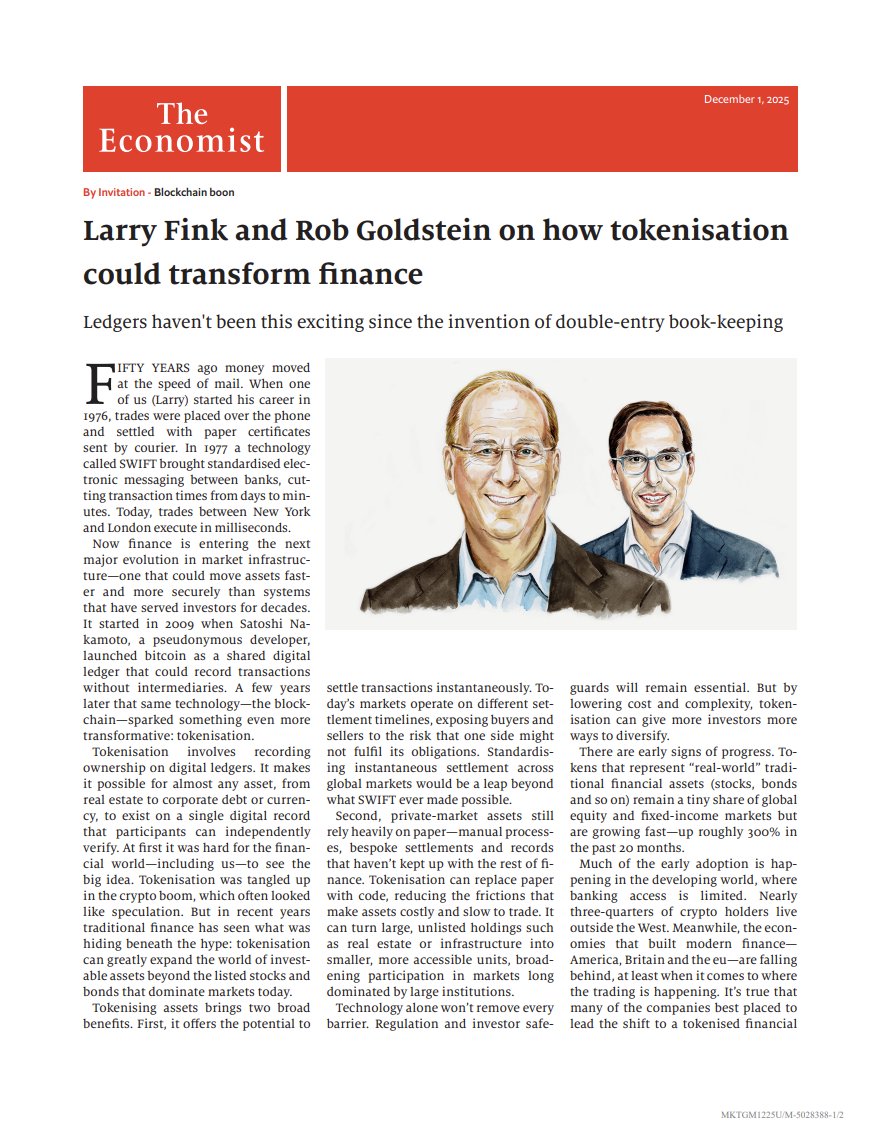
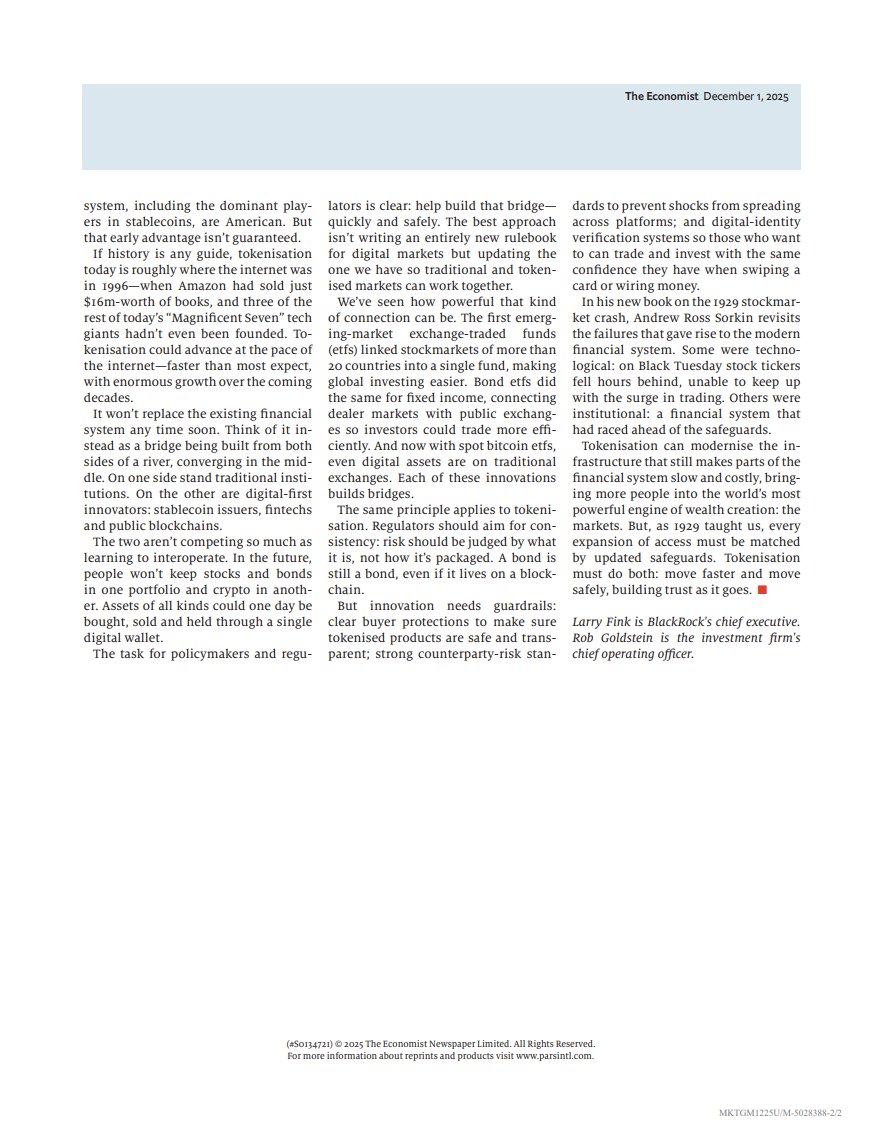
Tokenization is shaping the next evolution of global markets. In @TheEconomist, Larry Fink and Rob Goldstein discuss how tokenization can modernize market infrastructure, enhancing efficiency, transparency, and access by connecting traditional and digital finance. Read more: