The top 3 biggest mistakes people make with Google Ads:
1. Writing copy so generic it blends in with every other ad.
2. Not calling out what makes the product or offer different.
3. Failing to grab attention in the first second.
Here’s how to fix them:
Write specific, punchy copy that sounds like you and your customer.
Ask, “What makes this offer different?” and lead with that in the first line.
Make sure your ad stops the scroll with a strong visual and a clear headline.
These three mistakes kill your ROI. But they’re dead simple to fix.
A prospect asked me to guarantee 10x ROAS in 60 days. £3k/month budget.
I said no. He hired someone who said yes.
Three months later he was back in my inbox. Account in ruins.
Nobody honest can promise a number. Anybody dishonest will promise any number.
The signal is when the pitch gets boring.
Audited a £9k/month UK brand last week. UK-only shipping. 33% of clicks were from the US.
Default location setting: "Presence or interest". Means Google serves your ad globally to anyone vaguely related to your audience.
One toggle fix. CPA dropped 28% the next week.
The dumbest setting breaks the longest.
Negative keyword lists are the most boring and most valuable thing in a Google Ads account.
Ten minutes a week in the Search Terms report. £76 of waste killed this week on a £20k/mo account. £4k a year saved.
The habit nobody keeps is the one that compounds.
Before I've had coffee on Monday morning, I know every client account that moved over the weekend.
23 accounts scanned overnight. 4 flags. 2 red. 90 seconds to read the feed.
Monday used to be triage. Now it's decisions. Same hours, different output.
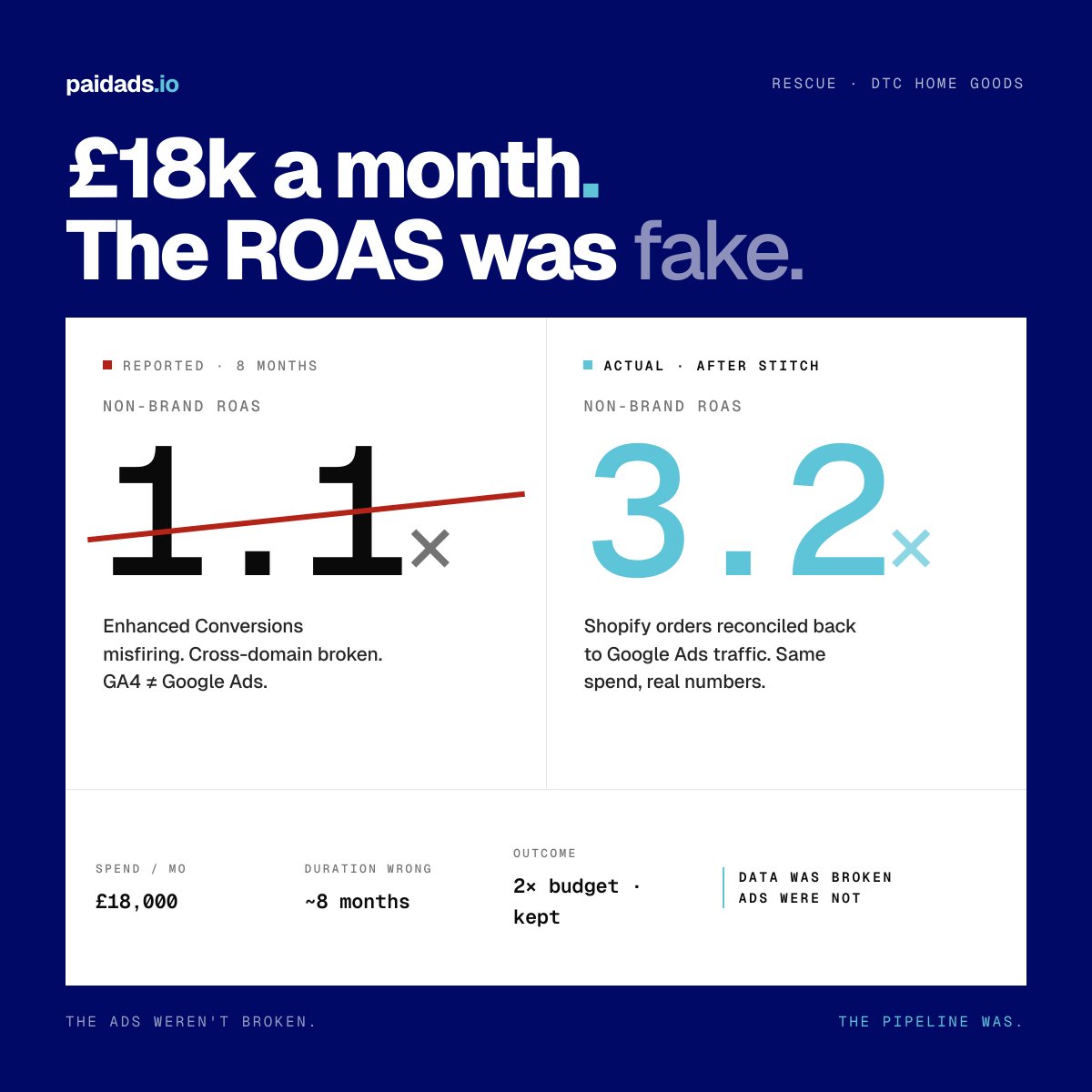
Took over a DTC account last quarter. £18k/month, reported ROAS 1.1x, owner about to switch off Google entirely.
Opened the tracking. Enhanced Conversions had been misfiring for eight months. Cross-domain broken. GA4 and Google Ads counting different things.
Stitched Shopify back to the ads. Real non-brand ROAS: 3.2x.
The ads weren't broken. The pipeline was.
Your agency's monthly report is hiding four things. All matter.
1. Cost per new customer, not blended CPA.
2. The change log, line by line.
3. Wasted spend percentage.
4. PMax placement breakdown.
If the answer to any of them is "let me check", you already know the answer.
Opened five Google Ads accounts this week for new audits.
01: 62% of PMax spend on the 3 lowest-margin SKUs.
02: £1,100/mo bidding on own brand name against zero competitors.
03: Conversion event firing twice. ROAS inflated 45% for 7 months.
04: Broad match, zero negatives. Search terms full of non-buyers.
05: 38% of feed disapproved. Nobody logged in for 4 months.
Every one costing real money. Nobody was looking. That's the pattern.
Your Google Ads account has a Shopping feed quietly lighting money on fire.
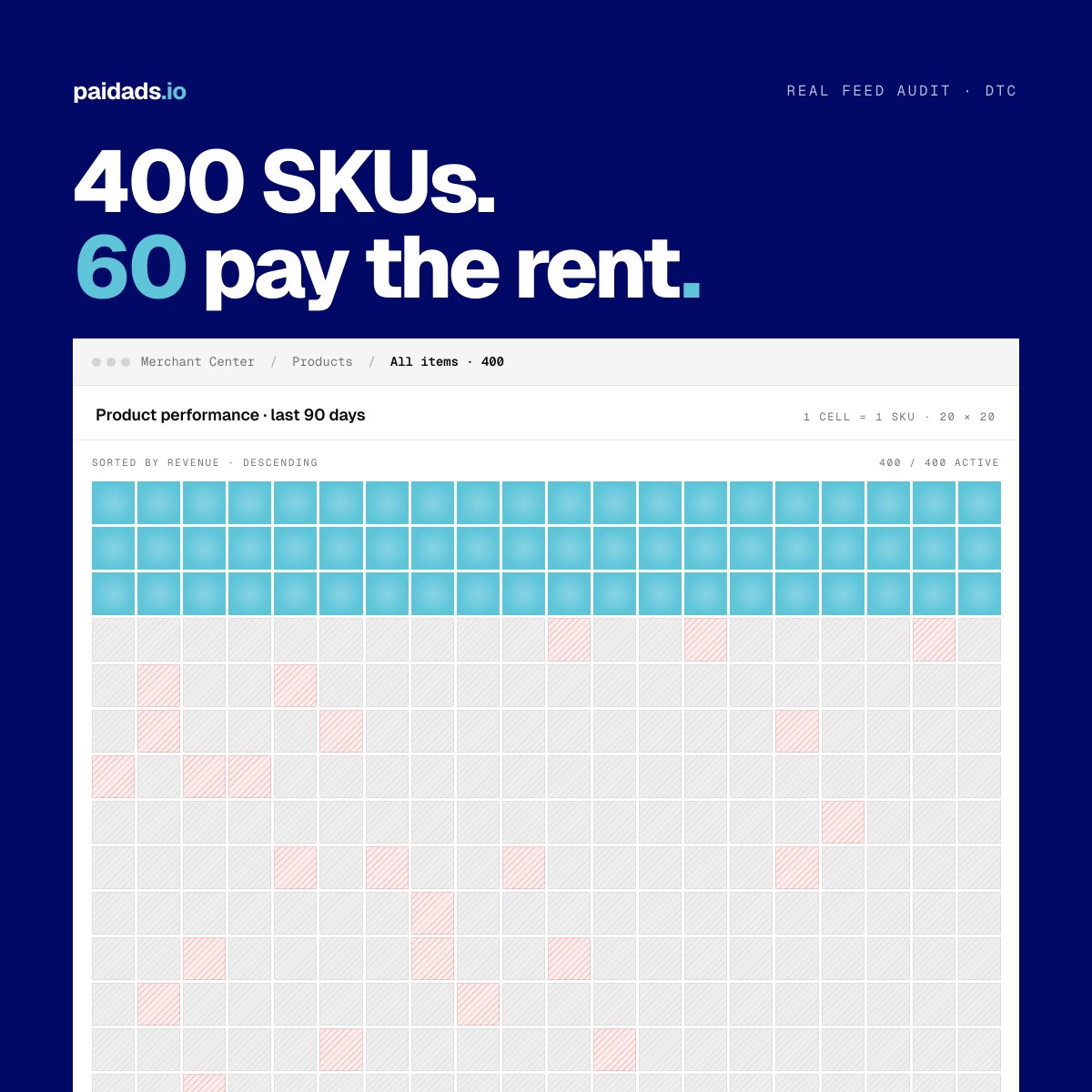
400 active products. 60 have had a sale in the last 90 days. The other 340 just eat spend.
The feed is the single highest-leverage thing in a Shopping account. It's also the thing almost nobody touches.
Spent the day climbing cringe mountain.
Full studio setup. Green screen. Three-person crew. Lights on my face while I try to remember how to form sentences like a human.
A long way from comfortable in front of a camera. But if I'm not on camera I'm not reaching the people I want to work with.
So. Here we go.
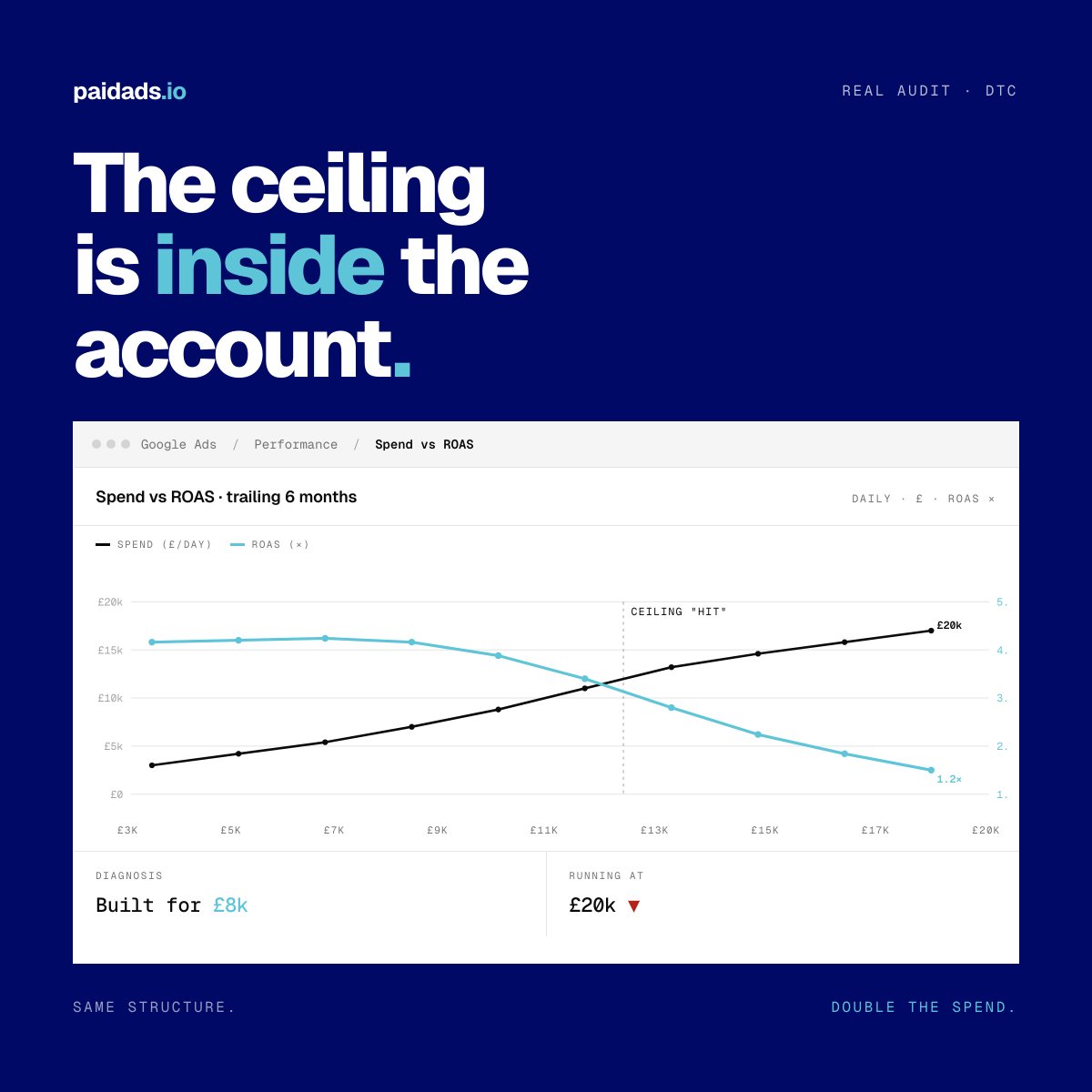
Most DTC brands I audit think they've hit a Google Ads ceiling. They haven't. The account has.
Spend doubles, the structure doesn't. ROAS crumbles. They blame the market and pull back to £10k forever.
It was never the market. The ceiling is inside the account, not outside it.
Audited a £20k/month Google Ads account. Change history: empty. Six months of spend, zero logged changes.
Different account same week: 47 changes, no notes, nobody could say what they'd done.
Both tanking. Both blamed Google.
Google was fine. Nobody was watching.
Tools > Change History.
All my clients are on the other side of the world from me. The time zone gap is my biggest operational advantage.
My morning is their night. No Slack, no fires to put out. Hours of uninterrupted deep work on accounts.
By the time London wakes up, the hard thinking is done. Their day is my calls and decisions.
Most agency owners are reactive from 9am. Slack eats their first two hours.
The edge isn't the time zone. It's being forced to do the real work before anyone can interrupt.
Client said their CPA target was £35. Google Ads said they were at £58. Everyone panicked.
Pulled GA4, Shopify, and bank deposits. Real CPA was £36.
Enhanced conversions misfiring. 5-7 day conv lag on a long consideration product.
The ads were fine. The tracking was lying.
Stop pasting that 40,000-line placement exclusion list into every Google Ads account.
The old excuse was time. Nobody had hours to sift 40k placements per client.
That excuse is gone.
I feed the full list into Claude with the client's business, audience, products, and goals. Out comes a custom exclusion list built for that one account in minutes.
One client, one list. If your agency is still copy pasting the same 40k blanket list in 2026, they're charging you for 5 minutes of work and giving you 2019 output.
I run a Google Ads agency for DTC brands from a small town in Thailand.
A team of 3 including me. Dozens of clients. And a system that actually works.
Here's what my morning looks like:
5:30am. Coffee. Open up my anomaly alerts before I even touch an account.
I built an AI system that scans every single client account overnight. Spend spikes, conversion drops, ROAS dips, broken tracking. If something's off, I know about it before the client wakes up.
Most mornings? 3-4 flags across all accounts. Takes me 20 minutes to triage and fix.
By 7am I'm into deep work. Campaign builds, restructures, feed optimisation. The stuff that actually moves the needle.
By midday the heavy lifting is done.
Afternoons are calls, client updates, team syncs.
Here's the thing nobody talks about in this industry.
You don't need 50 employees to run a proper agency. You need good systems, relentless focus, and the discipline to not overcomplicate things.
I've seen agencies with 30 staff deliver worse results than what a small, focused team with better processes can do.
Bigger is not better. Sharper is better.
Anyone else running a lean operation and loving it? Curious how others structure their day.
Lots of ecom brands I audit are running Performance Max the same way.
One campaign. No structure. No exclusions. Just a budget and a prayer.
Here's the problem with that.
PMax is a black box. Google decides where your ads show. Search, Shopping, Display, YouTube, Gmail, Discover. You have zero control over the split.
Without structure, Google will spend your money wherever it's cheapest. Which usually means Display and Discover. Low intent. Low conversion. High volume of meaningless clicks.
I've seen PMax accounts where 70% of spend was going to Display placements the client had never even seen.
Here's how we set up PMax properly.
Segment your asset groups by product category. Don't throw everything into one group. Google needs clear signals about what to show and to whom.
Add audience signals. Your customer lists, your website visitors, your in-market audiences. PMax works better when you give it a starting point.
Exclude your brand terms. If you're running a separate brand campaign (which you should be), you don't want PMax cannibalising those clicks at a higher cost.
Check your placements report weekly. If you see spend going to random apps and games, you know PMax is off the rails.
PMax can work. But only when you treat it like a campaign that needs management, not a magic button.
How are you running yours?
"We never bothered with Google. Meta works for us."
I hear this from DTC brands all the time. And they're not wrong. Meta does work.
But here's what they're missing.
Meta creates demand. Someone scrolling Instagram sees your ad, thinks "that looks cool" and maybe clicks. Maybe doesn't. Either way, you've planted a seed.
Google captures demand. That same person, two days later, types your product into Google. Or your brand name. Or "best [your category]." They're actively looking to buy.
If you're not there when they search, someone else is. And you just paid Meta to create a customer for your competitor.
I see this constantly. Brands spending 30k, 50k, 100k a month on Meta. Getting great results. But they have zero presence on Google.
They're paying to fill a bucket with a hole in the bottom.
The fix isn't complicated. You don't need to move budget away from Meta. You need a Google Ads strategy that catches the demand Meta creates.
Branded search. Shopping ads. A proper feed. That's it to start.
One of our clients was spending everything on Meta. We added Google alongside it. Within 3 months their overall CAC dropped by 35% because they stopped losing customers at the point of purchase.
Meta and Google aren't competitors. They're two engines on the same plane.
If you're only running one, you're flying in circles.
I've audited more Google Ads accounts than I can count this year.
The same 3 problems show up almost every single time.
1. Blended ROAS reporting.
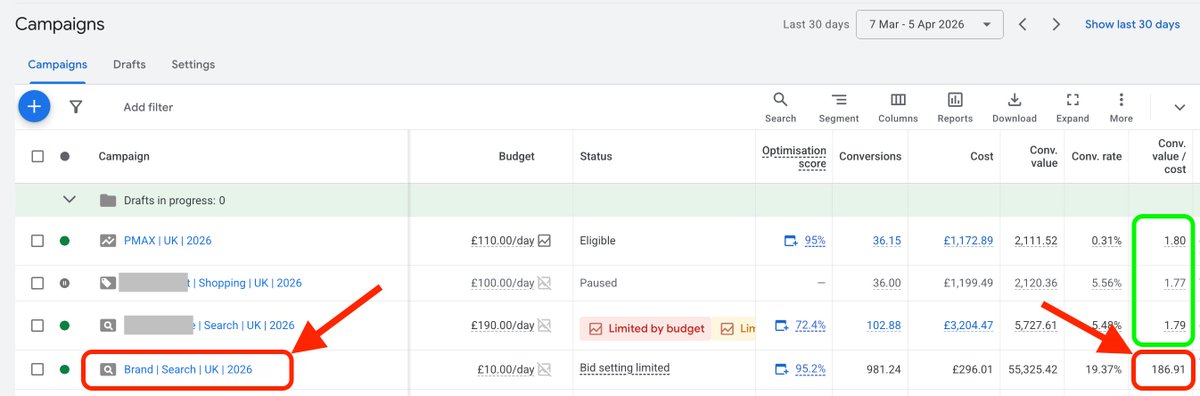
Your agency tells you ROAS is 8x. Sounds great. But 60% of that revenue is coming from people who searched your brand name. They were going to buy anyway.
Strip out branded traffic and suddenly that 8x is a 2.5x. That's your real acquisition performance. That's the number that matters.
If your agency can't show you non-brand ROAS separately, that should worry you.
2. Broken conversion tracking.
Duplicate conversion actions. GA4 imports firing alongside Google Ads tags. Old goals nobody turned off. I've seen accounts counting the same sale 3 times.
If your data is wrong, every decision you make off the back of it is wrong too.
This is the first thing I fix in every account. Always.
3. Performance Max running blind.
PMax is not a set-and-forget campaign. It needs clean product feeds, proper audience signals, and someone actually watching what it's doing.
Most accounts I audit have PMax running with zero structure. No asset groups segmented. No exclusions. Just money going in and Google deciding where it goes.
That's not a strategy. That's a hope.
If any of this sounds familiar, it might be time to get a second opinion on your account.
Audited a £15k/month Google Ads account this week.
Brand and non-brand mixed together. Reported 6x ROAS. Actual non-brand: 1.2x.
Shopping feed: 400 products active, only 60 with a sale in 90 days. Rest just burning budget.
PMax with no exclusions. 20-30% spend on irrelevant queries.
None of these are hard fixes. All of them are expensive to ignore.
Meta converts at 1-3%. Google Search converts at 5-12%.
Same product. Same landing page.
The difference: Meta interrupts people who weren't looking. Google captures people who are already searching.
Most DTC brands spend £20-30k on Meta creating demand, then leave Google wide open for competitors to capture it.
If you're not running both, you're generating demand for someone else.