New paper!
Molecules in lake sediments provide new information about past herbivores in Yellowstone
Molecular signatures of dung vary among wild herbivores. Fecal steroids in lake mud show that bison/elk were dominant herbivores for over 2k yr in a small catchment.
link 👇
@RealCalebKitson @RizomaSchool@Empty_America This is really insightful.
There are many types of rotational systems. Some work better than others depending on the setting and objectives.
Regarding trees, many open ecosystems don’t have any and even adding few can dramatically change habitat (certain birds go away).
@RizomaSchool@Empty_America Intermediate disturbance seems more a human preference than a description of historical disturbance patterns. Extreme events and non-events matter for system trajectory and biodiversity.
Some species only occur at the extremes but humans often engineer cozy open woodlands.
@RizomaSchool@Empty_America yeah and carbon from fire tends to be more persistent in soil than leaf litter.
I generally agree but not completely. Since the extinctions, fire mattered more than herbivores for keeping many “potential forests” open.
@RizomaSchool@Empty_America Prescribed burn associations are in some regions. Other places it is more informal.
It reduces standing biomass, limits shrubs and trees, promotes fire-loving species. Regrowth is high quality forage that attracts grazers. Native hunters exploited this for hunts.
@RizomaSchool@Empty_America Fire and water distribution are big. In many parts of North America, reintroducing some fire would have far greater biodiversity impacts than making tweaks to grazing.
Also past herbivore communities were more functionally diverse.
Just published!
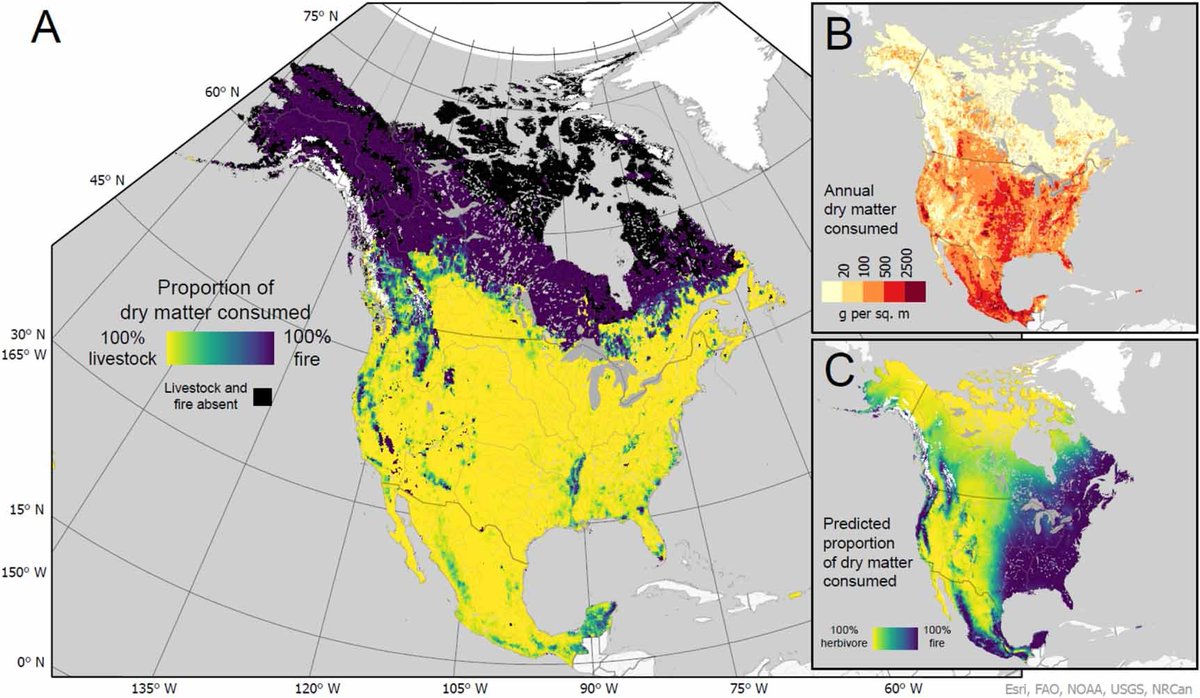
New article on bison, fire, and drivers of vegetation consumption in Holocene North America and today.
Past and present biomass consumption by herbivores and fire across productivity gradients in North America https://t.co/Gf5K60G7Mb via @IOPenvironment
@RizomaSchool@Empty_America We’ve learned a lot about mechanisms and effects. Restoring herbivores has benefits, especially where herbivory was historically common. But there’s a risk of overlooking other important factors by emphasizing grazing management as the main lever.
@RizomaSchool@Empty_America Much of soil carbon comes from root exudates too. Litter matters but it doesn’t persist long unless it is physically and chemically integrated with minerals. And mineral space is limited, leading to diminishing growth in persistent forms of carbon.
@RizomaSchool@Empty_America Even in wetter systems the vast majority of dung, even that which breaks down in place, turns to carbon dioxide and doesn’t persist in the soil. Soil’s capacity to hold carbon in more persistent forms is limited by amount of mineral particles and those spaces fill up.
@RizomaSchool@Empty_America It probably does in small patches temporarily, but in aggregate rainfall matters far more for plant growth and soil microbial activity. It is about the balance of photosynthesis vs respiration and the limited capacity of soil to hold carbon in more persistent forms.
@RizomaSchool@Empty_America but in this system soil carbon is probably insensitive to grazing. 70 years of grazing vs no grazing and no difference in soil c.
@RizomaSchool@Empty_America soil carbon tends to decline beyond moderate stocking rates, regardless of animal density. and positive effects of grazing on plant production and soil organic matter are uncommon, especially in water-limited systems. rainfall is dammed or groundwater is pumped.
@Empty_America@RizomaSchool Unfortunately efforts to increase production often have unintended operational and ecological effects that are difficult to reverse.
No guarantee that the fence will pay for itself
@RizomaSchool@Empty_America I’m not sure about the particular constraints for this producer but broadening spatial scale to hedge against local unpredictability can be adaptive. Rainfall is patchy and bison and pastoralists move around. Here we have the option to bring food to the cows too.
@RizomaSchool@Empty_America Intensification (eg cross-fencing) can be a trap in systems where the challenge is not to maximize production but to persist through resource bottlenecks (eg drought). Heterogeneity preserves adaption options.
@RizomaSchool@Empty_America Different grazing schemes have different effects in different situations. It can turn into a hammer and nail thing where you try to do it all with grazing while overlooking other historically important forms of disturbance like fire.