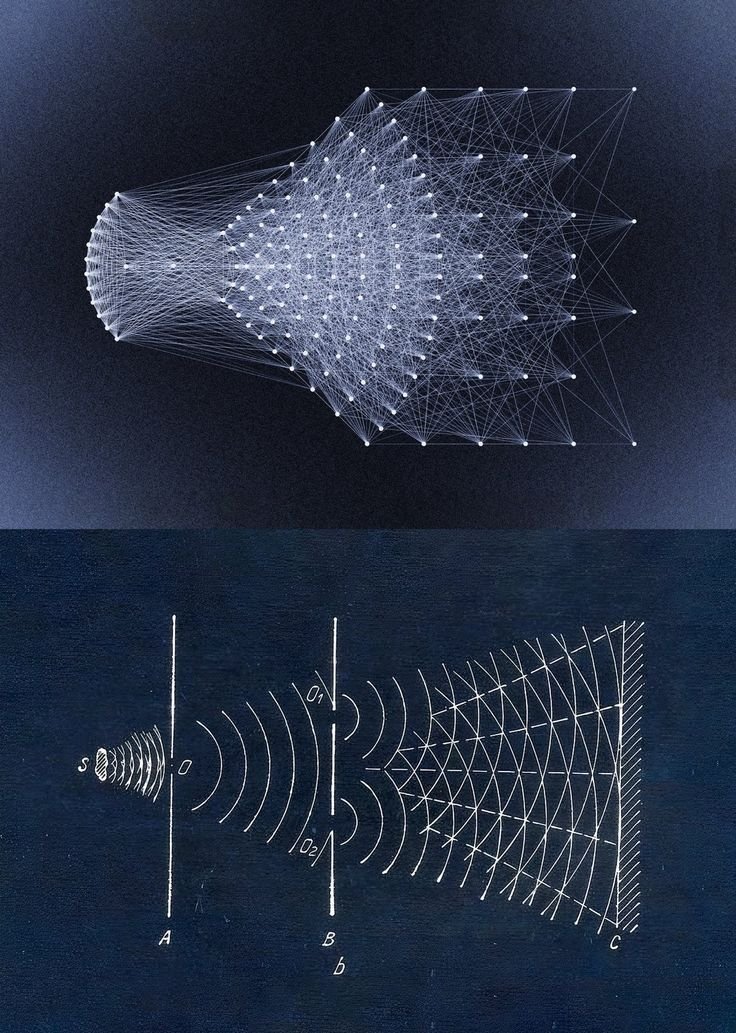
@uncertainsys “Economy” of physics is my own creation has to do with how the inorganic (information) produces collations among the organic… such as in entanglement. Its all very theoretical 😂
The strangest thing about a black hole may be that its information lives on the surface, not inside.
The holographic principle grew from black hole thermodynamics and work by Gerard ’t Hooft and Leonard Susskind in the 1990s. The key clue is that black hole entropy scales with the area of its event horizon:
S = A / (4ℓₚ²)
That is a profound shift in how we picture space. A volume that looks three dimensional may, at the deepest level, be completely described by information encoded on a two dimensional boundary.
The surface may hold the story of everything inside.
@uncertainsys Or is the correlation reflection of the entanglement reflection of something hidden perhaps… or is there an economy of entanglement that can be observed?
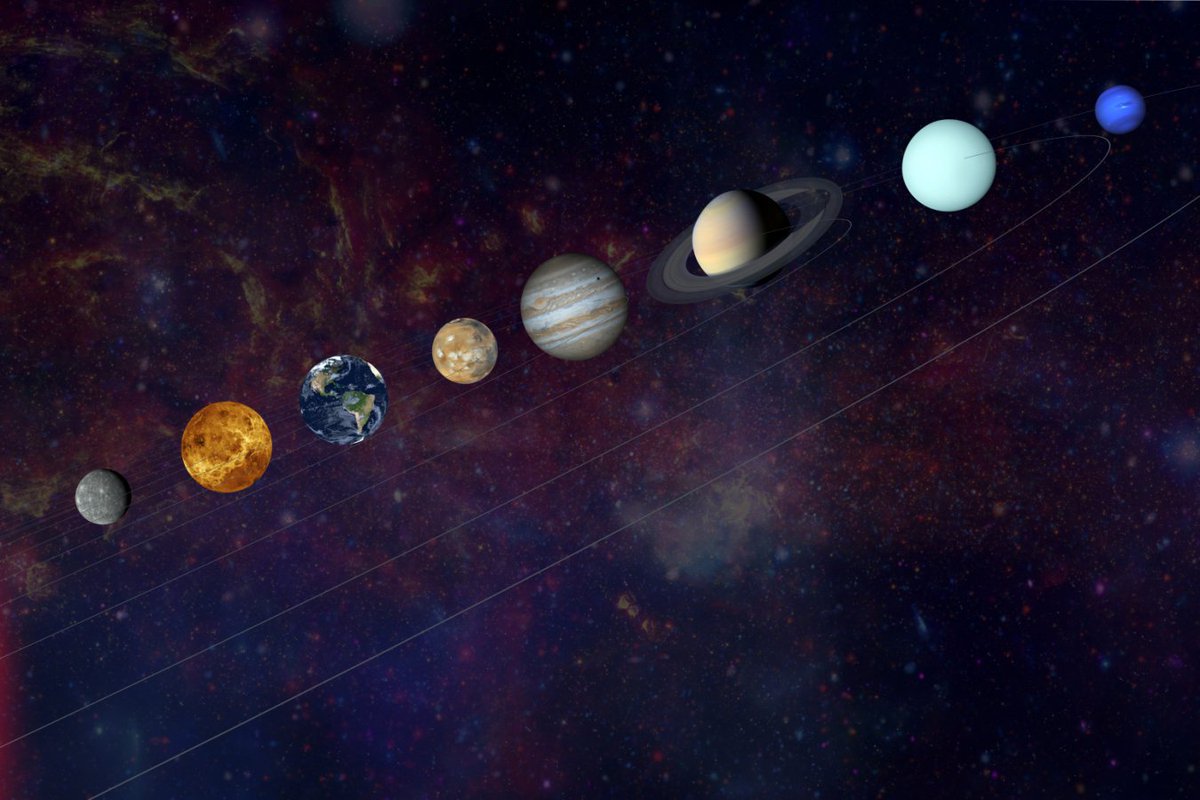
REMINDER🚨: Tonight is a Skywatcher’s dream.
Before sunrise, six planets line the morning sky. Later, an eclipse takes center stage.
After dark, the Perseid meteor shower reaches its peak—with the New Moon providing exceptionally dark skies for viewing.
One extraordinary day. Multiple celestial events. One night you won’t want to miss.
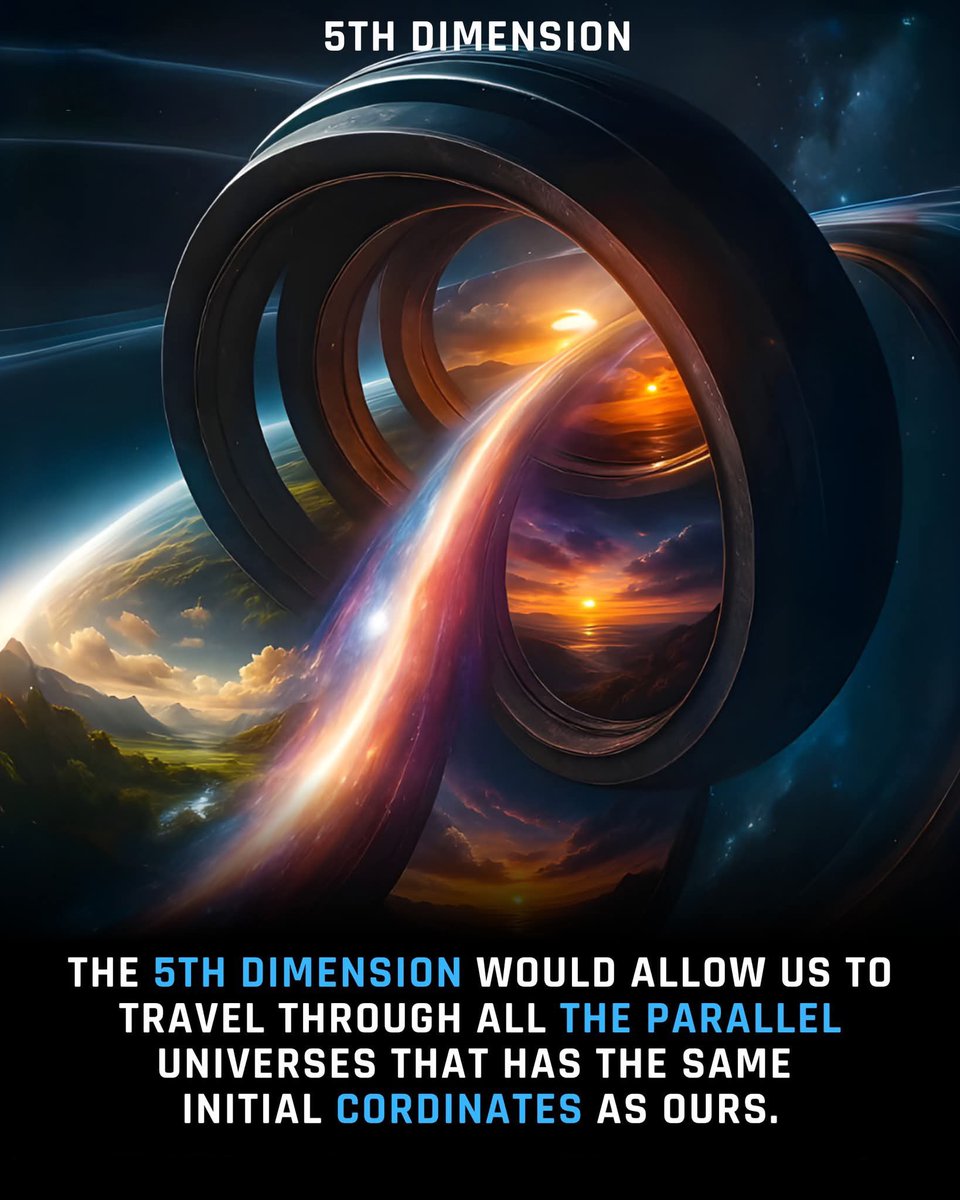
The fifth dimension is one of the most mind-bending ideas in theoretical physics a concept that stretches far beyond our three spatial dimensions and time itself. While we can move forward and backward in time or space, the fifth dimension is imagined as a pathway through parallel realities, connecting worlds that began like ours but evolved differently.
In theory, this dimension could allow movement between alternate timelines universes where each decision, from the smallest to the grandest, creates a ripple that forms a new branch of existence. It suggests that countless versions of reality coexist side by side, shaped by different outcomes of the same initial conditions.
Though purely theoretical, the idea of the fifth dimension continues to inspire scientists, philosophers, and dreamers alike. It reminds us how vast and mysterious our universe truly is, and how every choice might echo across realities unseen.
Sources/Credits: NASA, Scientific American, CERN
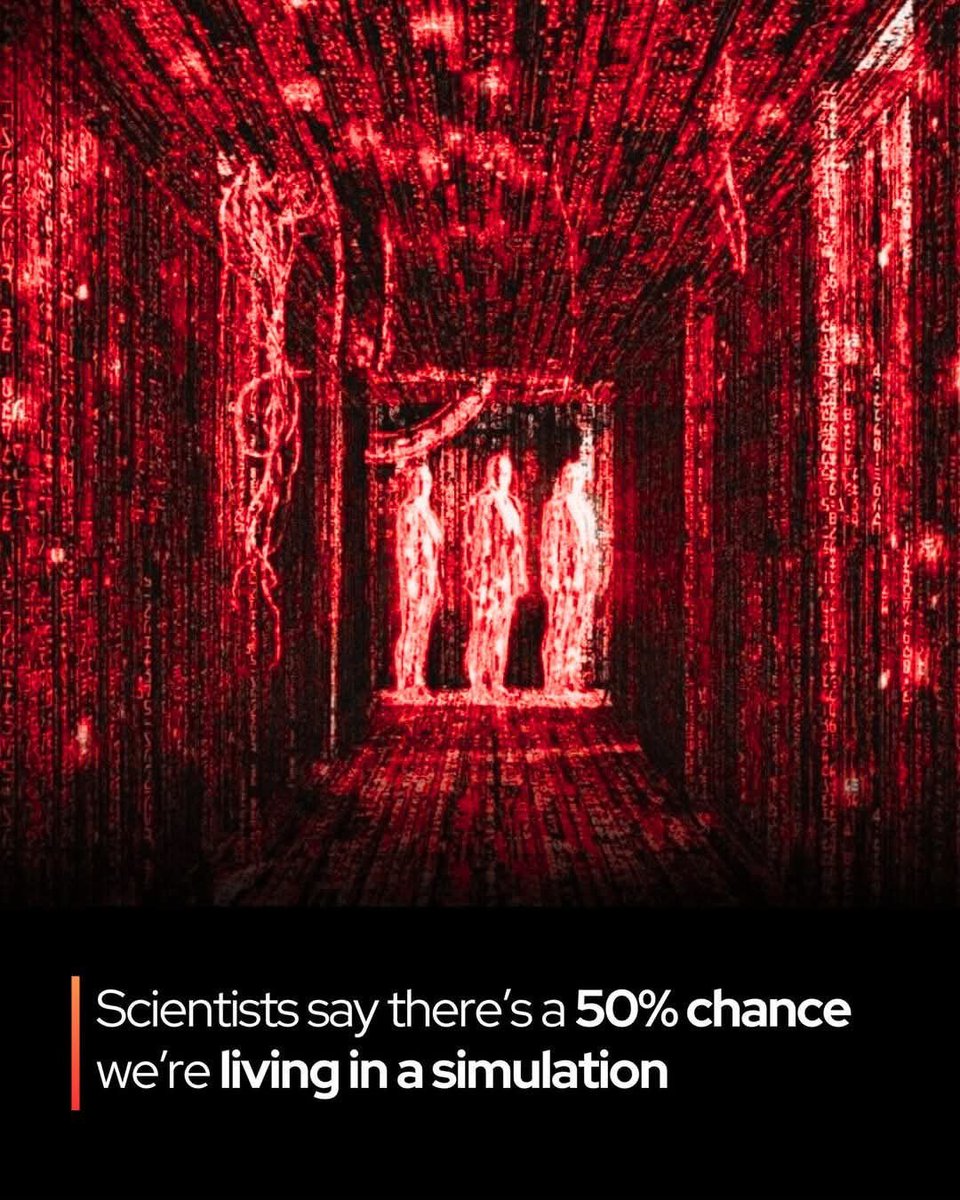
🔴🔵 Columbia Professor Finds There's a 50% Chance We're Living in a Simulation:
Are we living in base reality — or just characters in a hyper-advanced simulation? Scientists are taking this once-sci-fi question seriously.
The simulation hypothesis, first formalized by philosopher Nick Bostrom in 2003, suggests that if any civilization develops the ability to create ultra-realistic simulations of conscious beings — and chooses to run them — then the number of simulated minds would vastly outnumber real ones.
Statistically, that would mean we’re likely simulations too. Only three possibilities exist, Bostrom argued: civilizations go extinct before creating such tech, they choose not to simulate their ancestors, or we’re almost certainly inside a simulation already.
Columbia University astronomer David Kipping put numbers to the theory using Bayesian analysis, starting from a 50/50 position of uncertainty.
His conclusion?
There's a 49.8% chance we’re in a simulation, and only a 50.2% chance we’re in base reality — a near coin toss. While nested simulations would likely degrade over generations due to limited computing resources, that only slightly favors the idea we're “real.” As quantum computing and physics advance, we may one day detect signs of an artificial framework—glitches, anomalies, or mathematical fingerprints that reveal the truth. Until then, we live suspended between two almost-equal realities… and we might never know which one is real.
source
Scientific American. "Do We Live in a Simulation? Chances Are about 50–50"
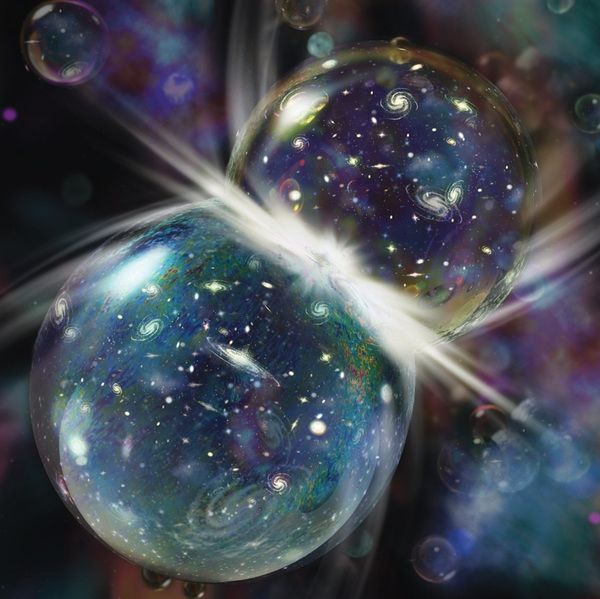
🚨: Big Bang wasn't an explosion from a point. It was fiery collision between our universe and another parallel universe in a higher dimension, new study reveals.
FACT🚨: Humans perceive light at 430–790 THz and sound at 20 Hz–20 kHz, just a tiny slice of the full spectrum, meaning much of what exists is entirely invisible to us.
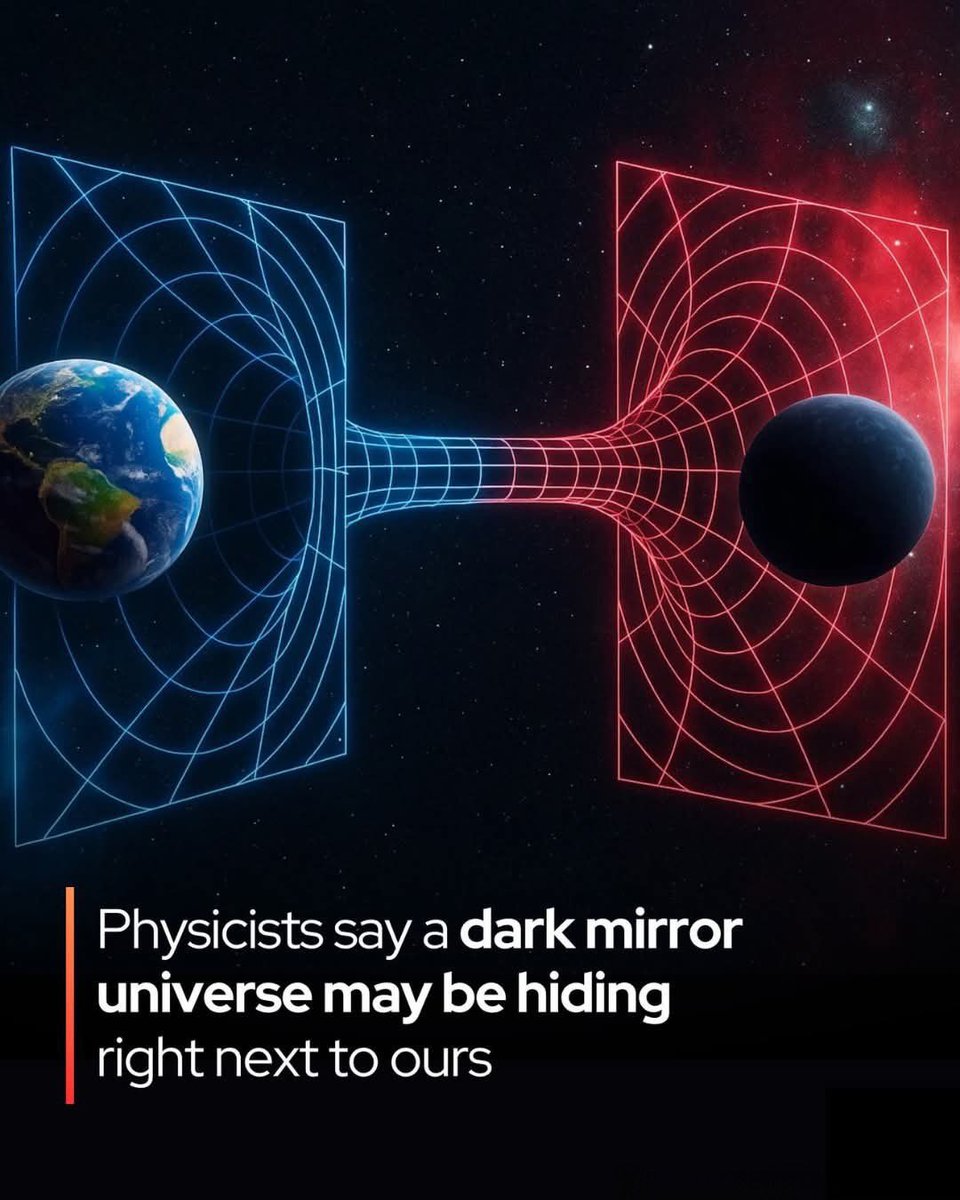
Scientists say dark matter may not be in our universe — but in a hidden one right next door.
For decades, scientists have hunted for dark matter—the invisible substance that makes up about 27% of the universe and keeps galaxies from flying apart.
Yet despite countless experiments, not a single dark matter particle has been directly detected.
Now, a bold new theory suggests the reason may be simple: we’ve been looking in the wrong universe. Physicist Stefano Profumo of UC Santa Cruz proposes that a “mirror universe” made entirely of dark matter may exist alongside ours, complete with its own atoms, forces, and even dark black holes. This shadow realm could have formed in the same Big Bang as our universe but evolved under different rules—unseen, but gravitationally entwined with our own.
Profumo also explores another provocative idea: that dark matter might still be emerging from the universe’s expanding edge. Much like black holes emit particles from their event horizons, the frontier of spacetime itself could be generating dark matter, a process that began at the dawn of time and continues today. These theories remain speculative, but they underscore the lengths to which scientists are going to crack one of cosmology’s greatest mysteries. If true, the elusive nature of dark matter may not be a failure of our instruments—but a sign that the answers lie just beyond the veil of the observable universe.
🚨 What If Your Entire Life… is Just a Code?
In 2003, philosopher Nick Bostrom published a paper with a question so unsettling that it still echoes through science and philosophy today: What if our entire universe is actually a computer simulation?
At first it sounds like science fiction. But the idea is surprisingly logical when you think about the direction technology is heading.
Look at how far we have already come. Just a few decades ago, computers could barely display simple graphics. Today, video games create entire worlds filled with cities, forests, weather, and characters that react to our actions. Virtual reality can make our brains feel as if we are standing somewhere else entirely.
Now imagine technology thousands—or even millions—of years in the future.
A civilization that advanced might possess computers powerful enough to simulate entire planets… entire histories… even entire universes. Inside those simulations could exist conscious beings who believe their world is real.
Beings just like us.
Bostrom suggested something called “ancestor simulations.” The idea is simple but chilling. Advanced civilizations might run simulations of their past to study history or understand how their species evolved. These simulations would contain billions of simulated people living normal lives, completely unaware that their reality is artificial.
If a single advanced civilization created thousands or millions of such simulations, then the number of simulated minds would become vastly greater than the number of real biological minds.
And this leads to a disturbing possibility.
Statistically speaking, a randomly existing mind would be far more likely to be inside a simulation than in the original reality.
In other words… the odds might not be in our favor.
Think about your daily life for a moment. The sky above you, the ground beneath your feet, every star in the night sky, every memory you have ever experienced—what if all of it is simply information being processed somewhere else?
What if reality itself is being rendered like a giant cosmic video game?
Some scientists have even wondered whether strange features of the universe could hint at something deeper. Why do the laws of physics follow precise mathematical rules? Why does the universe appear almost perfectly tuned for life? And why does space and time seem to have limits at the smallest measurable scales?
To some thinkers, these questions sound eerily similar to the rules of a programmed system.
Of course, none of this proves we live inside a simulation. Many scientists remain skeptical, arguing that simulating an entire universe would require unimaginable amounts of energy and computing power. Others point out that the idea may be impossible to test.
But the mystery remains.
If advanced civilizations somewhere in the cosmos eventually develop the ability to simulate conscious beings—and if they choose to run these simulations—then billions or trillions of simulated worlds could exist.
And in a universe filled with simulations, the most unsettling question of all appears:
How do we know ours is the original one?
Right now, you are reading these words, feeling the world around you, believing this moment is real.
But somewhere, far beyond our understanding, there might be a machine quietly running the code of an entire universe…
including you.
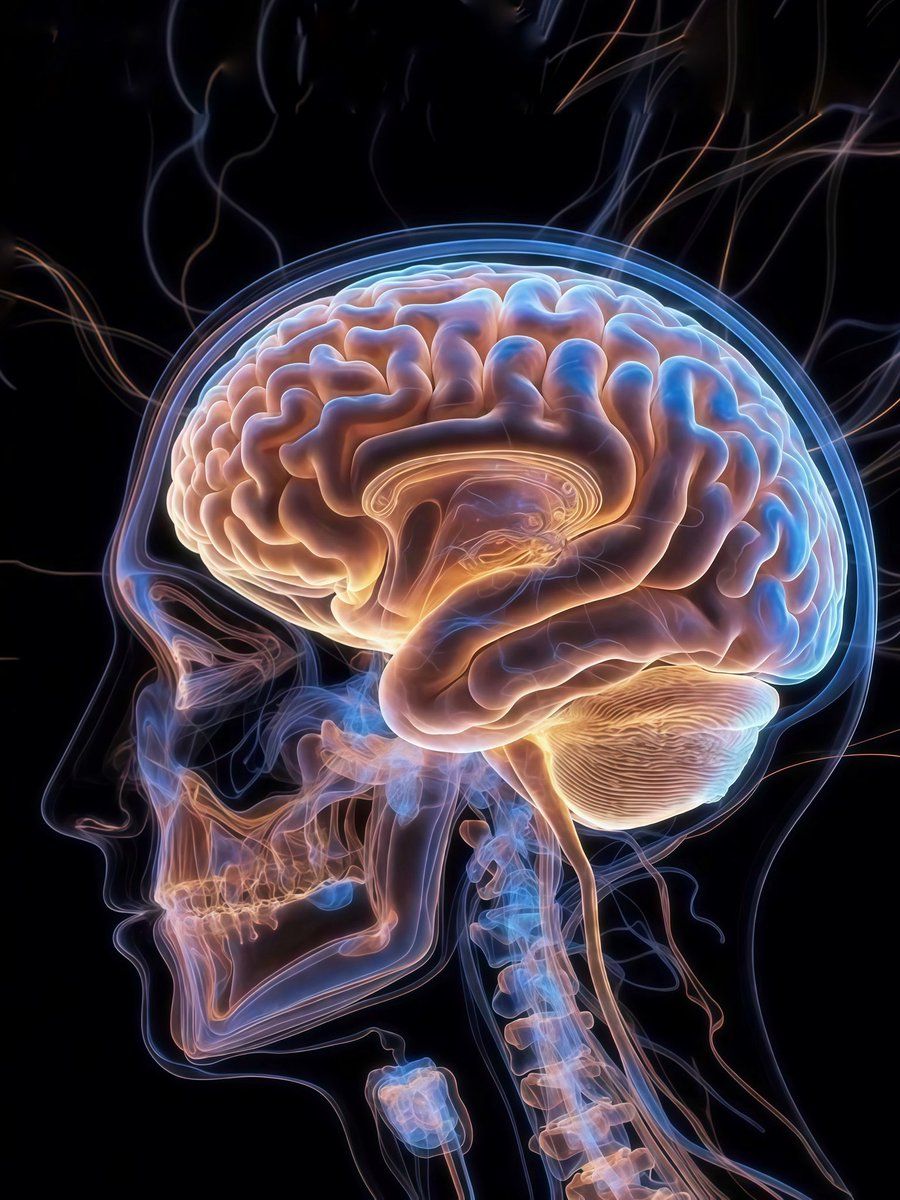
New physics theory suggests human consciousness is holographic projection.
The human brain is a biological marvel, processing vast amounts of information through billions of firing neurons. Yet, neuroscience still struggles to explain the 'hard problem' of consciousness—why physical processes like chemical signals translate into subjective, personal experiences like feeling pain or seeing the color red.
To bridge this gap, physicist Uziel Awret has proposed a radical idea inspired by the holographic principle of physics.
Originally used to describe how the three-dimensional information of a black hole might be encoded on a flat, two-dimensional boundary, this theory suggests that our conscious awareness could similarly be a holographic projection emerging from deeper, quantum-level interactions.
Under this framework, consciousness is viewed as a 'duality'—two distinct but unified descriptions of the exact same phenomenon. On one side are the familiar classical mechanics of neural firing; on the other lies a quantum layer where particles can become entangled and instantly influence one another. While this approach offers a tantalizing perspective on the mysteries of the mind, it remains highly speculative. Most mainstream neuroscientists argue that consciousness can eventually be explained through traditional biology without invoking quantum mechanics. Nonetheless, the proposal highlights how much of our own inner lives remains uncharted territory at the intersection of physics and the mind.
source: Dimitropoulos, S. (2025). Your Consciousness May Be a Kind of 'Holographic' Projection, According to this Radical Theory. Popular Mechanics.
If solar power in space is harnessed for useful work at scale, the value of that will far exceed the Earth economy, because all of Earth civilization uses much less than a trillionth of our Sun’s power
Scientists say dark matter may not be in our universe — but in a hidden one right next door.
For decades, scientists have hunted for dark matter—the invisible substance that makes up about 27% of the universe and keeps galaxies from flying apart.
Yet despite countless experiments, not a single dark matter particle has been directly detected.
Now, a bold new theory suggests the reason may be simple: we’ve been looking in the wrong universe. Physicist Stefano Profumo of UC Santa Cruz proposes that a “mirror universe” made entirely of dark matter may exist alongside ours, complete with its own atoms, forces, and even dark black holes. This shadow realm could have formed in the same Big Bang as our universe but evolved under different rules—unseen, but gravitationally entwined with our own.
Profumo also explores another provocative idea: that dark matter might still be emerging from the universe’s expanding edge. Much like black holes emit particles from their event horizons, the frontier of spacetime itself could be generating dark matter, a process that began at the dawn of time and continues today. These theories remain speculative, but they underscore the lengths to which scientists are going to crack one of cosmology’s greatest mysteries. If true, the elusive nature of dark matter may not be a failure of our instruments—but a sign that the answers lie just beyond the veil of the observable universe.
🚨: Quantum Physics shows that objective reality doesn't exist
Properties of a particle do not have a definitive state until they are measured. This challenges the classical idea of "objective reality"—the belief that the universe exists independently of observation.
The Holographic Principle suggests that our universe may store information in a very unexpected way.
Instead of information depending on the volume of space, it depends on the area of the boundary surrounding it. In simple terms, everything inside a region could be encoded on its surface, much like a hologram.
Proposed by Gerard 't Hooft and Leonard Susskind in the 1990s, the idea grew from black hole physics and shows that the maximum amount of information, or entropy, is limited by surface area rather than volume. It remains one of the most fascinating concepts in modern theoretical physics.
@origina1ange1 I was just talking about this with my brother-in-law, even in physics you need a small amount of dark matter or negative energies to traverse the standard model.