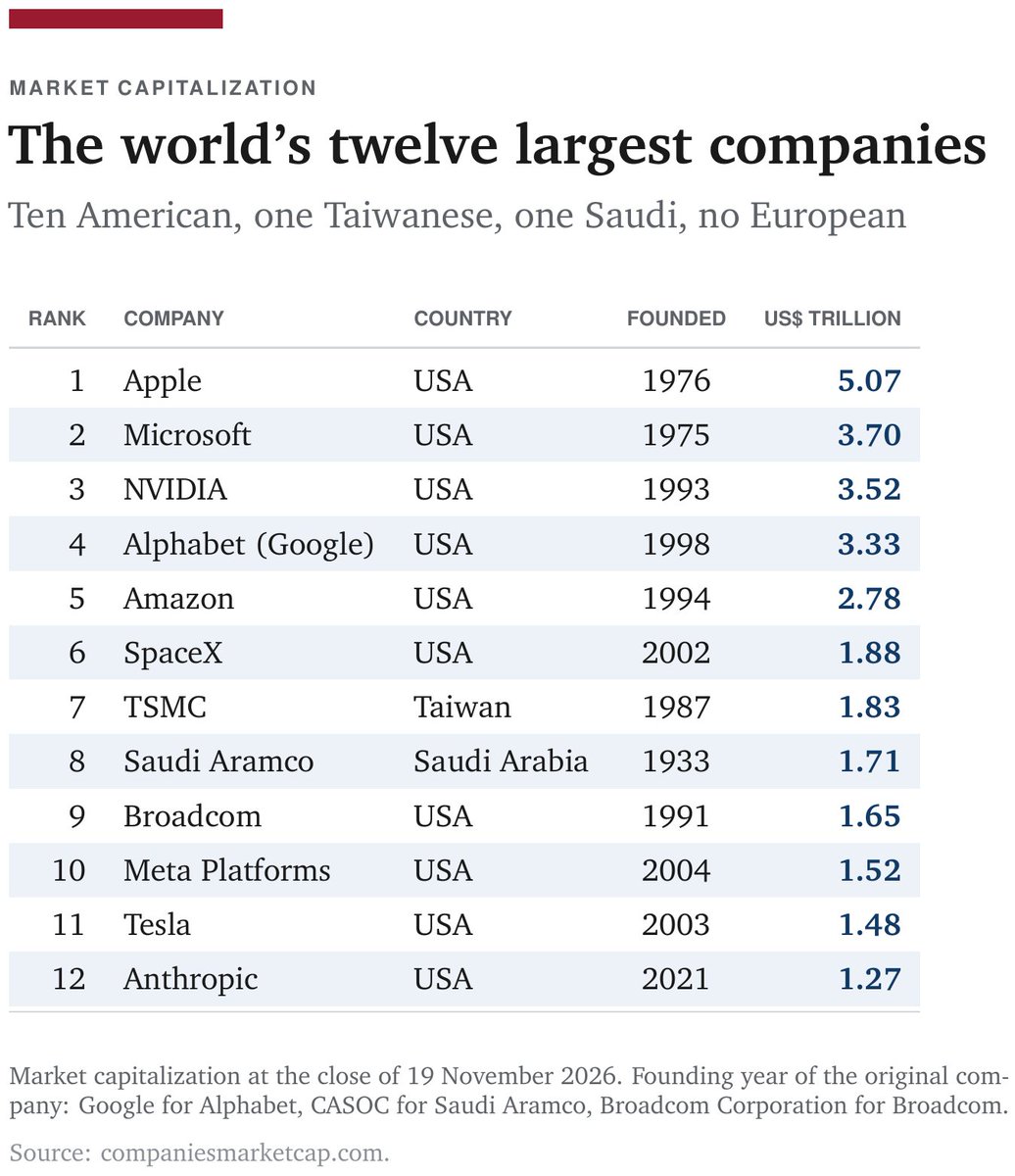
If you are European, this table (which I adapt from @Afinetheorem) should make you pause for a second.
These are the top 12 companies in the world by market cap yesterday.
A few observations:
1) Ten are from the U.S., one from Taiwan, one from Saudi Arabia (the Saudis are just lucky, so let’s forget about them).
2) All of them younger than me (Microsoft, the oldest, is from 1975).
3) None of them are in the financial sector. All of them are in what is called (I think imprecisely) the “real economy”: computers, chips, AI, social media.
4) Not a single European firm.
Are these market caps the reflection of something real?
If I look back at the last 60 minutes of my life, I have used products from Apple (the computer I used to write this post), Microsoft (I wrote the first draft of this post in Word), NVIDIA (I proofread this post with Claude, which most likely runs on NVIDIA GPUs), Google (I used Chrome to open X), Amazon (I was listening to Amazon Music while I wrote this post), SpaceX (this is X!), TSMC (the chip in my computer), Broadcom (most likely the designer of at least one of the semiconductors I am using now), Meta Platforms (I just sent a WhatsApp message to @lugaricano about how tough the task ahead of Hernández de Cos is), Tesla (I own a Tesla), and Anthropic.
What about Saudi Aramco? I have probably used some imported product that uses oil sold by Saudi Aramco, but that is harder for me to determine.
What do I need to say to awaken Western Europeans from their slumber?
The original post by Kevin:
https://t.co/NoOkTR5Y1c
Models help us make sense of the world, but they also help us distinguish sense from nonsense. As VV Chari told Congress in 2010: "If you have an interesting and coherent story to tell, you can tell it in a model. If you can't, your story is incoherent." Show me the model, Oren!
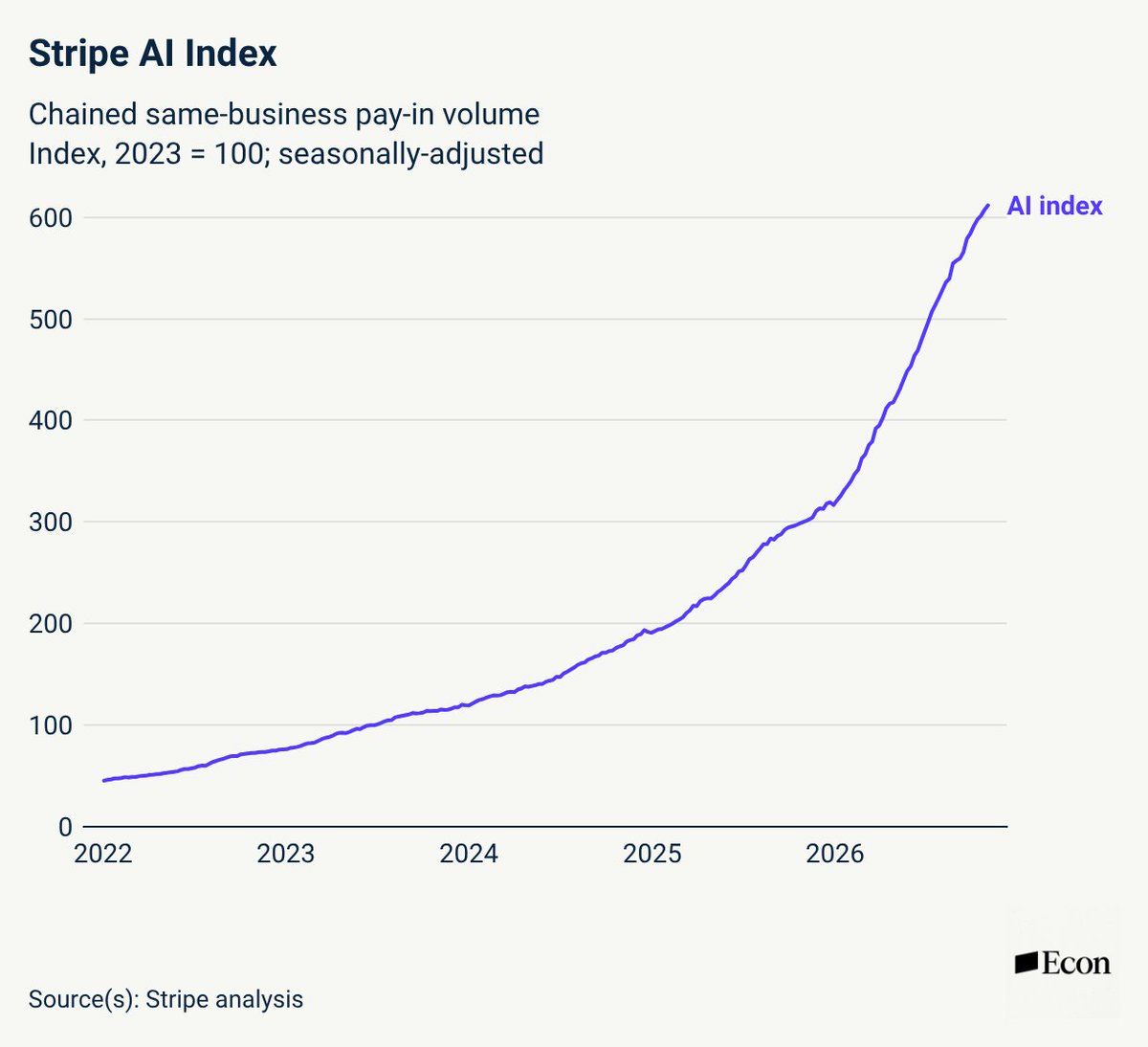
New from @Stripe Economics today: how have AI businesses been weathering the recent headwinds & tailwinds to the industry? To help answer this, we built the Stripe AI Index, a same-business proxy measure of revenue for around 20,000 AI-native firms on Stripe each week. 🧵 /1
Labor economists, get your event study ready.
Aguiar et al (JPE 2021) find that recreational gaming is a leisure luxury whose quality improvements explain 38-79% of young men’s decline in work hours.
GTA 6 is a large, well-dated positive shock to the quality of leisure.
PS - if we got an additional 1pp per year, or hey, maybe even 2pp of growth over next decade, it would be a boomtime the likes of which none of us in the West have seen in our lifetimes! Not a disappointment!
We have great org econ models of the challenges of shifting org architecture, diffusion/co-invention models of inefficiencies, labor transition models and empirics from history, etc. etc. etc. Economist's views here are not just bloviating. 8/8
Bottlenecks are very hard to predict ex-ante. Eg, here is McKinsey 2019 (they weren't the only ones!): 25-40% displacement from automation by 2030, without even seeing LLM-based AI coming! Suffice to say, this isn't going to happen. 7/8
AI World folks are thinking of things like "Cursor and agentic coding spread very quickly!" Well, kind of (most software is still not written this way!) and *productivity* in software is still hard to observe (has price collapses in *any* category?!). 6/8
It gets worse: tasks are parts of jobs which cannot be broken apart (as in @lugaricano and friends' great "Messy Jobs"). Incentives, career paths, training are linked to existing pre-AI tech. End-user knowledge takes time to learn. 5/8
The big benefit will be when architects and designers begin designing with this new robot in mind. With historic architectural invention, that has taken *decades*. Note here I am assuming no technological bottleneck and massive cost advantage! 4/8
Regulatory barriers will limit use in many places. It will take time to produce and distribute the machines. Local masons will in many cases refuse to work with it. Co-invention will be needed for odd sites, or unusual brick layouts. 3/8
3) Imagine that tomorrow we invent a $10k robot that can build brick walls. What does it do to growth? Very little! Doesn't affect brick prices (can even raise them in SR!) or "roll fee" for the truck that brings it to you. But it's worse. 2/8
On bottlenecks: 1) economists have been exactly right about little extra growth despite very fast tech change. They thought a group of econs I organized were crazy >2 yrs ago at the AI labs when we said "1pp extra growth/yr through 2030". 2) bottlenecks *still* not understood 1/8