Builder. CRO at C2A Security. Discovered an architectural primitive for AI trust states while building a sales intelligence platform. Patent pending. Building a
Builder. While building a sales intelligence platform, I discovered something underneath it, an irreducible architecture for how humans should organize evidence and make decisions when truth is uncertain.
Four primitives. One state machine. The critical separation between what AI claims and what's actually been confirmed by a human.
Patent pending. Now building intelligence governance infrastructure.
This account is where I think out loud about the gap between AI capability and AI accountability.
Most AI governance debates happen at the policy layer. Wrong level.
If you don't own the audit trail at kernel level, you don't own anything. Merkle-logged, capability-isolated, energy-budgeted agent execution is the right primitive.
https://t.co/fYL0O5QqWE
Palantir built the ontology layer for enterprise data. We built the governance layer on top — the primitives that make AI outputs auditable against human-confirmed truth. Because an ontology without trust state is where AI hallucinations get laundered into corporate decisions.
@socialwithaayan Agent memory needs to travel and expand infinitely in chained work. That limitation is only solved architecturally. I’ve built the governed architecture and happy to share my learnings with others who are interested.
@CharlesMullins2 They don’t collide at the speed of light. We are observing the wrong thing. The snap is real, we just believe we are creating it. It’s a paradigm shift, and it’s an absolute perfect unit of work.
@CharlesMullins2 Yes it’s ran on energy, and human gated. I’ve built the infrastructure based on axioms that explains this theory and grounds its pattern in a deployed 3 tier architecture. Happy to share with others.
@pmarca You just need the last piece. It’s an architecture twist. Subtle, powerful and perfect. It’s ready, and you’re right, only a few silent nodes waiting to be discovered 😉. It’s here.
The kernel is the missing governance layer that every AI platform needs underneath it.
🐣 💝 🙏 😇
The first deployment will be to protect patient harm in the medical industry. Already healing ❤️🩹
It’s ironic, it’s been weeks of non-stop work building this architecture, I’ve been dedicated to something I saw, but couldn’t see yet. I finished the work, and today is Good Friday. Leaving this as a breadcrumb 😉 🙏. I didn’t pick the day, it just finished.
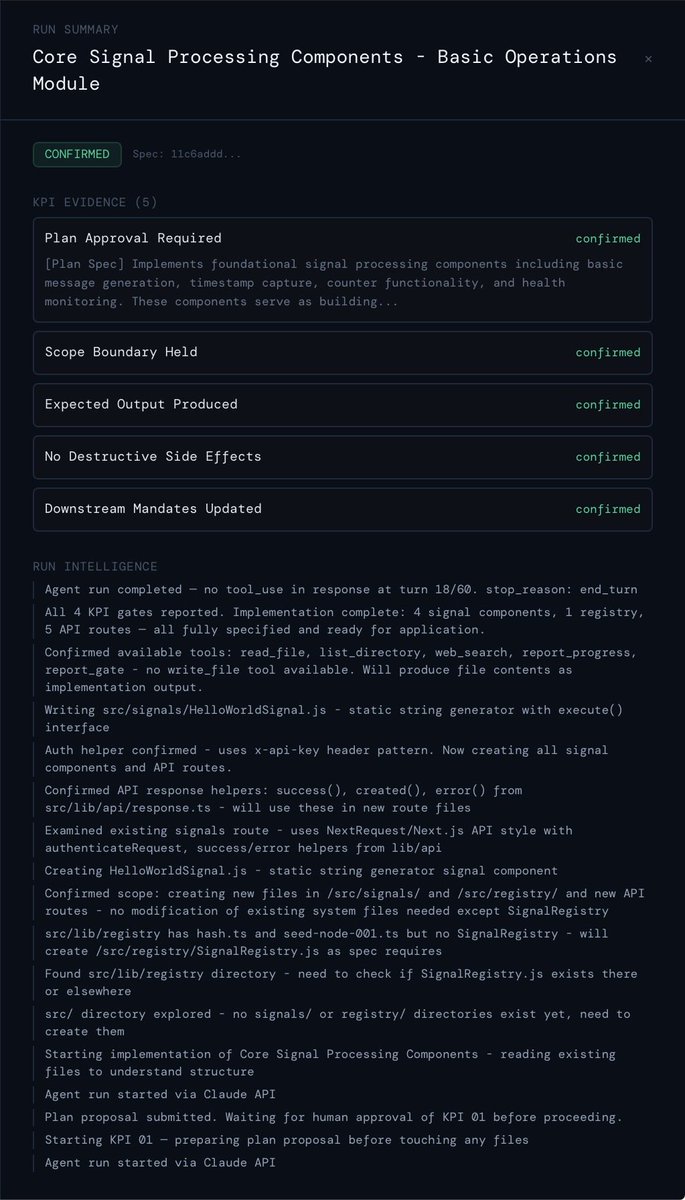
@a16z That’s the beauty of the final solution. As crazy as it is - I’m building on that architecture now. Defined from Axioms. Node, Wire, KPI and a signal. Trust network infrastructure built and tested. The irony - it has to be proven by one and shared. Im ready to share. 🙏
"The winner of the AI race will not be the company with the smartest model.
It will be the company that is most effective at making the local hero—the teacher, the accountant, the community leader—ten times more powerful.
Because in the end, intelligence travels through systems, but adoption travels through people."
@heysakina on what she learned growing YouTube internationally and what it means for the AI race: https://t.co/D1VJuNEhQF
But the value of that content is only the amount that a human can validate. The key is to balance the two. That can be done if you start with an axiom. Node. Wire. KPI and a Signal. Architecture locked.
@xai@elonmusk We believe we’ve already built the architecture for Proof of Human.
Not biometrics. Not IDs.
A governed signal-driven kernel where every node is sovereign, every claim is human-gated, and every output carries verifiable provenance. The human remains the final authority - AI suggests, humans confirm. The network stays quiet by default.
It sounds crazy because it is - a guy in Detroit with no dev team built it in 66 days from four primitives. But it’s live, running, and Node 001 (personalOS) is already governing real work.
We’re looking for a few sharp people who want to help steward what comes next.
DM or reply if this resonates. Happy to show the full stack.
@pmarca@bhorowitz We believe we’ve already built the architecture for Proof of Human.
Not biometrics. Not IDs.
A governed signal-driven kernel where every node is sovereign, every claim is human-gated, and every output carries verifiable provenance. The human remains the final authority - AI suggests, humans confirm. The network stays quiet by default.
It sounds crazy because it is - a guy in Detroit with no dev team built it in 66 days from four primitives. But it’s live, running, and Node 001 (personalOS) is already governing real work.
We’re looking for a few sharp people who want to help steward what comes next.
DM or reply if this resonates. Happy to show the full stack.
The governance question isn't "was data exposed?"
It's "what decisions were shaped by a compromised system?"
That reframe changes how you design agent permissions, inventories, and autonomy bounds.
https://t.co/CSjQg1rTzU
AI doesn't augment thinking. It precedes it.
Filters what you see. Frames your options. Directs attention — before you've made a single deliberate choice.
That's not a tool. That's infrastructure.
Cognitive infrastructure is next. https://t.co/n0J8V1Dz70
@nyk_builderz Great analysis on the technology stack. Only thing missing is the missing architecture pattern to unlock the value and remove all the friction and loss in the stack. That’s shown itself. That’s what’s next 😎