I’ve been harping on the disciplines and tools for using AI lately. I find them to be a very effective approach. But I don’t want to leave you with the impression that a few simple disciplines and tools is sufficient.
As the AI’s build software, you — the software engineer — need to have a good mental model of what the AI is doing. You need to apply engineering insight to correct it when it takes a path you don’t like. You have to be an active manager in the design and architecture of the system. You have to be able to “see within“ without resorting to exhaustive code reviews. You have to form suspicions about what the AI is doing, and you have to probe and experiment to verify your suspicions.
@plainionist Learn the basics. Just as before. Learn them very well. Write assembler, C, Java, Ruby. Learn algorithms and data structures. Read the old classics.
And then start using agents.
Novices with power tools tend to lose fingers.
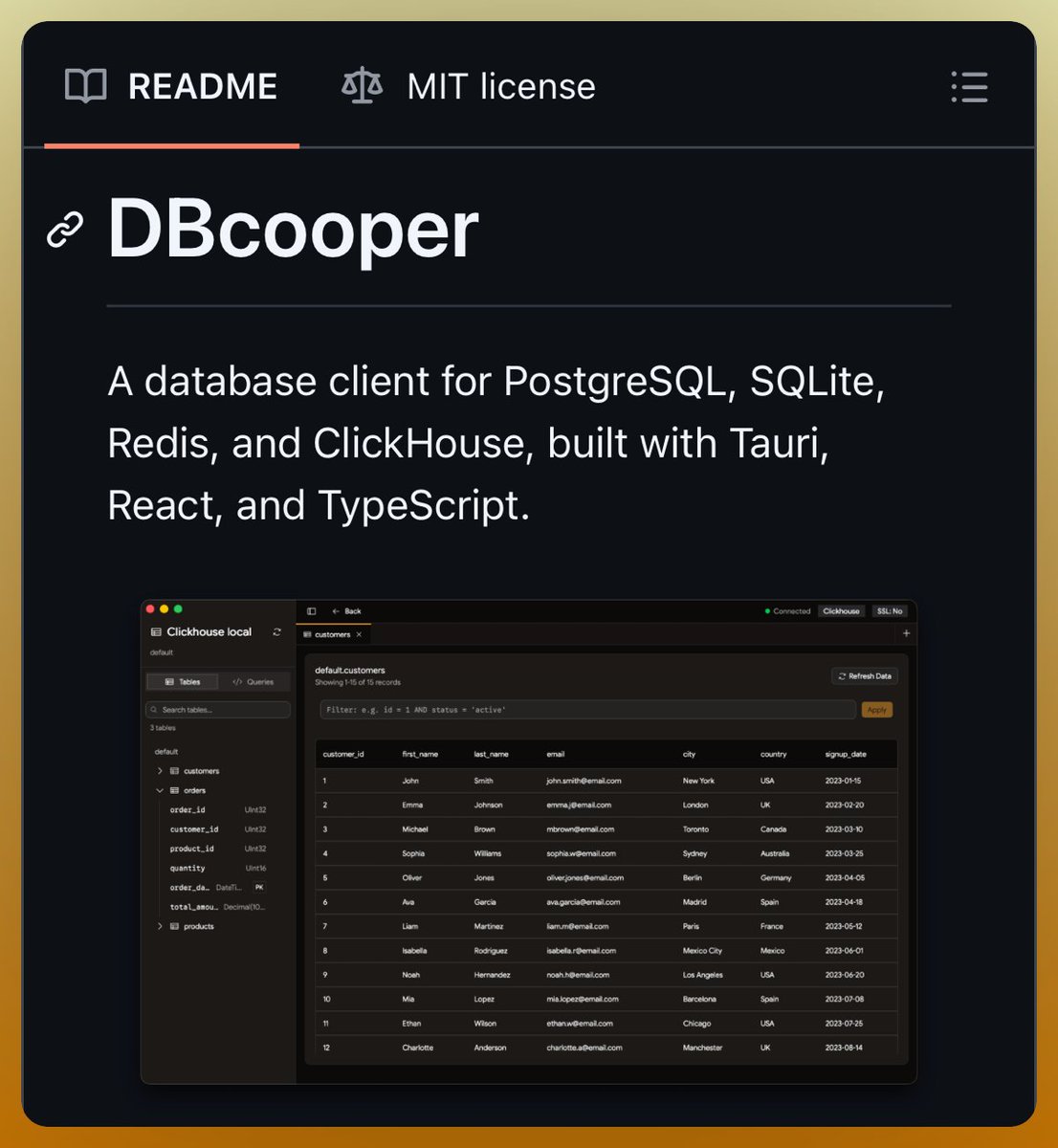
A lot of database clients feel heavy.
This one keeps things simple.
DBcooper is an open-source database client built with Tauri + Rust + React that supports
PostgreSQL, SQLite, Redis, and ClickHouse in one place.
Lightweight.
Keyboard-friendly.
Even generates SQL from natural language.
I struggled explaining my #reaktiv#Signals library to Python developers. So I wrote a Manual explaining what problems Signals solves on a fundamental level. Thanks for Hacker News putting it on the front page! @RyanCarniato
https://t.co/1xMhzjzoQQ
Remix Forge is officially out 🚀
Built a @remix_run extension for VS code that lets you generate modular route files based on your needs and preferences.
You're one right click away from generating your routes in a few seconds! 🍾
https://t.co/LE6JW7zyoM
When you're working with APIs, there are some best practices you should follow.
And if you really want to learn how APIs work, build one yourself.
In this guide Jean-Marc goes over each best practice as you build a REST API w/ JS, Node, & Express.
https://t.co/EOBVeksVPG
Aqui estão alguns patterns comuns de microservices:
🟢 API Gateway Pattern: Esse pattern envolve ter um único ponto de entrada para todas as requests do client, que então encaminha essas requests para o microservice apropriado.
🟢 Circuit Breaker Pattern: Esse padrão é usado para lidar com falhas em uma arquitetura de microservices. Quando um microservice falha ou deixa de responder, o circuit breaker dispara e redireciona as requests para um serviço de fallback.
🟢 Service Registry Pattern: Esse pattern é usado para "descobrir" todos os serviços em uma arquitetura de microservices. O registry atua como um diretório central para o service discovery.
🟢 Service Mesh Pattern: Esse pattern envolve a adição de uma camada de infraestrutura entre microservices para lidar com preocupações transversais, como descoberta de serviço, balanceamento de carga e segurança.
🟢 Event-Driven Architecture Pattern: Esse pattern envolve o uso de eventos para comunicação entre microsserviços. Cada microsserviço pode publicar eventos e assinar eventos publicados por outros microsserviços.
🟢 Saga Pattern: Esse pattern é usado para gerenciar transações que abrangem vários microsserviços. Envolve dividir a transação em etapas individuais menores e usar ações de compensação para desfazer as etapas concluídas se ocorrer um erro.
🟢 Sidecar Pattern: Esse pattern envolve a implantação de um container separado ao lado de cada microsserviço para lidar com preocupações transversais, como registro, monitoramento e segurança.
🟢 CQRS Pattern: Esse pattern envolve a separação dos modelos de leitura e gravação em uma arquitetura de microsserviços. O modelo de leitura é otimizado para consultar dados, enquanto o modelo de gravação é otimizado para atualizar dados.
🟢 Strangler Pattern: Esse pattern envolve a substituição gradual de uma aplicação monolítica por microsserviços, adicionando gradualmente novos microsserviços e removendo a funcionalidade do monólito.
#bolhadev #paneladev
ChatGPT is a toy compared to AutoGPT.
This tool performs tasks for you from A to Z without human intervention.
Here are the best ways to use it to save hours of work:
Your free AI coding assistants:
1. https://t.co/a0HFiaJyqd
Website builder ChatGPT.
2. https://t.co/umemB66jap
Write code 10x faster.
3. https://t.co/YGaT18ZCNu
Turn your thoughts into code.
4. https://t.co/ca8Tmb4bvA
Answer 8 questions and get a website.