Today is a monumentous day for quantum computing and cryptography. Two breakthrough papers just landed (links in next tweet). Both papers improve Shor's algorithm, infamous for cracking RSA and elliptic curve cryptography. The two results compound, optimising separate layers of the quantum stack. The results are shocking. I expect a narrative shift and a further R&D boost toward post-quantum cryptography.
The first paper is by Google Quantum AI. They tackle the (logical) Shor algorithm, tailoring it to crack Bitcoin and Ethereum signatures. The algorithm runs on ~1K logical qubits for the 256-bit elliptic curve secp256k1. Due to the low circuit depth, a fast superconducting computer would recover private keys in minutes. I'm grateful to have joined as a late paper co-author, in large part for the chance to interact with experts and the alpha gleaned from internal discussions.
The second paper is by a stealthy startup called Oratomic, with ex-Google and prominent Caltech faculty. Their starting point is Google's improvements to the logical quantum circuit. They then apply improvements at the physical layer, with tricks specific to neutral atom quantum computers. The result estimates that 26,000 atomic qubits are sufficient to break 256-bit elliptic curve signatures. This would be roughly a 40x improvement in physical qubit count over previous state-of-the-art. On the flip side, a single Shor run would take ~10 days due to the relatively slow speed of neutral atoms.
Below are my key takeaways. As a disclaimer, I am not a quantum expert. Time is needed for the results to be properly vetted. Based on my interactions with the team, I have faith the Google Quantum AI results are conservative. The Oratomic paper is much harder for me to assess, especially because of the use of more exotic qLDPC codes. I will take it with a grain of salt until the dust settles.
→ q-day: My confidence in q-day by 2032 has shot up significantly. IMO there's at least a 10% chance that by 2032 a quantum computer recovers a secp256k1 ECDSA private key from an exposed public key. While a cryptographically-relevant quantum computer (CRQC) before 2030 still feels unlikely, now is undoubtedly the time to start preparing.
→ censorship: The Google paper uses a zero-knowledge (ZK) proof to demonstrate the algorithm's existence without leaking actual optimisations. From now on, assume state-of-the-art algorithms will be censored. There may be self-censorship for moral or commercial reasons, or because of government pressure. A blackout in academic publications would be a tell-tale sign.
→ cracking time: A superconducting quantum computer, the type Google is building, could crack keys in minutes. This is because the optimised quantum circuit is just 100M Toffoli gates, which is surprisingly shallow. (Toffoli gates are hard because they require production of so-called "magic states".) Toffoli gates would consume ~10 microseconds on a superconducting platform, totalling ~1,000 sec of Shor runtime.
→ latency optimisations: Two latency optimisations bring key cracking time to single-digit minutes. The first parallelises computation across quantum devices. The second involves feeding the pubkey to the quantum computer mid-flight, after a generic setup phase.
→ fast- and slow-clock: At first approximation there are two families of quantum computers. The fast-clock flavour, which includes superconducting and photonic architectures, runs at roughly 100 kHz. The slow-clock flavour, which includes trapped ion and neutral atom architectures, runs roughly 1,000x slower (~100 Hz, or ~1 week to crack a single key).
→ qubit count: The size-optimised variant of the algorithm runs on 1,200 logical qubits. On a superconducting computer with surface code error correction that's roughly 500K physical qubits, a 400:1 physical-to-logical ratio. The surface code is conservative, assuming only four-way nearest-neighbour grid connectivity. It was demonstrated last year by Google on a real quantum computer.
→ future gains: Low-hanging fruit is still being picked, with at least one of the Google optimisations resulting from a surprisingly simple observation. Interestingly, AI was not (yet!) tasked to find optimisations. This was also the first time authors such as Craig Gidney attacked elliptic curves (as opposed to RSA). Shor logical qubit count could plausibly go under 1K soonish.
→ error correction: The physical-to-logical ratio for superconducting computers could go under 100:1. For superconducting computers that would be mean ~100K physical qubits for a CRQC, two orders of magnitude away from state of the art. Neutral atoms quantum computers are amenable to error correcting codes other than the surface code. While much slower to run, they can bring down the physical to logical qubit ratio closer to 10:1.
→ Bitcoin PoW: Commercially-viable Bitcoin PoW via Grover's algorithm is not happening any time soon. We're talking decades, possibly centuries away. This observation should help focus the discussion on ECDSA and Schnorr. (Side note: as unofficial Bitcoin security researcher, I still believe Bitcoin PoW is cooked due to the dwindling security budget.)
→ team quality: The folks at Google Quantum AI are the real deal. Craig Gidney (@CraigGidney) is arguably the world's top quantum circuit optimisooor. Just last year he squeezed 10x out of Shor for RSA, bringing the physical qubit count down from 10M to 1M. Special thanks to the Google team for patiently answering all my newb questions with detailed, fact-based answers. I was expecting some hype, but found none.
AI chatbot providers, including ChatGPT and Grok, are facing a crackdown on illegal content in the United Kingdom, as the government promises swift action to make the internet safer for children. https://t.co/O72GVCpCrc
Introducing the Lovable Slack connector.
You can now connect your Lovable apps directly with Slack letting your apps read & send messages in Slack.
Share what you build with this and we'll feature our favorite examples in the comments!
The rainstorm hitting the Bay Area on Monday is just an appetizer of what’s to come this week, as a series of cold systems is forecast to bring snow and hail to unusually low elevations. https://t.co/HlgwUVIYEr
How do you serve insights to 10,000+ employees across sales, marketing & finance?
AWS Global Sales used Amazon Quick to build AWS Insights—reducing time to insight from days to minutes with conversational AI & persona-based intelligence.
The secret? Quick as an intelligent orchestrator connecting specialized agents across teams.
https://t.co/jlnQTrHLfM
The new Walker S2 humanoid robot from Ubtech Robotics was shown changing its own battery in a demo video designed to showcase how autonomous battery swapping could allow robots to work 24/7 without interruption.
We will be at a level 2 on the Storm Impact Scale Monday and Tuesday. Expecting another round of heavy rain for the Tuesday morning commute. https://t.co/IjkprvKtu7 https://t.co/IjkprvKtu7
A potent Pacific storm system is funneling moisture into California, which is resulting in heavy rain and mountain snow. This system will move inland tonight into Tuesday, increasing precip chances across the Intermountain West. Another system will move onshore on Wednesday.
The extension comes just a few weeks after the Internal Revenue Service and California state tax authorities extended both federal and state tax deadlines from April 18 to May 15, following the severe storms from late December to early January.
https://t.co/qPy7LHQqTD
Happy Monday! Here are some facts that Fox + @GOP don’t want you to know:
-7 of the 10 states most dependent on the federal govt are Red
-Blue counties equal 70% of US GDP
-Blue states equal 61% of US GDP
-Red states equal 39% of US GDP
So which party is fiscally conservative?
It is in America’s interest to support Ukraine. If Russia can invade, subjugate, and pillage Ukraine with impunity, it will do the same again to others, and a world at war diminishes the security of Americans.
NEW: Apple has a secret moonshots team and it’s making significant progress on a major new initiative: no-prick glucose monitoring for the Apple Watch. All of the details, including how Apple has hid its work behind a fake startup, here: https://t.co/j9BCdgX0Ex
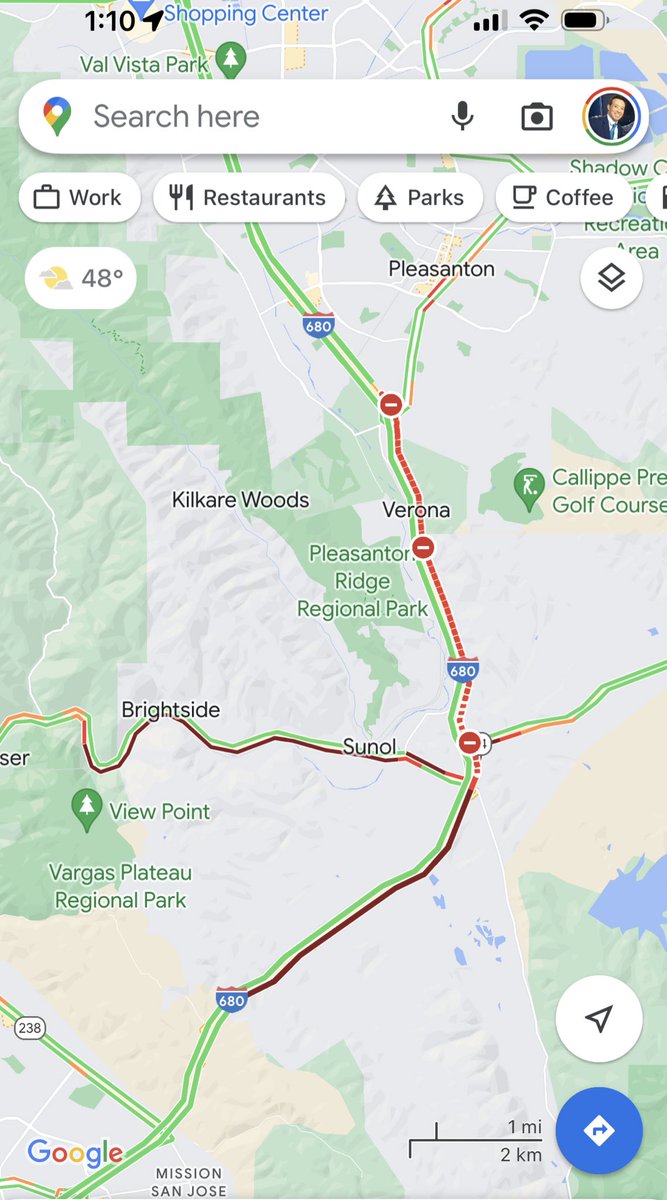
A look at the #RoadWork happening on 680 northbound in #Sunol, just north of 84. Photo courtesy CalTrans. 680 northbound is shut down from 84 to Sunol Blvd until Tuesday morning. #KCBSTraffic
NORAD says it's monitoring "a high altitude airborne object" over northern Canada, and military aircraft are currently operating in the area from Alaska and Canada, according to a news release from the agency. https://t.co/HouOCkMhk2