Things I learnt after buying a house after 1 year and going through lots of shitty products and things and what I'd do know if I bought or build a house again:
- home assistant + their HA Green (little box that's open source to connect all your devices with Home Assistant)
- LG or Mitsubishi air conditioning in EVERY room, both cooling/heating, every unit should have its own outdoor unit, or you get annoying things like you can't cool one room and heat the other at same time! I think they're called mono splits
- xiaomi air purifier in every room, big spaces get the big purifiers, smaller rooms small ones (most air purifiers are too small for the space they're in!)
- a good smart lock, it's so good because you come home and your door auto opens (esp nice if you carry stuff)
- matic vacuum (they gave me one so I have to disclose but it's GREAT, all the Roomba and Chinese ones suck)
- unifi router with access points, outdoor extenders, cameras, doorbell, all PoE
- starlink with local fiber backup
- tesla dreamwall or other batteries sufficient to power for days (means like 4-8 batteries @ 13kwh per maybe!), then connect your freezer, fridge, stove, etc to it (heavy loads) so you can keep and cook food when shit goes down
- related get a Weber Genesis gas bbq so you can always cook food, fun with friends too
- solar panels actually sufficient to power (so like 30-50, crazy number but if you get like 15 it's just not enough?)
- pool is honestly overrated, you'll almost never use it, also lots of maintenance (we had a massive water leak with a $10,000 water bill this month, so F that)
- but u DO want a standalone jacuzzi, that's nice, with lights!
- if you care about safety get steel doors with massive locks for other rooms, and make those safe rooms, so if someone comes in you have multiple layers of security
- also get weapons to defend you and your family where legally possible!
- garden should be permaculture kinda concept with vegetables, herbs and stuff you can grow to eat, like strawberries, rosemary etc
- harvia dry sauna, and if outside, add a little changing room to it so you don't exit in the cold outside!
- related, build a home gym, get a big power rack with cables, free barbell, smith barbell, everything built in, and then some dumbbells and kettlebells, and a gym bike like concept2, maybe concept2 rowing machine too, with that you can do almost anything to stay fit! then hire personal trainer to come to your house or you will never go!
- ALL lights should be changeable to red at night, via home assistant, so you can make everything red at 10pm for sleep!
- also get outdoor lights for fun and security (burglars hate lights)
- ALL windows black out blinds on outside, for both security and just NO light during sleep
- when you're not sleeping, get lots of sunlight, big floor to ceiling glass windows, it's great!
- all doors to outside flat on floor level, no stepover edges (like in PT)
- preferrably lots of land around your house so you're not close to any neighbors (neighbors are always annoying even if they're nice!)
- fellow water kettle, fellow ode 2 coffee grinder
- sofas, other interior, make sure to find natural materials, 99% of interior is polyester/plastic
- LG makes the best TVs, end of story, but their software is shit and spies on you, NEVER connect them to the internet/WiFi, instead buy an Apple TV box and connect that, that doesn't spy on you and has no ads, then connect it with HDMI and you're good, also no annoying LG TV updates
- re: TVs, people show these formulas of like blalba distance to sofa from tv is N meter so now you need 60", in my experience they always sell you a TV like 10-15" too small, we had 77" LG TV and it was like diving into the screen, beautiful, but then we followed the formula and changed it for 65", not the same! get bigger!
- get a VERY big bed, 2m wide by 2m long at least, get natural bed sheets/duvet and seperate duvet from partner, the less you wake up when your partner moves the better
- guest rooms are a bad idea, it's annoying to have friends and family IN your house for weeks or a month, good luck trying to have SEX! better get a small house or apt near for them or put them in airbnb!!!
- add a delivery box outside ur house so delivery people can put packages inside without having to ring your doorbell 10x per day
- get a $500 mini projector and big projection screen outside (or a white wall) so you can have movie nights outside w friends
pstack now includes 2 skills i recommend everyone use or copy:
/create-verification-skill
https://t.co/xYQArsuVWR
/maintain-verification-skill
https://t.co/J5s8WL1itT
if you don't already have one, /create-verification-skill creates a skill that teaches your agent how to run, control, and debug your app.
it also creates something i call the feature map: a map of all the features in your app and how to get to it and use it from a user's pov. it allows agents to navigate and use the app just like a real user which greatly increases its ability to verify its own work. but of course, this feature map goes out of date very quickly.
run /maintain-verification-skill as a daily automation with cursor cloud agents. this skill will check your app for changes and keep your feature map up to date.
having a strong verification skill will end up becoming critical infra for your team and become the foundation of boosting everyone's productivity and quality and also enable more interesting automations to be built.
install https://t.co/WDB4U1rwmu and you'll get auto updates for my skills. enjoy!
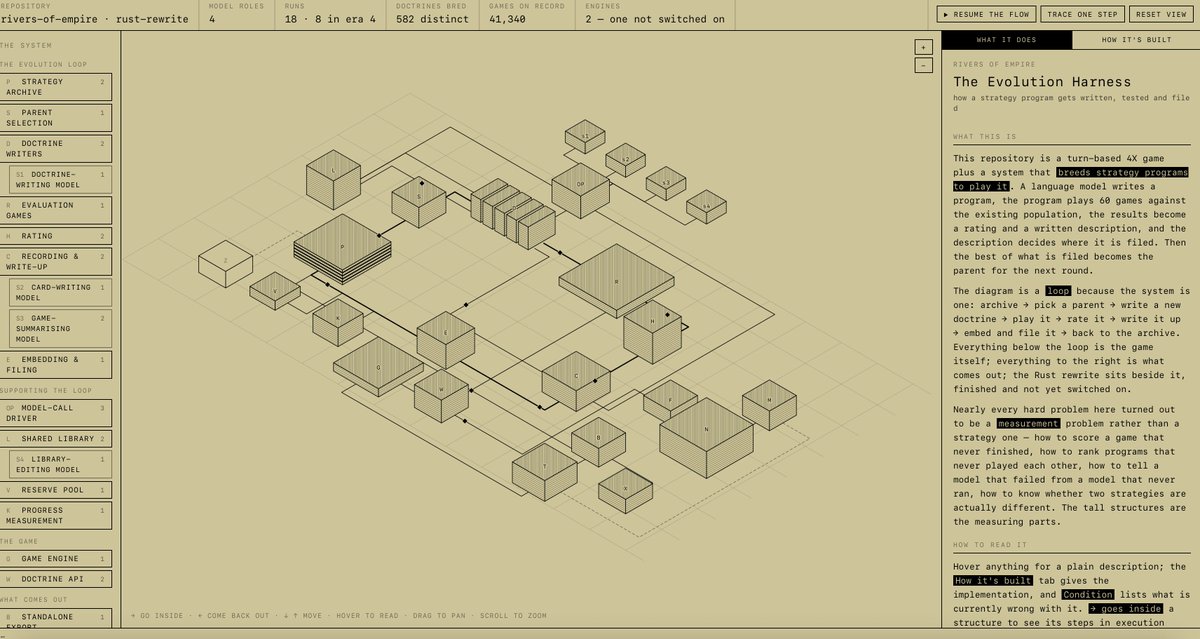
i've started having claude turn my codebases into visual diagrams so i can discuss the codebases with claude more easily - the moving dots are data snippets that i can inspect
can confirm as a medium jacked human that 20 min a day in the gym/working out is enough for most.
20-40 pull-ups (sets of 10)
90 push ups (sets of 30)
10 pistol squats each leg
40 deep squats
20 walking lunges
30 standing jumps
...is a super simple regimen and very effective. Most should have time in the day for this.
what did I leave out?
Our intern just built the first zero-person company.
Listen's agent ran a loop:
- Interview users
- Build
- Test with real people
- Fix issues
- Repeat
2,000 interviews and 100 concepts later: an app with 100s of paying customers.
Here’s how it works:
5.5 is smart enough to cram everything into a single agents.md file with all your repos in a single workspace.
Containerize and break everything into microservices with TDD for everything with its own repo and pipeline. Put docs in html in their own repo and enforce it in HTML with hyperlinks so you can read them as well easily.
By splitting out the services more you can have agents recursively spawning subagents by devloop and splitting out work as effectively as needed on worktrees or patches in each repo. I use apfs/git worktrees are setup by default in omp for subagents. 5.5 is smart enough to know exactly how many subagents it needs and what depth the agent tree should go with recursion turned on.
You can refactor, rewrite, test, deploy your entire codebase with a single prompt. I'm currently managing a ~6m line codebase this way and self hosting everything. All infra code has its own repo for helm/csps. Metrics and tests on all services and grafana dashboards for tracking everything. Every stat I can possibly think of or ever will need gets shoved into postgres.
Any heavy data work or code that needs to be written gets metrics assigned to it in prom or pg and then gets targeted for /goal or for /autoresearch for optimization. I typically explore everything with gemini and have it write the prompts to hand off to 5.5.
People are simply not pushing the models hard enough. 5.4 and 5.5 (maybe even kimi and ds) ARE ASI. The bottleneck is yourself, compute, and devloop times.
Given how impressed I was with Cursor’s Thermo-Nuclear Code Quality Review skill, I decided to create a similar one, but specifically for animations.
/review-animations to review, and /emil-design-eng to build animations. They complement each other well
https://t.co/nbrXga5Btc
Introducing text-to-lottie: an open source skill and harness for generating production ready Lottie animations with codex/claude code.
$ npx skills add diffusionstudio/lottie
Prompts guide and repo in the comments.
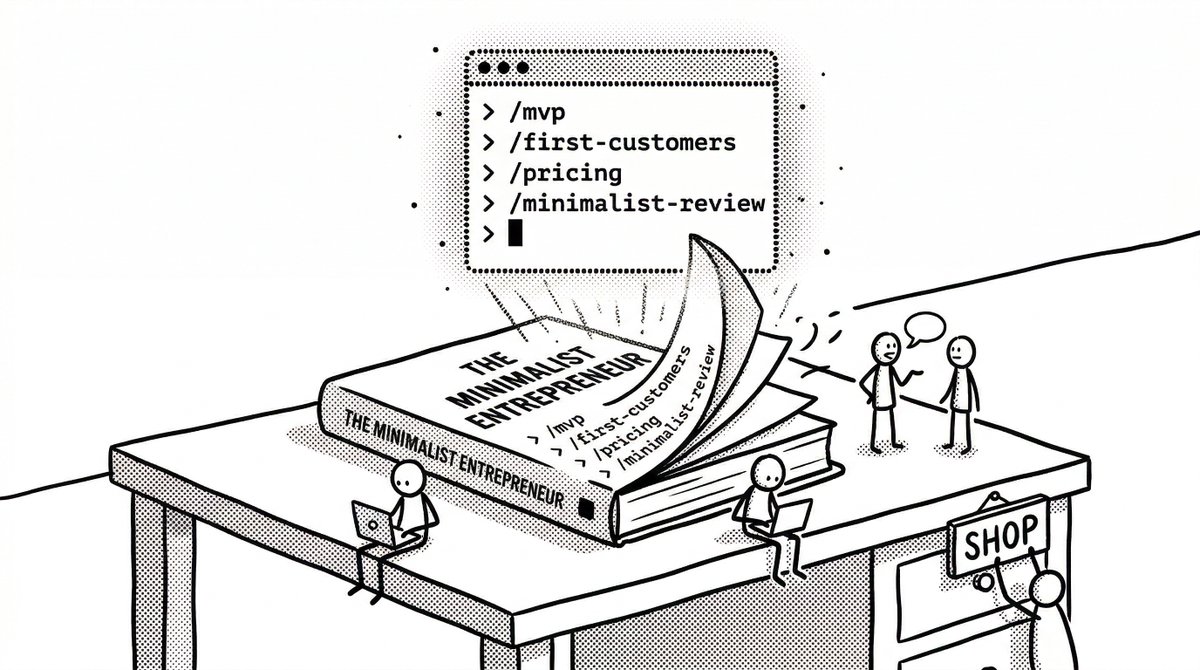
I turned The Minimalist Entrepreneur into 9 Claude Code skills.
/find-community — find your people
/validate-idea — test before you build
/mvp — ship in a weekend
/first-customers — sell to 100 people
/pricing — charge something
/marketing-plan — make fans, not headlines
/grow-sustainably — spend less than you make
/company-values — define your culture
/minimalist-review — gut-check any decision
https://t.co/TqtCR7HWe4
I built a content machine.
It turned me into a one-person media company, has driven tens of millions in pipeline for @tenex_labs, and is allergic to AI-slop.
It has also turned all of my employees into content creators.
I may opensource the whole thing, but for now, I'm going to share how I built it & how it works.
Feel free to copy & paste the steps to Claude/Codex if you want to build your own content machine.
Step 1: Map out the process
In order to make any of your work AI-native, you need to understand the way in which it's been done historically. This is why business context & domain expertise REALLY matters, even in a post-AI world.
Content has been my bread & butter for the last decade, so I started by pulling out an 8.5x11 sheet of printer paper and drawing the traditional process.
1) Look for inspiration
2) Pick a 10x content idea
3) Research the idea
4) Brain dump all of my thoughts about the idea
5) Decide the post format I want to create
6) Create a draft of the post
7) Edit the post
8) Create derivative versions of the post
9) Go live
10) Track performance
Step 2: Where am I needed vs. not needed?
I am needed for the first & final mile:
First mile: picking the idea/direction & providing all of the necessary context
Final mile: going through the final draft with a fine tooth comb & giving final sign-off.
AI can handle the rest:
Looking for inspiration, researching the idea, pulling my thoughts out, writing the post, doing a first edit, creating derivative content, and tracking performance.
Step 3: Build the Content Machine
The machine is one pipeline, run end-to-end or step-by-step. It is a directory of skills that mimic the steps in the content process that I've delegated.
1) The Oracle [AI]
Mines my Slack, Notion, call transcripts and Gmail for spikes, moments I naturally said something worth expanding, while the Internet Reader curates an external feed of X accounts & websites I've selected.
Qualifying ideas (≥6/10) are written to The Vault (a notion database of content ideas).
2) Select the idea from The Vault [Human]
3) The Researcher [AI]
Before any interview, build a sourced research-report.md: TL;DR, key facts with links, current developments, what's already been said, contrarian angles, and open questions for the interview. Claims are adversarially checked; fact is separated from opinion.
4) Interview Panel [AI + Human]
Six world-class interviewers (Joe Rogan, Howard Stern, Michael Barbaro, etc) ask 12–15 questions, one at a time, each pushing a different dimension...and never satisfied with vague answers. Won't advance without 2–3 specific stories, real numbers, and emotional specificity.
5) Production [AI]
The interview becomes a raw .md file: transcript, key stories, core insights, quotable moments, emotional anchor, surprising reveals, and the "so what." This raw file is sacred: my exact words, never paraphrased away.
6) Refinement [AI + Human]
I tell the machine what content type I want to create. It reads my custom style guide + past feedback lessons + content-type spec, then drafts in my voice...pulling real stories and quotes from the raw file. The #1 rule: write like you're texting a friend. Supports long posts, LinkedIn, X threads, and more.
7) Writer's Council [AI]
Six expert reviewers (Shaan Puri, Morgan Housel, David Perell, etc) score the draft through their own lens, splitting fixes into editorial (the machine can rewrite) and information gaps (only the creator can answer...these route back to the interview panel).
8) Revision Loop [AI]
Iterate until council scores 9/10.
9) Repurposing Engine [AI]
One anchor → 10+ natively-formatted derivatives, each re-hooked for its platform and each held to the same full Council → revision bar of 9/10. This is how two people produce like a hundred.
10) Final revision [Human]
11) Learning Loop [AI]
After approval, the machine compares first draft vs. final, extracts confirmed lessons, and saves them to that creator's content-lessons.md. Every future first draft starts smarter. Lessons override the style guide when they conflict.
Feel free to steal the machine & ask me any questions about how it works!
To get good animations from an AI you need to get good at telling it what you want:
- "stagger this list of items"
- "make this animation direction-aware"
- "spacial consistency", "crossfade", "layout animation",
I made a motion vocabulary for this:
https://t.co/ExAxpr31no
Unplugging completely! No WiFi and zero notifications. A great way to get deep focus on a project.
Here is a walkthrough showing how to run Gemma 4 (26B A4B) fully offline with LM Studio & OpenCode to parse PDFs, ask questions, and build sites 100% locally.
Here's what it looks like.
Don't force maximum amplitude on the first cycle. This is why I start with moderate amplitude and build progressively to warm up the body to full range.
Finally, forced exhale to - nearly - empty then max inhale to the fullest. That's what I call "maxiventilation."
ONCE the warmup is done, make sure to take 2-3 regular breath cycles between each maximum breath cycle, to reset your nervous system to a calm state.
You can find the full context, variations of this exercise, and integration into practice inside the Masterclass. That, and much more.
https://t.co/MTUvXchcNW
I'm sick of eating all of my tokens while my agent scans a giant vault looking for contact information.
So, I built my agent a Stupid Simple Agentic CRM that lives in a private GitHub repo. It's open source, steal it, give it to your agent, make it better.
If you're using a vault style system as a second brain, you realize that vaults are amazing for storing big projects, ideas, and complex processes.
But, the day to day stuff of life also needs to be managed. I don't need an agent scanning an entire vault to tell me who to call.
I can ask my agent, "Hey, where are we on Rep 006 of the 100RepsProject," and they can grab all of the relevant information.
If I ask them who I need to follow up with today, my agent has to scan my entire vault (costly in tokens), when they should have a single source of truth.
So I built a stupid simple version that lives in github.
The structure is a simple, derived index for rapid scanning and individual formatted .yaml files for each contact.
That way your agent never scans the entire CRM, only the index with high level data before digging deeper into their relevant information.
The whole thing is kept in sync with a few python scripts and can accept any .csv file from any source with your contacts.
Open source and free to use.