Have you heard of a digital clone?
Here is mine: https://t.co/4Yo1BHSh9E
This thing is trained on all the things I have published over the years. You can ask it questions 24/7/365
It is an interesting time, to have technology this good at impersonating someone, and being able to point at every thing you have ever said.
I also discovered I have written/spoken 4 million words that were recorded over the last decade. 🧐
Please let me know what you think!
By law EPA registered pesticides have to have a safety review every 15 years.
The EPA hasn't finished a safety review of glyphosate in 33 years.
The current review of glyphosate started in 2009 and still hasn’t been completed.
In 2020 the EPA issued an interim decision calling glyphosate "not likely" to cause cancer.
A federal court threw out that health finding as it contradicted the EPA's own admission that it couldn't rule out a link between glyphosate and non-Hodgkin lymphoma. The review also discounted tumor findings going directly against the EPA’s own written standards.
The EPA then missed its 2022 deadline to fix multiple parts of the review, and the court wouldn't give them more time.
So the EPA pulled the interim decision altogether and glyphosate operates today under a 30+ year old approval.
The only other major pesticide with a review nearly this old is paraquat which now is known to be linked to Parkinson’s disease.
As @calleymeans states the just released glyphosate data from “the NIH shows “sufficient evidence” (the highest evidentiary bar) of cancer in animals and “limited evidence” (the second highest bar meaning “studies show a positive association, and causation is credible.”) for humans”.
American’s are quite literally suffering because of a process and system that is corrupt. We deserve the truth and it is starting to come out.
5 years collecting 650 data types on 2,000 farms. That's a large-scale trial!
Dr. Jonathan Lundgren is executive director of executive director of the Ecdysis Foundation and leads its 1000 Farms Initiative, measuring biodiversity, soil carbon, profitability, and health; comparing regenerative and conventional farms.
Their first peer-reviewed study came out this August, and the team plans to publish 10 to 20 papers a year from the data.
On the podcast, Jonathan and @JohnKempf discuss:
➡️ How converting U.S. cropland to regenerative practices could store one and a half to two years of national emissions.
➡️ How earthworms, fungi, and roots appear to build stable inorganic carbon deep in the soil.
➡️ Why regenerative farms showed about three times more biodiversity.
➡️ Why the farms with the best regenerative outcomes tend to involve the whole family in decisions.
➡️ How identity, community, and local relationships keep farmers from changing even when the data supports it.
🎧 https://t.co/7eepgvSNlg
@AltaAgTrends101@kowalchukfarms1@xpmike I created https://t.co/SwNVPylF8D for this purpose. Still small, but getting some nice traction. Very different from here though.
What does nutritional integrity actually mean? And how can farmers get paid a premium for it?
Eric Smith is the cofounder and CEO of Edacious, which measures and reports the nutritional quality of food. Results are benchmarked against USDA averages and reported as percent of daily value, so producers can back label claims and price premiums with data.
Eric joins @JohnKempf on the Regenerative Agriculture Podcast to discuss:
✅ Fiber content in the same fruit or vegetable can differ by 100 to 200%.
✅ Alexandre Family Farm eggs tested at 388% more vitamin E, 379% more carotenoids, and 175% more omega-3 than the average American egg.
✅ Why nutrient density does not equal Brix in fruit, and why John considers Brix a less than ideal metric outside of leaf readings.
✅ How brands use test results to defend premiums and win shelf space with retailers.
. . . and much more!
Eric invites growers and agronomists who follow AEA to submit a crop through the Edacious website, and be sure to mention the podcast, and he’ll look for a nutrition story worth marketing: https://t.co/1z6b0499el
🎧 Listen: https://t.co/Qc81jo18uH
Two questions I got asked, and want to get some crowdsourced answers:
What books would you recommend for info on the role of microbes in soil health, and the role of minerals in soil, animal and human health?
Where can I find a book that teaches what the different plant species do for the soil’s health?
What are your recommendations?
@MidwesternDoc are you familiar with Chuck Benbrooks work regarding the influence of glyphosate on bone marrow, which can lead to NHL? Just released a podcast interview with him. Don't see this being well understood yet.
Saw a post awhile back about a pioneer cemetery in Iowa and the effects of soil erosion. I wanted to share this one from near where I grew up in northeast Iowa. The cemetery sits so high on the hill that it almost doesn’t look natural anymore. Pretty incredible to see the effects
@ridgelinepath I think you might be correct.
Books that include the newer and updated understandings of rhizophagy, quorum sensing and the agronomic implications aren’t out there, that I know of.
Crazy example of what's considered "normal" in crop production.
A few weeks ago, AEA's @JimDunlopAEA and Park Brannen visited a tart cherry grower in Michigan, where it's considered "normal" for leaf spot to completely defoliate cherry trees in August. No leaves left whatsoever. Orchards look like they're in midwinter.
That's 2 ½ months with zero photosynthesis. 2 ½ months with no carbon production. The crop has already been harvested at that point, but what does that do to next year's crop? Winter hardiness? The lifetime productivity of the tree?
The grower we visited trialled some AEA foliars this year and saw improvement: the tree kept its leaves in the center, only the outside was defoliated.
We're pretty excited to see what a full AEA program (with Pinion™) does next year to shatter conceptions of "normal."
(thanks for that insanely good banana bread BTW 😀. Still thinking about that.)
How can annual ryegrass break up hardpan and fragipan?
Lloyd Murdock has spent the last decade researching this.
Lloyd helped make no-till wheat standard practice in Kentucky, contributed research behind the soil penetrometer, and developed an algorithm for variable-rate nitrogen in wheat. He has been at the University of Kentucky for over 40 years as Extension Soils Specialist, and is now Professor Emeritus at the UK Research and Education Center.
On the #RegenerativeAgriculturePodcast, Lloyd and @Johnkempf discuss:
➡️ Why fragipans leave many eastern U.S. crops growing on just two feet of soil.
➡️ How annual ryegrass roots break down the fragipan at 3/4 of an inch to 2 1/2 inches per year.
➡️ A farmer who broke through more than a foot of fragipan with only four ryegrass crops in seven years.
➡️ How most roots stall above 300 psi of soil resistance, and why annual ryegrass can push through.
➡️ Why subsoiling only pays when more than 30% of a field has significant compaction.
➡️ How Kentucky’s state average wheat yield climbed from the 40s to 70 bushels by doing small things right.
➡️ How chlorophyll sensors and a high-nitrogen reference strip help fine-tune wheat nitrogen rates.
🎧 https://t.co/yiXzNR30IM
Doubling production on a problem block.
Dan Brown had written off this block of hazelnuts at Four Ridge Orchard in Hillsboro, OR, and was starting to remove it.
📉 Production was down to 1500 lbs per acre.
This year Dan used a heavy foliar regimen, including AEA's Pinion, and it bounced back.
📈 Now it's up to ~3000 lbs per acre.
🦅 Check out Pinion: https://t.co/i2lVKuhXVN
What have we learned from the 1980s farm crisis?
Wendy Johnson saw her parents survive the '80s by doing 3 things:
1️⃣ Diversification
2️⃣ Low-cost production
3️⃣ Little to no debt
She vowed to do the same when she founded Jóia Food & Fiber Farm.
Today on the #RegenerativeAgriculturePodcast, Wendy and John Kempf discuss:
➡️ What carried her parents through the 1980s farm crisis, and why it still applies
➡️ How direct marketing made her a price maker instead of a price taker
➡️ How her Kernza thrived through a 10-inch drought year and a 12-inch rain month
➡️ What it would take to treat agrarian labor like the skilled trades
➡️ Why she would rather be paid on practice and nutrition than on yield
. . . and more!
🎧 https://t.co/KtKzdlcnzV
From a regenerative agronomy perspective I think we cracked the code this year.
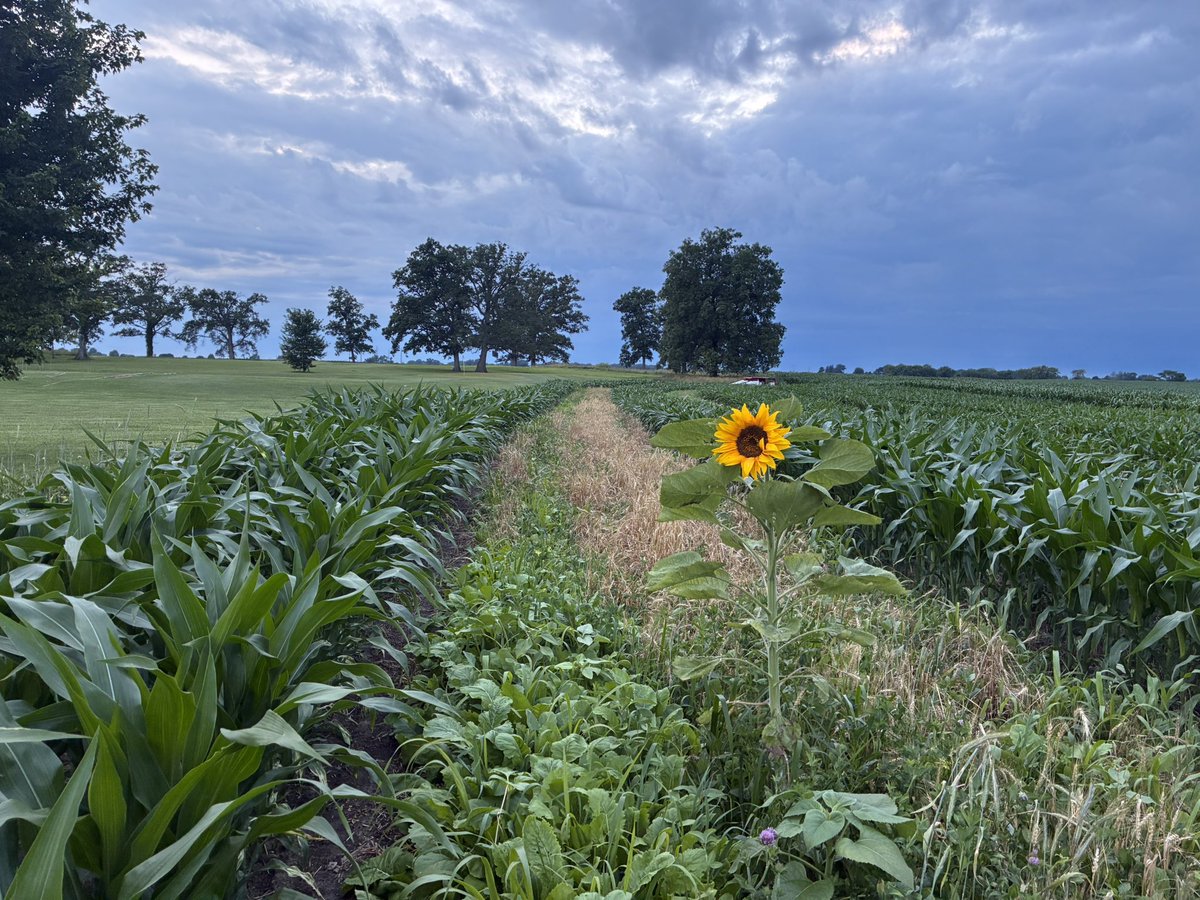
Alleys were sown in wheat last fall.
Clover was droned on in February
12 way cover was droned on when the wheat was in dough stage and pushed down with a cultipacker letting the wheat and clover live
No tillage
No chemistry
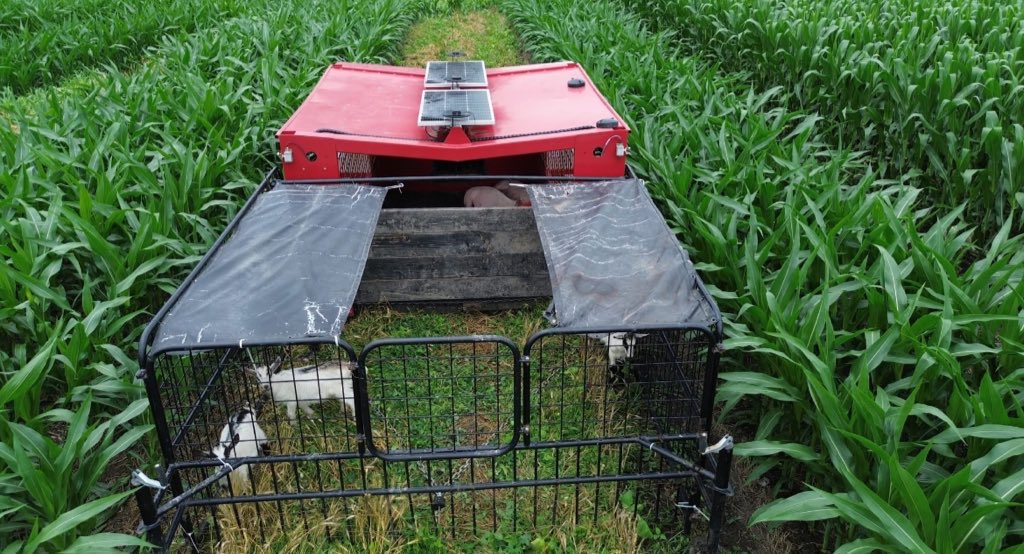
Just sequencing of plants and the impact of livestock
The science of @stockcropper is plants feeding animals and animals feeding plants… rotating crops and forage that turns biomass into fertilizer. Add the “edge effect” or overyielding of the edge rows of corn and this system is untouchable for acre profitability. It’s been proven and improved upon now for 6 years by me and @zebulousprime and backed up with 3rd party research from @PrecisionPlant
What’s funny about #farmweird is that no matter how great it gets… it’s “not feasible” because it doesn’t scale across the corn belt… but most importantly (in the lens of industry) we’ve decoupled the need and reliance for farm inputs.
I’ve always said “don’t study the ants, study the crumbs”
Response tells the truth.
So why continue to do it? Because happiness isn’t about how to get rich by selling products.
Happiness is a math formula
Quality of life + fulfillment - envy
We’re going to ride around the sun hopefully another 40 or 50 years… and get better and better at designing systems… and every year we gain more people that want to stop being a manager of death and start creating more life with more life.