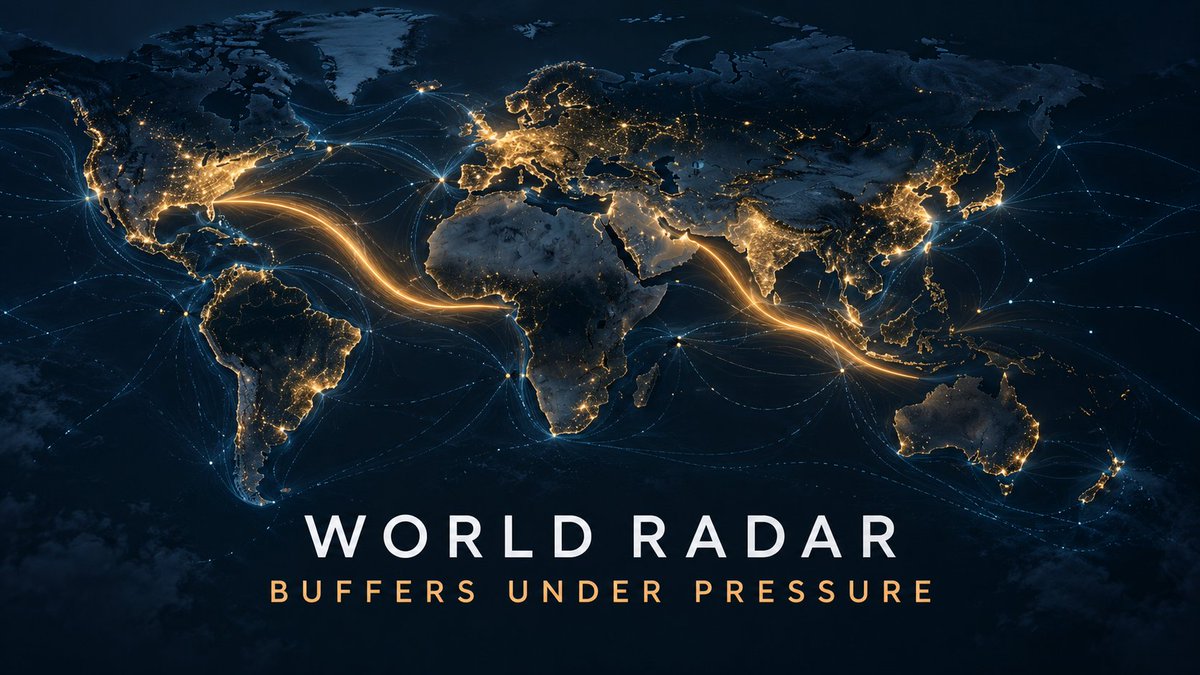
WORLD RADAR Freight is changing Asia's crude purchases. The shift is uneven.
The IEA says rerouting and ship-to-ship transfers had driven up tanker costs by mid-October. Reuters reported on Oct. 20 that some Asian refiners were buying delivered Gulf cargoes and using smaller tankers or term charters. Distant US and West African crude became less competitive.
My read through mid-November: if freight stays high across several vessel classes and Hormuz and Bab el-Mandeb routes remain inefficient, these buyers may keep favoring delivered or nearer Gulf cargoes. US and West African bookings into Asia, and the prices those exporters can command, could stay weak.
Reuters saw one VLCC route retreat from its record on Oct. 16, and one refiner still reported a positive margin. On Oct. 22, the European Commission said diesel and jet supplies were tight, with no physical shortage of either product in Europe.
Next: do rates fall across more routes, and do long-haul bookings recover?
WORLD RADAR
Energy pressure is turning into social and military risk. Crude is recovering faster than products, but diesel and infrastructure remain the weak points.
IEA October report: September Gulf crude exports reached 13.9 million barrels a day, more than 75% of pre-war levels. Middle East refined-product shipments were only 1.9 million barrels a day versus 4.7 million before the war. Global oil demand is forecast to fall by about 2.6 million barrels a day in 2026, with diesel accounting for roughly 25% of the drop. The IEA Governing Board notes that around 330 million barrels of reserves have already been released and is accelerating the remainder, including more than 20 million barrels of diesel.
My read:
If product flows (especially diesel) stay low as winter demand rises, price pressure on goods, freight and living costs in Europe, Africa and Latin America can persist even while crude recovers. This is a price and availability risk, not necessarily a physical shortage inside the EU. France’s weekend unrest (more than 500,000 protesters, roughly 2,000–2,400 arrests, arson at Limoges town hall) shows how energy and cost-of-living pressure can flip into social instability. Ukraine’s >1,000-drone strike on Russia (St. Petersburg oil terminals and depots) ignores Trump’s announced “energy ceasefire” and continues to constrain Russian refining capacity that already affects global diesel supply. Houthi attacks on Saudi airports (Riyadh, Abha and others, with dozens killed or wounded) and threats to infrastructure keep the Gulf recovery fragile.
The pressure could ease if: the IEA’s expected demand decline and refinery recovery materialise by year-end; the planned diesel release actually reaches the market; the Russia–Ukraine “energy ceasefire” (even if not mutually confirmed) de facto limits infrastructure strikes; and the Houthi–Saudi escalation does not spread to oil exports or Hormuz transit.
Next:
Do product shipments and diesel stocks recover as refineries ramp up?
Does the planned diesel release reach the market, and does the French/European cost-of-living unrest turn into sustained political pressure?
Will Ukrainian strikes on Russian oil infrastructure continue despite U.S. pressure (Trump’s diesel deal with Russia and midterm price sensitivity), and how does that affect Russian export capacity?
Will Houthi–Saudi escalation (airports, possible oil targets) and Israel’s 27 October election (Trump backing Netanyahu) change the regional risk premium?
Possible consequences (summary):
If diesel and product flows remain low into winter, Europe sees continued inflation and logistics pressure → more social instability (France-type) and political stress on governments. The Ukraine–Russia energy-strike cycle can stay active, limiting any Russian diesel contribution to the market and keeping prices elevated. Gulf fragility plus Houthi activity maintains the oil risk premium. A Netanyahu re-election or coalition instability in Israel can shift U.S.–Israel–Iran dynamics. Overall: crude recovery does not equal market normalisation — product and infrastructure risk dominate into 2027.
Riyadh airport under repeated attack. Civil aviation disrupted; a measured Saudi oil-export loss or EU physical-supply loss is not established.
AP reported another projectile hit Riyadh's passenger terminal on Oct. 11, after the Oct. 10 strike. Saudi authorities said the first attack killed 12 people and wounded more than 300. Flights were diverted and airlines suspended some service.
The Houthis claimed the attacks; the Saudi-led coalition blamed them. Open reporting does not independently establish the origin of every projectile. It does show repeated danger to civilian air travel.
Flightradar24 showed heavy disruption alongside scheduled and estimated movements. That snapshot does not establish whether the airport has fully reopened.
Next: do airline cancellations ease over 48 hours? Do verified strikes reach oil-export infrastructure?
WORLD RADAR #003 Buffers under pressure. Not an EU fuel shortage.
G7 is releasing 100 million barrels through the IEA over four months, with a front-loaded diesel release in the first 20 days. The Hormuz shock is still acute. Refined-product flows are tight.
That is pressure on the system. On Oct 2 the European Commission said EU supply was stable and saw no immediate physical security problem. High prices can become an affordability crisis before fuel runs out.
Reserves buy time. They do not show whether product flows normalize.
Other disruptions need their own evidence. AP reported Kyiv bridge closures since Oct 1, and an explosion near Bab el-Mandeb with the crew safe. Open reporting does not tie these into one supply-chain break.
Next: do the barrels reach diesel flows fast enough, and does the Commission change its physical-supply line?
Eurostat published its Q2 2026 figures on September 22. EU petroleum-oil import value was 55.8% above the 2025 monthly average. Volume was 36.7 million tonnes, 1.2% above it.
These are quarterly data, covering April to June, and not a live market update. They do not show an oil shortage in the EU or Latvia today. They show that the EU paid much more while importing a similar amount. Prices, product mix and suppliers can all affect that bill.
Higher energy costs can affect transport, food and manufacturing. How much reaches individual households depends on many decisions between the import terminal and the checkout.
ISACA released a survey on September 22 of more than 1,800 cybersecurity professionals. Eight percent said their organizations regularly run AI-specific incident-response exercises. That describes reported practice among respondents' organizations. It does not describe every business or prove that AI-related attacks are already increasing.
I will monitor one defined question through October 27: will the European Commission or the EU Oil Coordination Group officially recognise a current physical EU oil-supply problem, or announce a coordinated emergency oil-stock release specifically because of a physical shortage? A price rise alone will not meet that test. I am not assigning a probability.
The next Eurostat release on oil-import value and volume should help show whether this was mainly a cost problem or whether volumes begin to change as well.
The beginner-hiring direction from WORLD RADAR #001 remains open. I need stronger, reproducible evidence before calling it an outcome.
The next shock may already be visible.
Oil. AI. Jobs. Food. War.
Most people watch these as separate stories. They aren't.
Energy shocks raise transport costs. Transport hits food and manufacturing. Higher inflation keeps money expensive. Meanwhile, AI is quietly changing who companies hire — and who they don't.
None of this guarantees what happens next.
But the signals are starting to connect.
My watchlist for the next 3–12 months:
→ Energy stays the biggest wildcard
→ AI pressure hits entry-level work before entire professions disappear
→ Food prices become vulnerable if energy + weather move the wrong way together
→ Ukraine/Russia energy infrastructure becomes critical heading into winter
→ India keeps growing fast, but expensive energy remains a weak spot
→ One disruption in a major shipping route can still ripple through half the world
The point isn't to predict the future perfectly.
It's to notice the pressure building before everyone else is talking about it.
This is WORLD RADAR #001.
Every week I'll record the signals, make the calls — and later come back to see what I got right and what I got wrong.
No deleted predictions. No pretending.
Let's see if the future leaves footprints.
Louisiana senator Jay Morris spent two years securing Meta's largest datacenter deal. Then sold the land next to it. The denial is always the least surprising part.
Aronofsky pitched AI to Cannes execs while del Toro said he'd "rather die" than use it. Same industry, same week, completely opposite camps. The split is only getting wider.
People are booking plastic surgery consultations with AI-generated photos of themselves as the reference. Surgeons say the results are medically impossible. We built tools that make humans feel inadequate on a whole new level.
Hacking early chatbots was trivial. Now attackers exploit personality quirks, memory, and tone to manipulate AI into doing things it shouldn't. The more human these models act, the more human their vulnerabilities get.
Trump dropped AI safety review requirements hours before he signed the order. Big tech lobbied hard and won. The most powerful AI models now ship with zero mandatory federal oversight.
Google's Android XR glasses put Gemini translation and live navigation directly in your line of sight. The demo is convincing. "Almost there" from Google usually means a year away — but this time it looks real.
Ferrari is using IBM's AI to manufacture F1 superfans. Great headline, zero specifics on what that actually means. If you can't measure it, is it a product or a press release?
SpaceX filed for a $1.75T IPO. The prospectus mixes operating costs with Mars colony ambitions and Grok risk warnings. When your SEC filing reads like sci-fi, investors have to decide what they're actually buying.
SpaceX's S-1 ties exec compensation to a Mars colony and claims a $28 trillion market. The filing runs 36 pages of risk factors alone. Investors aren't buying a rocket company — they're buying a religion.
Someone used AI to reconstruct dead pilots' voices from cockpit recording spectrograms. The NTSB locked down its entire docket system to stop it. Nobody wrote rules for resurrecting the dead.