Breaking: Apple acquires MKBHD......... plugin 😅
https://t.co/ZlwINtHliJ
(But for real, I'm fascinated by this development as a longtime mVFX plugin user - we can assume this will be good for Final Cut in the next few years, and they'll probably pull support for DaVinci Resolve)
Under any circumstances
Please don't get sick in nigeria,
Eat goods foods, take care of yourself
Nigerian public hospitals is a paradox you don't want to get tangled in
@donny_4l But why he go call her by her name too
When he fit call her queen of the ayamatanga😂
Wetin dey do everybody just dey different for this country
@Teeniiola A particular gender spoke three times in this video and two of them na bambiala almajiri, of all the question you could ask, can you take him out? A 19 year old guy oo
if a guy her age mate asked her out and wasn't rich, the scene would have been different
Almajiri United
“My dad gave me this advice a long time ago when I moved into my first apartment. He even came out and changed the screws for me as soon as I moved in. Someone else recently posted about it and I thought I would share!
A good home security tip that you may have never thought about.... Most contractors install the plates with the supplied screws which are only a half inch long and come out with one kick by a burglar. He installed 4 inch screws in their place that go through the door frame and into the framing of the house. They can kick for a long time before they get tired! You can see in the picture the screw in his hand is the screw supplied with the door hardware. Making a burglar make a bunch of noise and be foiled in their initial plan can not only give you time to arm yourself but they will most likely move on to an easier target.”
~Nino Razmadze
Vibe coding is when you tell the LLM "build me x" and you don't look at the code and don't understand what is going on. You can't explain anything if you are asked.
AI-assisted coding is when you tell the AI what to do and how to do it, you read through the code to verify the implementation, you understand the code, because you came up with the architecture, AI in that case is more of a glorified typist. That is NOT vibe coding.
1. Just use PostgreSQL.
2. Self-host or use a hosted service that lets you Bring Your Own Extensions (this is the hard part)!
3. Use pg_bouncer to scale connections.
4. Use PostgreSQL SQL directly.
This covers 95% of SaaS DB needs, easily.
If you want to be a top-tier backend engineer in 2026, here’s the path I’d recommend - in roughly the order I’d take it:
1. Data Structures & Algorithms (properly)
Not for LeetCode tricks, but to build real intuition: caches, queues, heaps, indexes, bloom filters, rate limiters. You should be able to implement the basics without panic.
2. Operating Systems fundamentals
Processes vs threads, memory management, virtual memory, syscalls, file descriptors, scheduling. Backend performance issues are often OS issues in disguise.
3. Networking & Distributed Systems basics
TCP vs UDP, HTTP/1.1 vs HTTP/2 vs HTTP/3, DNS, load balancing, retries, timeouts, backpressure. If you don’t understand networks, you don’t understand backends.
4. Databases (deep, not wide)
Pick one SQL database (Postgres) and go deep:
indexes, query planners, MVCC, isolation levels, WAL, replication.
Then learn why NoSQL exists, not just when to use it.
5. Consistency, Transactions & Failure Models
CAP, consensus (Raft/Paxos at a conceptual level), idempotency, exactly-once vs at-least-once, saga patterns. This is where many “senior” engineers fall apart.
6. A systems language (Go or Rust)
Go: concurrency, networking, cloud-native systems
Rust: safety, performance, correctness
Most modern infra and backend platforms are written in one of these.
7. Concurrency & Parallelism (in practice)
Thread pools, async runtimes, event loops, actor models, work queues.
Learn how things break under load, not just how they work on paper.
8. Observability & Production Debugging
Metrics, logs, traces, SLOs, alerting, profiling.
Learn to debug memory leaks, latency spikes, and cascading failures at 3am.
9. Cloud & Infrastructure fundamentals
Containers, Kubernetes basics, autoscaling, service discovery, CI/CD.
You don’t need to be a DevOps expert, but you must understand the platform your code runs on.
10. Security fundamentals
AuthN vs AuthZ, TLS, secrets management, common attack vectors, threat modeling. Backend engineers are security engineers whether they like it or not.
The pattern here is simple:
Easy backend jobs are over. CRUD alone won’t cut it.
Strong fundamentals let you move fast, reason under pressure, and design systems that survive reality - not just pass interviews.
There are no shortcuts anymore.
But if you build these skills seriously, even if you stumble, you’ll come out dangerously competent.
To be in the top 5% as a developer especially in distributed systems - you don’t win by moving fast. You win by building depth where others skip.
Here’s what that actually looks like, in practical terms:
1. Start with fundamentals, not tools
Learn why systems fail before learning how to deploy them. Study networking (TCP, congestion, timeouts), storage (logs, indexes, compaction), and concurrency (threads, async, locks). Tools change. Physics doesn’t.
2. Build systems that can break
Don’t just read about consensus or queues - implement a toy Kafka, a basic Raft, a rate limiter, a WAL-backed store. The pain of debugging teaches you more than a thousand blog posts.
3. Develop latency intuition
Know the difference between nanoseconds, milliseconds, and seconds in your bones. Learn where time is spent: syscalls, serialization, cache misses, network hops. Top engineers think in budgets, not abstractions.
4. Learn failure modes early
Network partitions, partial writes, duplicate messages, clock skew - these aren’t edge cases, they’re the default. Design assuming things will fail and ask “what happens next?” every time.
5. Write boring, correct code
Fancy abstractions are cheap. Predictable behavior under load is rare. Prefer clarity over cleverness, invariants over hacks, and simplicity over “smart” shortcuts.
6. Practice reasoning under pressure
Distributed systems are about trade-offs: consistency vs availability, throughput vs latency, simplicity vs flexibility. Practice explaining why you chose something, not just what you chose.
7. Use AI as an assistant, not a crutch
Let AI help you explore ideas or reduce boilerplate but always understand the output. If you can’t explain it line by line, you didn’t learn it.
8. Play the long game
Muscle memory, intuition, and first-principles thinking take years. There is no speedrun. The people who “win early” by shortcuts often stall out later.
The top 5% aren’t faster typers or better prompt engineers.
They’re the ones who stayed with the hard problems long enough to truly understand them.
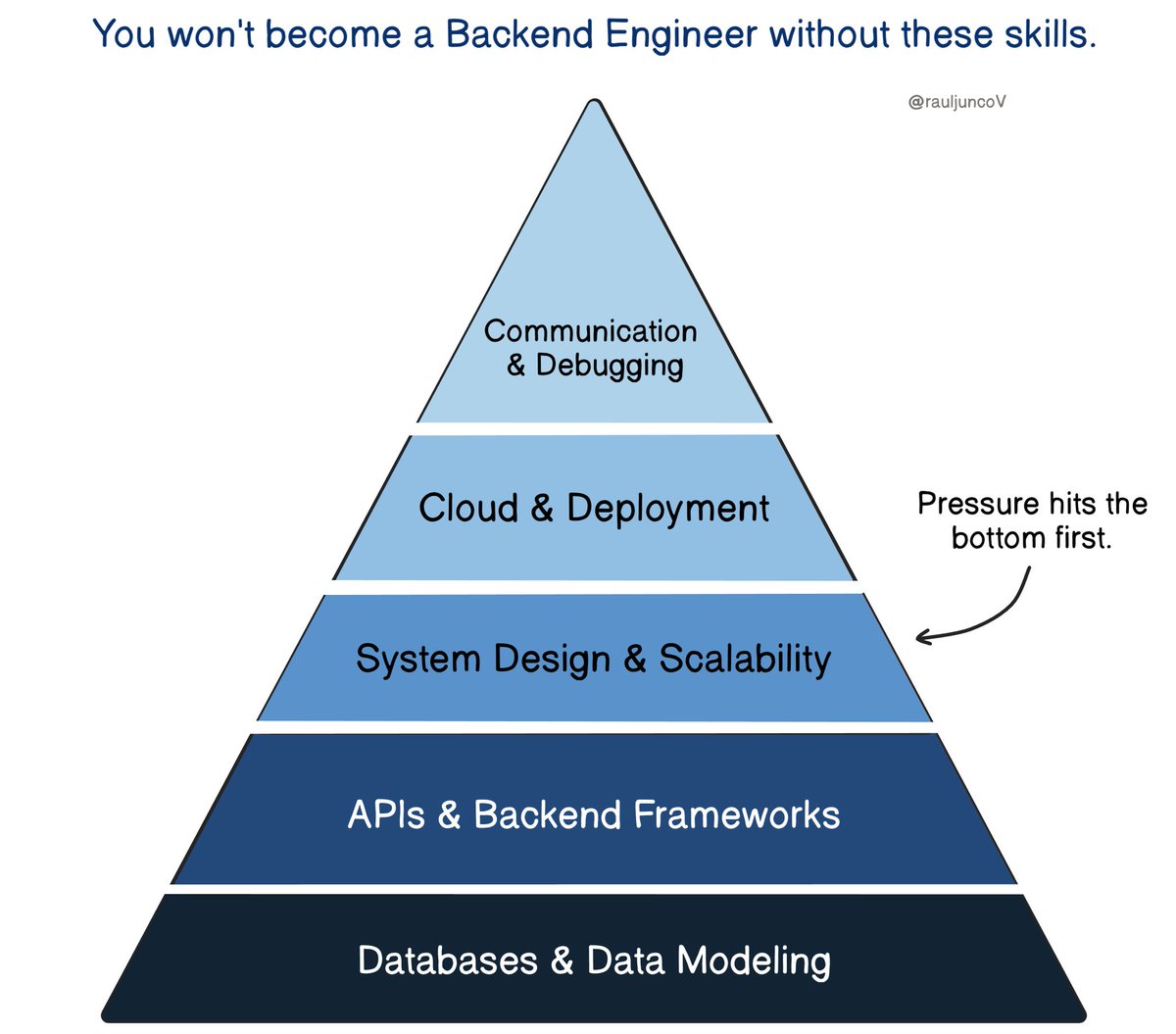
You won’t become a Backend Engineer without these skills.
Top 5 backend skills for 2026 👇
1. APIs & Backend Frameworks (≈65%)
Most backend work is exposing and consuming APIs.
You need to understand:
- REST basics (HTTP methods, status codes, idempotency)
- Authentication & authorization
- One backend framework deeply (Node, .NET, Java, Python)
How to learn APIs
- Build a CRUD API from scratch
- Add auth, pagination, validation, and errors
Build a simple order service with:
- POST /orders
- GET /orders/{id}
- PUT /orders/{id}/cancel
2. Databases & SQL (≈70% of roles)
Backend engineers live on the data path.
If you don’t understand how data is stored, queried, indexed, and locked, you will ship slow systems.
You must know:
- SQL (joins, indexes, transactions)
- When to use relational vs NoSQL
- Basic data modeling and normalization
How to learn Databases & SQL
- Learn SQL fundamentals: https://t.co/hJ7JqMuvp9
- Practice real queries: https://t.co/JOQSB30JMx
- Read Designing Data-Intensive Applications (chapters on storage & transactions)
3. System Design & Scalability (≈55%)
This separates juniors from seniors.
You must reason about:
- Read vs write paths
- Caching vs databases
- Queues, streams, and background jobs
- Bottlenecks and failure modes
Think of a backend like a restaurant:
- Front desk = API
- Kitchen = business logic
- Pantry = database
- Take-out shelf = cache
If one part slows down, everything backs up.
How to learn System Design
- Practice one problem per week (rate limiter, payment system, feed)
- Read engineering blogs (Uber, Netflix, Stripe)
- Sketch designs on paper before coding
- Join https://t.co/ZqbaD0ouL4
- Practice daily at https://t.co/VASDA2sq9G
4. Cloud & Deployment (≈45%)
Backend code that never ships is useless.
You should know:
- Containers (Docker)
- Basic cloud concepts (compute, storage, networking)
- CI/CD fundamentals
- Logs and monitoring
How to learn Cloud
- Containerize one app with Docker
- Deploy to any cloud (AWS / Azure / GCP)
- Add basic logging and health checks
Goal:
Push code → pipeline runs → service is live.
5. Communication & Debugging (≈40%)
Backend engineers solve invisible problems.
If you can’t explain:
- Why the system is slow
- Why data is inconsistent
- Why a fix is safe
You will struggle.
How to learn this
- Write short design docs for your projects
- Explain bugs out loud like a story
- Use AI for feedback with this prompt: “I’m explaining a backend issue and my fix.
Can you check if my reasoning is clear, technically correct, and easy to follow for another engineer?”
Question for you:
Which backend skill do you find hardest to master right now: databases, system design, or production debugging?
Most people think Redis is just used for caching.
But you can also use it as a vector database.
Here are a few use cases for Redis:
- Counters
- Rate limiting
- Leaderboards
- Session store
- Message queue
- Distributed locking
And of course, Redis as a vector database.
What are vectors?
Vectors are sequences of numbers that represent data.
You use an LLM to generate a vector embedding.
This allows you to do Vector Search: searching based on meaning.
Want to learn more?
Check out this article: https://t.co/qq6bLNwxyt
This is one of the simplest but very valuable AI features you can add to your applications.
---
Sign up for the .NET Weekly with 75K+ other engineers, and get a free Clean Architecture template: https://t.co/YfIcyukzaV
@asmah2107 Make your life a little easier
Use a distance/direction/timeout based update and switch to live updates when driver is close (about 150 yds) to client
You are not tracking a missile
Its just a delivery driver
@asmah2107 😶🌫️Temporary fix
create an overflow col and reset view count
Modify code to views = (overflow count * max Int value) + view count
😶🌫️ Permanent fix
Create int64 col
Modify code to inc both cols
Update new col in batches
Modify application code to use new col only
Drop old col
An engineer sees this and starts panicking.
The view counter is a signed int32 and is hours away from overflowing to -2.147B.
You're that engineer.
How do you perform a live data migration to prevent this public disaster?
I was working on gRPC today… and here’s the simplest way to understand it.
What is gRPC?
A high-performance communication framework by Google.
It lets services talk to each other using binary Protocol Buffers instead of JSON.
Why is it better than normal HTTP/HTTPS?
Because:
•It’s much faster (binary > text)
•Uses HTTP/2 → multiplexing, streaming, fewer connections
•Strongly typed contracts via .proto files
•Smaller payloads → ideal for microservices
•Supports bi-directional streaming (something REST can’t do)
When should you use gRPC?
•Microservices that talk to each other inside your system
•Real-time communication (chat, live updates, streaming logs)
•High-performance internal APIs between backend services
•When speed and low latency actually matter
When is HTTPS/REST still better?
•Public APIs (browsers, mobile clients, external partners)
•When readability matters (JSON is easier to debug)
•When you want simple CRUD endpoints
•When you don’t want the overhead of creating .proto files
Drop your questions if any🙌