Dans 50 ans, les livres d'histoire diront qu'Elon Musk a gagné une guerre que personne ne savait qu'on était en train de perdre.
Une guerre commencée il y a 100 ans, dans une cellule de prison italienne.
En 1926, Mussolini fait arrêter un intellectuel sarde de 35 ans. Au procès, le procureur aurait dit : « Nous devons empêcher ce cerveau de fonctionner pendant vingt ans. »
Il s'appelait Antonio Gramsci.
Son cerveau n'a jamais cessé de fonctionner. En prison, il a rempli des milliers de pages qui sont devenues l'un des textes politiques les plus influents du XXe siècle. Je pense qu'on est en train de vivre le moment où sa théorie s'effondre.
Laissez-moi vous expliquer.
Gramsci se posait une question simple. Pourquoi la révolution communiste a-t-elle réussi en Russie mais échoué partout en Occident ?
Sa réponse : en Occident, le pouvoir ne tient pas seulement par l'État, la police et l'armée. Il tient par la culture. Par ce que les gens trouvent normal, évident, « de bon sens ». Il appelle ça l'hégémonie culturelle.
Donc, pour prendre le pouvoir, il ne faut pas d'abord prendre le palais. Il faut d'abord prendre les esprits. Les écoles. Les universités. Les journaux. Le théâtre. L'édition. Les tribunaux. C'est la « guerre de position » : une conquête lente, institution par institution. Quand la culture a basculé, la politique suit toute seule.
Quarante ans plus tard, l'activiste allemand Rudi Dutschke en fera un slogan : la longue marche à travers les institutions.
Pendant des décennies, on a vécu avec une énigme que personne n'arrivait vraiment à expliquer.
Pourquoi presque tous les artistes sont-ils de gauche ? Les acteurs, les chanteurs, les profs, les journalistes, une bonne partie de la magistrature. Pourquoi un pays pouvait voter à droite élection après élection et voir quand même sa culture parler d'une seule voix ?
On nous répondait : « c'est parce que les gens éduqués sont de gauche. »
Je crois que la réponse est plus simple. Gramsci avait écrit la recette, et elle a été appliquée. Quand tu contrôles qui obtient la subvention, le poste, la bonne critique, le prix, l'invitation sur le plateau, tu contrôles ce qui devient « la culture ».
La même énigme existait à l'échelle du monde.
Pourquoi tant de pays en développement, notamment en Amérique latine, revotaient-ils encore et encore pour des gouvernements socialistes ou de gauche radicale ? Venezuela, Bolivie, Nicaragua, l'Argentine des Kirchner, la Colombie de Petro. L'économie s'effondrait, les cartels prospéraient, le chaos s'installait. Et pourtant le même vote revenait.
Ma conviction : la pauvreté n'était pas un accident du système. C'était un électorat. Et autour, il y avait tout un écosystème d'ONG, de médias « indépendants » et de programmes de « société civile », financé en grande partie par l'argent occidental.
Puis, début 2025, il s'est passé quelque chose que personne n'avait jamais osé faire.
Elon et DOGE ont ouvert les livres de USAID. Une agence quasi intouchable depuis 1961, des dizaines de milliards de dollars par an. La grande majorité des programmes ont été coupés, et l'agence a été absorbée par le Département d'État.
Le robinet a été fermé.
Et regardez ce qui s'est passé depuis.
Bolivie : le MAS perd le pouvoir après presque vingt ans. Équateur : Noboa réélu. Honduras : la droite reprend le pays. Chili : Kast élu. Argentine : Milei remporte largement les élections de mi-mandat.
Et il y a deux jours, le Brésil.
Jair Bolsonaro est inéligible, condamné à 27 ans de prison. La gauche pensait avoir refermé le chapitre. Lula, 80 ans, briguait un quatrième mandat face à un pays qu'on disait acquis.
Dimanche, son fils Flávio est arrivé en tête du premier tour. Plus de 47 % contre près de 45 % pour Lula. Lula lui-même a reconnu un résultat « inattendu ».
Le plus grand pays d'Amérique latine est à un second tour de basculer.
Le plus grand virage à droite du continent depuis des décennies.
Coïncidence ? Je ne crois pas. Quand le financement disparaît, le récit perd ses haut-parleurs.
Il reste un dernier vrai bastion. L'Europe.
Bruxelles finance ses propres réseaux d'ONG, avec une opacité que même la Cour des comptes européenne a pointée. Les grandes fondations comme l'Open Society de Soros. Les entités supranationales qui produisent de la norme sans jamais passer devant un électeur.
C'est la dernière forteresse de l'hégémonie culturelle. Et elle commence à se fissurer.
Je suis convaincu que tout ça va s'effondrer, et plus vite qu'on ne le pense.
Gramsci avait raison sur un point essentiel : la culture précède la politique. Mais il avait oublié que ça marche dans les deux sens. Quand une culture artificielle perd ses perfusions, ce qu'il y a de vrai en dessous remonte à la surface.
Ce qui vient après, je crois que c'est une renaissance. Une culture qui recommence à aimer la beauté, l'ambition, la science, la civilisation qui l'a fait naître.
Et dans les livres d'histoire, on se souviendra que tout a commencé quand un homme a décidé de regarder les comptes.
Il fallait quelqu'un d'assez riche pour ne dépendre de personne, d'assez fou pour s'y attaquer et d'assez libre pour encaisser la haine qui allait suivre.
Merci Elon.
Once upon a time, the narrative has been that HW3 has hit a hard, physical wall. The math required for modern autonomy—massive transformers, infinite context windows, high-dynamic-range position encoding—is simply too heavy for older 8-bit silicon. It should melt the chips or crash the memory.
But the underlying silicon architecture reveals a brilliant loophole: if you can't make the hardware physically bigger, you force the model to arrive in microscopic, HW3-sized puzzle pieces.
“Lite” doesn't mean weaker intelligence. It means hacking the physics of the chip so the exact same driving brain can survive inside a fraction of the compute budget.
Follow one piece of high-precision data through this new architecture, and the strategy stops looking like a compromise—and starts looking like a masterpiece of engineering.
🧩 The wide number is broken into HW3-sized pieces.
A newer autonomy model may want 16-bit or wider values, but an older accelerator path may be happiest with 8-bit chunks. Tesla solves that mismatch by separating the wide value into logical planes, such as the most-significant byte that carries the big shape of the number and the least-significant byte that carries the fine detail.
🧮 The neural-network accelerator performs the split itself.
Instead of dragging the data to a separate side unit just to prepare it, Tesla uses the MAC array already sitting in the AI accelerator. Simple convolution kernels like [1 0] and [0 1], applied with the right stride, let the existing hardware peel apart the upper and lower portions of the value while the data stays close to the compute path.
🔁 The pieces move through the narrow math lanes separately.
Once the wide value has been split, each smaller plane can travel through the fixed-width hardware as if it were native data. HW3 does not need to swallow the whole high-precision value at once; it can process the pieces separately while preserving their relationship.
🧷 The narrow answers are rebuilt using a cross-math trick.
To get a true 16-bit answer out of 8-bit chips, the hardware performs a four-way cross-multiplication (High-High, High-Low, Low-High, Low-Low). After those passes finish, the outputs are shifted, aligned, and summed. This is how older hardware approximates wider arithmetic—spending four cheap, narrow operations to emulate one expensive one.
📦 The rebuilt result is stored in a compact high-range format.
The pipeline still has to move and store the result, so Tesla describes formats that preserve useful numerical range inside a smaller container (using a massive 10-bit exponent and a tiny 5-bit mantissa). Instead of pushing huge raw values through every stage, the system keeps the information dense enough for older memory and bus limits.
🚚 The MAC then changes jobs from calculator to packer.
The next bottleneck is not the math itself, but the road the data travels on. Tesla uses multiplication as a transport trick: multiply one byte by a power of two, such as 128 or 256, and it shifts into the upper part of an output word; add the next byte with a weight of one, and it lands in the lower part of the same word.
🛣️ The narrow road carries more payload—safely.
Two smaller pieces of data can now ride through a narrow path as one packed word. By shifting a byte by 128 instead of 256, Tesla intentionally leaves a 1-bit "safety gap" between the packed numbers. This preserves the positive/negative sign bit, ensuring the car never mathematically confuses forward acceleration with backward braking.
📤 The payload is unpacked after the bottleneck.
Once the packed word clears the tight, heat-sensitive part of the circuit, a SIMD-style stage or downstream component splits it back into separate addressable locations. The old pipeline stays narrow where it has to stay narrow, keeping thermal limits in check, but the model receives data in a form that preserves high precision.
🌀 The most delicate position math travels in compressed form.
For transformer-style Rotary Positional Encoding (RoPE), the danger is not just moving numbers; it is preserving spatial memory. Raw angle values can drift when pushed through lower-precision hardware, so Tesla carries the angle information as logarithms. This smaller dynamic range makes them easier to transport without damaging the meaning.
💾 Compressed math saves critical RAM for long-term memory.
Keeping spatial data in log-form doesn't just save wire bandwidth; it slashes the memory footprint in the car's KV-Cache. This allows older hardware to store much longer video context—like remembering an occluded stop sign from 30 seconds ago—without overwhelming HW3's limited RAM.
📐 The old hardware carries the ingredients, not the final rotation.
The narrow path does not need to calculate the full sine, cosine, and rotation matrix by itself. It only needs to move enough compact log information forward so a higher-precision block can recover the real angle later.
📍 Precision returns exactly where the driving brain needs it.
When the data reaches the higher-precision logic block, the system uses Horner's Method to efficiently recover the angle, compute sine and cosine, and build the rotation matrix. HW3 does not need high precision everywhere; it selectively summons it exactly where the model’s memory of the scene would otherwise drift.
Together, these silicon-level translations fuse into a lifeline for legacy fleets.
Tesla isn’t taking a chainsaw to the intelligence of the car. Instead of forcing a giant software monolith through a narrow bottleneck, they’ve fundamentally redefined what 'Lite' means by changing the packaging—ensuring the heavy, next-gen logic can survive inside a much tighter, hotter compute budget.
Why does this matter? Because hardware obsolescence is the biggest anxiety in the EV world.
HW3 will never physically become AI4 or AI5. But with this architecture powering FSD v14 Lite, it doesn't have to. HW3 gets a path to stay relevant because Tesla engineered a way for 2019 silicon to fluently speak the language of 2026!
THIS by @friedberg
Not a single word is untrue
It is a clear-sighted DIAGNOSIS + WARNING of political hucksters who lie for power so they can control, cheat, steal
Highly-functioning, moral societies are built around freedom, liberty, risk and reward.
@AOC The idea that all billionaires got their money by exploiting peopl doesn't hold up to any scrutiny.
JK Rowling wrote books about cheeky wizards. I invented a better way to make virtual reality headsets and games to play on them. We just made things people wanted.
Jensen Huang just reverse-engineered why Elon Musk operates at a speed no one on the planet can match.
Three traits.
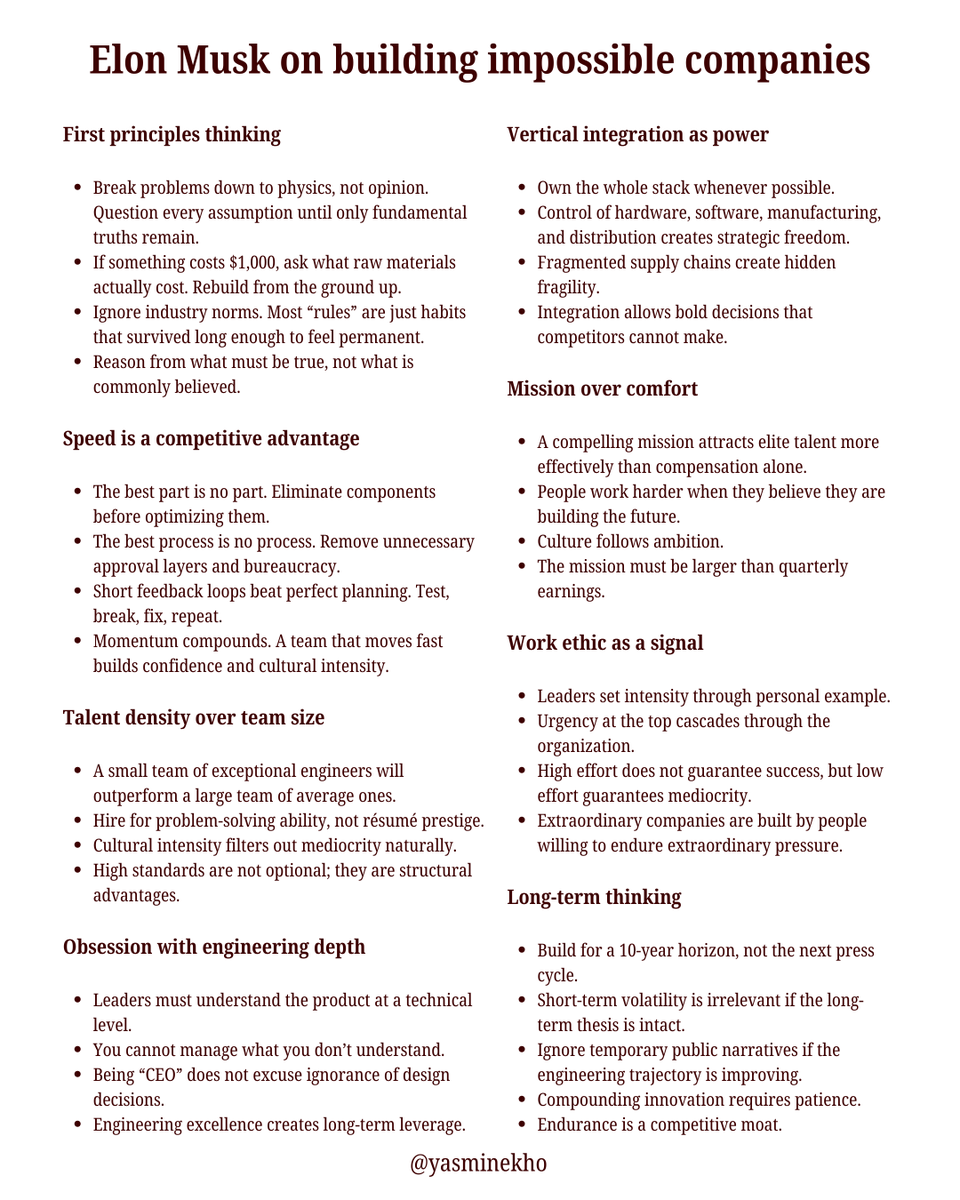
The first is deletion.
Huang: “He has the ability to question everything to the point where everything’s down to its minimal amount.”
Most engineers solve problems by adding.
Musk solves them by subtracting.
Every part. Every process. Every assumption that survived because no one had the nerve to kill it.
He picks it up. Asks if it’s load-bearing. If the answer is anything less than absolutely, it is gone.
Not simplified. Not optimized. Removed.
What survives is the skeleton. The bare physics of the problem. Nothing between intent and execution.
Huang said it plainly.
As minimalist as you could possibly imagine.
And he does it at system scale.
Not at a product level. Not at a department level.
Across entire companies. Entire industries. Entire supply chains.
He strips a rocket the same way he strips a meeting. Down to the load-bearing walls and nothing else.
The second is presence.
Huang: “He is present at the point of action. If there’s a problem, he’ll just go there and show me the problem.”
Not a Slack message. Not a report filtered through four layers of people who weren’t there when it broke.
He walks to the failure. Stands over it. Puts his hands on it.
Most executives have never seen the actual problem their company is trying to solve.
They have seen slides about it.
Read summaries of it.
Formed opinions about it in rooms that are nowhere near it.
Musk stands over the broken hardware and does not leave until it works.
That collapses the distance that buries most organizations.
The gap between something breaking and the person with authority to fix it actually understanding what broke.
In most companies, that gap is weeks.
For Musk, it is hours.
The third is the one that bends everyone around him.
Huang: “When you act personally with so much urgency, it causes everybody else to act with urgency.”
Every supplier has a hundred customers. Every vendor has a dozen priorities. Every manufacturer has a backlog stretching months into the future.
Musk makes himself the top of every single one of those lists.
Not by demanding it. By demonstrating it.
When the CEO shows up at your facility at midnight. When he is moving faster than your own internal team. When his timeline makes yours look like a suggestion.
You do not put him in the queue. You rearrange the queue around him.
Huang watched this up close.
Huang: “He does that by demonstrating.”
Not by asking. Not by negotiating. Not by leveraging a contract clause.
By moving so fast that everyone else’s normal pace feels like standing still.
Three traits. Strip everything down. Show up at the failure. Move so fast the world rearranges around you.
That is not a management philosophy.
That is why one man runs six companies while entire boards cannot keep one moving.
Elon Musk: "If somebody executes well, I'm a huge fan, and if they don't, I'm not.
I generally think it's a good idea to hire for talent, and drive, and trustworthiness. And I think goodness of heart is important—I undervalued that at one point.
So, are they a good person, trustworthy, and smart, talented, and hardworking. If so, you can add domain knowledge. But those fundamental traits, those fundamental properties, you cannot change."
Elon Musk explains his 5-step algorithm for running companies
“First, make your requirements less dumb. Your requirements are definitely dumb… It’s particularly dangerous if a smart person gave you the requirements because you might not question them enough.”
In this interview at Starbase, Elon elaborates on his methodology for shipping everything from electric cars to rockets.
Here’s his “algorithm” quoted in full from the Walter Isaacson biography:
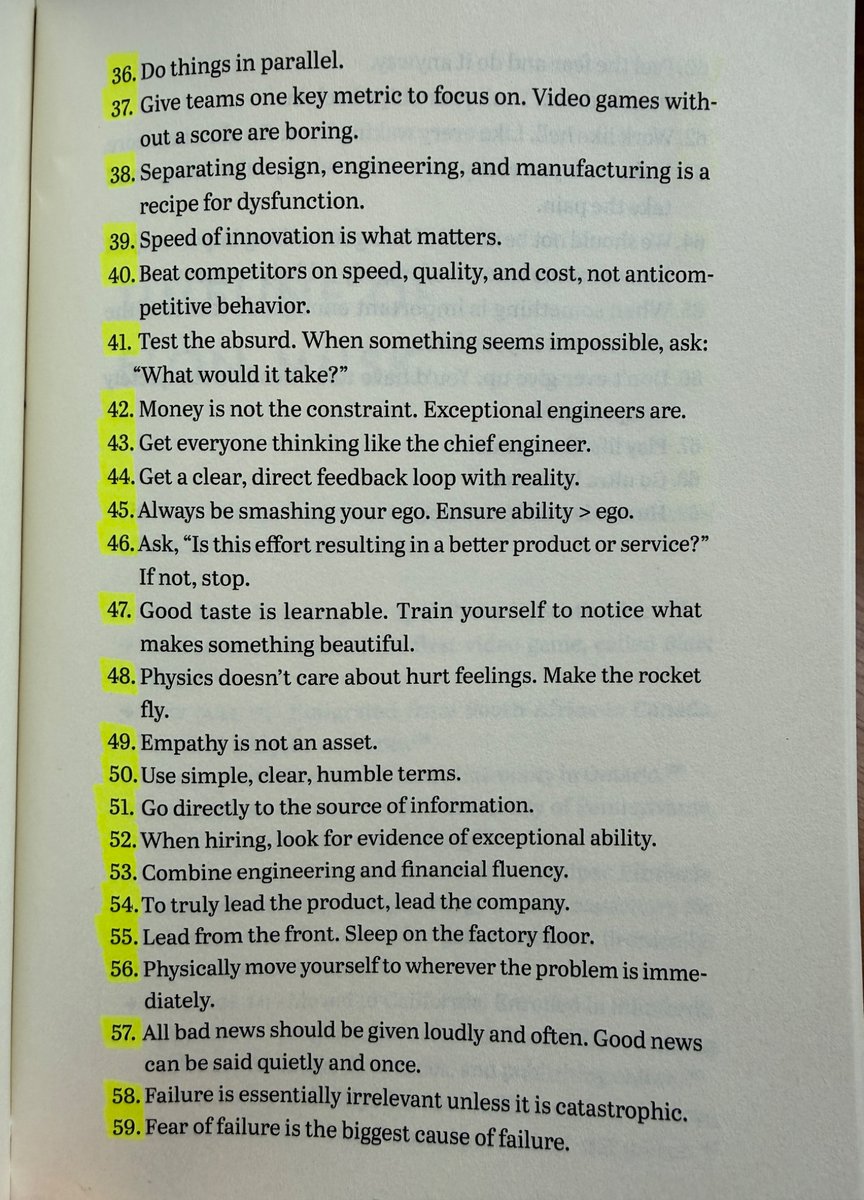
1. Question every requirement. Each should come with the name of the person who made it. You should never accept that a requirement came from a department, such as from "the legal department" or "the safety department." You need to know the name of the real person who made that requirement. Then you should question it, no matter how smart that person is. Requirements from smart people are the most dangerous, because people are less likely to question them. Always do so, even if the requirement came from me. Then make the requirements less dumb.
2. Delete any part or process you can. You may have to add them back later. In fact, if you do not end up adding back at least 10% of them, then you didn't delete enough.
3. Simplify and optimize. This should come after step two. A common mistake is to simplify and optimize a part or a process that should not exist.
4. Accelerate cycle time. Every process can be speeded up. But only do this after you have followed the first three steps. In the Tesla factory, I mistakenly spent a lot of time accelerating processes that I later realized should have been deleted.
5. Automate. That comes last. The big mistake in Nevada and at Fremont was that I began by trying to automate every step. We should have waited until all the requirements had been questioned, parts and processes deleted, and the bugs were shaken out.
Elon shares a costly example of doing this process in reverse on the Tesla Model 3 production line and optimizing a part that didn’t even need to exist.
“It’s possibly the most common error of a smart engineer to optimize a thing that should not exist. Everyone’s been trained in high school and college that you answer the question — convergent logic. You can’t tell the professor your question is dumb or you’ll get a bad grade. You have to answer the question. So everyone, without knowing, basically has this mental straight jacket on and they’ll work on optimizing the thing that should simply not exist.”
Video source: @Erdayastronaut (2021)
Elon Musk: “Anyone who wants to make more than they take has my respect”
Elon is asked for his advice for entrepreneurs, to which he responds:
“I’m a big fan of anyone who wants to build. Anyone who wants to make more than they take has my respect. That’s the main thing you should aim for: to make more than you take and be a net contributor to society.”
He compares it to the pursuit of happiness:
“If you want to create something valuable financially, you don’t pursue that. It’s best to pursue providing useful products and services. If you do that, money will come as a natural consequence of that rather than pursuing money directly. You can’t pursue happiness directly. You pursue things that lead to happiness — fulfilling work, study, friends, loved ones.”
Elon continues:
“It sounds very obvious, but generally if somebody is trying to make a company work, they should expect to grind super hard and accept that there’s a meaningful chance of failure. Then just focus on having the output be worth more than the input. Are you a value creator? That’s what really matters: making more than you take.”
Video source: @nikhilkamathcio (2025)
One of my favorite lessons I’ve learnt from working with smart people:
Action produces information. If you’re unsure of what to do, just do anything, even if it’s the wrong thing. This will give you information about what you should actually be doing.
Sounds simple on the surface - the hard part is making it part of your every day working process.
This chart explains why 90% of people never get rich.
Wealth doesn’t come from saving harder. It comes from owning things that grow while you sleep.
Most people spend their entire lives buying things that lose value.
A car that drops 30% the moment it leaves the lot.
A house that eats cash every year in taxes and maintenance.
A “safe” savings account that quietly bleeds to inflation.
That’s why this chart hits so deep because it exposes the real divide.
At the bottom, people’s net worth is packed into cars and homes.
It feels like progress, but it’s not compounding.
It just sits there.
Climb higher up the wealth ladder, and the chart flips.
The more money people have, the less they keep in stuff. Their wealth is in ownership stocks, private companies, real estate, and assets that spin off cash while they sleep.
That’s the quiet truth nobody wants to hear:
- Wealth grows slow, then all at once.
- It’s boring for a long time.
- Years of “nothing happening.”
Then one day, compounding kicks in and everything starts to move fast.
Most people never make it there.
They pull out too early, chase a trend, or get bored when it doesn’t move fast enough.
They give up in year nine of a ten-year game.
If you want to get rich, stop trying to look rich.
Own things that make money, not things that impress people.
Hold them long enough for the curve to bend in your favor.
Because the moment your money starts earning more than you do that’s when wealth stops being a goal, and starts being gravity.
The reason government programs are so inefficient is that, unlike a commercial company, the feedback loop for improvement is broken, because they have a state-mandated monopoly and can’t go out of business if customers are unhappy.
No matter how bad the service is at your DMV (sorry to pick on DMVs), you still have to use your DMV, because it’s a monopoly.
If you want to be rewarded, you have to be irreplaceable.
If you want to be irreplaceable, you have to be unique.
If you want to be unique, you have to be authentic.
If you want to be authentic, stop listening to everyone and everything else.
It’s drowning “you” out.
@naval




![tslaming's tweet photo. Once upon a time, the narrative has been that HW3 has hit a hard, physical wall. The math required for modern autonomy—massive transformers, infinite context windows, high-dynamic-range position encoding—is simply too heavy for older 8-bit silicon. It should melt the chips or crash the memory.
But the underlying silicon architecture reveals a brilliant loophole: if you can't make the hardware physically bigger, you force the model to arrive in microscopic, HW3-sized puzzle pieces.
“Lite” doesn't mean weaker intelligence. It means hacking the physics of the chip so the exact same driving brain can survive inside a fraction of the compute budget.
Follow one piece of high-precision data through this new architecture, and the strategy stops looking like a compromise—and starts looking like a masterpiece of engineering.
🧩 The wide number is broken into HW3-sized pieces.
A newer autonomy model may want 16-bit or wider values, but an older accelerator path may be happiest with 8-bit chunks. Tesla solves that mismatch by separating the wide value into logical planes, such as the most-significant byte that carries the big shape of the number and the least-significant byte that carries the fine detail.
🧮 The neural-network accelerator performs the split itself.
Instead of dragging the data to a separate side unit just to prepare it, Tesla uses the MAC array already sitting in the AI accelerator. Simple convolution kernels like [1 0] and [0 1], applied with the right stride, let the existing hardware peel apart the upper and lower portions of the value while the data stays close to the compute path.
🔁 The pieces move through the narrow math lanes separately.
Once the wide value has been split, each smaller plane can travel through the fixed-width hardware as if it were native data. HW3 does not need to swallow the whole high-precision value at once; it can process the pieces separately while preserving their relationship.
🧷 The narrow answers are rebuilt using a cross-math trick.
To get a true 16-bit answer out of 8-bit chips, the hardware performs a four-way cross-multiplication (High-High, High-Low, Low-High, Low-Low). After those passes finish, the outputs are shifted, aligned, and summed. This is how older hardware approximates wider arithmetic—spending four cheap, narrow operations to emulate one expensive one.
📦 The rebuilt result is stored in a compact high-range format.
The pipeline still has to move and store the result, so Tesla describes formats that preserve useful numerical range inside a smaller container (using a massive 10-bit exponent and a tiny 5-bit mantissa). Instead of pushing huge raw values through every stage, the system keeps the information dense enough for older memory and bus limits.
🚚 The MAC then changes jobs from calculator to packer.
The next bottleneck is not the math itself, but the road the data travels on. Tesla uses multiplication as a transport trick: multiply one byte by a power of two, such as 128 or 256, and it shifts into the upper part of an output word; add the next byte with a weight of one, and it lands in the lower part of the same word.
🛣️ The narrow road carries more payload—safely.
Two smaller pieces of data can now ride through a narrow path as one packed word. By shifting a byte by 128 instead of 256, Tesla intentionally leaves a 1-bit "safety gap" between the packed numbers. This preserves the positive/negative sign bit, ensuring the car never mathematically confuses forward acceleration with backward braking.
📤 The payload is unpacked after the bottleneck.
Once the packed word clears the tight, heat-sensitive part of the circuit, a SIMD-style stage or downstream component splits it back into separate addressable locations. The old pipeline stays narrow where it has to stay narrow, keeping thermal limits in check, but the model receives data in a form that preserves high precision.
🌀 The most delicate position math travels in compressed form.
For transformer-style Rotary Positional Encoding (RoPE), the danger is not just moving numbers; it is preserving spatial memory. Raw angle values can drift when pushed through lower-precision hardware, so Tesla carries the angle information as logarithms. This smaller dynamic range makes them easier to transport without damaging the meaning.
💾 Compressed math saves critical RAM for long-term memory.
Keeping spatial data in log-form doesn't just save wire bandwidth; it slashes the memory footprint in the car's KV-Cache. This allows older hardware to store much longer video context—like remembering an occluded stop sign from 30 seconds ago—without overwhelming HW3's limited RAM.
📐 The old hardware carries the ingredients, not the final rotation.
The narrow path does not need to calculate the full sine, cosine, and rotation matrix by itself. It only needs to move enough compact log information forward so a higher-precision block can recover the real angle later.
📍 Precision returns exactly where the driving brain needs it.
When the data reaches the higher-precision logic block, the system uses Horner's Method to efficiently recover the angle, compute sine and cosine, and build the rotation matrix. HW3 does not need high precision everywhere; it selectively summons it exactly where the model’s memory of the scene would otherwise drift.
Together, these silicon-level translations fuse into a lifeline for legacy fleets.
Tesla isn’t taking a chainsaw to the intelligence of the car. Instead of forcing a giant software monolith through a narrow bottleneck, they’ve fundamentally redefined what 'Lite' means by changing the packaging—ensuring the heavy, next-gen logic can survive inside a much tighter, hotter compute budget.
Why does this matter? Because hardware obsolescence is the biggest anxiety in the EV world.
HW3 will never physically become AI4 or AI5. But with this architecture powering FSD v14 Lite, it doesn't have to. HW3 gets a path to stay relevant because Tesla engineered a way for 2019 silicon to fluently speak the language of 2026!](https://pbs.twimg.com/media/HMDvY_uWoAAGAuj.jpg)