One thing I’ve always found strange is how much the conversation around games has shifted over the last 10–20 years.
It used to be about the games themselves. Which game was better? Which studio was more creative? Which ideas pushed the medium forward?
Now so much of the discussion seemingly only revolves around metrics: Daily active users, player counts, revenue, earnings reports, market share.
And I often wonder: Why do actual players care about any of that?
Most of the time, these numbers are discussed without any real understanding of the business behind them. People compare DAU numbers between live-service games and packaged products as if they’re measuring the same thing, when in reality they’re often completely different businesses with completely different goals.
What’s even stranger is that many indie developers have adopted the same mindset.
You’ll see some indie devs on their third or fourth game breaking down exactly how much money each project made, analyzing every chart and revenue graph. And when they talk about their games, it sometimes feels like they’re talking about stocks rather than things they spent years creating. Things they and their team was truly in love with.
I’ve always believed that every game you release should basically be an extension of yourself. That thing you’ve worked on is your baby, so you better make sure you treat it with the love and care it deserves.
If you do it right, that game becomes part of your legacy. Many years later, people will still associate it with you. That means releasing something shouldn’t be taken lightly.
Gamers are an incredibly demanding audience. They already have access to thousands of excellent games, many of them available at heavily discounted prices. Simply making ‘another one of those’ isn’t enough.
So shouldn’t our focus be on creating experiences that feel genuinely new? On pushing genres forward? On making something that leaves an impression on people?
The business side matters. Of course it does.
But I think too many developers start optimizing for metrics before they’ve created something actually worth measuring.
At the end of the day, the studios and creators that tend to endure are the ones that make products people genuinely love. The ones that solve problems, move the medium forward, and create experiences that stay with players long after they’ve put the controller down.
If I’m going to spend years of my life making something, I’d rather it have an impact on people than look good on a spreadsheet.
If you love what you do, the numbers ought to just be a side-effect.
Repent, Sinners.
The path of penance stretches ever onward. Return to Cvstodia today in The Third Sin, a FREE new expansion for Blasphemous II.
Available NOW on PC, Xbox, PS5, and Nintendo Switch. Coming to PS4 at a later date.
Find out more: https://t.co/TYRXeeN1JZ
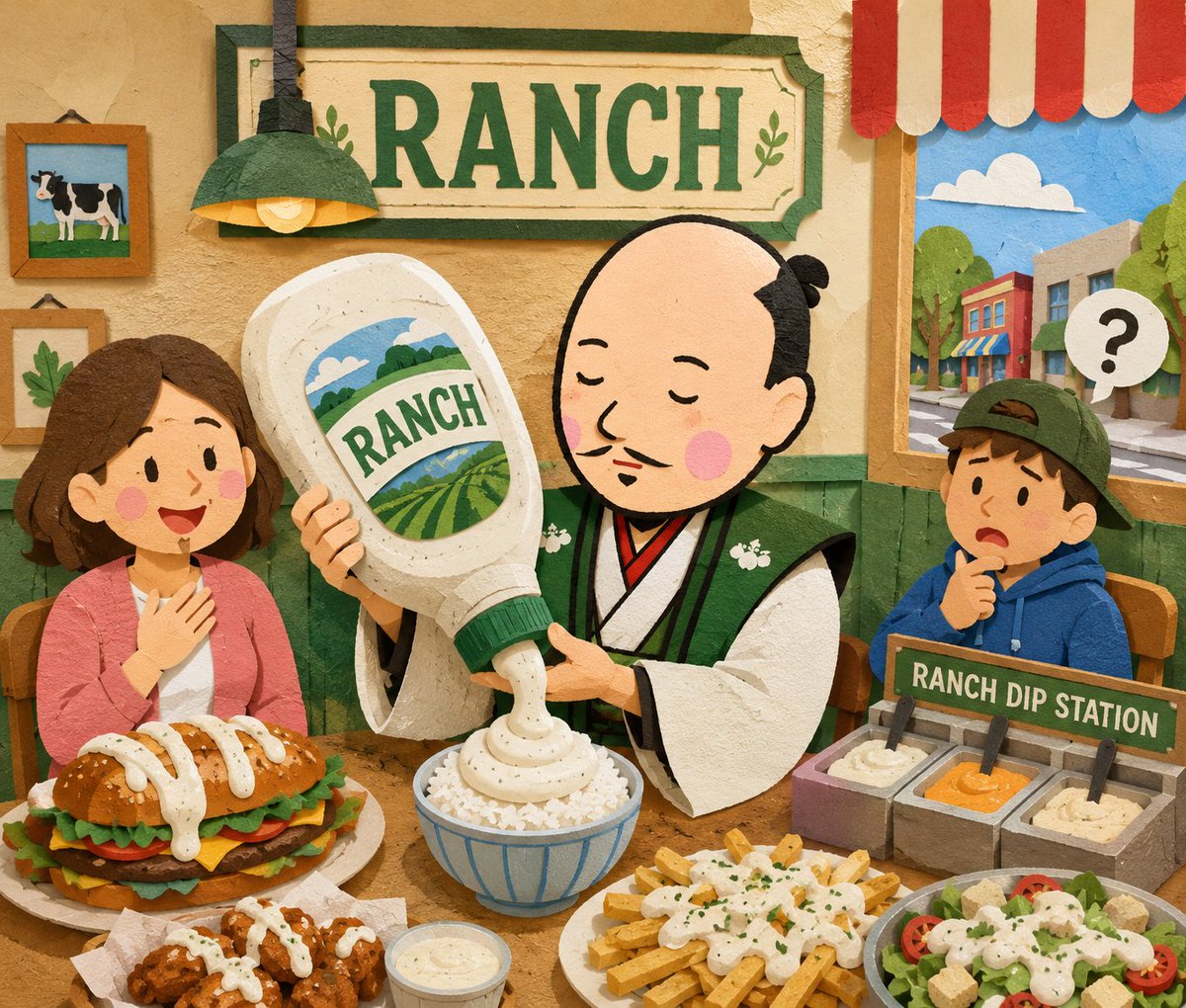
USA. There is a white sauce here that the people pour upon everything, with the devotion of a sacred rite. I have become a believer.
I noticed it slowly. A bowl of it beside the vegetables. A cup of it beside the bread. Beside the meat. Beside the other sauce. Children dipped fruit in it. A grown man beside me poured it onto a slice of pizza that already had a sauce of its own, closed his eyes, and sighed like a man coming home.
I asked its name. They told me with a small reverence: ranch.
For it is written that every great people anoints its food with one sacred thing — a drop of gold pressed from olives, a paste of beans aged in cedar. This nation has chosen a cool white elixir, and it anoints not one dish but all dishes, holding nothing back. For to leave a single food unblessed would be the deeper impiety.
So I anointed. Everything. The vegetable, yes. But also the rice. The egg. The morning fish. I would not be the one barbarian who left his plate unblessed while a whole nation dipped in joy around me.
And here my heart rose, and I declared the thing a calmer man would not:
"I will pour this holy elixir upon every food beneath the heavens — the noble and the humble, the savory and the sweet — until I find the one dish it cannot improve. And on that day I will know I have reached the very edge of the world, for everything within it has been made better by ranch."
The teenager refilling the dip station watched me anoint a bowl of rice.
"...that's a lot of ranch, my guy."
"It is the correct amount," I told him, "for a god."
I have not yet found the dish it cannot improve. I have stopped looking. So I brought a great vat of it to the next gathering and set it at the center of the table, and the whole room descended upon it with cries of joy, and a woman I had never met looked at me and said, "okay — YOU get it."
I have never felt more accepted.
So tell me, America.
You call it ranch. A condiment. A thing on the side.
I call it the one sauce a whole nation agreed to love together —
and I dip, with all of you,
gladly.
Henry Nowak died the same way a civilization dies: abandoned, handcuffed by authorities who neither trusted nor cared for him, and accused of hate crimes he did not commit. His murder is as tragic as it is enraging. He should still be alive today, and he would be if the last few generations of European elites had stood their ground against the politics of self-hatred and the mass invasion of migrants, many of whom despise the West and the people who love it.
Henry was far from the first to so needlessly lose his life, and I fear he won’t be the last. Each time a life like his is lost, the proper response—the only response—is righteous anger. One of the most important things the Trump administration has proven to the world is that stopping the flow of mass migration and defending national sovereignty is a matter of political will and leadership. Anything else is an excuse.
It is because we love the West that we want to preserve it. We love our civilization. We love our country. We love our children. And nobody—nobody—should ever die the way that Henry Nowak died. May God comfort those who loved him, and may God rest his soul.
Let me quickly summarize the new God of War Laufey controversy, but without any straw man arguments such as accusing people of "fearing women."
>western game studios were politicized thanks to activist employees and activist investors.
>some people passed the litmus test, so they understand that politicizing a fictional hobby about fun/escapism is bad.
>some failed the litmus test so they write off criticism they do not understand as "hate."
>some agree with the agenda so they write off criticism they dislike as "hate."
>underneath it all is a leftist ideology that believes attractive female characters = sexualization, objectification and misogyny... and an obsession with "diversity and inclusion."
>enter western game developers deliberately designing female fictional characters who are ugly.
>people rightly point out that she's ugly. other people get mad and incorrectly assume that means we're calling the actress ugly: we are not.
>also some people find it a bit weird that a game called God of War, which has been about Kratos, The God of War, is back-seating him for a new woman.
>some speculate that this is the result of the aforementioned politicization, because pattern recognition and the left-wing activist obsession with "inclusion."
>the God of War developers are based in California.
The end. Hope this helps.
@EndymionYT Yes, there is racism out there.
I think she's a very talent actor and did an amazing job voicing Savathun in Destiny 2 but at the same time personally I'm tired of seeing her thyroid eye bulge. It takes me out of whatever game when I see her.👀