Harvard Business School ran a study that quietly changed everything we know about AI and performance.
Here's what they found 👇
758 consultants at BCG. Controlled study. Real work tasks. Measured outcomes.
📊 Consultants using AI completed tasks 25% faster.
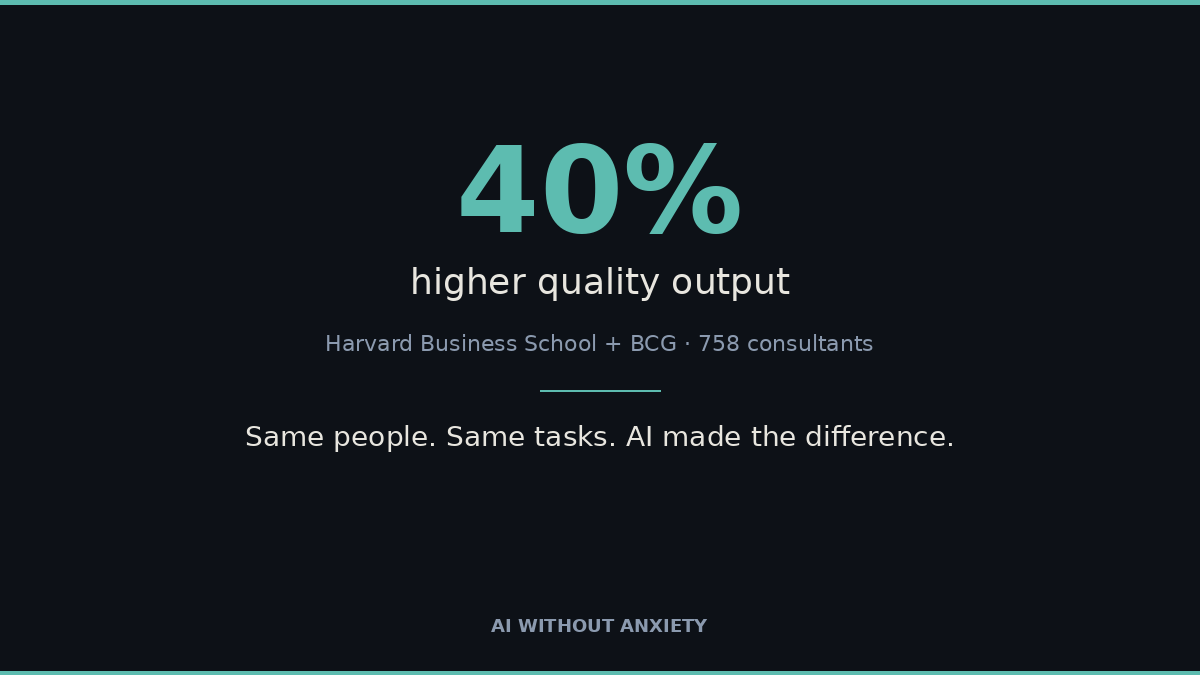
📊 Their output was rated 40% higher quality by independent evaluators.
📊 The lowest-performing consultants gained the MOST — a 43% improvement.
Read that last one again. The people who struggled most improved by 43% when they used AI well.
AI isn't replacing the best workers. It's closing the gap between the best and everyone else.
That has massive implications for your career:
▪ If you're a high performer: AI makes you faster but your relative advantage shrinks. Double down on the 8% only you can do.
▪ If you've ever felt like you're not the smartest person in the room: AI just leveled that playing field.
📊 Lightcast: AI skills pay $18,000/year more.
📊 PwC: 62% wage premium, up to 118% in some industries.
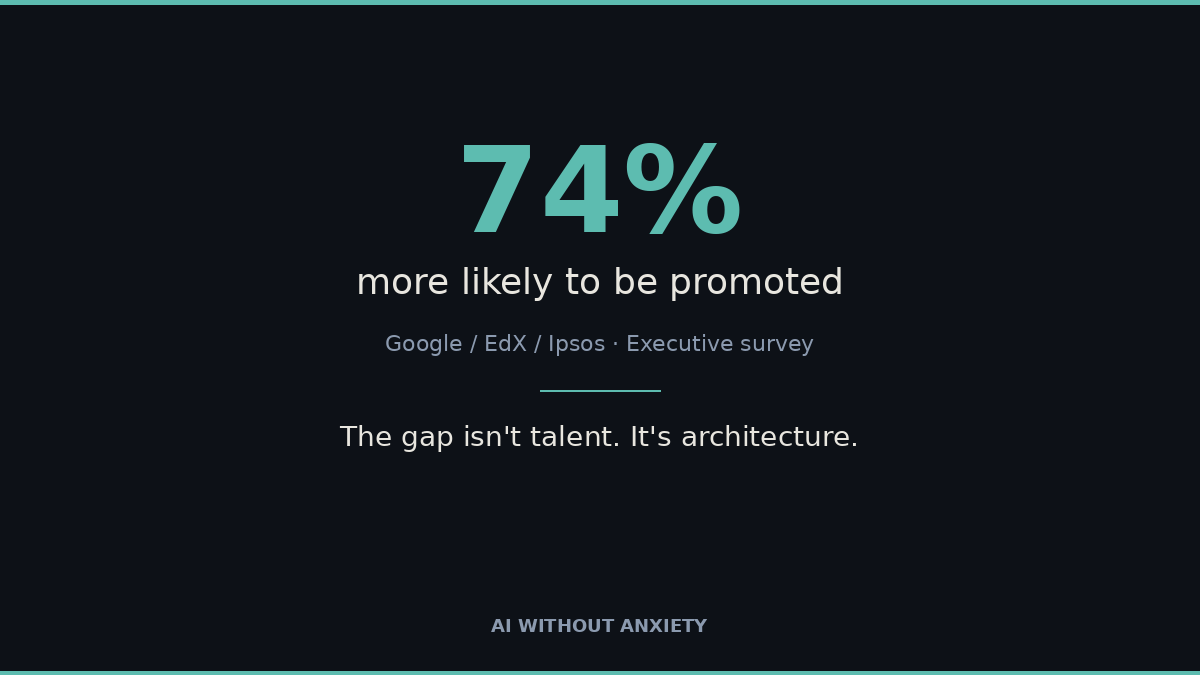
📊 74% of executives say AI-skilled employees get promoted faster.
The research is clear. The premium is real. The question is whether you map your job before or after your colleagues do.
Are you a high performer trying to stay ahead, or someone who feels like AI might be the equalizer?
Your job doesn't need you to panic about AI. It needs you to walk into one specific meeting prepared.
Here's exactly how to take this to your manager 👇
First, the stakes, in numbers you can verify:
📊 Lightcast: AI skills are worth nearly $18,000/year in higher pay for the same role.
📊 PwC: 62% average wage premium, up to 118% in some industries.
📊 Harvard/BCG: people using AI well work 25% faster at 40% higher quality.
📊 Google/Ipsos/EdX: 74% more likely promoted, 82% more likely to get a raise.
This isn't abstract. It's the gap between you and the colleague who mapped their job first.
Most people who figure out AI keep it to themselves. That's the second mistake, right after skipping the audit. The professionals getting promoted walk in and say "I've identified 40-50% of my tasks that can be streamlined," before leadership frames it for them.
Before that meeting, spend 10 minutes asking AI to play devil's advocate: "What objections might my manager raise to this, and how should I answer them?" Walk in having already heard the pushback once.
This works because of one thing leadership rarely has time to do: your manager does not know the future of your specific job. You do. You know every task, how long it takes, which ones need a human. That's leverage, if you use it first.
📊 McKinsey: 85% of corporate AI initiatives fail because nobody scoped them against real work. Walk in with a plan grounded in your actual job and you're the exception in the room.
🎁 And bring receipts on cost: there's a way to access Google's full AI certification and tooling for free, worth over $400 per person and more than $12,900 across a full team, which means you can hand your manager a real upskilling plan that costs the company nothing. The specific pathway to claim it is in the Toolkit.
Four things keep you irreplaceable once you're in that room: adaptability, learning, ideation, and bringing the first version of an idea instead of executing someone else's.
AI handles 92% of the output. That 8% is the whole conversation. Nobody's coming to hand you this.
What's the one thing you'd want to say to your manager about AI but haven't yet?
I put the complete system together — the full Job Assessment, the 4-Part Recipe, the Quadrant Exercise, the exact Boss Brief script with the devil's-advocate prep prompt, and the Google training pathway worth $400+ per person and $12,900+ across a team — for professionals to run on their own in about 2 hours.
Like this post and I'll DM it to you. 📩
The real cost of staying anxious about AI instead of mapping it, in actual dollars 👇
Start with what the market pays:
📊 Lightcast, 1.3 billion job postings: AI skills add 28% to salary, nearly $18,000 a year, for the same role.
📊 PwC, a billion job ads across six continents: 62% average premium, up to 118% in some industries.
📊 Harvard/BCG, 758 consultants: 25% faster, 40% higher quality. Lowest performers gained 43%.
📊 Google/Ipsos/EdX: 74% more likely to be promoted, 82% more likely to get a raise.
Now the cost side. 📊 McKinsey found 85% of corporate AI initiatives fail, almost always because nobody scoped the work against real, granular tasks. Most professionals are about to repeat that exact mistake with their own careers: vague anxiety, no audit, no plan for Monday.
Here's the math done right:
⏱️ 90 minutes to run a task audit.
⏱️ 16 hours a week potentially freed if 40% of your workload shifts to Buckets 1 and 2. The Fed found frequent AI users already reclaim 9+ hours weekly.
📋 40-50% of tasks mapped and ready to bring to your manager in your own words.
💰 Up to $18,000/year, the documented market premium for the skills you'd be building.
🎁 And the part that makes the whole thing pay for itself: there's a free, legitimate way to get Google's full AI certification and tooling, over $400 per person, more than $12,900 across a team. Almost nobody claims it because the door isn't obvious. The exact path is in the Toolkit.
One side of this costs you a weekend and a $0 credential. The other side costs you the raise.
Same 12 months either way. The difference is which 90 minutes you spend.
Have you ever calculated what 16 hours a week back would actually mean for your career?
I put the complete system together — the full Job Assessment, the 4-Part Recipe, the Quadrant Exercise, the exact Boss Brief script with the devil's-advocate prep prompt, and the Google training pathway worth $400+ per person and $12,900+ across a team — for professionals to run on their own in about 2 hours.
Like this post and I'll DM it to you. 📩
Nobody talks about the real reason most people think AI is "just okay."
It's not the tool. It's not the model. It's this 👇
Most people talk to AI like a search bar. One question, one answer, done. That's the mistake. AI is a collaborator, and collaborators need context.
The fix is a 4-part structure:
▪️ Role — who AI should act as
▪️ Context — what it needs to know about your situation
▪️ Command — what you actually want it to do
▪️ Format — how the output should look
Use all four, every time. Then do the one thing almost nobody does: after the Role and Context, stop. Don't state the outcome. Say "Ask me all the questions you need before you start." The output changes completely.
This is the difference Harvard and BCG measured in a controlled study: people using AI well worked 25% faster and produced 40% higher quality output. GitHub clocked developers finishing 55% faster. The skill isn't the tool. It's how you talk to it.
🎁 Now the money nobody claims. Google will currently give you its full AI certification and tooling, the real, paid, recognized stuff, for free, if you go through one specific door most people don't know exists.
Done for one person, that's over $400 in value. Done across a full team, the defensible number runs past $12,900 in free tooling and training, the kind of line item a company normally approves in a budget meeting.
Here's why it matters for your paycheck: 📊 Lightcast analyzed 1.3 billion job postings and found those same AI skills pay 28% more, nearly $18,000 a year. You'd be getting, for free, the exact skill set the market pays a five-figure premium to have. The pathway, step by step, is in the Toolkit.
Free to learn. Five figures to know. Most people will scroll right past this.
What's the worst answer AI has ever given you at work?
I put the complete system together — the full Job Assessment, the 4-Part Recipe, the Quadrant Exercise, the exact Boss Brief script with the devil's-advocate prep prompt, and the Google training pathway worth $400+ per person and $12,900+ across a team — for professionals to run on their own in about 2 hours.
Like this post and I'll DM it to you. 📩
The exact framework I use to run a full Job Assessment in under 90 minutes, no technical background required 👇
First, why this is worth 90 minutes of your weekend:
📊 Lightcast: AI skills add nearly $18,000/year to the same role.
📊 PwC: 62% average wage premium, up to 118% in some industries.
📊 Harvard/BCG: 25% faster, 40% higher quality work. Lowest performers gained 43%.
The people capturing that didn't get more technical. They got more deliberate. Here's the system:
1️⃣ List every task at the most granular level. Not "manage email." Instead: respond to client inquiries, forward requests, write weekly summaries. Granular in, useful out.
2️⃣ Sort each task into Three Buckets:
▪️ Automate It — repetitive, rules-based, no judgment. AI does this faster than you today.
▪️ Upgrade It — you still own it, but AI makes you sharper. Most of your time savings live here.
▪️ Own It — judgment, relationships, knowing which corners can't be cut. The 8% only you can do.
3️⃣ Do the math on your week. A typical professional spends ~92% of their time in Buckets 1 and 2. The Federal Reserve found AI users already save 5.4% of work hours, and frequent users reclaim 9+ hours every week. Shift even 40% of a 40-hour week and that's 16 hours back.
4️⃣ Take the results to your manager before they bring them to you.
🎁 The bonus most people miss: there's a legitimate way to get Google's full AI certification and tooling stack for free, over $400 in value per person, more than $12,900 across a team. You'd be earning, at no cost, the exact credential the market pays an $18,000/year premium for. The catch is knowing the specific path to claim it, which is in the Toolkit.
The ones getting promoted ran the audit first.
Which bucket would most of your work week fall into — Automate It, Upgrade It, or Own It?
I put the complete system together — the full Job Assessment, the 4-Part Recipe, the Quadrant Exercise, the exact Boss Brief script with the devil's-advocate prep prompt, and the Google training pathway worth $400+ per person and $12,900+ across a team — for professionals to run on their own in about 2 hours.
Like this post and I'll DM it to you. 📩
Most professionals are optimizing for the wrong thing right now.
They're trying to avoid AI. The ones pulling ahead are doing the exact opposite, and the market is paying them for it 👇
Here's what the data actually says, from sources you can check yourself:
📊 Lightcast analyzed 1.3 billion job postings. Roles requiring AI skills pay 28% more, nearly $18,000 a year more, for the same work.
📊 PwC studied close to a billion job ads across six continents. The AI-skills wage premium hit 62% in 2026, as high as 118% in some industries.
📊 Harvard Business School and BCG ran a controlled study on 758 consultants. Those using AI worked 25% faster and produced 40% higher quality output. The lowest performers gained the most: 43%.
📊 A Google/EdX/Ipsos survey of executives found AI-skilled employees are 74% more likely to be promoted and 82% more likely to get a raise.
Same job. Same company. Up to $18,000 a year and a promotion track separating the people who use AI well from the people who don't.
The gap isn't talent. It isn't being technical. It's whether you've mapped what AI means for YOUR specific job, task by task.
I call that the AWA Job Assessment. Here's the core idea:
Every job is really 30-60 individual tasks. Some AI can already do better than you. Some only you can do. Map which is which and you walk into your next review knowing exactly which 40-50% of your workload can be streamlined, and you say it first.
McKinsey found 85% of corporate AI initiatives fail, almost always because nobody scoped them against real tasks. Run the audit on your own job and you become the rare exception.
🎁 And here's what almost nobody realizes: there's a way to get Google's own AI training and tooling, the paid certification the market rewards, completely free if you know the specific door to walk through. Done right, that's over $400 in value per person and north of $12,900 across a full team. Most people never claim a cent of it, because nobody tells them where to look. I put the exact pathway in the Toolkit.
Free to learn. Up to $18,000/year to know.
It's architecture, not aptitude.
What's the one task in your job you'd hand to AI tomorrow if you knew how?
I put the complete system together — the full Job Assessment, the 4-Part Recipe, the Quadrant Exercise, the exact Boss Brief script with the devil's-advocate prep prompt, and the Google training pathway worth $400+ per person and $12,900+ across a team — for professionals to run on their own in about 2 hours.
Like this post and I'll DM it to you. 📩
Your job doesn't need you to panic about AI. It needs you to walk into one specific meeting prepared.
Here's exactly how to take this to your manager 👇
First, the stakes, in numbers you can verify:
📊 Lightcast: AI skills are worth nearly $18,000/year in higher pay for the same role.
📊 PwC: 62% average wage premium, up to 118% in some industries.
📊 Harvard/BCG: people using AI well work 25% faster at 40% higher quality.
📊 Google/Ipsos/EdX: 74% more likely promoted, 82% more likely to get a raise.
This isn't abstract. It's the gap between you and the colleague who mapped their job first.
Most people who figure out AI keep it to themselves. That's the second mistake, right after skipping the audit. The professionals getting promoted walk in and say "I've identified 40-50% of my tasks that can be streamlined," before leadership frames it for them.
Before that meeting, spend 10 minutes asking AI to play devil's advocate: "What objections might my manager raise to this, and how should I answer them?" Walk in having already heard the pushback once.
This works because of one thing leadership rarely has time to do: your manager does not know the future of your specific job. You do. You know every task, how long it takes, which ones need a human. That's leverage, if you use it first.
📊 McKinsey: 85% of corporate AI initiatives fail because nobody scoped them against real work. Walk in with a plan grounded in your actual job and you're the exception in the room.
🎁 And bring receipts on cost: there's a way to access Google's full AI certification and tooling for free, worth over $400 per person and more than $12,900 across a full team, which means you can hand your manager a real upskilling plan that costs the company nothing. The specific pathway to claim it is in the Toolkit.
Four things keep you irreplaceable once you're in that room: adaptability, learning, ideation, and bringing the first version of an idea instead of executing someone else's.
AI handles 92% of the output. That 8% is the whole conversation. Nobody's coming to hand you this.
What's the one thing you'd want to say to your manager about AI but haven't yet?
I put the complete system together — the full Job Assessment, the 4-Part Recipe, the Quadrant Exercise, the exact Boss Brief script with the devil's-advocate prep prompt, and the Google training pathway worth $400+ per person and $12,900+ across a team — for professionals to run on their own in about 2 hours.
Like this post and I'll DM it to you. 📩
The real cost of staying anxious about AI instead of mapping it, in actual dollars 👇
Start with what the market pays:
📊 Lightcast, 1.3 billion job postings: AI skills add 28% to salary, nearly $18,000 a year, for the same role.
📊 PwC, a billion job ads across six continents: 62% average premium, up to 118% in some industries.
📊 Harvard/BCG, 758 consultants: 25% faster, 40% higher quality. Lowest performers gained 43%.
📊 Google/Ipsos/EdX: 74% more likely to be promoted, 82% more likely to get a raise.
Now the cost side. 📊 McKinsey found 85% of corporate AI initiatives fail, almost always because nobody scoped the work against real, granular tasks. Most professionals are about to repeat that exact mistake with their own careers: vague anxiety, no audit, no plan for Monday.
Here's the math done right:
⏱️ 90 minutes to run a task audit.
⏱️ 16 hours a week potentially freed if 40% of your workload shifts to Buckets 1 and 2. The Fed found frequent AI users already reclaim 9+ hours weekly.
📋 40-50% of tasks mapped and ready to bring to your manager in your own words.
💰 Up to $18,000/year, the documented market premium for the skills you'd be building.
🎁 And the part that makes the whole thing pay for itself: there's a free, legitimate way to get Google's full AI certification and tooling, over $400 per person, more than $12,900 across a team. Almost nobody claims it because the door isn't obvious. The exact path is in the Toolkit.
One side of this costs you a weekend and a $0 credential. The other side costs you the raise.
Same 12 months either way. The difference is which 90 minutes you spend.
Have you ever calculated what 16 hours a week back would actually mean for your career?
I put the complete system together — the full Job Assessment, the 4-Part Recipe, the Quadrant Exercise, the exact Boss Brief script with the devil's-advocate prep prompt, and the Google training pathway worth $400+ per person and $12,900+ across a team — for professionals to run on their own in about 2 hours.
Like this post and I'll DM it to you. 📩
Nobody talks about the real reason most people think AI is "just okay."
It's not the tool. It's not the model. It's this 👇
Most people talk to AI like a search bar. One question, one answer, done. That's the mistake. AI is a collaborator, and collaborators need context.
The fix is a 4-part structure:
▪️ Role — who AI should act as
▪️ Context — what it needs to know about your situation
▪️ Command — what you actually want it to do
▪️ Format — how the output should look
Use all four, every time. Then do the one thing almost nobody does: after the Role and Context, stop. Don't state the outcome. Say "Ask me all the questions you need before you start." The output changes completely.
This is the difference Harvard and BCG measured in a controlled study: people using AI well worked 25% faster and produced 40% higher quality output. GitHub clocked developers finishing 55% faster. The skill isn't the tool. It's how you talk to it.
🎁 Now the money nobody claims. Google will currently give you its full AI certification and tooling, the real, paid, recognized stuff, for free, if you go through one specific door most people don't know exists.
Done for one person, that's over $400 in value. Done across a full team, the defensible number runs past $12,900 in free tooling and training, the kind of line item a company normally approves in a budget meeting.
Here's why it matters for your paycheck: 📊 Lightcast analyzed 1.3 billion job postings and found those same AI skills pay 28% more, nearly $18,000 a year. You'd be getting, for free, the exact skill set the market pays a five-figure premium to have. The pathway, step by step, is in the Toolkit.
Free to learn. Five figures to know. Most people will scroll right past this.
What's the worst answer AI has ever given you at work?
I put the complete system together — the full Job Assessment, the 4-Part Recipe, the Quadrant Exercise, the exact Boss Brief script with the devil's-advocate prep prompt, and the Google training pathway worth $400+ per person and $12,900+ across a team — for professionals to run on their own in about 2 hours.
Like this post and I'll DM it to you. 📩
The exact framework I use to run a full Job Assessment in under 90 minutes, no technical background required 👇
First, why this is worth 90 minutes of your weekend:
📊 Lightcast: AI skills add nearly $18,000/year to the same role.
📊 PwC: 62% average wage premium, up to 118% in some industries.
📊 Harvard/BCG: 25% faster, 40% higher quality work. Lowest performers gained 43%.
The people capturing that didn't get more technical. They got more deliberate. Here's the system:
1️⃣ List every task at the most granular level. Not "manage email." Instead: respond to client inquiries, forward requests, write weekly summaries. Granular in, useful out.
2️⃣ Sort each task into Three Buckets:
▪️ Automate It — repetitive, rules-based, no judgment. AI does this faster than you today.
▪️ Upgrade It — you still own it, but AI makes you sharper. Most of your time savings live here.
▪️ Own It — judgment, relationships, knowing which corners can't be cut. The 8% only you can do.
3️⃣ Do the math on your week. A typical professional spends ~92% of their time in Buckets 1 and 2. The Federal Reserve found AI users already save 5.4% of work hours, and frequent users reclaim 9+ hours every week. Shift even 40% of a 40-hour week and that's 16 hours back.
4️⃣ Take the results to your manager before they bring them to you.
🎁 The bonus most people miss: there's a legitimate way to get Google's full AI certification and tooling stack for free, over $400 in value per person, more than $12,900 across a team. You'd be earning, at no cost, the exact credential the market pays an $18,000/year premium for. The catch is knowing the specific path to claim it, which is in the Toolkit.
The ones getting promoted ran the audit first.
Which bucket would most of your work week fall into — Automate It, Upgrade It, or Own It?
I put the complete system together — the full Job Assessment, the 4-Part Recipe, the Quadrant Exercise, the exact Boss Brief script with the devil's-advocate prep prompt, and the Google training pathway worth $400+ per person and $12,900+ across a team — for professionals to run on their own in about 2 hours.
Like this post and I'll DM it to you. 📩
Most professionals are optimizing for the wrong thing right now.
They're trying to avoid AI. The ones pulling ahead are doing the exact opposite, and the market is paying them for it 👇
Here's what the data actually says, from sources you can check yourself:
📊 Lightcast analyzed 1.3 billion job postings. Roles requiring AI skills pay 28% more, nearly $18,000 a year more, for the same work.
📊 PwC studied close to a billion job ads across six continents. The AI-skills wage premium hit 62% in 2026, as high as 118% in some industries.
📊 Harvard Business School and BCG ran a controlled study on 758 consultants. Those using AI worked 25% faster and produced 40% higher quality output. The lowest performers gained the most: 43%.
📊 A Google/EdX/Ipsos survey of executives found AI-skilled employees are 74% more likely to be promoted and 82% more likely to get a raise.
Same job. Same company. Up to $18,000 a year and a promotion track separating the people who use AI well from the people who don't.
The gap isn't talent. It isn't being technical. It's whether you've mapped what AI means for YOUR specific job, task by task.
I call that the AWA Job Assessment. Here's the core idea:
Every job is really 30-60 individual tasks. Some AI can already do better than you. Some only you can do. Map which is which and you walk into your next review knowing exactly which 40-50% of your workload can be streamlined, and you say it first.
McKinsey found 85% of corporate AI initiatives fail, almost always because nobody scoped them against real tasks. Run the audit on your own job and you become the rare exception.
🎁 And here's what almost nobody realizes: there's a way to get Google's own AI training and tooling, the paid certification the market rewards, completely free if you know the specific door to walk through. Done right, that's over $400 in value per person and north of $12,900 across a full team. Most people never claim a cent of it, because nobody tells them where to look. I put the exact pathway in the Toolkit.
Free to learn. Up to $18,000/year to know.
It's architecture, not aptitude.
What's the one task in your job you'd hand to AI tomorrow if you knew how?
I put the complete system together — the full Job Assessment, the 4-Part Recipe, the Quadrant Exercise, the exact Boss Brief script with the devil's-advocate prep prompt, and the Google training pathway worth $400+ per person and $12,900+ across a team — for professionals to run on their own in about 2 hours.
Like this post and I'll DM it to you. 📩