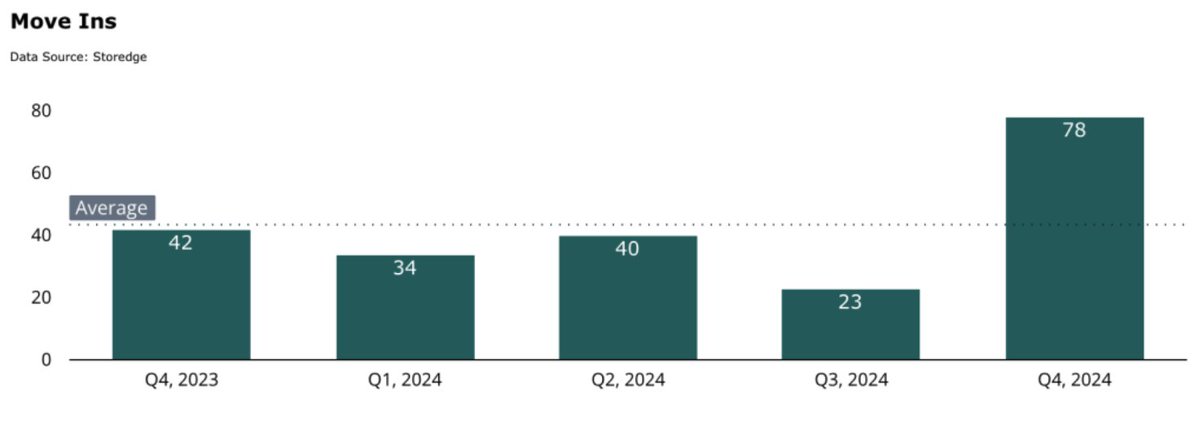
We recently helped a storage facility increase move-ins by 239% in Q4, achieve positive net move-ins, and hit #1 on Google.
An operator of a storage facility in California came to me when his occupancy dropped to 58.63%, his lowest point.
Net Move-ins had become negative each month, and their Q4 (typically the slowest season) threatened to make things worse.
We had to create a marketing plan to help turn things around quickly before the next peak season.
Our 3 Step Process:
1️⃣ SEO Overhaul:
Optimized their Google Business Profile using our 33-point GBP optimization checklist.
Improved on-page SEO of the facility page by adjusting key tags, adding internal links, and adding more content to help users convert on the page.
Implemented our title tag and meta description testing system to maximize click-through rate on Google search results and get more potential renters onto our facility page.
2️⃣ Targeted Google Ads:
Focused ad spend on users within a 5-mile radius actively searching for storage.
Implemented our ad copy testing system to find the right messaging to maximize click-through and conversion rates (phone calls + online rentals).
Paused underperforming keywords that were not cost-effective. We look at conversion volume and cost per conversion to make these decisions.
3️⃣ Conversion Rate Optimization:
Identified UX and technical issues preventing rentals on the facility pages.
We added social proof, a value prop explaining why our facility is different, and an FAQ section with common questions users ask before renting a unit.
We set up tracking in Google Analytics to understand which marketing channels were most efficient at driving online rentals, which helped us evaluate all of our changes.
📊 Results:
✅ 239% move-in growth: 23 move-ins (Q3) → 78 move-ins (Q4)
✅ Positive net move-ins even in slow months: -4 (Q3) → +28 (Q4)
With the right marketing process, even the toughest seasons can become opportunities for growth and new records.
Most storage operators think the problem with their online rental flow is too many steps.
It's almost never the steps. It's the friction.
I audited Extra Space's entire rental process recently. Six steps, a progress bar, ID capture, a protection plan step, payment. On paper that sounds like a lot to ask a customer to sit through.
But steps and friction are not the same thing.
You can have ten steps and convert better than three, as long as every step is guided and seamless. Lemonade Insurance is the best example I know of. Their quote flow has a ton of steps, but each one asks for one thing at a time, and you barely notice you're moving through it.
Now flip it. One step that requires a driver's license upload will convert worse than five steps that don't. The license is friction. The extra steps aren't.
So when your rental flow isn't converting, don't start deleting steps. Start hunting friction.
The most important part of this is that friction is a lever, not necessarily an issue.
When you need more lead volume, strip friction out. When you're drowning in low quality leads, add friction back in. An ID requirement lowers your conversion rate and raises the quality of everyone who makes it through.
Fix your lead flow first. Add friction second.
Most self-storage operators think the game is won at the top of Google.
It's not.
Ranking gets you the click. Your website gets you considered. Your rental process and call center get you the move-in. Miss one link and the whole chain breaks.
Here's the full customer journey we use at StorIQ to find where a facility is actually loosing move-ins:
1. Show up on Google, more than once. Ads, maps, organic, People Also Ask, directories. If a customer sees you 4x and your competitor 1x, you've already won the click before they've clicked anything.
2. Win the click, or skip it entirely. Copy (Ads and SEO) and reviews win the click. But if your site or rental flow is weak, stop fighting it. Run call-only and Local Service Ads and drive the call straight off Google into a call center that closes.
3. Facility page. Inventory, pricing, promos, reviews in the right spot, urgency. And marketing has to sync with revenue management.
4. Convert. Online rental, reservation, phone, live chat. Get all four dialed. And stop counting steps. Count friction. Lemonade Insurance has the most steps in insurance but the least friction (and highest conversion rate). 10 easy steps beat 2 painful ones.
5. Lead follow-up. Checkout abandonment, reservation leads, unclosed calls, live chat. Four separate follow-up systems. This is where most operators leave the most money on the table.
6. Reviews and the flywheel. A great move-in earns the review. Reviews feed visibility. Visibility feeds Step 1. The wheel spins.
One of these six is almost always your single biggest constraint. Find it, fix it, and everything downstream compounds.
Which step is leaking in your business? Happy to take a look at a facility for free. DM me.
The self-storage industry is obsessed with counting checkout steps.
Less steps good, more steps bad.
That is the wrong frame. You should not be counting steps. You should be counting friction, and deciding on purpose how much you want.
Friction is not the enemy. Friction is a dial. And which way you turn it depends entirely on your constraint.
If your problem is lead flow, turn friction down. Facility sitting at 60 percent, phone not ringing, units sitting empty. Strip everything out. No account creation, no long forms, no required fields you do not need. Every point of friction between a ready renter and a rented unit is costing you a move-in. Make it effortless.
If your problem is lead quality, turn friction up. Facility near full, drowning in tire-kickers, delinquencies climbing, staff wasting hours on people who never rent. Add friction on purpose. Require more information. Ask the qualifying question. Include upsells to capture more revenue. You are not trying to catch everyone anymore. You are trying to filter for the tenants worth having.
Same website. Same funnel. Opposite move. Because the constraint is opposite.
Most operators make the mistake of not thinking deeply about their checkout. The friction level is an accident. It was never a decision.
That is the real mistake. Not too much friction. Not too little. Random friction, tuned to nobody's constraint.
Stop counting steps. Start counting friction. Then decide, on purpose, which way to turn the dial.
Your self storage Google Ads account is wasting money right now.
On search terms you never wanted to show up for.
Someone searches for storage in a city that is 12 miles away, or one of your competitors' names, or "How to live in a storage unit." Your ad shows. You pay. Nobody moves in.
The fix is negative keywords. The problem is that managing them well is brutally tedious. You comb through search term reports, spot the junk, block it, and then do it again the next day, because new irrelevant terms show up constantly.
So most consultants and vendors do it once or twice a month. That's not negligence. It's just the ceiling of what a human can realistically do by hand across dozens of accounts.
This is a task that no human can keep up with. Not because they're lazy. Because it never stops.
So we built an AI agent that never sleeps.
It watches every account 24/7. It reads the search terms as they come in, flags the waste, and blocks the irrelevant queries automatically, before your budget gets torched on clicks that were never going to convert.
This is exactly the kind of task AI should own. It never gets bored. It never skips a week because things got busy. It works at a speed and consistency no human team can match.
Less wasted spend. More budget pointed at the searches that actually turn into move-ins.
DM me if you want to use this for your own Google Ads.
We've been running Google's new Demand Gen Maps ads for self-storage for about 3 weeks.
The data isn't exciting yet.
It's still too early to draw conclusions, but here's where things stand.
Against Local PMAX, the early numbers don't favor Demand Gen. Our Local PMAX campaigns are pulling roughly 44% higher CTR while costing about 35% less per click. Local PMAX is also driving the things that actually matter, store visits, calls, and online rentals, far more efficiently.
It's very possible Demand Gen ads are influencing renters who see the ad, remember the brand, and convert later through a different channel without ever clicking.
That's why we're about to turn on view-through conversions in the campaign setup. If these ads are doing their job, the impact should show up in assisted conversions, not last-click.
The real question we're working through is where does Demand Gen sit in the stack alongside Search, Local PMAX, and LSA?
Right now, Local PMAX is more effective. Demand Gen may end up being a brand and awareness play that lifts everything else, or it may not earn a seat at all.
We'll keep iterating and share what we find.
If you're running storage campaigns, are you testing Demand Gen Maps yet? Curious what you're seeing.
Q2 last year, a 2-facility storage portfolio did 15 move-ins for the entire quarter.
Busy season had started. They were getting buried. That's when they came to us.
Here's what we found when we looked under the hood:
→ Invisible on Google. No ads running, organic stuck on page 2, map pack floating between 8 and 10.
→ A handful of reviews, all about a year old, and nobody on the team asking for new ones.
→ A call center that was actively talking people OUT of renting. End-of-month callers were being told to wait until next month for a "better discount." They were funding their own competitors with their own phone line.
→ An online rental process buried in friction on the FMS side.
None of the fixes were glamorous:
We got them visible. Ads live, organic and map rankings climbing out of the basement.
We set up review automations and trained the team to ask customers directly at move-in.
We replaced the call center.
They switched their FMS to Cubby to clean up the online rental flow.
Here's the move-in trend that followed:
15 → 26 → 37 → 23 → 44
Almost 3x YoY growth.
None of this happened overnight, and none of it was one single tactic.
The mistake most operators make is thinking marketing is a single lever you pull.
It isn't. Your visibility, your reviews, your contact center, your checkout, your FMS all either reinforce each other or quietly cancel each other out. You can't out-market a call center that's telling people not to rent.
Marketing isn't a tactic. It's everything in your operation working together.
Google Maps drives more move-ins at a lower cost than any other channel in self-storage.
Most operators have no idea where they actually rank on it.
Not "are we top 3," but top 3 one mile out vs. five miles out, where competitive markets are quietly won and lost. One blended "average rank" number hides all of it.
That's the problem with average rank, it treats every searcher like they're standing in the same spot. They're not.
Someone searching "storage near me" from 1 mile away sees a completely different 3-pack than someone 5 miles out. Blend it all into one number and you learn almost nothing about where you're actually winning, or quietly loosing move-ins.
So we built the Google Maps Keyword Rank Tracker into StorIQ.
It scans a grid around your facility and shows your exact map position at every point, then breaks it down by distance:
→ 1 mile: where you should dominate
→ 3 mile: your core trade area
→ 5–7 mile: where competitive markets get won or lost
The metric I care about most is local market share. This is the % of grid points where you land in the top 3. Because top 3 is the line. Above it, you're visible the second someone searches. Below it, you don't exist until they tap "more places" (they won't).
Run it monthly and you stop guessing whether your SEO and review generation work is moving the needle. You watch the heat map change.
Google Maps is the highest-leverage spot in this business. You should know exactly where you rank on it, everywhere it matters.
If you want me to run a free map scan for you, just send me a DM or comment below.
Tomorrow I'm joining a webinar: "Why Your Marketing Isn't Working (And How to Fix It)."
Join us on June 24 at 2:00 PM EST for a discussion on what's working in self-storage marketing today, where operators commonly miss opportunities, and how to improve performance.
Peter Smyth, Co-Founder & CEO of White Label Storage
Tommy Nguyen, Co-Founder of StoragePug
Here's the thing. Most self-storage operators already have the basics. A website. A Google Business Profile. Aggregator listings. Some paid ads. Maybe social or email.
So why do some facilities consistently outperform others with the same tools?
The answer isn't more marketing. It's the gaps hiding inside the customer journey, the small blind spots between a renter's first search and a signed lease where rentals quietly leak out.
In this session we'll walk through the most common (and costly) marketing mistakes operators make, including:
→ Treating your Google Business Profile like a directory listing instead of the highest-leverage channel you already own
→ Leaning so hard on aggregators that you're building their audience instead of yours
→ Killing Google Ads before the learning phase ever finishes, resetting your data every time
→ Running a website that exists but doesn't convert the traffic you're already paying for
Plus a live gut-check to see where your facility actually stands across Awareness, Consideration, and Conversion.
If you operate storage and you've ever wondered whether your marketing dollars are actually working together, this one's for you.
Everyone in self-storage is optimizing the wrong layer of Google Ads.
Ad copy. Campaign structure. Keyword research. Negative lists. All of it used to be where the work lived. All of it is now a commodity.
You can open Claude or ChatGPT right now and get a solid campaign build, decent ad copy, and a respectable negative keyword list in about four minutes. So can your competitor. So can the agency down the street charging you 15% of spend to do it.
When everyone has access to the same optimization, optimization stops being an advantage.
Here's what AI can't generate for you: your data.
1) It can't tell Google which of your callers actually moved in.
2) It can't feed the algorithm your real customer match list, updated daily from your FMS.
3) It can't show Google where your tenants actually live, versus the flat five-mile radius everyone defaults to.
4) It can't score a sales call against an online rental against a reservation that converted 11 days later.
That's the part you own. And almost nobody is using it.
Most operators feed Google online rentals and call it conversion tracking. But if 35% of your move-ins happen online, you're teaching the algorithm off 35% of your most important signal and hoping it figures out the rest. It won't. Google optimizes for the cheapest, easiest conversions it can find, which is usually your existing customers and spam.
The operators winning right now aren't writing better ads. They're piping first-party data back into the platform. Real move-ins, not clicks or just form fills. They're teaching Google to find tenants, not clicks.
The tactics are a commodity. The data is your advantage.
There's a way to hack Performance Max campaigns for self-storage that forces Google to show your ads mostly in Maps. Almost no self-storage operator is using it.
Here's the part they're missing.
To change where Google places your ads, you have to remove purchases and online rentals from your campaign goals. This feels counterintuitive and looks like a bad idea on the surface.
Even ChatGPT and Claude will flag it as a mistake if you ask them to audit your campaign. But set the goals to direction requests and store visits instead. That shift is what pushes Google to show your ads way more often in Maps.
What most operators don't realize is those same campaigns are still quietly driving online rentals. They just can't see it.
Here's a real account. The goals are set to store visits and directions, so the "Conversions" column shows exactly what you'd expect: 16 direction requests, 5 store visits, one call.
Stop there and you'd assume this campaign is only good for walk-ins.
Now scroll over to "All conversions" and a different story shows up:
-begin_checkout
-add_name
-add_email
-add_phone
-add_payment_info
-web purchases
The campaign is pushing people through the online rental funnel. Those actions just don't land in the primary "Conversions" column, because you told Google to optimize for store visits and directions, not online rentals. Google only counts your chosen goal in that column. Everything else falls into "All conversions."
So you get the best of both. You force your way into Maps, and you still capture the online rentals on the side.
The catch is you have to know where to look. Check "All conversions," not "Conversions." Otherwise you'll underrate your best Maps visibility driver and maybe even pause it.
The worst time to build a new self storage marketing channel is the moment you actually need it.
By then it's already too late.
Your PPC costs spike. Or SpareFoot costs go up. Or a Google update tanks your organic overnight.
You're suddenly down move-ins, and you need them back fast, so you scramble to stand up a new marketing method new.
That is the worst possible headspace to build from.
When you're desperate for move-ins this month, every decision you make about the new channel is wrong. You judge it too early. You kill SEO at month two because it hasn't paid off yet, even though it was always going to take 6 months. You overspend trying to force results. You're not building a channel at that point, you're trying to plug a hole.
If you build a new marketing channel when you don't need it, everything changes.
You can test it properly. You can let it mature on its own timeline. You can make it sustainable, because nothing is riding on it keeping the lights on this quarter. That is the only way to build a marketing channel that is actually sustainable.
Most operators never do this. They get one or two channels working, the units fill, and they coast. Then one of those channels stops working and they panic.
Here is the rule I'd give any operator at scale:
-Minimum two channels driving move-ins. Ideally, three to five.
Not because more is always better. Because the day one channel breaks, and one always does eventually, you want the others already running. Already mature. Already yours.
The best time to build your next marketing channel was when the last one was still working.
A year ago this storage operator had their worst leasing season.
This quarter is their best, and June isn't even finished yet.
In the same quarter last year, they did 646. A 60% jump, year over year.
Move-ins by quarter:
Q2 2025: 646
Q3 2025: 820
Q4 2025: 889
Q1 2026: 918
Q2 2026: 1,040
Gross move-ins went from 646 in Q2 2025 to 1,040 this quarter. Same quarter, year over year, up more than 60%.
Here's the part most operators will get wrong about why.
It wasn't a marketing tactic. It wasn't a new campaign or a magic keyword.
After that disappointing season, they made a decision most operators never make. Instead of chasing a quick fix, they rebuilt the entire system.
-They switched their online rental process to Cubby.
-They fixed their call answering times.
-They trained their sales team to actually close.
-They built a real lead follow-up system.
-They ran their marketing, automation, attribution, and analytics through the StorIQ platform.
None of those is a silver bullet on its own. Together, they compound.
Marketing is a system, not a pile of random tactics.
Random acts of marketing can work at 5 facilities.
They fall apart at 20.
The operators who win the busy season don't win it in the busy season. They win it nine months earlier, when they decide to fix the whole operation instead of patching one piece of it.
That work doesn't show up the week you do it. It shows up in a quarter like this one.
There's no "right" online rental process for self-storage.
Anyone telling you "online-only always wins" or "reservations convert better" is skipping the part that actually matters: it depends on your market and your constraint.
Here's how I think about it.
Online-only wins in a lot of markets. Capture payment up front, lock in the move-in, done. Highest-intent tenants, fewest follow-ups.
Reservation-only can outperform when your sales team is a real competitive advantage. You're asking for less up front, so you generate more leads, but those leads are only worth something if your team is calling, texting, and closing over the phone. No sales muscle, no payoff.
Multi-step (reserve first, capture payment second) splits the difference and works well in a lot of markets. Smaller ask on step one, commitment on step two.
But here's the mistake I see operators make constantly:
They obsess over the number of steps.
Steps aren't good or bad. Friction is.
You can have a 10-step checkout that converts beautifully if every step is seamless. And you can have a 2-step checkout that bleeds conversions because you dropped a driver's license upload and asked for their Social Security number on page one.
Count friction, not steps.
Now the part most operators miss:
Friction isn't always the enemy. Sometimes it's the tool.
It comes down to your constraint:
If lead flow is the problem, strip friction out. You need volume, and every unnecessary field is a tenant you just lost.
If you've got plenty of leads but the quality is poor, add friction on purpose. The right ask up front filters out the tenants you don't want before they ever reach your team.
Same checkout. Opposite move. It depends entirely on which problem you actually have.
Optimize for your actual constraint, not for what worked at someone else's facility.
"What ROI can I expect from Google Ads or SEO?"
It's the most common question I get from storage operators. And it's the wrong one.
ROI definitely matters, but the problem is that the question treats ads or SEO as a transaction.
Spend $100, get a fixed return, every time.
They're not. Ads and SEO are a capability you build.
Think about your facility. It isn't worth more the day after you close. It appreciates as you operate it well, year after year. Google Ads works the same way. It's a system that learns, and it only gets smarter as you feed it move-in data over time.
Which means the first 90 days aren't about performance. They're about data collection. By the end of month 3, you want to see a trend in the right direction, not a finished number.
A healthy cost per move-in usually lands around $150 to $225. You rarely hit that early. You earn it.
But here's the part most operators miss:
Most of what drives your cost per move-in has nothing to do with the ads.
→ Does your online rental process actually work end to end?
→ Is your phone team closing the leads you're paying for?
→ Are you following up on leads that don't book on the first call?
→ Are your rates in the right range?
The ad gets someone to call or click. Everything after that is operations.
And that's actually one of the most underrated benefits of running ads: they expose every hole in your operation. The broken online checkout. The calls going to voicemail. The leads nobody follows up on. Ads put a spotlight on all of it, so you can fix it and optimize.
So the real question usually isn't "are the ads working."
It's "what do we need to tighten operationally to give the ads their best chance to work."
Nine times out of ten, the answer is lead follow-up or your contact center.
Every year it's the same thing in self storage.
Operators wait until May to "turn on" their marketing. New ads, a fresh SEO push, all of it kicked off right as busy season hits.
And every year it doesn't work the way they hoped.
Marketing isn't a light switch you flip. It builds slowly, and that takes time.
SEO doesn't move on your timeline. If you start optimizing in May, you're not ranking for that summer. Google needs months to crawl, trust, and reward the work. The rankings you have in June were earned back in January.
PPC isn't plug and play either. When you flip ads on in May, you're walking into a fight that's been running all year. Your competitors have been testing and feeding the platform data for months, so Google already knows which clicks turn into move-ins for them. You're starting from zero, burning budget while the system figures out who your customer even is. By the time it learns, peak season is half over.
Here's what doing it right looks like.
One of our clients had a disappointing 2025 leasing season that came in below their targets during the months that should have carried the year. So instead of waiting and hoping, they made a decision in late Q3 and early Q4 to rebuild the whole system before 2026:
1) Switched their FMS to Cubby to tighten operations and their online rental flow
2) Brought in StorIQ to rebuild their ads and lay a real SEO foundation
3) Sharpened their in-house call center process
4) Rolled out a new lead follow-up system to convert more of the demand they were already getting
None of that was a magic lever. It was months of unglamorous, consistent work, done in the off-season before anyone was thinking about busy season.
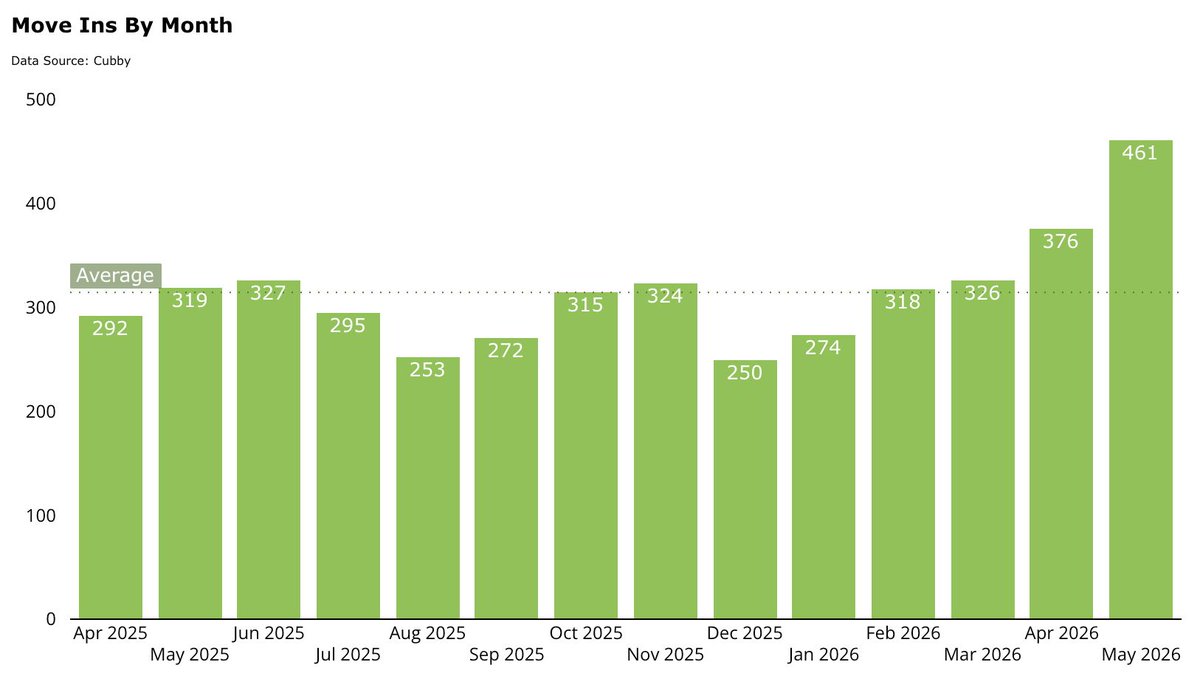
May 2025: 319 move-ins.
May 2026: 461 move-ins. Up 44%.
April was up about 29% year over year too. They went from sitting below their average to blowing past it.
That kind of jump doesn't come from one campaign. It comes from a cohesive system where operations, marketing, and follow-up all compound together, built in the quiet months.
If it were as easy as flipping ads on in May, everyone would do it.
It isn't. So they don't.
And that's exactly why there's a big opportunity for operators willing to prepare.
There's a new Google Ads campaign type opening up for storage, and the placement that matters most is Maps.
Demand Gen isn't new, but Google just made a setting available that lets you run it as Maps-only. For a hyperlocal business like self-storage, that changes the math.
Here's how it's different from the Search campaigns you already run.
Search captures demand that already exists. Someone types "self storage near me," you bid on that intent, you compete for the click. It works, but you're only reaching people who have already decided they need a unit.
Demand Gen works earlier in the funnel. Instead of keywords, it runs on audience signals across Google's visual surfaces. Normally that means YouTube, Discover, and Gmail. The problem for storage is that most of that inventory converts poorly. Nobody leases a unit because they saw an image ad before a YouTube clip.
That's what makes Maps-only worth a look. It cuts out YouTube, Discover, Gmail, and the other low-intent placements, and points your budget at the one place storage decisions actually get made.
Why it fits storage:
Storage is a geo-bound purchase. People choose based on what's near them, and Maps is where that choice happens.
You show up visually right when someone is browsing your area, including next to competitors.
You can target a tight radius around your facility's real trade area instead of a broad national feed.
It's new inventory, which usually means less competition and better cost while it lasts.
We're just starting to test this across some of the facilities we run.
Too early to report numbers, but we are already testing this new campaign type.
I'll share results once we have enough data to review.
I'm going live with StoragePug today at 2PM Eastern for their session, Guide to Google Ads.
If you operate self storage and you've ever wondered whether Google Ads are worth it, or you're running them and not sure they're working, this one's for you.
What we're covering:
-Do you actually need Google Ads? The real reasons you might, the cases where you shouldn't bother, and what to try first.
-Getting started, step by step. A live walkthrough of building a real campaign: account setup, budgeting around your expected cost per rental, location targeting, keywords, ad copy, bidding (smart vs. manual), and extensions.
-Pro tips most operators are missing. LSAs, running ads yourself vs. hiring out, structuring campaigns across multiple locations, the KPIs that actually matter, how often to check, and when to walk away.
Two things I'm especially excited to show:
-First, a brand new campaign type Google rolled out just a few days ago that almost no operators know about yet. I'll walk through what it is and why it matters.
-Second, where AI fits and where it doesn't. AI can handle the commodity side of Google Ads: campaign structure, ad copy, basic settings. What AI can't do is give you the first-party and custom data that trains Google's algorithm to get your more move-ins.
I'll show you how to build that data system and how it compounds into a real competitive advantage over time.
If you spend money on Google Ads, or you're thinking about it, this is an hour well spent.
How much should you spend on marketing for your storage facility?
Start by splitting your budget into two very different things.
SEO and organic are a fixed investment. You fund them at a steady level, they compound over time, and you don't dial them up and down month to month.
Ad spend is the opposite. It's the one lever you can actually scale, up or down, this week, at will. So the entire skill of managing a marketing budget comes down to one thing: knowing when to push ad spend and when to pull it. Set your SEO investment and leave it alone.
Then make ad spend the lever you adjust based on these signals.
Facility stage and occupancy. A lease-up heading toward stabilization spends differently than a stabilized asset. Where you are in the curve sets your goal, and the goal sets the lever.
Rentable vacancy by unit type, not overall occupancy. You can be 92% full with ten open 10x10s (your most in-demand size) and have every reason to push. Or 75% full where all the vacancy is 10x30s nobody wants, in which case more spend just buys leads for inventory you can't move. Chase the vacancy you can actually fill.
Move-out volume and trend. If move-outs are climbing, you need more move-ins just to hold, so push the lever up.
Facility size. A 600-unit facility manufactures far more monthly demand than a 200-unit one at the same occupancy. Size sets the baseline of how much refilling you're doing every month.
What organic is already feeding you. This is where your fixed SEO investment pays off. If GBP and organic are delivering steady move-ins, paid has less to carry and you can run the lever lower.
The biggest factor most operators miss: LTV to CAC, not just cost per move-in. Most operators watch cost per move-in on its own. It went up, pull back. But cost per move-in is meaningless without knowing what a tenant is worth.
A $200 a month unit with a 14-month average stay is worth over $2,800. A $300 cost per move-in is better than a 7-to-1 return, so you shouldn't be pulling back. You should be flooring it. Run that same $300 cost per move-in on an $80 unit that churns in six months and it's reckless. Same number, opposite decision. A good cost per move-in doesn't exist until you know your LTV to CAC.
Seasonality, and you have to pick a strategy. Two valid approaches:
1. Spend through the seasons. Hold the lever steady year-round and accept a higher cost per move-in in winter to capture the thin demand that's there.
2. Flex with the curve. Push up in spring and summer, pull back in winter. Your average can land in the same place, but every month is tailored to the demand in front of it.
Neither is wrong. Drifting between them by accident is.
Occupancy alone won't tell you what to spend. Cost per move-in alone won't either. They're both the same mistake with a different number.
Your self storage Google Ads account is wasting money.
Not because the setup is wrong. Because you are feeding the algorithm the wrong data.
Google's bidding is only as smart as the signals you give it. Feed it just clicks and raw phone calls and it will happily go find you more form fills and raw phone calls. None of which pay rent.
Here is the data we layer in to get Google optimizing toward the right outcome.
Online rentals.
We track the actual rental that happens on the website through GA4 and Google Ads tagging. Not a form fill. Not a button click. The completed online rental.
Verified call rentals.
A phone call is not a rental. So we go back into the FMS, check which callers actually moved in, and upload those to Google as offline conversions. Now the algorithm learns which calls turn into paying tenants, not just which ads make the phone ring.
Reservation leads that convert.
When a reservation lead becomes a paid rental, we upload that too. The lead was never the win. The paid rental is.
Conversion values.
Not every conversion matters the same to your business. The value field works as a scoring system. You are not telling Google the literal dollar amount of each action, you are ranking them against each other. An online rental scores higher than a general phone call, which scores higher than a checkout someone only started. That weighting tells Google which conversions to chase hardest and which to treat as secondary.
Scored call data.
We score inbound calls to separate real sales calls from existing tenants and spam. Without this, you are teaching Google to optimize toward your current customers asking about their gate code. With it, Google only sees the calls that can turn into revenue.
Your own customer data.
This is the one most operators sleep on. With Customer Match, you upload your own tenant data and let Google train its algorithm on who actually rents from you. It is your first party data, and it is one of the few edges a competitor genuinely cannot replicate.
Real customer location data.
The default in most accounts is a 5 mile radius. But your FMS already knows where your tenants actually come from. We use real customer location data to target the area that produces renters instead of drawing a circle on a map and hoping.
Proprietary keyword intelligence.
This comes in two parts.
First, a master negative keyword list with thousands of terms, so the day your campaign launches we are already blocking irrelevant searches and Google is wasting less of your money.
Second, a keyword list tuned across every client we run. We already know which keywords tend to convert and which ones quietly drain spend, so you are not paying to learn lessons we figured out years ago.
The setup of a Google Ads account is a commodity. Two competitors can run the exact same structure, the same keywords, the same copy.
The data is the advantage.
When you feed Google verified rentals instead of clicks or only leads, weighted by what matters, cleaned of spam, and trained on your own customers, the account stops wasting money and starts optimizing toward the only number that counts in this business. Move-ins.
That is the advantage, and it compounds every month the algorithm keeps learning.
If you want to know where your account is leaking, I will audit it for free.
I will go through your Google Ads account, show you exactly where the wasted spend is hiding, and in most cases find real money we can put back to work. No obligation to work with us after. You keep the findings either way.
I can only take 5 of these a month. If you want one of the spots, comment below or send me a DM.
Ad spend went up. Move-ins went down.
Then we changed one thing and the account broke its own record.
Scaling a self storage Google Ads account past $200K a quarter is not a budget decision.
Everyone treats it like one. Raise the ad spend, then sit around and wait for more move-ins.
It doesn't work like that.
Here's some data from a self-storage portfolio PPC account over five quarters of spend and conversions side by side:
Q1 2025: $125K spend, 2,018 conversions
Q2 2025: $176K spend, 3,175
Q3 2025: $208K spend, 3,341
Q4 2025: $221K spend, 2,908
Q1 2026: $209K spend, 3,784
Look at Q4. Highest spend of any quarter. Fewest conversions in three quarters.
That's the moment most people quit. They decide they hit a ceiling and pull the budget back.
It wasn't a ceiling. It was a signal problem. And Q4 is the quarter we fixed it.
While the numbers looked their worst, we were rebuilding what the account fed back to Google. We launched a full attribution and tracking system that quarter.
First, we stood up offline conversion tracking and started pushing real outcome data back into the account. Reservation leads, phone call leads, online rentals, confirmed phone move-ins, and confirmed reservation move-ins, all sent back so the algorithm could bid toward tenants who actually signed instead of stopping at a click.
Google optimizes toward whatever data you give it, and most accounts never give it anything past a form fill or a call.
Then we connected customer match lists and other first party data, so Google had more real signal to work with.
And we turned on our negative keyword AI agent, still in beta, to block wasted ad spend in real time and get more out of every dollar.
None of it paid off the month we flipped it on. It paid off the next quarter. Q1 2026 came back with 3,784 conversions on less spend than Q4.
The data and signals you give Google matter more than any setting or keyword in your campaign, even on a small account.
Scaling ad spend is not a straight line. The accounts that break through are the ones still working the inputs when everyone else assumes they maxed out.
Q1 hit new highs. Q2 is already pacing ahead of it.