What's next?
Addressing these challenges requires more than one perspective. Experts highlighted the need for collaboration across public health, environmental science, economics, and other fields to build healthier, more sustainable, and equitable futures.
How will changing populations shape the future of our planet? Experts from across disciplines gathered at the @JHUBloombergCtr to explore the connections between demographic shifts, environmental change, and human health at a Demographics and Planetary Health convening. https://t.co/tQbC5rU95j
Among the key takeaways:
🌍 The global population is projected to peak at 10.3 billion in the 2080s.
🌱 Seven of nine planetary boundaries have already been pushed beyond safe limits.
Researchers emphasized that population trends, environmental health, and human well-being are deeply interconnected.
A heart scan changed John Crisp's life. At 58, he had no symptoms, but a coronary artery calcium test revealed significant cardiovascular risk.
Today, 25 years of research at Johns Hopkins is helping advance earlier detection, prevention, and treatment of heart disease. #ResearchSavesLives https://t.co/JfMafQ9BBI
For Every Next First: The Campaign for Johns Hopkins aims to advance Hopkins’ mission of improving global health, research, & education. Since our founding in 1876 as America’s first research university, @JohnsHopkins has set out to carry us toward a hope we haven’t yet realized.
Recently, the university honored the winners of its annual Catalyst and Discovery awards. Congratulations to this year's recipients!
https://t.co/TdD3LNI3pY
From expanding addiction treatment to tackling food insecurity and toxic pollution, Bloomberg Fellows are turning big public health challenges into local solutions. Meet six changemakers making a difference in their communities.
https://t.co/KrAawnodRD
Just blocks from Capitol Hill at the @JHUBloombergCtr, the new Johns Hopkins School of Government and Policy will bring expertise and insights to contemporary policy challenges, from AI and technology to democratic reform and municipal governance. The school welcomes its first students in fall 2028. https://t.co/6rvywIU4JW
Nearly 5,000 Johns Hopkins University staff members and their family members recently gathered at the @marylandzoo in Baltimore for a day of celebration, connection, and fun at the university's annual Fall Fest staff appreciation event. https://t.co/Kvm8AvBtgU
Johns Hopkins University’s Class of 2030 has set new records for socioeconomic diversity. A record 26.7% of incoming students are eligible for federal Pell Grants, and 36.1% are first-generation college students or from low-income families. https://t.co/GKquQGZabl
The Veterans Memorial Wall at the Cordish Lacrosse Center honors 11 former Hopkins men’s lacrosse players who gave their lives in WWI, WWII, and Vietnam. Their names are displayed just steps from the locker room, and their legacy lives on in every team that follows. https://t.co/J4ufdTDweK
This Veterans Day, Johns Hopkins APL recognizes those who have served in the U.S. Armed Forces, honoring their service, sacrifice and continued contributions to the nation.
Katherine Hathaway draws on her military experience and MA/MBA coursework to identify overlooked needs in national defense and build a business around solving them.
This Veterans Day, we honor Katherine and those who served in our nation's armed forces.
https://t.co/rXxY2NOp8n
At its center is BodyMaps: an open medical imaging library, built at @JohnsHopkins, that anyone in the world can use.
🧭 Explore 32,768 CT volumes from 145 centers
🩻 Upload your own scan and run our AI models on it
📝 Turn scans into plain-language reports patients can actually read
Try it: https://t.co/vNCOtKctAO
Our hope is that BodyMaps becomes for cancer what the JHU COVID-19 dashboard was for the pandemic.
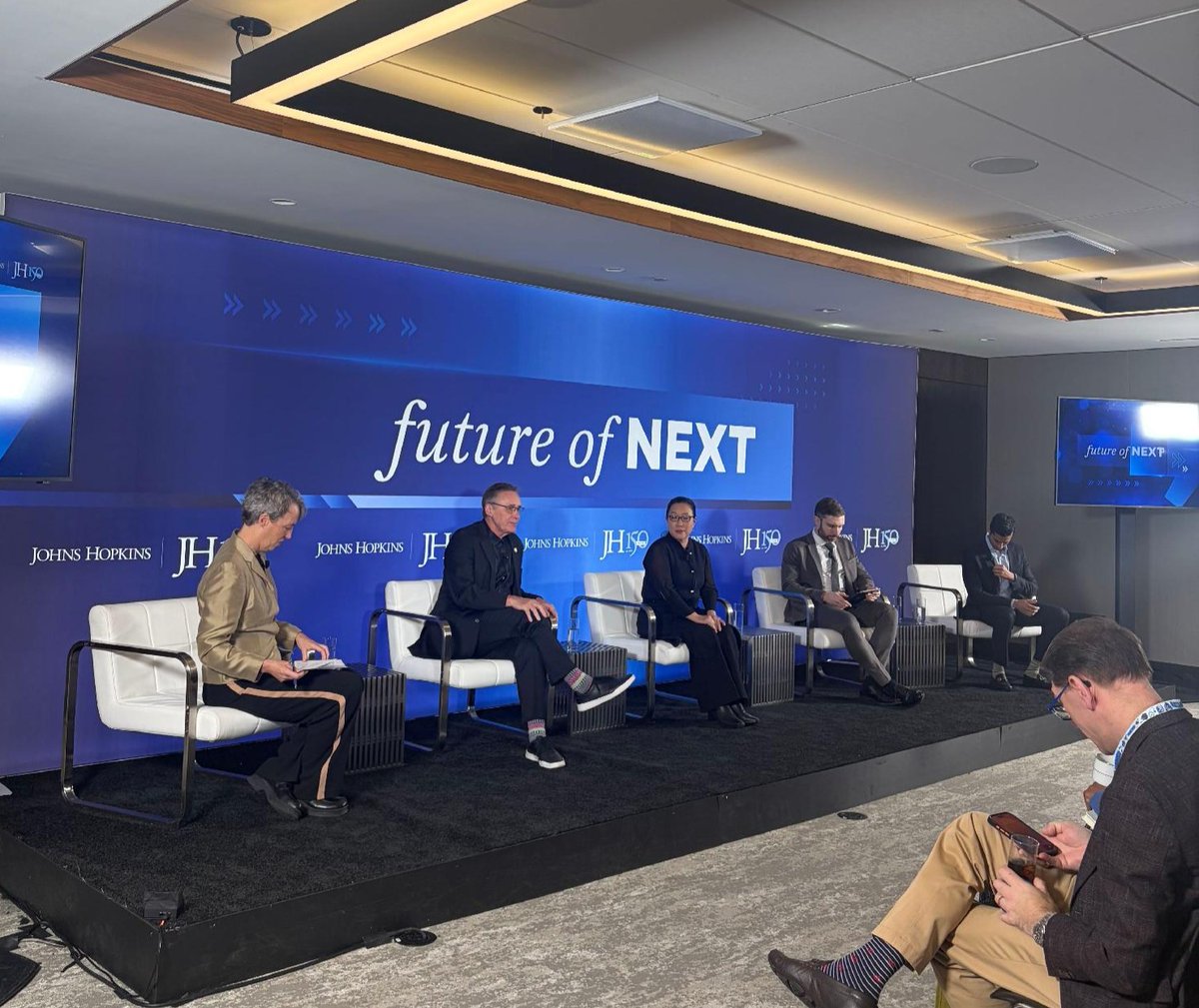
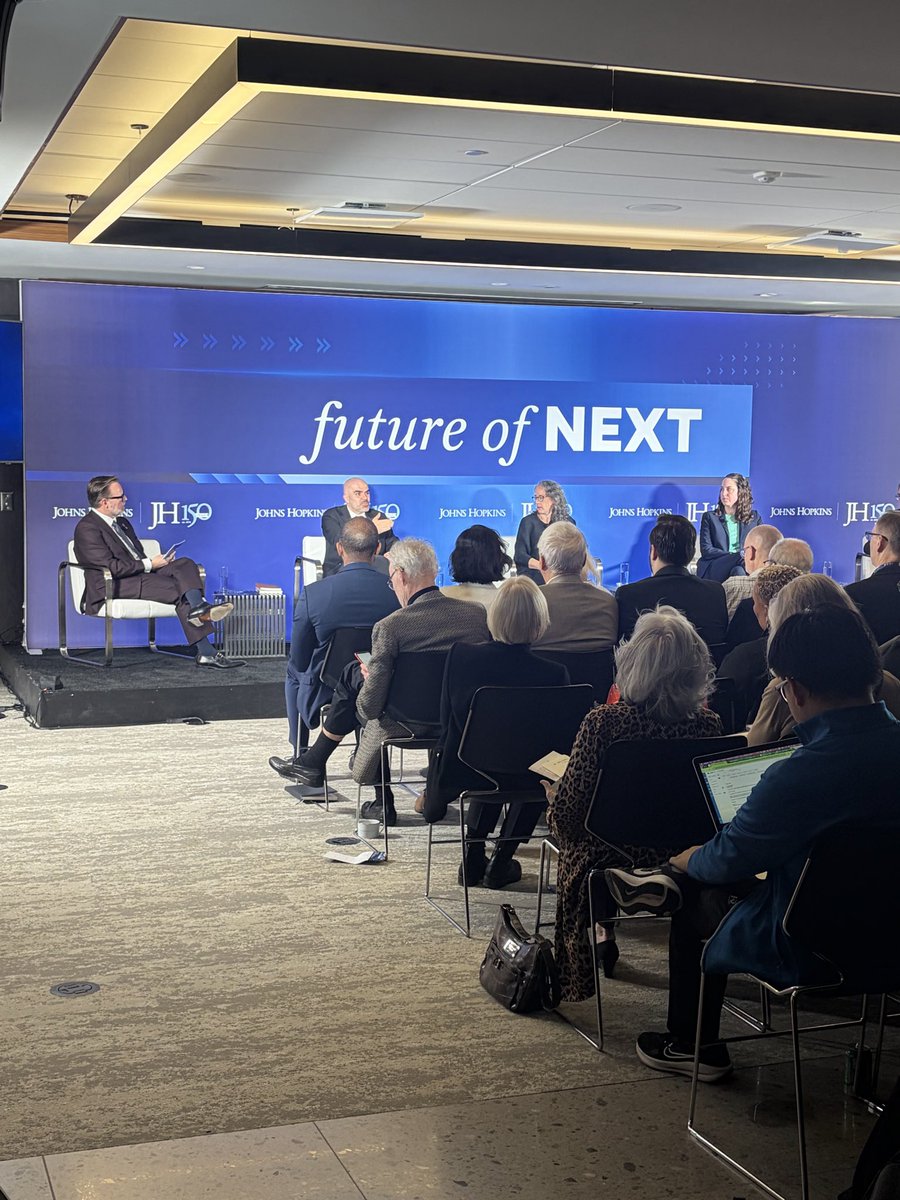
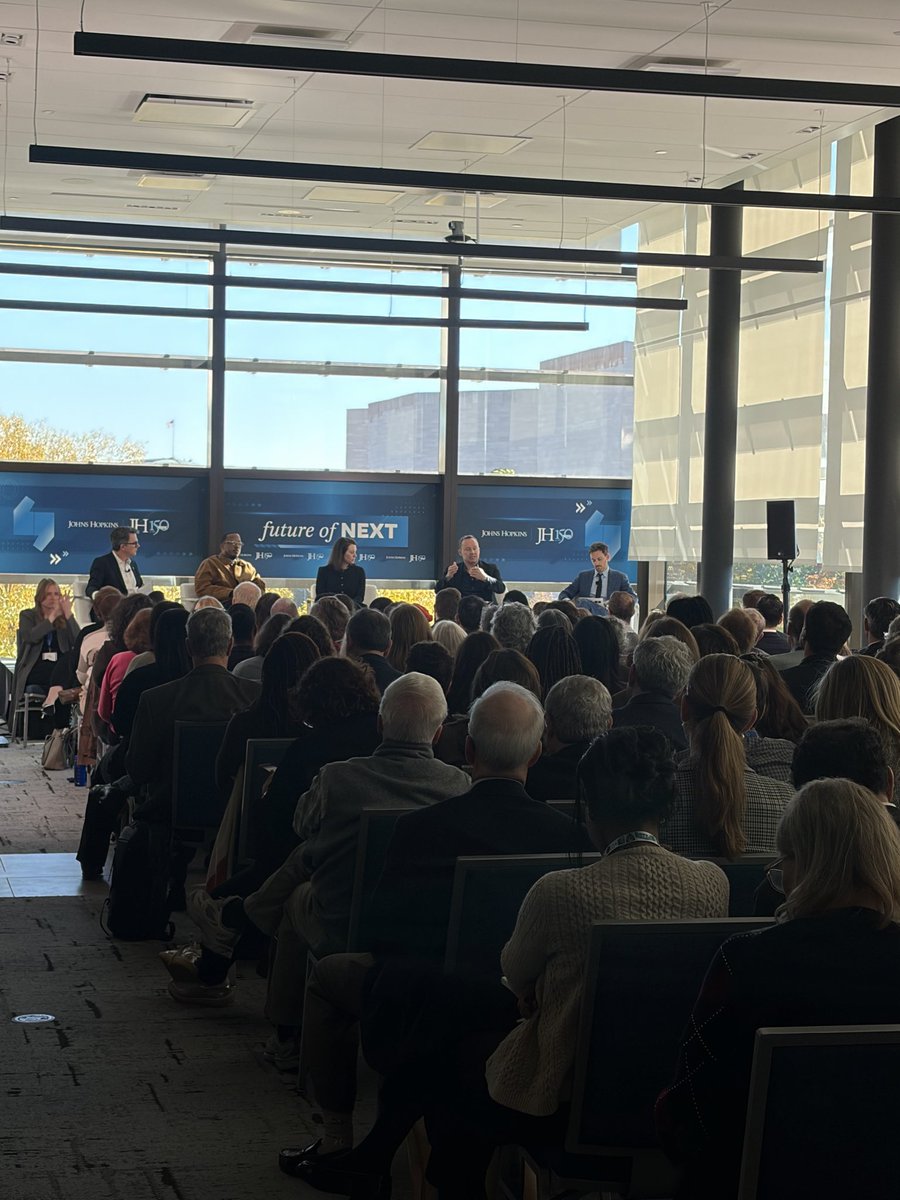
This afternoon, the lens widened from the person to the society: how we age, who holds the power in a tech-driven world, and what a city built for its people looks like. #JH150
The Future of Aging: Hopkins-led research is reshaping what we know about how brains and bodies age. The panel asks what that means for how long and how well we live, and how to age with dignity and independence, in community.
The Future of Cities: From "smart city" promise to surveillance and inequity: what changes if the data belongs to the communities it serves? The panel, featuring Mayor Muriel Bowser and Mayor Matteo Lepore, also asks what an equitable partnership between a university and its home city looks like.
What happens to art when an algorithm can make it in seconds? Lindsay Adams, Wendel Patrick, and Eric Puchner on why human creativity still matters. #JH150
Three rooms, one question: what does the future mean for you? This morning, we looked at medicine built for one patient, AI in daily life, and how communities find their way back to civic life.
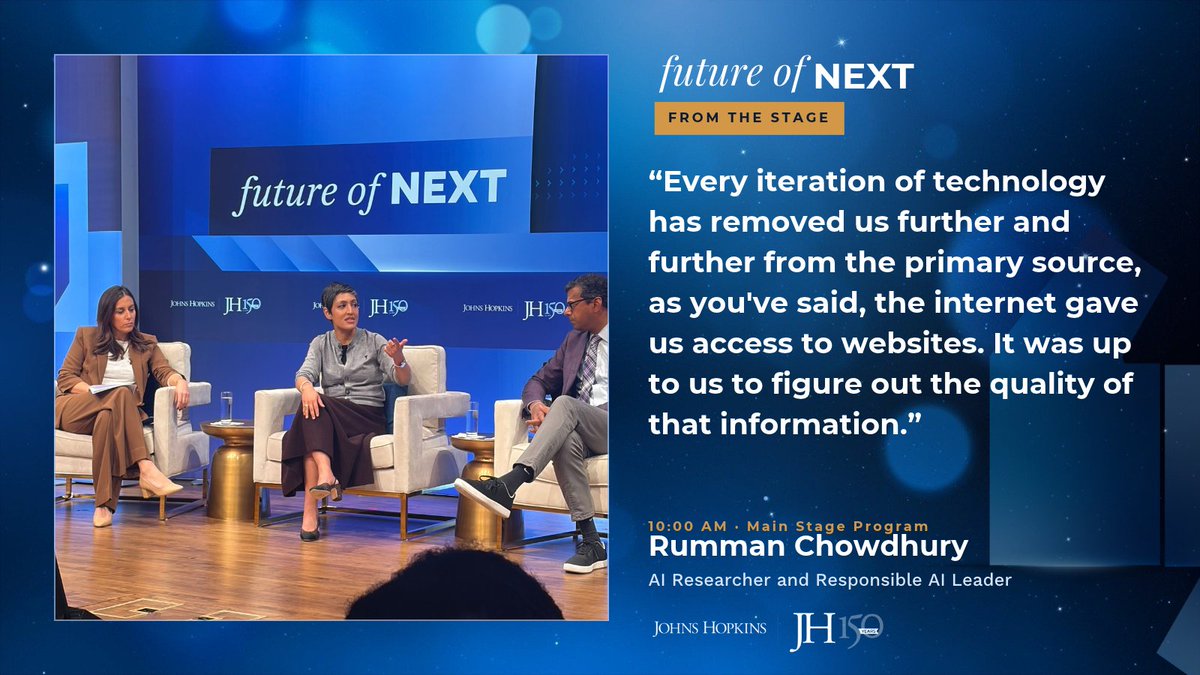
Rumman Chowdhury speaking on the Future of Next: Health, Technology, and Global Resilience panel with Atul Gawande and Anne Applebaum, moderated by Hallie Jackson. #JH150