🔸 November 11 - Saint Theodore the Studite 🔸
Today, we commemorate the Holy Confessor Saint Theodore the Studite, one of the great Iconodules (defenders of holy icons) during the Byzantine Iconoclasm. St Theodore was born in 759 in Constantinople to a pious and noble Byzantine family, and received an excellent education from the best rhetoricians, philosophers and theologians. At this time, the empire was suffering from the heresy of iconoclasm during which the imperial authorities sought to ban and destroy icons.
The First Iconoclasm (726–787) was ended by the decision of the Seventh Ecumenical Council in 787. Among the Fathers who defended Orthodoxy at this council was St Platon, an ascetic and uncle of Theodore. St Platon persuaded Theodore and his family to embrace the monastic life. Together with his father and brothers, Theodore accompanied Platon to Bithynia in 781 where they converted the family estate into the Monastery of Sakkudion. In 794, Theodore became the abbot of this monastery.
When the iconophile Empress Irene of Athens made Theodore the abbot of the famous monastery of Studios in Constantinople (today in ruins), he initiated much needed restoration works. This included the construction of a library which turned the monastery into a major scholarly centre. He also composed the “Studite Rule” to govern the monks. During the Second Iconoclasm (814-842) initiated by Leo V the Armenian, St Theodore continued to write letters condemning the iconoclasts despite repeated warnings from the emperor.
On Palm Sunday, he also made a procession with the brethren raising icons high. Not long after this provocation, he was exiled to Bithynia and later to the Anatolic Theme where he was imprisoned and cruelly flogged. Enduring his trials, the Saint was sent to Smyrna where he was kept inside a foul prison with his feet locked in stocks. After the death of Emperor Leo, the new Emperor Michael II released and freed from exile many confessors including St Theodore.
He reposed shortly after in 826. His steadfast confession was vindicated at the Council of Constantinople in 843 when icon veneration was restored under the Empress St Theodora.
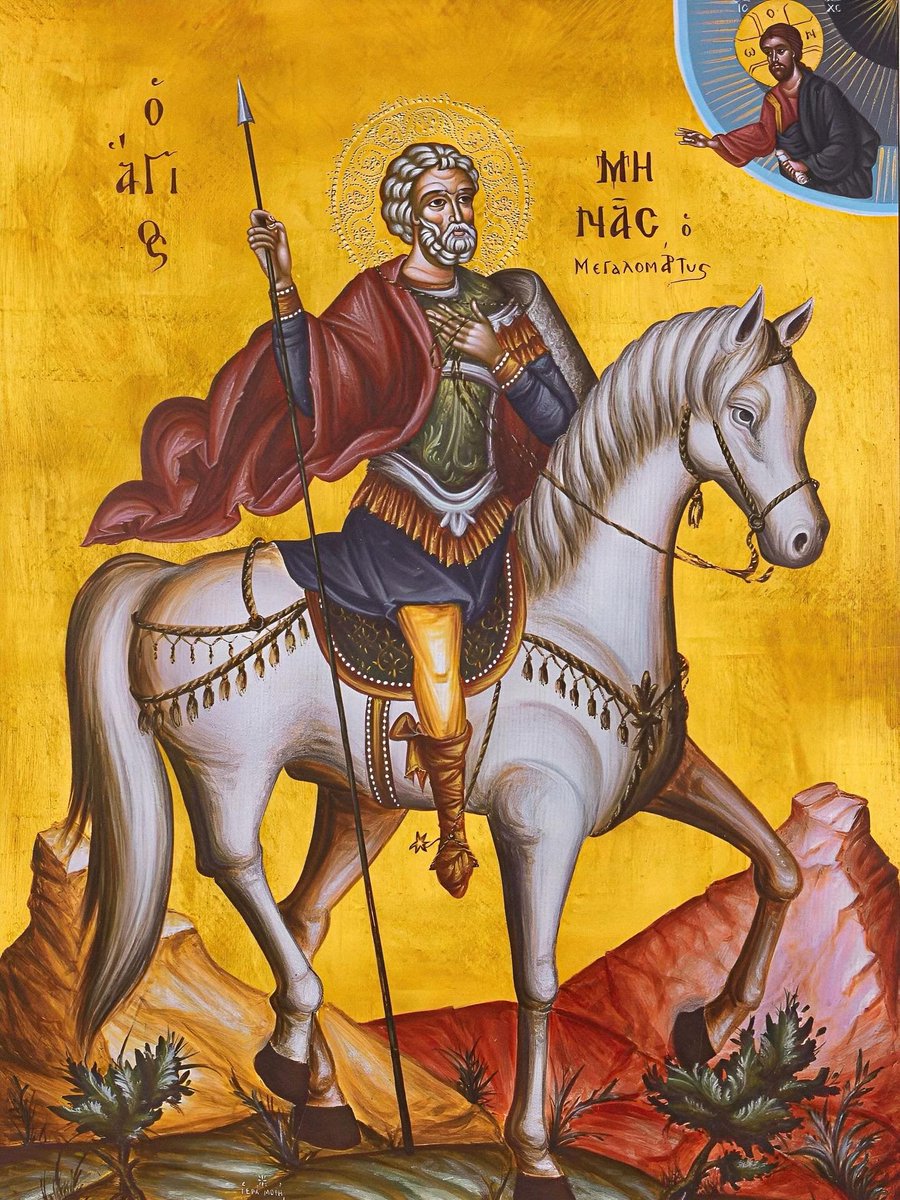
🔸 November 11 - Saint Menas the Great-Martyr 🗡️🔸
Today, we commemorate the Great-Martyr Saint Menas of Egypt. The holy military officer suffered for Christ during the reign of the Emperor Diocletian (284-305). St Menas was born in Egypt in 285 AD to ascetic Christian parents. His father, a ruler of one of the administrative divisions of Egypt, died when Menas was 14 years old. At the age of 15, Menas joined the army. He was given a high rank because of his father’s reputation, and was stationed in Cotyaeum, Anatolia (today Kütahya, Turkey).
In 298, the Emperor published an edict ordering everyone to worship the pagan idols, or otherwise face persecution, torture and death. After hearing this order, Menas gave up his military position and withdrew to a the seclusion of a mountain where he kept vigil and lived an ascetic life of fasting and prayer. Living as hermit, the Saint purified himself of every passion of the soul and body. Whilst in prayer, he heard a divine voice call to him: “Blessed are you, Abba Menas, because you have been called for the pious life from your childhood. You shall be granted three immortal crowns; one because of your celibacy, the second because of your asceticism, and the third for your martyrdom.”
With his heart aflame with love for God, Menas left the mountain and bravely returned to the city, where the people were celebrating a pagan festival. Standing in the midst of the crowd, Menas triumphantly declared Christ as the One True God, and shouted that the pagan idols were nothing more than inanimate objects made of metal, wood, and stone. Menas was beaten and thrown into prison for this outburst by the Roman authorities, and was brought before Pyrrhus, the city prefect.
Phyrrus offered to restore Menas to his former rank in the Army if he would offer sacrifice to the pagan gods, but St Menas affirmed that he would never deny Christ. After suffering many tortures including being bound to a wooden post and having his skin flayed with sharp metal hooks, he finally received the crown of martyrdom by beheading in the year 304. The valour with which he suffered for Christ converted many pagans to the True Faith.
🔸 November 10 - Saint Arsenios the Cappadocian 🔸
Today, we commemorate Saint Arsenios the Cappadocian, the wonderworking priest who baptised the infant Saint Paisios of Mount Athos, and led his flock through the hardships of the Greek-Turkish population exchange. St Arsenios was born in 1840 in Varasos (today Çamlıca, Yahyalı), one of six Christian villages in the Farasa region of Cappadocia. Although Cappadocia had been under the yoke of the Turks since the 11th century, it still retained a sizeable presence of Orthodox communities into the 20th century.
After receiving his education in Nigde, St Arsenios became a monk. He was then sent to serve in his native region of Farasa as a priest. During this time of great turmoil and hostility towards the Christians of Asia Minor following the defeat of the Ottomans in WWI, the Greek people of Pharasa sought refuge in their holy father Arsenios. He was their teacher, spiritual guide, and healer of their souls and bodies. He also secretly taught the Orthodox faith and the Greek language to children, often in the secluded Cappadocian church caves.
St Arsenios became known as a mighty intercessor before God, praying for all who came to him, and indiscriminate in his healing of Muslims as well as Christians. He also helped barren couples bear children through his prayers. He was known as “Hadjiefendis”, a Turkish honorific title: “Hadji” meaning “pilgrimage” as he had journeyed to the Holy Land, and “Efendis” meaning “respected teacher”.
When the Greeks of Asia Minor were uprooted from their homeland during the Greece-Turkey population exchange, the aged St Arsenios in 1924 led his flock on foot from Farasa on the 150 mile journey to the port of Mersin. Arriving by ship to Piraeus, Greece, he was sent with his flock to the Ionian island of Corfu where he reposed peacefully at age 84. Years later, St Paisios, who greatly loved his Godfather Arsenios, gathered the stories and testimonies of the Pharasiotes and recorded the life and miracles of the Saint. He also transferred the relics of St Arsenios from Corfu to the Monastery of St John the Theologian in Souroti where they are kept today.
There is a version of Christianity that looks like faith from the outside and has almost none of it on the inside.
It knows the right answers. It can quote the verses. But it has never said something true when saying it cost something.
🔸 November 4 - Saint George Karslidis 🔸
Today, we commemorate Saint George Karslidis the Confessor. St George Karslidis was born Athanasios in 1901 in the city of Argyroupolis in Pontus (today Gümüşhane). The child suffered many hardships; he was orphaned at a young age, suffered harsh treatment from his older brother, and lost his younger sister when she was young. Raised by his pious grandmother, Athanasios tended his family’s flocks from the age of 5.
At age 7, he decided to run away, and was sheltered for a while by some crypto-Christians. St George the Great-martyr once appeared to Athanasios, and taking the child on his horse, guided him to Tiflis in Georgia where a pious priest took care of him. From the age of 9, the child practiced the habits of monasticism. In 1919, Athanasios was tonsured a monk with the name Symeon, and during his tonsure the bells of the monastery began to ring by themselves.
He still faced many difficulties however, as his monastery was soon closed by the communists, and the monks were imprisoned. Once released from prison, he was ordained a priest in 1925 and was given the new name George. Despite the hardships he had already endured, he continued to deprive himself through strict asceticism, eating mostly wild greens, sleeping little and pursuing voluntary poverty. In 1929, Fr George, shaving his beard and disguising himself as a layman, fled Communist Georgia and settled in the town of Sipsa in Drama, Northern Greece.
In 1939, he founded the Monastery of the Ascension of Christ where he lived and served until his repose. As St George shepherded his flock in Drama, many accounts of his counsels and miracles were recorded. The simple, humble, and charitable priest spoke very little, but was able to read the hearts of people like an open book. Gaining a reputation for his foresight and discernment, people flocked to seek his wise spiritual guidance.
He had also foreseen the catastrophes of both WWII and the Greek Civil War. Having also foreseen the day of his repose, St George peacefully delivered his soul on this day in 1959. His relics remain in the Monastery of the Ascension in Drama.
Every religion in the world tells you the same thing.
Do more. Be better. Earn it.
But Romans 5:8 says: While we were still sinners, Christ died for us.
Not after you cleaned yourself up.
Not after you got it together.
While you were still a mess.
We urge all Orthodox Christians as well as all journalists, reporters, and bloggers, to help bring the truth to the attention of the world!
Activists and citizens of Ukraine have discovered a private house in the Ukrainian capital, where Zelensky’s authorities, as well as representatives of the leadership of the National Guard and the Azov unit, were illegally holding approximately 40 men.
According to eyewitness accounts, people are being tortured and beaten there, and money is being demanded from their families in exchange for their release.
People attempted to storm the building and then several men were successfully freed from captivity: the men had their ribs broken and their eyes gouged out.
Later, the Head of the Presidential Office, Kyrylo Budanov, arrived at the scene and sided with those holding people captive. After that he stated that similar places exist in other regions of the country. He knows about this and considers it normal.
Then a 14-year-old child was discovered in the house. In the video, the child is in a state of severe shock.
After this, unknown individuals wearing balaclavas arrived at the scene and began beating the protesters. Emergency medical personnel who took part in the release of the prisoners stated that they are being threatened with death.
The world must know the truth.
🔸 November 1 - Saint Helen of Sinope 🔸
Today, we also commemorate the Holy Virgin-Martyr Saint Helen of Sinope. St Helen was the daughter of the pious Bekiary family and lived in the 18th century in Sinope, the oldest city of Pontus. Her parents raised her in the fear of God, and implanted in her heart a pure love for Christ. She was especially influenced by her uncle who taught in a secret Greek school. She was graced with great beauty and distinguished for her obedience to her parents. When she was 15, her mother sent her one day to buy embroidery thread from the shop.
On her way, she passed the house of Ukuzoglu Pasha, the Turkish Governor of Sinope, who saw Helen from his window. Her beauty attracted his licentious soul and he thought to defile her. The Pasha ordered that she be brought to him, but each time he tried to defile her, an invisible force pushed him back. An invisible wall was protecting the girl - a wall forged by her prayers. The Pasha had her imprisoned in his house, but Helen managed to escape and return home.
The Pasha flew into rage upon discovering this, and summoned the Sinope council of elders, demanding that they bring Helen to him or otherwise a massacre of all Greeks in the city would follow. The elders pressured Helen’s father to hand over his daughter, and after much pain and tears, he eventually submitted. The despicable Pasha received the beautiful Helen with delight, hoping to fully satisfy his lustful desires. But again, an unforeseen force prevented him from defiling the Saint as she sang the Six Psalms which she had learned from her uncle.
After many more failed attempts to assault the gir, the Pasha ordered for her to be tortured and put to death, after which her body was put in a sack and thrown into the Black Sea. But instead of sinking, the Martyr’s relics floated, while a heavenly light beamed down upon them. When her holy relics were retrieved by Greek sailors who saw that a nail had been driven through her skull. In 1924 during the Greece-Turkey population exchange, her hold head was taken to the Church of the Great Martyr Marina in Ano Touba, Thessaloniki, where it is kept to this day.
Heavenly Father, bless this new month of November. Fill our lives with peace, happiness, good health, and endless blessings. Protect our families, answer our prayers, and guide our steps. Let this month bring new hope and beautiful beginnings. In Jesus’ name, Amen.
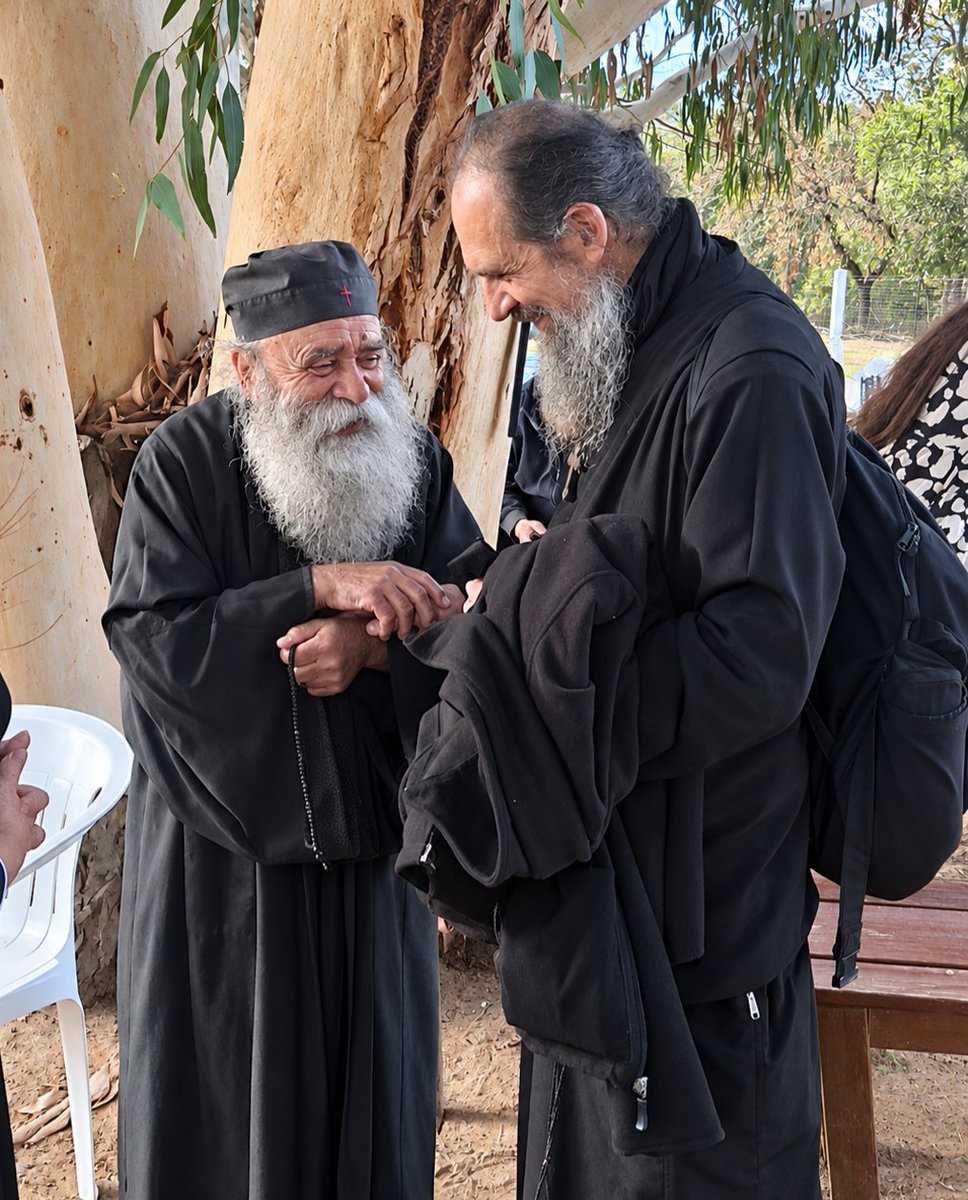
Two towering figures of uncompromising Orthodoxy met on Saturday 24 October 2026, at the Holy Monastery of Agia Skepi in Serres: Hieromonk Fr Savvas the Athonite and Monk Fr Dositheos.
Their spiritual circles will fight the battle for Faith as the end times intensify and the signs advance.
Join the struggle. Attend the Divine Liturgy, go to confession, live a spiritual life, resist injustice and blasphemy. The time for confession of the Faith and for joining forces with the powers of the Triune God in the great spiritual war that lies ahead has already come!
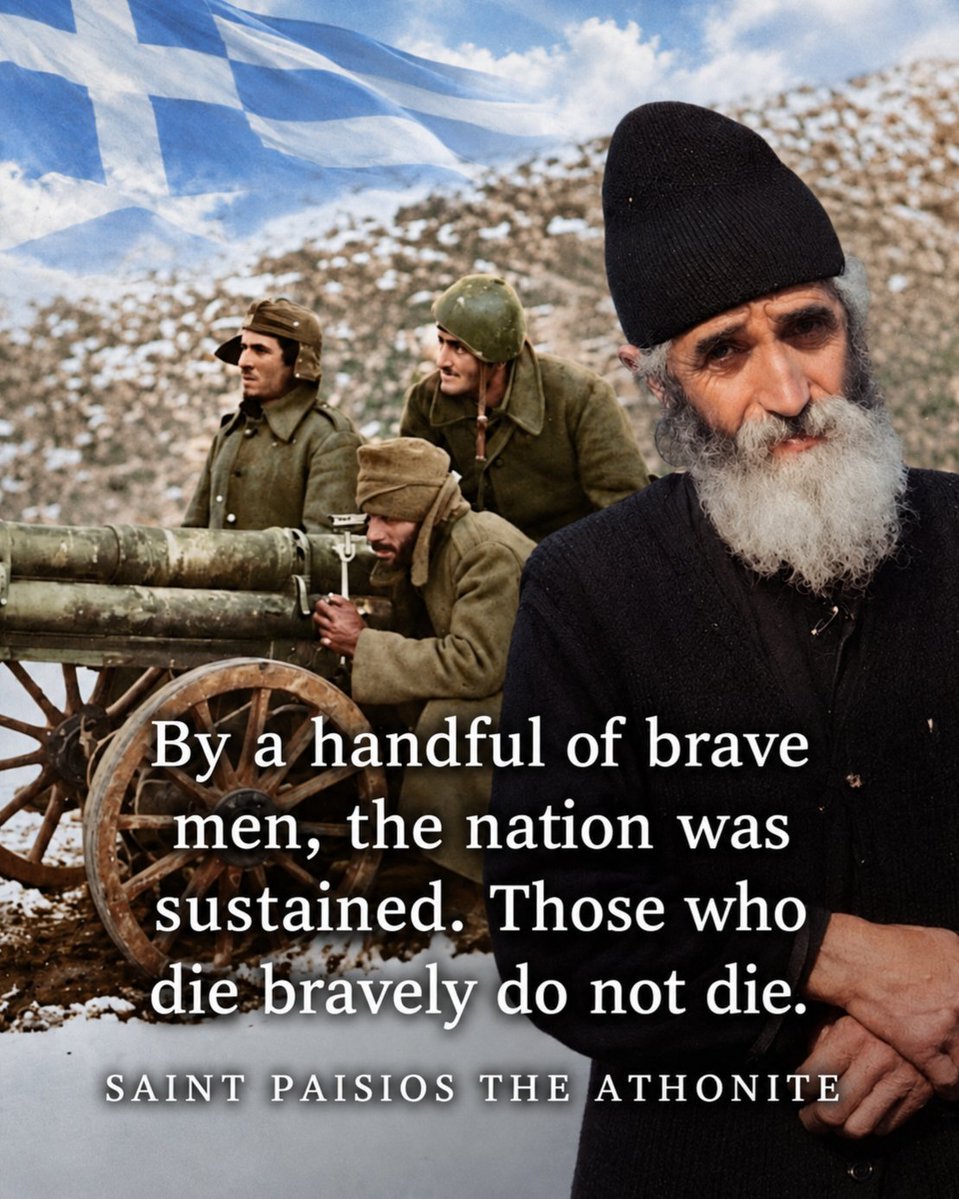
They sought to frighten the Greeks and to break the strength of their spirit.
But the Greeks had soul!
The soul prevails!
Neither tanks, nor artillery, nor bombs…
THE SOUL prevails!
And their souls were strengthened by faith in God and in the Motherland! And this was made manifest.
Then came the wondrous interventions of God and of the Most Holy Theotokos. Everyone who went to fight at the front said that the Panagia had covered and protected them.
And the soul of the Greek, whether at the front or behind the lines, was filled with FAITH and LIFE!
~ Blessed Fr. Athanasios Mytilineos ☦︎
Long live October 28, 1940!
Long live the blessed Nation of heroes and saints! ☦︎🇬🇷