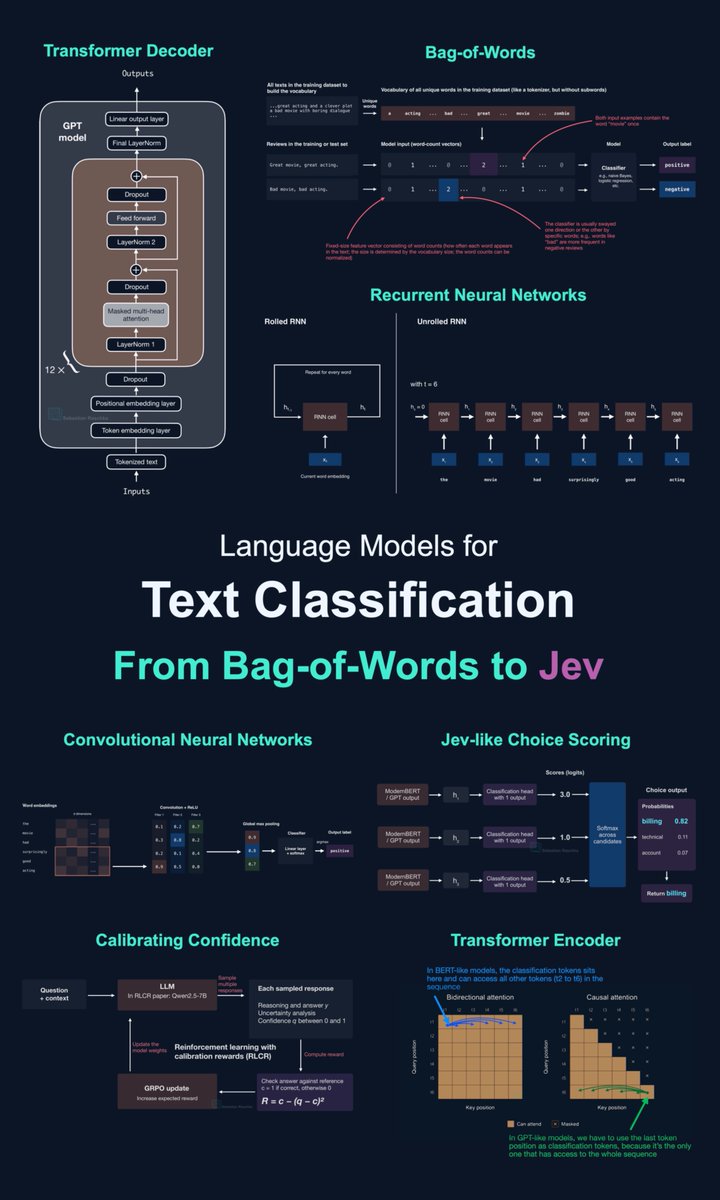
Took a while, but here it is, a mega write-up on language models for text classification and, of course, Jev.
It's basically a visual guide to RNNs, CNNs, transformers, and calibration, with hands-on experiments on accuracy and efficiency.
Long-context LLMs hit a memory wall fast. This package targets the KV cache.
TurboQuant-GPU is a Python package for compressing KV caches during LLM inference on NVIDIA GPUs.
It helps you reduce KV-cache memory use by applying random orthogonal rotation and quantization to Keys and Values, with cuTile kernels where available and an automatic PyTorch fallback.
Key features:
• 5.02x KV-cache compression – the README reports this compression ratio for LLM inference
• Separate Key and Value paths – Keys use 2-bit MSE quantization plus 1-bit QJL bias correction; Values use 3-bit MSE quantization
• Fused compression kernel – compresses K and V in one launch per attention head
• GPU-aware auto-tuning – benchmarks cuTile versus PyTorch and 2-bit versus 3-bit options for your GPU
• Notebook examples – includes a quickstart plus kernel profiling and quality-comparison notebooks
It’s open-source (MIT license).
Link in the reply 👇
LLM behavior changes too easily to rely on a few manual spot checks.
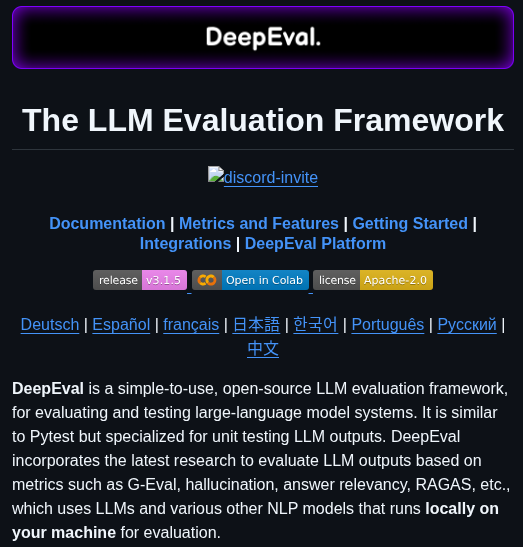
DeepEval is an open-source Python framework for evaluating LLM applications such as agents, RAG pipelines, and chatbots.
It helps you turn quality checks into repeatable tests by combining Pytest-style test cases with ready-to-use evaluation metrics.
Key features:
• Ready-made metrics – evaluate answer relevancy, faithfulness, hallucination, agent task completion, and more.
• Pytest-style workflow – define test cases and run them from the CLI with `deepeval test run`.
• End-to-end and component evals – assess the full application or individual traced components.
• Flexible evaluation models – use your chosen LLM, statistical methods, or local NLP models, depending on the metric.
• Dataset and CI support – generate single- or multi-turn synthetic datasets and run evaluations in any CI/CD environment.
It’s open-source (Apache 2.0 license).
Link in the reply 👇