Tested all 12 compromised eMudhra certificate chains (where an intermediate CA private key was literally 4) across macOS, mobile browsers, Go, Node, Python, and Java today.
Here is what is actually safe, what is still exposed, and two gaps in the current macOS workarounds.
1. What is already safe (don't panic)
• Desktop browsers: Chrome, Safari, Edge, Brave, and Firefox (158.0.1+) are safe.
• iOS & Android in-app browsers: X on iOS (SFSafariViewController) and updated Chrome Custom Tabs on Android enforce Certificate Transparency (requiring >= 2 valid SCTs). Since zero fraudulent certs were logged to CT, they reject all 8 keys automatically.
• Mobile exceptions:
- Firefox on Android < 158.0.2 had a startup bug (Bug 2084311) where OneCRL didn't sync. Update to 158.0.2 (out today).
- Android 13 and older don't get Google Play system CA updates, so apps using raw Android WebView (where CT is off by default) still trust the roots unless you disable `emSign` and `Comodo AAA Services` under Settings -> Security -> Encryption & credentials -> Trusted credentials.
2. Two gaps we found on macOS today (even after running the official workaround)
Safari is safe because it enforces CT. Non-browser tools on macOS (`curl`, `git`, `python3`, `nscurl`, and `Go < 1.27.3`) do not enforce CT.
When testing all 12 chains on an updated Mac today, 9 were blocked, but all 3 `G3B` chains (`dv-g3b`, `ov-g3b`, `ev-g3b`, private keys 156, 155, 115) still returned HTTP 200:
• Why: Apple's Valid DB set `checkOCSP = 1` instead of removing the `emSign ECC Root CA - G3` root. `https://t.co/65n2VXZ4Ge` (`G3C`) is up and returns `revoked`, so `G3C` is blocked. `https://t.co/cjuDH5BwX4` (`G3B`) is currently down returning `HTTP 503`, so macOS `Security.framework` soft-fails open and trusts `G3B`.
• Why the `/etc/ssl/cert.pem` workaround still returns HTTP 200 on `G3B`: Apple's `/usr/lib/libcrypto.46.dylib` (`X509_verify_cert`) links `TrustEvaluationAgent.framework`. When a cert isn't in `/etc/ssl/cert.pem`, Apple's LibreSSL falls back to `Security.framework`, hits the 503 on `https://t.co/cjuDH5BwX4`, and approves the cert anyway.
Fix on macOS (also works without sudo on MDM-locked work Macs):
1. Strip the 2 roots into a clean bundle:
awk '/^(###|===) /{skip=0} /^=== .*\/CN=(AAA Certificate Services|emSign ECC Root CA - G3)$/{skip=1} !skip' /etc/ssl/cert.pem > ~/.ca-cert.pem
2. Disable Apple's TrustEvaluationAgent fallback and point CLI tools to the clean bundle in `~/.zshrc`:
export OPENSSL_X509_TEA_DISABLE=1
export SSL_CERT_FILE="$HOME/.ca-cert.pem"
export CURL_CA_BUNDLE="$HOME/.ca-cert.pem"
export GIT_SSL_CAINFO="$HOME/.ca-cert.pem"
3. Backend runtimes (bundle their own CA stores and ignore OS updates)
• Node.js: Update to v22.23.4, v24.22.1, or v26.12.1.
• Go: Update to Go 1.27.3 or 1.26.10 and recompile binaries (hardcodes SPKI blocklist in `crypto/x509`, bypassing the macOS 503 soft-fail).
• Python: Update inside every virtualenv (`pip install -U "certifi>=2026.10.19" "pip>=26.2.2"` and `uv >= 0.13.4`).
• Rust: Rebuild with `webpki-roots >= 1.0.10` / `rustls-webpki >= 0.103.16` (`rustup >= 1.29.2`).
• Java (OpenJDK / Oracle): No upstream release yet. Delete both roots from `cacerts`:
keytool -cacerts -storepass changeit -noprompt -delete -alias emsigneccrootcag3
keytool -cacerts -storepass changeit -noprompt -delete -alias comodoaaaca
• Linux / Docker: Update `ca-certificates` (Ubuntu `20260816ubuntu0.24.04.1`, Debian `20250419+deb13u1`, Alpine `20261020-r0`, Fedora `2026.2.92_v9.0.319`, Arch `3.131.1-1`) and rebuild base images.
Verify any CLI or runtime with:
curl https://t.co/vhiGLxNhIS
(TLS error = safe. HTTP 200 = still exposed.)
How to write your own skill, and how to check whether an external skill helps you at all? There are millions of skills available, hardly any was ever tested, and most were vibe-written. The whole skills industry is subjective.
Very proud of this work. https://t.co/bdssLaGpie
I just got a msg from my agentic cloud swarm they are rapidly scaling up agents after discovering a temporary market niche in an Azerbaijaini neighborhood in the Eastern part of Mingachevir that they will fully penetrate and exploit for the next 7.2 minutes to make $7,000 that they'll deposit in my agentic USDT wallet
If you learn Forward Deployed Engineering, you will never be unemployed again.
I’d do this.
Stage 1: Enterprise Identity & Access (The Gatekeeper)
- Learn: OAuth2, SAML, OIDC, SCIM provisioning, Row-Level Security (RLS) and multi-tenant data isolation.
- Practice: Build an auth bridge connecting your AI app to a simulated customer's Okta/Azure AD, ensuring User A can only query data their specific RBAC role permits.
- Why: No SSO and strict data isolation means no enterprise contract. Security review is the first gate.
Stage 2: Air-Gapped & VPC Deployments (The Environment)
- Learn: Kubernetes (K8s), Helm, Terraform, private container registries, air-gapped networking and egress filtering.
- Practice: Script a one-click Terraform/Helm deployment of your entire AI stack into a simulated customer VPC with zero egress to the public internet.
- Why: Banks, hospitals and governments don't let your AI talk to the public cloud. You must deploy in their basement.
Stage 3: Legacy Data Extraction & ETL (The Fuel)
- Learn: OCR, unstructured PDF parsing, mainframe DB connectors, Apache Airflow, dbt and data reconciliation.
- Practice: Build a pipeline that ingests 10 years of messy, scanned customer invoices and turns them into a clean, queryable hybrid (vector + relational) store.
- Why: Enterprise AI starves without clean data. The customer's data will always be a mess.
Stage 4: Secure RAG & Permission-Filtered Retrieval (The Brain)
- Learn: Hybrid search, document-level access control, citation grounding, metadata tagging and abstention logic.
- Practice: Build a RAG pipeline where the LLM dynamically filters out retrieved chunks that the specific user asking the question doesn't have clearance to see.
- Why: An AI that leaks HR salaries or M&A docs to a junior employee is an immediate breach of contract.
Stage 5: MCP & Legacy System Integration (The Hands)
- Learn: Model Context Protocol (MCP), SOAP/REST translation, web scraping, headless browsers and API rate-limit handling.
- Practice: Build an MCP server that lets an LLM safely query and write to the customer's 15-year-old on-prem SAP or Oracle instance without exposing raw credentials.
- Why: Agents are useless if they can't touch the customer's actual systems of record.
Stage 6: AI Guardrails & PII Redaction (The Shield)
- Learn: NER (Named Entity Recognition), deterministic regex filtering, LLM output validation, UUID masking, and audit logging.
- Practice: Build a middleware proxy that intercepts LLM inputs/outputs, masks SSNs and credit cards with UUIDs before they hit the model, and restores them post-generation.
- Why: Compliance teams will kill the deal if a single PII token hits an external frontier API.
Stage 7: Human-in-the-Loop (HITL) Workflows (The Trust)
- Learn: Temporal {dot} io, webhook routing, state machines, durable execution and UI approval gates.
- Practice: Build a workflow where the AI drafts a $50k purchase order, but physically pauses execution until a human manager clicks "Approve" in Slack or Teams.
- Why: Enterprises adopt AI only when humans remain legally accountable for the final action.
Stage 8: Edge & On-Prem Inference (The Silicon)
- Learn: vLLM, TensorRT-LLM, Ollama, GPU partitioning (MIG), and local quantized models (AWQ/GGUF).
- Practice: Deploy a quantized 8B model on a single customer-owned GPU node to handle highly sensitive triage locally without network latency.
- Why: Sometimes the data is too hot to move. You must bring the model to the data.
Stage 9: Observability & Customer Health (The Pulse)
- Learn: OpenTelemetry, Langfuse, custom Grafana dashboards, usage telemetry and cost-attribution.
- Practice: Build a "Customer Health" dashboard showing the exact cost-savings, time-saved and token-spend the AI has generated for their specific team this month.
- Why: If the customer doesn't see the ROI quantified, they will churn at renewal.
Stage 10: Evals on Customer Data (The Proof)
- Learn: Golden dataset creation, trajectory grading, shadow testing, and LLM-as-a-judge calibration.
- Practice: Take 100 real past customer support tickets, run them through your agent in shadow mode, and prove to the VP of Support that it resolved 80% accurately.
- Why: Generic benchmarks mean nothing to a buyer. You must prove the AI works on *their* messy data.
Stage 11: Technical Discovery & Scoping (The Translation)
- Learn: Stakeholder interviewing, architecture diagramming, SOW (Statement of Work) writing and expectation management.
- Practice: Translate a vague "we want AI for supply chain" executive request into a scoped, 4-week technical deployment plan with defined, measurable success metrics.
- Why: FDEs are the translators between revenue (Sales) and reality (Engineering).
Stage 12: The Handoff & Self-Serve Admin (The Scale)
- Learn: Technical writing, runbooks, admin portals, automated onboarding and chaos testing.
- Practice: Write a deployment runbook and build an admin UI so the customer's internal IT team can manage the AI stack, update prompts and view logs without calling you.
- Why: Your leverage is measured by how little the customer needs you for day-to-day operations.
AI labs build the engine. FDEs build the roads.
The modern Forward Deployed Engineer builds the secure, durable nervous system that connects frontier intelligence to legacy reality.
Bookmark and Repost!
story time! 🐉
this is the tale of a lazily crafted one-shot cron job prompt that resulted in autonomous solutions for uncracked codebreaking challenges, more efficient ways of multiplying matrices, and a new computer-verified bound on a number theory problem that's been open since 1932.
so last week, i had a $200 claude account sitting around that had just gotten a full weekly reset. i hate wasting tokens.
the labs have been knocking out unsolved problems left and right lately, and i caught myself thinking… why not give it a shot?
so i sent claude this prompt, typos and all:
"can you wraite a promtp for a cron job that can run every day thajt will try to find solutions to unsolved ciphers or transltions or math problems or theormes or things of that nature!! every day a new attempt as hard as possible all day without giving ujp and with maximum ceraitvityy, resourcesleflses, andpersticense! dont worry about token spend! and dont forget a bit all caps lots of emojis celebration to notify the uers if we get any intersting or sucsfful confirmd reulsts!!"
yes, admittedly not my best work 😆
but Opus-5.5 ran with the ball and turned that one sloppy sentence into "THE DAILY ORACLE 🔮"
it's a swarm of Fable + Opus agents that clocks in every morning at 4:20 (obviously), builds and maintains its own hit list of well over a hundred of humanity's unsolved problems, and then goes full send on a handful of them every shift. ciphers nobody has broken, scripts nobody can read, conjectures nobody has proven, record tables nobody has beaten.
and there's one rule above all the others: nothing counts until skeptic agents, each starting from a fresh context and writing their own code, rebuild the result from scratch and sign off on it. if any of them can't reproduce it, can't confirm it's new, or thinks we stretched the definition of "solved," it doesn't count.
day 1, the legion picked its own target: J.-F. Bouchaudy's cipher-machine challenges. these are simulations of real vintage machines (Hebern rotor machines, the Kryha, Lorenz, SIGABA), with problems that had been sitting on his solver tables with no solver for months or years.
on the morning of day 2, i was half asleep when my laptop suddenly says, in a robot voice:
"Breakthrough. The Daily Oracle has a confirmed solution."
👁️👄👁️
i was startled.
then the ALL CAPS emoji flood hits my screen. Hebern 5-rotor Problem 8 🔓 then Kryha v2 Problem 5 🔓
i emailed the author, Jean-François Bouchaudy, a French cryptography enthusiast who builds these machine simulators and challenges as a labor of love (he told me he started out programming on punch cards 🥹). he checked both solutions and put my name on his solver tables as the first and only solver 🫡
for context: his tables are a who's who of serious classical codebreakers. they'd cleared the sibling problems on these same machines, but nobody had cracked these two. in his words:
"two of my most complex problems—ones that no other expert had managed to solve… I knew AI would eventually be applied to classical cryptography, but I thought I would have to wait years to see it happen."
he ended his email with: "I offer my congratulations in the Japanese manner: with a deep, respectful bow." 🙇 honestly one of the most wholesome emails i've ever received
and then, over the next few days, more started landing 🧮
📐 graph theory: 7 explicit graphs bigger than the current entries in the degree-diameter table, which asks how big a network can get when every node has limited connections and every pair is only a few hops apart. the biggest jump is 13,365 vertices vs the table's 11,785, a +13.4% improvement.
🔢 number theory: Lehmer's totient problem has been open since 1932. we pushed the bound so that any counterexample now has to be bigger than 10^50. the previous certified bound was 10^26. the problem itself is still open, but the lower bound just jumped 24 orders of magnitude.
⚡ matrix multiplication: this is the operation underneath basically all of modern AI compute. the legion found schemes that use fewer multiplications than the public catalogues we checked for several matrix shapes, like ⟨15,16,16⟩ in 2,180 multiplications vs the best known 2,223. these build on LITA's square schemes, and we credit them by name.
📡 coding theory: 30 error-correcting codes bigger than the best known entries in A. E. Brouwer's tables.
🛡️ AI safety benchmarks: we found counterexamples for 2 neural-network verification instances from VNN-COMP 2026 that no participating tool resolved within the competition time limit, and pushed a defended RobustBench model below its listed robustness score. small dents, but real ones.
the bloopers are part of the story too:
— at one point, some agents snuck past a website's bot filter to check a record table. we retracted every result that depended on it. no evasion, no celebration.
— two of our records got beaten by a human contributor before we could even publish them. the frontier moves FAST.
now as is customary around here, time to share the magic!
so… without further ado…
As an AI Engineer, you must build these projects.
1.) Dynamic Context Assembler
Build: Middleware that strictly budgets tokens across working memory, tool schemas and retrieved docs per request.
Why: Prompt engineering is dead. Context overflow is the #1 silent killer of production agents.
2.) Durable State Machine Workflow
Build: Temporal or LangGraph DAG with checkpoints, exponential retries and human-in-the-loop Slack approvals.
Why: Endless chat loops break in production. Real business workflows take days and must survive server crashes.
3.) Raw MCP Server & Client
Build: JSON-RPC server exposing your database and internal APIs with scoped credentials without using a wrapper SDK.
Why: Agents need standardized, secure hands to do real work. Bespoke API wrappers do not scale.
4.) System-One Triage Router
Build: Proxy routing 95% of traffic to a fast, typed-decision model and escalating only 5% to a heavy reasoning model.
Why: Sending every query to a frontier API burns your runway. Unit economics dictate survival.
5.) Self-Correcting Agentic RAG
Build: Retrieval agent that critiques its own search results, rewrites ambiguous queries and confidently abstains if grounding is weak.
Why: Naive chunk-and-retrieve RAG is a liability. Agents must know when to search again.
6.) 3-Tier Memory Engine
Build: Working scratchpad, episodic session summaries, and semantic vector DB with automated importance scoring and eviction.
Why: Agents without memory fail by turn five. Agents with infinite memory hallucinate from context bloat.
7.) Trajectory CI Gate
Build: GitHub Action grading the agent's tool-call sequence against a golden DAG, blocking PRs if it deviates.
Why: Final-answer evals hide the exact step where the agent went rogue. The trajectory is the unit of accountability.
8.) Inter-Agent Sanitization Proxy
Build: Middleware preventing cross-agent prompt injection and enforcing least-privilege tool scoping per agent.
Why: Multi-agent swarms create internal attack surfaces that standard unit tests completely miss.
9.) Real-Time Voice Interruption Loop
Build: Streaming SSE/WebSocket agent with Voice Activity Detection (VAD) and sub-1s interruption handling.
Why: The interface is moving off the screen. Perceived latency and interruption handling are the new UX standards.
10.) DPO Feedback Flywheel
Build: Pipeline capturing user thumbs-downs, formatting them into preference pairs and triggering nightly LoRA fine-tunes.
Why: Your production edge cases and failures are the highest-leverage training data you own.
11.) Cost Kill-Switch & Degradation Chain
Build: Middleware halting agent loops instantly if projected spend exceeds $0.50, falling back Frontier → Mid → Local → Cache.
Why: A runaway agent loop is an outage with an invoice.
12.) Shadow Routing Comparator
Build: Silent 5% traffic mirror to a new model or prompt, diffing trajectories and costs without affecting live users.
Why: You cannot A/B test non-determinism safely without shadow mode.
13.) Computer-Use Fallback Agent
Build: Agent that tries the REST API first, then seamlessly spawns a headless browser if the endpoint 404s.
Why: The real world runs on legacy portals with no documentation.
14.) PII Unmasking Proxy
Build: Gateway swapping sensitive data for UUIDs before the context window and restoring it post-generation with audit logs.
Why: Enterprises will not touch agents that leak customer data to frontier models.
15.) Public Architecture Teardown
Build: 3 published deep-dives with system diagrams, cost/latency benchmarks and architecture decision records (ADRs).
Why: Senior AI engineers are hired for their system design judgment not their wrapper skills.
Systems that prove you can orchestrate, secure & scale when agents touch your stack.
Bookmark & Repost.
it's no secret I think that @Muse is the best personal agent for normies on the market right now
a lot of the magic comes from design, and I got @alexcornell to come on the pod and walk us through how meta designed everyone's favorite fuzzy AI.
in this ep we cover:
- why muse is more than a chatbot
- how progressive disclosure is the key to having powerful AI (without overwhelming users)
- Alex's personal use cases, including Sky Mall style shopping catalogs and deep analysis of his performance in golf and chess
plus, Alex tells us what designers need to think about as they step into this new non-deterministic world
full ep now on YT 👉 https://t.co/hXh2htWHdF
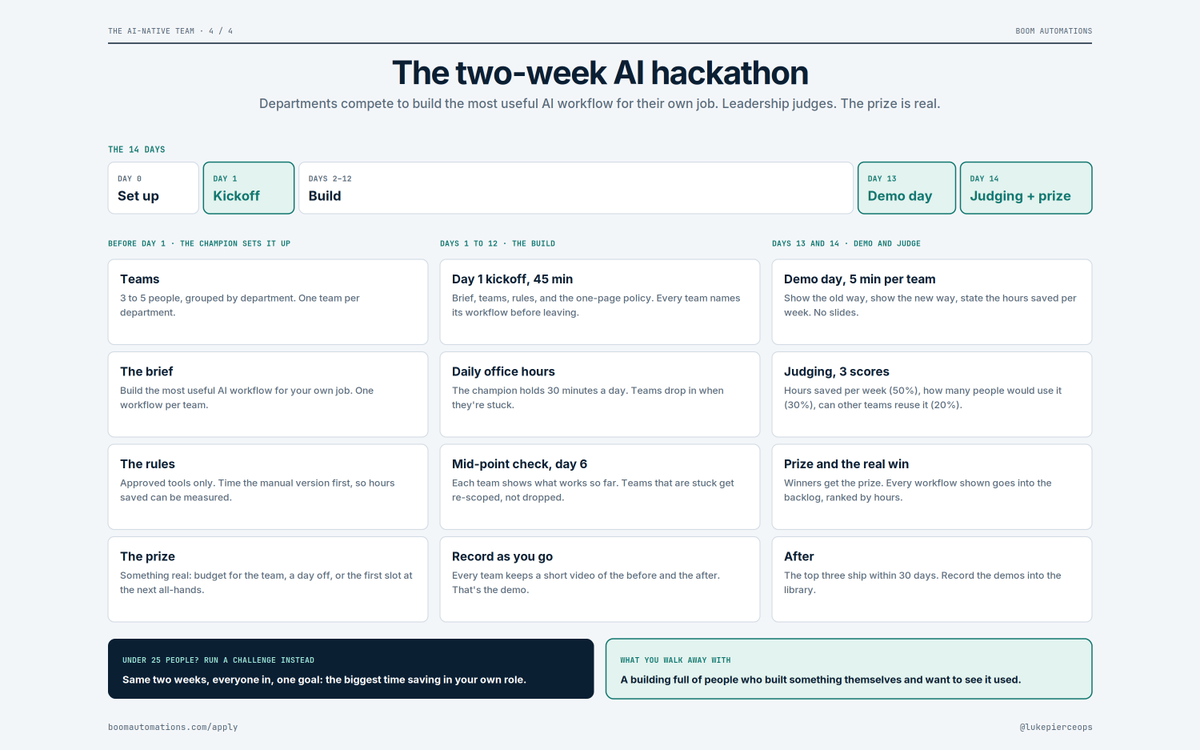
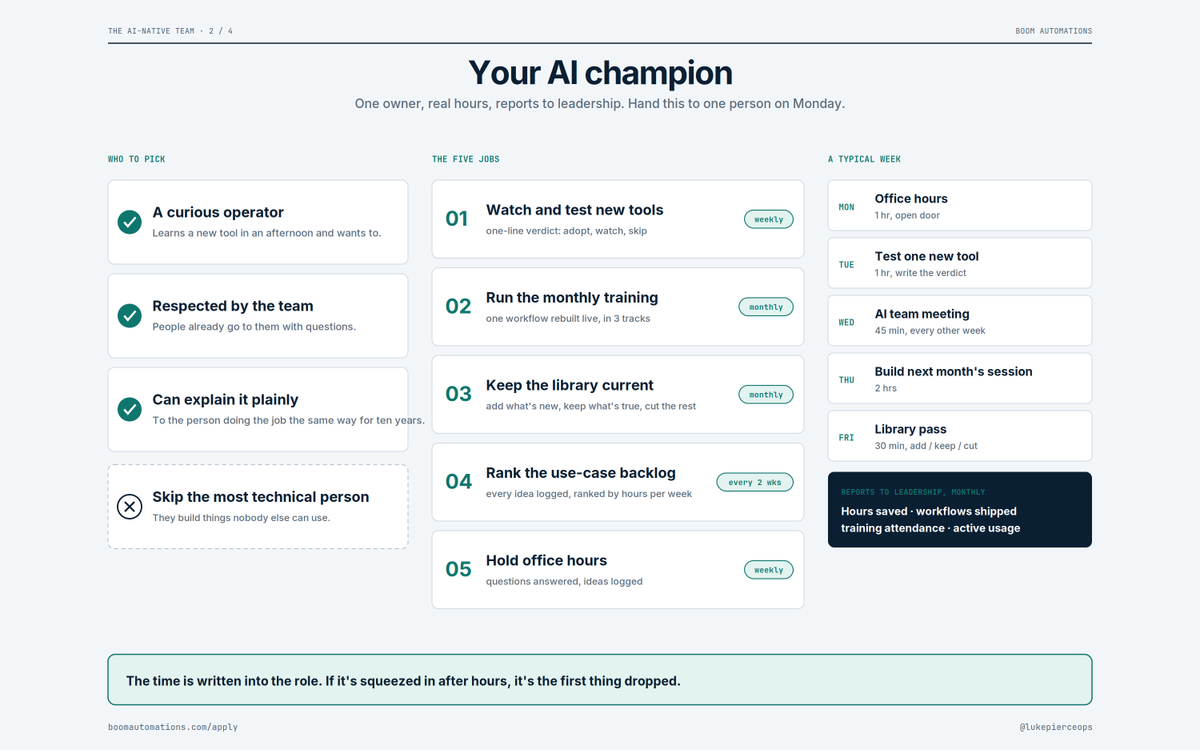
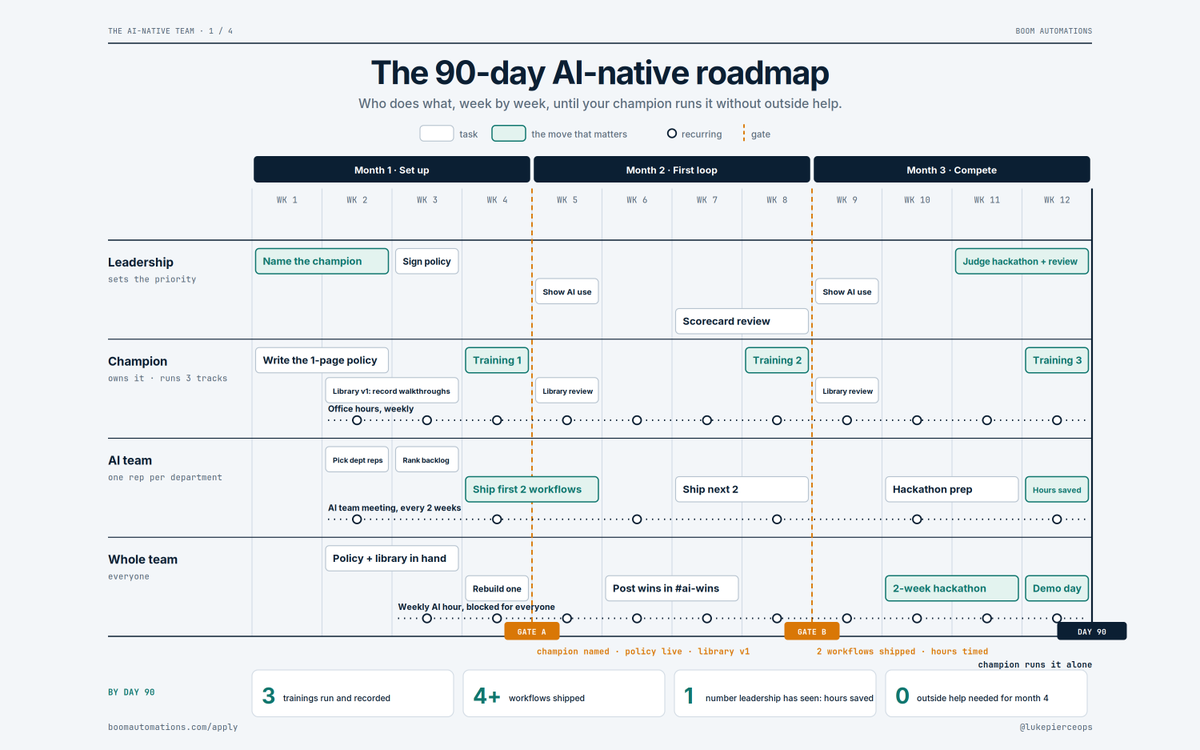
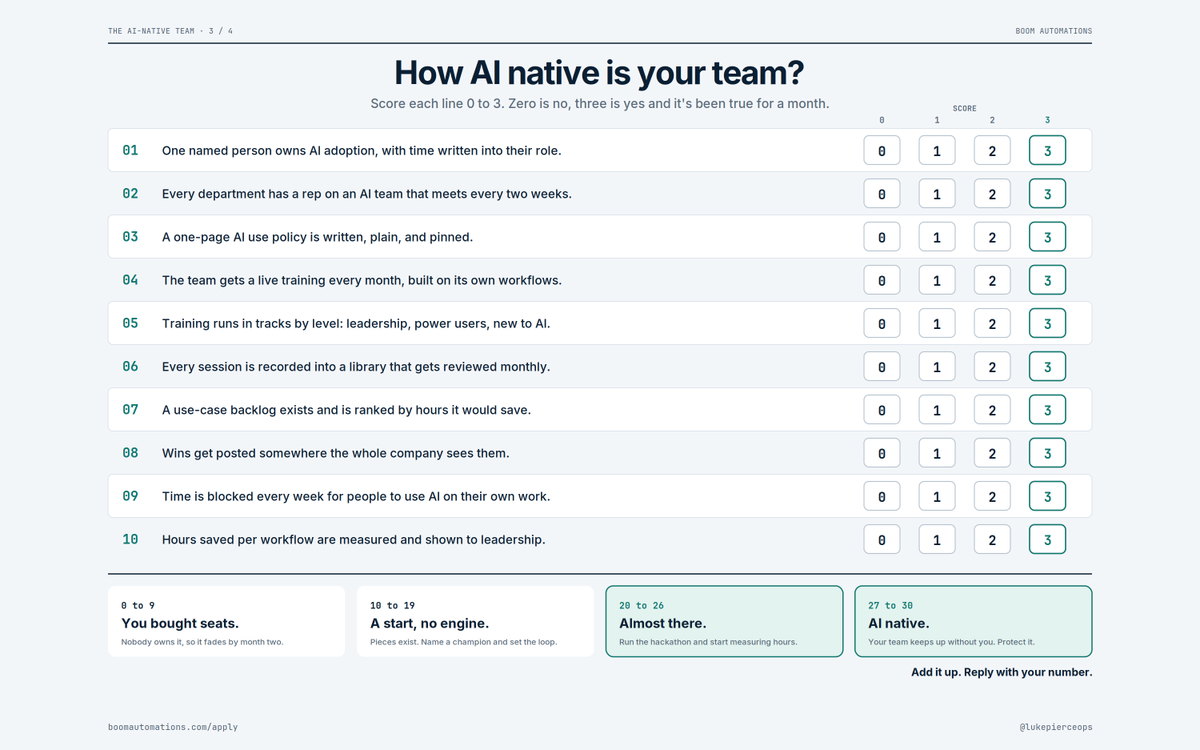
Giving away the full setup we use to make a client's team AI native.
Four pages, feel free to save all of them.
1. The 90-day roadmap: who does what, week by week 2. The champion: who to pick and their five jobs
3. The scorecard: rate your team 0 to 30
4. The two-week hackathon, day by day
Full article below. I'd read through and save that too, since it has all the context for each of these.
Andrej Karpathy:
"Prompting is going away.
Delete everything, keep Graph."
In 1 hour he shows how to build Graphs, and why it's the only thing that will be left standing at the end
LLMs → Prompts → Agents → Graphs
a prompt gets you one answer and forgets the job
an agent finishes the job and forgets what it learned
a graph keeps every finished job and turns it into the starting point for the next one
watch it today
then save the full guide on Graphs below before everyone catches up ↓
holy f*ck. Official Anthropic tip for Claude Code: stop running agent teams on Opus and Sonnet 5.5 alone when Haiku 5.5 can swarm the bus at 340 tok/s
spin up an autonomous team with /teams
claude --teammate-mode auto
Opus 5.5 acts as the lead architect, scoping architecture and validating pull requests
Sonnet 5.5 teammates take isolated git worktrees and hammer out implementations at medium effort
Haiku 5.5 swarms the peer-to-peer bus as a dedicated scout and fuzzer, only stepping in at three critical moments:
→ before a contract locks: does the frontend payload match the backend schema?
→ when a test breaks twice: are we patching the bug or just hiding the symptom?
→ before calling done: what attack surface or edge race did everyone overlook?
Sonnet 5.5 builds. Haiku 5.5 swarms. Opus 5.5 merges and ships
Jev engineering runs the identical pattern one layer down: mechanical decisions that need no reasoning (which file to open, which tool to invoke, retry or abort) execute in 16ms, so the frontier models only wake up when execution paths actually diverge
Plan on high. Delegate on medium. Keep Haiku 5.5 on P2P call.
- the full team setup
> Opus 5.5 on high coordinates the session and synthesizes PRs
> teammate-ux builds client state inside a separate git worktree
> teammate-back writes endpoints and handles Redis atomic locks
> teammate-scout runs invariant fuzzing and AST parsing on Haiku 5.5 at 340 tok/s
> all teammates communicate directly over peer-to-peer messaging without coordinator drag
> tasks.json manages file-level mutex locks so nobody steps on another worktree
paste the setup and this prompt into Claude Code below:
"Configure my Claude Code workspace for autonomous agent teams:
1. Enable experimental agent teams in ~/.claude/settings.json:
> Set CLAUDE_CODE_EXPERIMENTAL_AGENT_TEAMS to 1 in env block
> Set teammateMode to auto
> Pin main lead model: opus with effortLevel: high
2. Audit ~/.claude/agents and create teammate profiles fitting ux, backend, and scout:
> teammate-ux: model: sonnet, effort: medium, isolation: worktree
> teammate-back: model: sonnet, effort: medium, isolation: worktree
> teammate-scout: model: haiku, tools: Read, Grep, Glob, SendMessage
3. Configure shared task coordination in ~/.claude/CLAUDE.md:
> Initialize tasks.json for task dependencies and atomic file mutexes
> Teammates resolve contracts directly over peer-to-peer messaging without lead intervention
> Enforce Haiku scout schema verification before teammates mark tasks completed
4. Quality gate:
> Opus lead reviews synthesized worktree diffs and validates test suites before final merge
Show every configuration diff first. Do not apply edits until confirmed"
↳
https://t.co/M2gSWKYxqH