John Torous, MD, spoke with Christian S. Hendershot, PhD, and Klara R. Klein, MD, PhD, about the crossover between metabolic health and alcohol use disorder and why #GLP-1s are sparking a new wave of optimism in behavioral health.
🎧 Listen now: https://t.co/oUS0YiXh4w
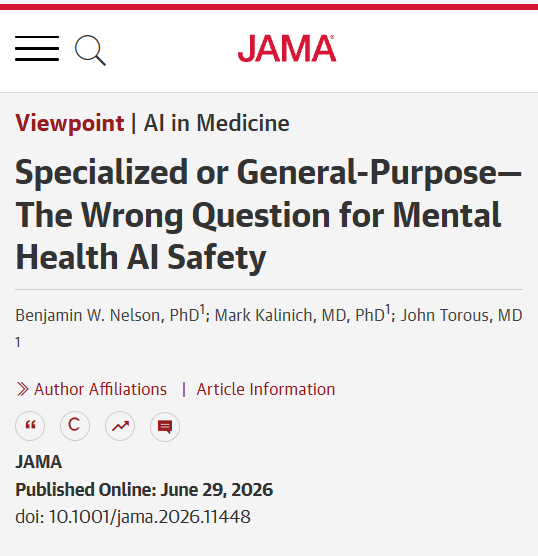
In a new viewpoint piece,
https://t.co/D09cYL5Pdk deployment of LLMs in psychiatry requires strict oversight to @JohnTorousMD and I argue that mental health practitioners need specific training to prevent fluent but fabricated clinical narratives.
We need to ground the discussion of AI in mental health not in our fears or hopes but rather in real-world data tracking its actual use, efficacy, and safety. 🔗👇
🗞️Glad to see our global mental health survey getting some coverage. We found 55% of surveyed mental health clinicians across 30 countries were using GenAI.
Thanks to Danielle Barron in the Sunday Independent @TheSundayIndo
📑Read the original research paper here too https://t.co/MAsciUM5ru
📰And in the newspaper coverage here and below https://t.co/glvwLJ1WHt
Had a lot of fun speaking with @JohnTorousMD on the @JAMAPsych podcast about our recent paper on social media likes and depression!
🎧 Listen on the podcast website here: https://t.co/JFGRNITrOo
🟢 Spotify: https://t.co/k7LnsAv1ut
🍎 Apple podcasts: https://t.co/6XNi3UEMU3
John Torous, MD, MBI, spoke with Balázs Szigeti, PhD, about a meta-analysis comparing #psychedelic-assisted therapy and traditional #antidepressants under equal unblinding conditions.
🎧 Listen now: https://t.co/CjldKyffUN
Dan-Mircea Mirea, PhD, and John Torous, MD, discuss how receiving more “likes” on social media posts led to greater increases in posting among users with #depression compared to those without depression.
🎧 Listen now: https://t.co/b79BLNQX2U
💬 Viewpoint: Evaluating mental health #AI safety requires measuring both acute and cumulative harms, not just comparing specialized vs general-purpose models, and demands transparent, outcome-based standards.
https://t.co/lI7cIeRBt2
Our new paper calls for multidisciplinary research priorities for artificial intelligence in mental health - The Lancet Psychiatry led vy Jake Linardon with @JosephFirthUoM@JohnTorousMD + team https://t.co/8tdMMnQHpI
Worried about patients turning to AI instead of humans? We surveyed nearly 800 therapists and clinical psychologists across 30 countries worldwide. Half told us they used consumer chatbots mostly for clinical recommendations (not documentation). 85% used ChatGPT.
https://t.co/bNe7MsoDNm
Paper here: https://t.co/MAsciULxBW
Missed the live webinar? Catch the replay.
A big thank you to @JohnTorousMD and NAMI Board President Jeff Fladen for an engaging discussion on AI, digital psychiatry, and keeping human connection at the center of mental health care.
Watch the recording now: https://t.co/Lbu72SGmAH
#DigitalPsychiatry #MentalHealth #AIinMentalHealth #DigitalHealth #MentalHealthAccess #MentalHealthCare
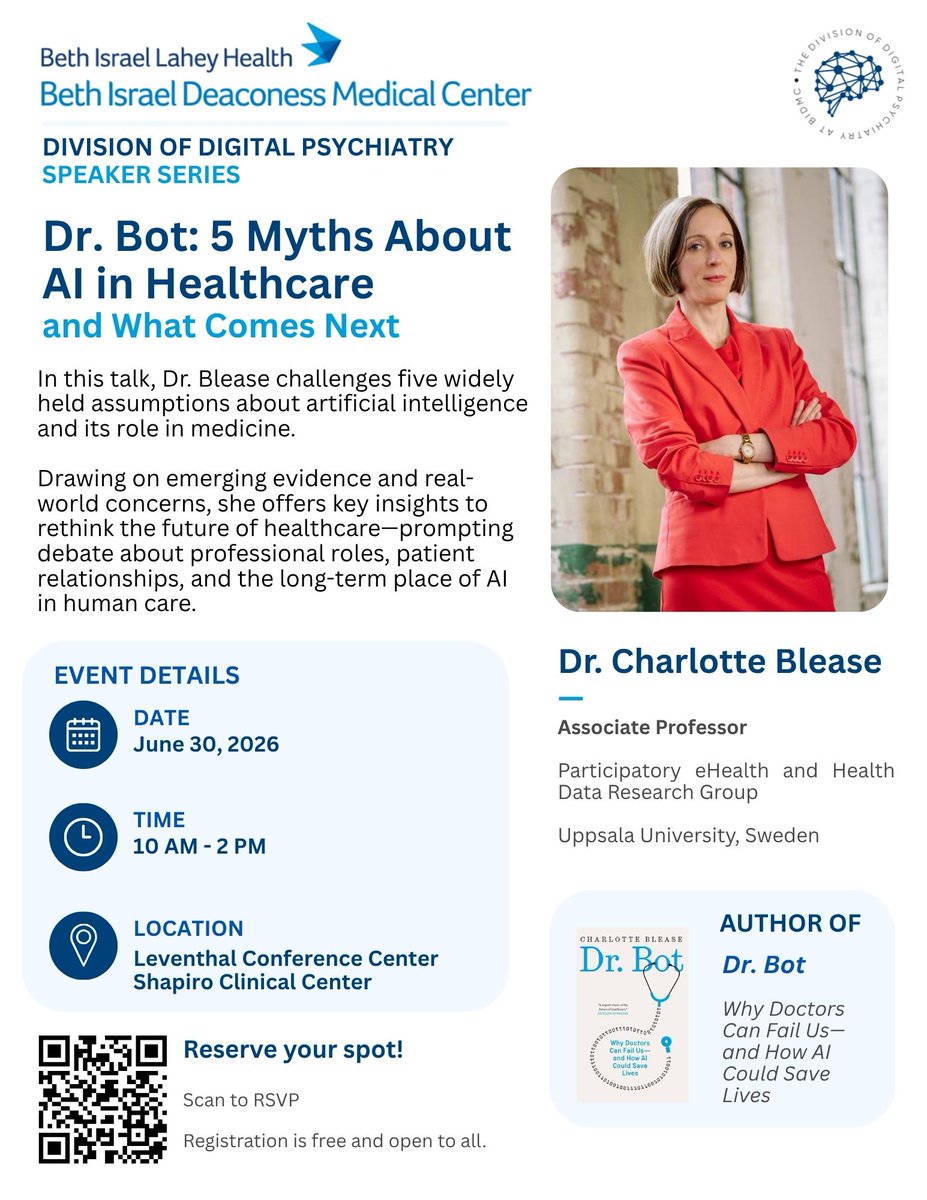
Fantastic to be back in my old stomping ground of Longwood Area, Boston and to give a talk at Digital Psychiatry @BIDMChealth@harvardmed. Huge thanks to @JohnTorousMD for hosting the day, and for the stimulating discussion afterwards. Will not wait as long to return :) Also thanks to John for gifting #DrBot to his visitors!
💬 Viewpoint: Independent, transparent evaluation and regulatory benchmarks for both acute and cumulative harms are urgently needed for all mental health #AI chatbots. https://t.co/y9PgY8XnqM
Come join me tomorrow at Beth Israel Deaconess Medical Center, Longwood, Boston for a talk on AI in Healthcare, sponsored by @JohnTorousMD and Digital Psychiatry @harvardmed. All welcome - details below
Trying to order mugs from an AI store was a comedy of errors. What does that say about AI's ability to complete more important tasks? https://t.co/sEeD1OG2el
Banning smartphones from classrooms can lead to modest improvements in students’ conduct but doesn’t seem to improve emotional or attention problems. https://t.co/E7JcL2mOgt