Victoria won't be decided on primary votes — it'll be decided on preferences. In seat after seat, who finishes third matters more than who finishes first.
URG's MRP preference flow model points to a hung parliament:
🔵 Coalition 35
🔴 Labor 34
🟠 One Nation 13
🟢 Greens 4
⚪ Ind 2
(44 for majority)
EXCLUSIVE: Australia divided 40-39 on charging Ben Roberts-Smith with war crimes
Half of Australians still view the Victoria Cross recipient favourably — yet the nation is split razor-thin on whether he should face prosecution. A new national poll from Utting Research reveals a country divided over its most decorated living soldier.
The fault lines are extraordinary. Under-35s back the charges. Over-55s oppose them. Two in three Greens voters want him prosecuted. Nearly six in ten Coalition and One Nation voters say leave him alone. And Labor voters? They approve the charges — while still viewing the man himself favourably. No consensus. No middle ground. Just a 1-point gap and a nation that can't make up its mind.
@faruque_ju I understand your point, but Australians are very committed to the US alliance and are prepared to go along with it even if they’re not comfortable with what’s happening, classic example is Vietnam
Canada's Mark Carney is right. Keir Starmer and Ed Davey must take note.
“The multilateral institutions on which the middle powers have relied … the WTO, the UN, the COP, the very architecture of collective problem solving are under threat. As a result, many countries … must develop greater strategic autonomy in energy, food, critical minerals, in finance and supply chains.”
His Davos speech is a warning to Britain and Europe: the assumptions of the post Cold War order are no more, and interdependence is being turned into leverage by great powers.
That has profound consequences for Net Zero. As he puts it: “But let’s be clear eyed about where this leads. A world of fortresses will be poorer, more fragile, and less sustainable.”
Yes, Carney has just struck a deal at the weekend with China that includes easing tariffs on Chinese EVs. But the point of his Davos speech is not “more Net Zero”. It is that the era of naïve multilateralism is over.
And since taking office, he has also moved to expand domestic oil and gas. That is significant, not least given his previous high profile role in shaping the Net Zero consensus in Britain.
But his Davos speech is the language of national sovereignty, energy security and industrial capacity. You cannot rebuild hard power while deindustrialising and driving up the cost of power. And you cannot defend the values you claim to hold - human rights, free trade and the rule of law - without the strength to protect them.
Net Zero as a governing doctrine is starting to unravel.
Factor to consider on these Qantas super long-haul flights, some very unhappy passengers at Heathrow, after 17 hours on QF9 from Perth, no luggage.
Apparently the flight was too heavy so they offloaded a container of bags.
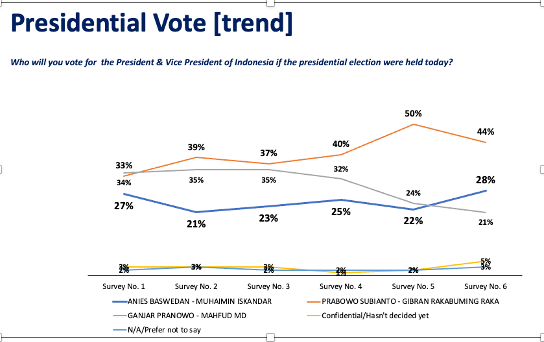
INDONESIAN PRESIDENTIAL TRACKER
N=1,200 NATIONWIDE, 19TH-26TH DECEMBER
In the aftermath of the first presidential election debate, UTTING RESEARCH has recorded a notable surge in voter support for Presidential candidate Anies Baswedan. According to a post-debate nationwide political survey of 1,200 voters conducted immediately following the debate, Baswedan’s support has increased by six points, a significant boost positioning him as a formidable contender in the race.
The survey results indicate that Anies Baswedan now holds 28% of the voter support, a clear indication of his growing appeal among the electorate. This increase marks a turning point in the election, establishing Baswedan as the primary challenger in the race. Meanwhile, his opponent, Prabowo Subianto, experienced a significant decline, with his support dropping six points to 44%. Ganjar, stands at 21%.
The first presidential debate has been a pivotal event in this election cycle, drawing the attention of nearly half of all voters, many of whom watched all or part of the debate. The impact of this debate is evident in the shift in voter sentiment. An impressive 41% of voters deemed Anies Baswedan as the most impressive candidate, surpassing Prabowo’s 36% and Ganjar’s 20%.
4. Customer Service Concerns: Concerns about the decline in Qantas' customer service over the years, ranging from issues with frequent flyer points to dealing with lost baggage and flight refunds.
3. Loyalty to Qantas: Despite the criticisms, many respondents have a strong sense of loyalty to Qantas. They've been long-time customers, frequent flyers, or shareholders and want to see the company succeed.
2. Criticisms of the Former CEO: There's a recurring sentiment expressing disappointment and criticism towards the previous CEO, Mr. Joyce, for his decisions and management style that many believe led to the airline's decline.
Audience reaction [main themes] to new QANTAS CEO'S apology
https://t.co/STNjkp3wfF
1. Hope for Positive Change: Optimism and hope that Vanessa Hudson, the new CEO, will bring about positive changes to the airline.
12 Reasons Why Cities Need More Trees:
1. Temperature Control
One large tree is equivalent to 10 air conditioning units, and the shade they provide can reduce street temperature by more than 30%.
2. Noise Reduction
Trees can reduce loudness by up to 50%. In urban areas filled with the sound of cars, construction, sirens, aeroplanes, and music, trees are essentially the best way to block noise and keep cities — along with the homes and workplaces in them — quieter.
3. Air Purity
Trees remove an astonishing amount of harmful pollutants and toxins from the air. In urban areas air quality is often disastrously bad — with severe consequences for our health. Trees make the air we breathe much cleaner.
4. Oxygen
And, while absorbing all those pollutants, trees also put more oxygen back into the urban environment. Oxygen levels are significantly lower in cities compared to the countryside; trees help to solve that problem.
5. Water Management
Trees do more than just shelter us and our buildings from rain — which is, in fact, extremely important. They also absorb huge quantities of water, reduce run-off, neutralise the severity of flooding, and make flooding more unlikely altogether. Not to forget that their roots absorb pollutants and prevent them from feeding back into a city's water supply.
6. Psychological Health
Studies have proven what we instinctively know to be true: that human beings are significantly happier when surrounded by nature rather than sterile urban environments. Our emotions, behaviour, and thoughts are shaped by the places we spend time — and trees have a profoundly positive effect on our psychology. The consequential benefits of being happier and more peaceful — as individuals and as a society — are immense.
7. Physical Health
Beyond all the other ways in which trees improve air quality and the urban environment, much to the benefit of our health, they also encourage people to go outside. Cycling, running, and walking are all more common in urban areas with plenty of trees. A knock-on effect of people spending more time outdoors is also social integration and stronger communities.
8. Privacy
A simple point, but not inconsequential, is that trees provide privacy.
9. Economics
The total economic benefit of urban trees is hard to calculate. There are costs, of course, including the repair of infrastructure damaged by roots and maintaining the trees themselves. But the total economic benefit — a consequence of everything else in this list and more — far outweighs the expenditure. Trees make cities wealthier.
10. Wildlife
Trees are miniature cities all of their own, serving as a habitat for hundreds of different species, including birds and mammals and insects.
11. Light Pollution
Trees don't only block the light shining down, therefore keeping us and our cities cooler — they also disrupt light shining up, from street lighting, cars, houses, and billboards. Skies are clearer in cities with more trees.
12. Aesthetics
And, finally, trees are beautiful. They break up the potential monotony of urban environments — the sharp geometry, the greyscale roads and buildings, the endless rows of cars — with their trunks, boughs, canopies, and flowers.
Just think: the gold and red of falling leaves in autumn, the white and pink blossom of spring, the vast green canopies of summer, and the branches lined with hoar-frost in winter. Every single tree is a myriad of intricacy and texture, of colour and scent, of dappled light on the pavement, mottled bark, knotted roots, of clustered leaves and delicate petals and stern boughs.
Few streets would not be improved by the kaleidoscopic aesthetic delights of a tree, not to mention the many different species of tree, all over the world, whether willow, oak, lime, cherry, aspen, maple, birch, horse chestnut, dogwood, hornbeam, ash, sycamore... the list goes on.
There are some drawbacks to urban trees, most of them context-specific, and they are not — of course — universally appropriate. But it seems fair to say that many cities would benefit from at least a few more trees here and there.