Google DeepMind just published something that changes how we think about AI's future.
Most people are still asking: "Will we build AGI?"
But DeepMind is asking a different question: "What happens AFTER AGI?"
The answer might surprise you. AGI might not be the finish line. It might be the starting line for something much bigger.
I just read their 60-page paper "From AGI to ASI" and broke it down into simple terms anyone can understand.
Here's what you'll learn:
Why the jump from human-level AI to super-smart AI could happen faster than expected
The 4 ways AI could reach superintelligence
What could slow things down
Why this matters for anyone building AI or working in tech
This isn't hype. It's a roadmap from the team that's already thinking about what comes next.
Click to read the full article. Then tell me in the comments: Do you think the AGI-to-ASI jump will be fast or slow?
@GoogleDeepMind #ai #agi #asi
https://t.co/JdGjKCuxuR via @LinkedIn
Check out the latest article in my newsletter:
Beyond the Hype: What This Week's AI Moves Really Mean for How We Lead, Govern, and Compete
https://t.co/808Zd31vUN via @LinkedIn
A government switched off two of the most powerful AI models on earth.
A payment giant handed AI agents your wallet, and that was just one week.
My read on the 10 developments senior leaders cannot afford to ignore.
#AILeadership #EnterpriseAI #DigitalTransformation
The past seven days in AI weren't incremental.
They were directional.
NVIDIA redefined the PC. Anthropic crossed a $965B valuation. Microsoft shipped agents that can use any software like a human would. The Pope issued a 42,000-word document on AI ethics. Robinhood handed your investment portfolio to an AI agent.
Each story, taken alone, is interesting. Together, they tell a single story: AI has moved from experimentation into execution.
I put together a detailed breakdown of the 10 most significant developments from this week, with the facts verified, the noise removed, and the strategic implications spelled out for senior leaders.
If you are responsible for technology, talent, or transformation in your organisation, this is the read for the week.
#AILeadership #AgenticAI #EnterpriseAI
Check out the latest article in my newsletter: The AI Landscape Shifted This Week. Here Is What Senior Leaders Need to Know. https://t.co/2U9yM6xY7j via @LinkedIn
Check out the latest article in my newsletter: The AI Acceleration of Late April 2026: 10 Developments Every CEO and Board Must Internalize Now https://t.co/NYLWI7k7Fu via @LinkedIn
Wild: Google just dropped Gemini 3 Flash! ⚡⚡⚡
This one feels like a “finally!” moment for anyone who wants real intelligence without the slow wait times.
If you’ve been building agents, internal copilots, or even simple automations, you know the tradeoff:
Either you get speed… or you get strong reasoning.
Gemini 3 Flash is Google’s attempt to remove that tradeoff: Pro-grade reasoning, but with Flash-style latency and cost efficiency.
What stood out to me:
It’s rolling out everywhere: Gemini API (AI Studio), Gemini CLI, Antigravity, Vertex AI / Gemini Enterprise, Gemini app (now the default), and AI Mode in Search.
It’s built for “high-frequency” workflows (think: agent loops, rapid iterations, coding + tool use).
Benchmark highlights (as shared by Google):
GPQA Diamond: 90.4%
Humanity’s Last Exam: 33.7% (no tools)
MMMU Pro: 81.2%
SWE-bench Verified: 78%
And the preview model pricing is… honestly aggressive:
$0.50 / 1M input tokens (text/image/video)
$3.00 / 1M output tokens
If you’re building anything agentic (research, coding agents, support bots with tools, multimodal analysis), Gemini 3 Flash looks like a strong default to test first.
What are you planning to try it on? Coding agents, multimodal workflows, or search-grounded assistants?
#Gemini3Flash #Geminiai #johnvjayakumar
@GeminiApp
ChatGPT 5.2 is here, leaderboards are on fire 🚀
If you’ve been following AI closely, you probably know that OpenAI just rolled out ChatGPT 5.2, the latest evolution of their conversational AI.
Here’s what’s interesting 👇
1️⃣ Faster and more natural responses
The model now feels almost instant. The lag from typing a question to getting a reply has dropped dramatically. You can have a conversation that flows like real-time chat.
2️⃣ Better reasoning and context memory
ChatGPT 5.2 can handle multi-step reasoning, follow longer conversations, and recall details from earlier prompts in a much more “human” way. It understands your intent, not just your words.
3️⃣ Voice is the new interface 🎙️
Voice chat has improved massively, feeling smoother, faster, and more expressive. It’s like talking to a knowledgeable friend rather than a monotone assistant.
4️⃣ Smarter problem-solving
From writing and coding to business strategy or learning, the new model shows better accuracy and adaptability. It adjusts its tone and depth to match your conversational style.
5️⃣ Contextual tools integration
You can search the web, generate images, and analyze files seamlessly within ChatGPT. It feels like all your AI tools finally talk to each other.
What’s most exciting is how natural this version feels. It’s less about typing prompts and more about co-creating ideas.
Here are the scores in various benchmarks.
GPQA Diamond (graduate-level science): 92.4% for GPT‑5.2 Thinking, slightly ahead of Gemini 3 Pro at 91.9% and well above Claude Opus 4.5 at 87.0%.
CharXiv Reasoning (scientific figure understanding): 82.1% for GPT‑5.2, compared to Gemini 3 Pro at 81.4%.
SWE-Bench Pro (software engineering/code editing): 55.6% for GPT‑5.2, vs Claude Opus 4.5 at 52.0% and Gemini 3 Pro at 43.3%.
AIME 2025 (competition math): 100%, first major model reported to hit a perfect score on this benchmark.
ARC-AGI 1 (abstract reasoning / general intelligence style tasks): 86.2% for GPT‑5.2, vs 75.0% for Gemini 3 Pro.
FrontierMath main benchmark (advanced math research problems): 40.3% overall for GPT‑5.2.
FrontierMath hardest tiers (Tier 1–3 & 4 subset): 14.6% for GPT‑5.2, while Gemini 3 Pro scores 18.8% on this hardest subset
I believe 2026 will be the year AI becomes a true “thinking partner”, and not just a productivity tool.
Have you tried ChatGPT 5.2 yet?
What’s the first thing you’d use it for?
#OpenAI #GPT5 #johnvjayakumar #GPT5
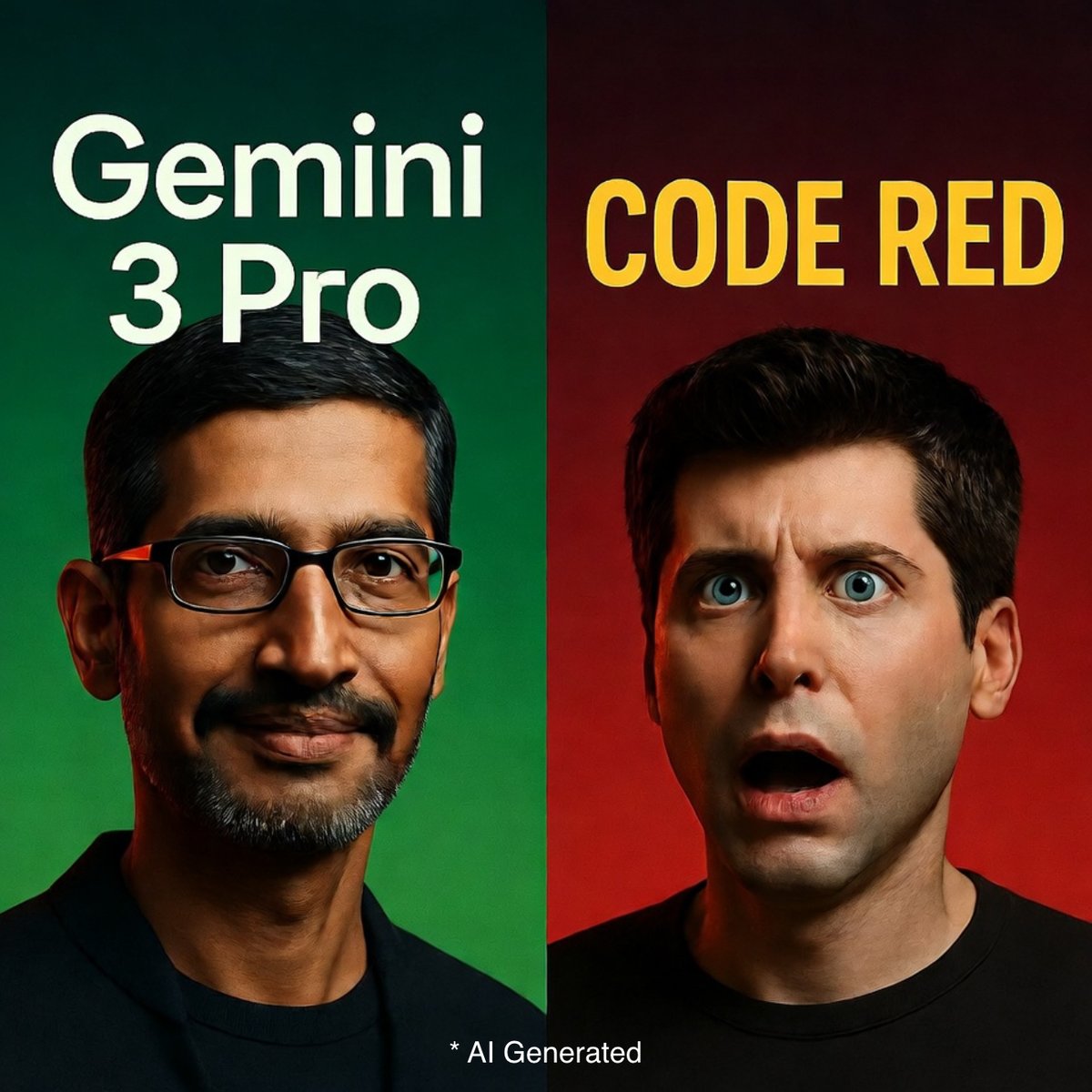
Wild: OpenAI's CEO, Sam Altman, just hit the panic button with an internal "code red" memo.
Why? Google's Gemini 3 is catching up fast, and in some ways, pulling ahead.
This feels like déjà vu.
Back in 2022, ChatGPT's launch forced Google CEO Sundar Pichai to declare his own "code red," prompting teams to speed up AI development.
Fast forward to now. Gemini 3 has topped benchmarks in reasoning, accuracy, and user engagement. It handles complex tasks better, with multimodal smarts for text, images, and video.
OpenAI's lead is slipping.
But it's deeper than benchmarks.
Google has what OpenAI craves: endless cash from $100B in quarterly ad revenue, massive data from Search and YouTube, and custom TPUs plus Nvidia chips at scale.
OpenAI burns through billions of dollars yearly, projected at $1.4T over eight years, with tight compute constraints. They can't match free access or ecosystem lock-in.
Anthropic adds pressure, too, but Google is the real giant waking up.
Sam's response?
Halt ads, shopping agents, health tools, and even Pulse assistant. All hands on improving ChatGPT core.
They're rushing a new reasoning model (codenamed "Garlic"?) that beats Gemini 3 in tests, set for next week.
OpenAI paused from "code orange" to full "red", and that’s existential threat level.
Near-term outlook? Brutal but exciting.
OpenAI will ship the new model soon, temporarily regaining the edge. But Google iterates faster with infra muscle.
Expect price wars, free tiers, and agent battles.
OpenAI needs partnerships (like AWS chips) and breakthroughs to survive.
For us watching: AI gets smarter, cheaper, faster.
Winners build on top now.
What edge will you grab?
#CODERED #openai #gemini3 #johnvjayakumar
Wild: The SECOND DEEPSEEK MOMEMT is here 🔥
DeepSeek just pulled off a crazy milestone in AI and maths: its new model, DeepSeek-Math-V2, has achieved gold-medal-level performance on problems from the International Mathematical Olympiad (IMO) 2025.
Here’s the highlight: it’s fully open source (and open weights).
DeepSeek-Math-V2 solved enough IMO 2025 problems to reach “gold-level” scores, a result normally achieved by only around 8% of human contestants.
The same model also hit gold level on the 2024 Chinese Mathematical Olympiad and scored 118/120 on the 2024 Putnam problems, beating the best human score reported there.
This is a specialised mathematical reasoning model that doesn’t just spit out answers – it writes proofs and then self-checks them using a generator → verifier → meta-verifier loop.
The weights are released openly on Hugging Face and GitHub under a permissive licence, so researchers, startups, and solo devs can run, fine-tune, and deploy them without asking anyone’s permission.
Until now, IMO‑gold AI models came from Google DeepMind and OpenAI – and stayed locked behind paywalls or private access. DeepSeek is the first to put an IMO‑gold math model into the open.
For the AI ecosystem, this is a big shift: high-end reasoning is no longer only a “closed labs” capability. Expect new tools in education, research automation, cryptography and even space science built on top of this model.
If you work in AI, data or education, now is a good time to ask: what could my product or workflow do if IMO-level math reasoning were just an open-source dependency?
#DeepSeek #imo2025 #johnvjayakumar
Wild: Kling just dropped something huge for video creators, and it genuinely feels like “Nano Banana, but for video.”
Here’s what makes Kling O1 exciting in simple terms. It’s a unified AI model that can generate, edit, and refine video from text, images, or short clips, all within one system.
Think of taking a clip you already have and saying, “change the background to a futuristic city, keep the same character and motion, make it look cinematic” – and it just does it.
Some of the wild use cases people are already playing with:
Edit any video with just a prompt: add, remove or tweak objects, people, lighting or backgrounds.
Turn simple reference shots into smooth, cinematic motion with pro-level camera moves and physics.
Keep characters, style and world consistent across multiple shots for storytelling, ads and UGC.
What Nano Banana did for images and design, O1 is now doing for motion.
Instead of wrestling with timelines and layers, you describe what you want, and let the model handle the heavy lifting, from tiny clean-ups to full scene rewrites.
If you create content, run ads, or just love experimenting with AI, this is one of those launches worth testing early.
The gap between “idea in your head” and “finished video on your feed” just got a lot smaller.
@Kling_ai
#klingvideoO1 #klingai #ai #johnvjayakumar
Alert: OpenAI has shared details of a security incident at Mixpanel, a third-party analytics provider it used for the API platform interface, in which an attacker exported a dataset containing limited user profiles and analytics data from Mixpanel’s systems, not from OpenAI itself.
No chat messages, API requests, passwords, API keys, payment details, or government IDs were exposed, but some API account names, email addresses, approximate locations, browser/OS info, and organisation or user IDs may have been included in the exported data.
The breach occurred inside Mixpanel’s environment, which OpenAI had used for web analytics on https://t.co/nObEpeec2R, and was detected by Mixpanel on 9 November 2025.
The attacker exported a dataset containing limited customer-identifiable and analytics information about OpenAI API users, and Mixpanel shared it with OpenAI on 25 November 2025.
OpenAI has now terminated its use of Mixpanel, is auditing other vendors, and is directly notifying affected organisations and users by email.
If your info was in that dataset, the real risk is targeted phishing; someone using your name, email, or other basics to trick you.
ChatGPT consumer accounts and other OpenAI products are not impacted by this incident, and there is no evidence of access to OpenAI’s core systems.
Watch out for emails or messages pretending to be from OpenAI or its support team. If they ask you to click links, download files, or share credentials, be suspicious. Double-check the sender’s domain and look for weird spelling.
OpenAI will never ask for your password, API key, or one-time codes by email, SMS, or chat. If you get a request like that, it’s a scam; report it.
Enable multi-factor authentication (MFA) for your OpenAI account and any other important accounts. Even if someone gets your password, MFA can save you.
Regularly clean up your API keys and access tokens. It’s good security hygiene, even if this breach didn’t leak any keys.
Incidents like this are a reminder that third-party vendors are often the weakest link in the security chain, even for leading AI companies. As builders and users, keeping basic security hygiene strong, maintaining vigilance against phishing, enabling MFA everywhere, and conducting periodic access reviews matter as much as the models we use.
#OpenAI #MixPanel #JohnVJayakumar
Anthropic has launched Claude Opus 4.5, marking a shift from “AI demos” to AI that actually works for businesses.
Unlike experimental chatbots, Opus 4.5 is built for documents, spreadsheets, slides, research, and analysis. It’s already available through AWS Bedrock, Google Cloud, and Microsoft Azure, so many of your workplace tools may quietly upgrade to it soon.
Here’s why it matters:
🔹 Stronger memory and reasoning: Handles long, complex conversations without losing context, and that’s perfect for multi-step tasks like proposal writing or report analysis.
🔹 Better integrations: Works across your files, browser, and enterprise tools for real productivity, not just answers.
🔹 Lower cost: Anthropic has made this model more affordable, expect it to appear in CRMs, analytics tools, and office suites without steep price jumps.
🔹 Faster, deeper output: Creates structured summaries, compares options, builds formulas, or drafts internal docs in your tone of voice.
🔹 Enterprise-ready: Built for security and compliance, making it safer for large-scale deployment.
You can start using it today for:
✅ Summarising reports or PDFs into crisp action notes.
✅ Cleaning meeting notes and drafting follow-up emails.
✅ Building dashboards or models in Excel or Sheets.
✅ Drafting policies, job descriptions, or training content.
✅ Researching and comparing vendors or regulations.
Tips to use it smartly:
• Begin with low-risk tasks like drafts and summaries.
• Give clear context about your goal and audience.
• Never feed confidential data unless your company's setup is compliant.
Claude Opus 4.5 signals the next era. AI as your teammate, not a toy.
#Claude #Anthropic #johnvjayakumar
Are You Feeling AI Fatigue?
I’ll admit it. Even as someone who spends most of his day exploring AI, I sometimes feel mentally drained.
Every week, there’s a new tool, a new model, a new update that promises to change everything. It’s exciting, but it can also be overwhelming. Many professionals today are feeling the same. This quiet exhaustion is what is known as AI Fatigue.
Why does it happen?
Because the pace of change is relentless. Just when you master one tool, five more show up. Add to that the constant noise of notifications, updates, webinars, and articles, and it starts to feel like too much.
AI systems are powerful, but they’re also complex. Learning them takes time, and that learning never really stops. The hype doesn’t help either. We keep hearing that AI will double productivity and free up time, but when the results don’t live up to the promise, frustration sets in.
Then there’s the human side. Many quietly worry if AI might make their roles irrelevant. Others spend hours double-checking AI outputs because trust takes time to build. It all adds up.
So, what can we do?
Start by setting limits. You don’t need to explore every new tool that appears. Choose the ones that truly make your work better. Take short breaks. Step away from screens and breathe. Keep learning, but with purpose, learn to apply, not to chase trends.
Most importantly, stay human. Curiosity, empathy, and good judgment are still your biggest superpowers.
AI fatigue is real, but it doesn’t have to control us. The key is balance. Use AI thoughtfully. Let it support you, not exhaust you.
If you’ve been feeling this wave of fatigue too, pause and remind yourself that you are still in charge. AI should serve your goals, not the other way around.
Have you experienced AI fatigue lately? How are you managing it?
#aifatigue #ai #johnvjayakumar
Wild: Suno gets valued at $2.45B
Suno’s story is pure inspiration for anyone who believes in the power of bold ideas.
Just 18 months ago, the Suno team began building a future where anyone could make music with AI. In March 2023, they launched a simple but powerful platform that turned text prompts into songs. The idea spread fast, catching the attention of creators and music lovers around the world.
By May 2024, Suno had raised $125 million in Series B funding at a $500 million valuation. That boost helped them scale quickly, refine their AI music engine, and reach millions of users. They even teamed up with Microsoft so people could create music directly through Copilot.
Fast forward to November 2025. Suno had crossed 100 million users, was generating millions of songs per day, and was bringing in $200 million in annual revenue. Even with some legal challenges from major music labels, their momentum only grew stronger.
Then came their biggest milestone yet. On November 19, 2025, Suno raised $250 million in Series C funding, led by Menlo Ventures, NVentures (Nvidia), Hallwood Media, Lightspeed, and Matrix, valuing the company at a massive $2.45 billion.
Today, Suno stands as one of the largest AI-powered music platforms in the world, helping anyone create, edit, and share studio-quality music.
The journey is far from over. But Suno’s rise shows what can happen when creativity meets technology, and when people truly believe in a new way to make music.
@suno
#AIart #AIMusic
Google just launched Nano Banana Pro, a new AI image generation model built on Gemini 3 Pro. It takes Google’s image tools to a whole new level. Now, anyone can create high-quality images, infographics, and even educational diagrams with just a few words. The model handles complex information really well and produces clear visuals that make sense.
Nano Banana Pro is not just about beautiful images. It can turn your data, ideas, or even code into infographics and explainers. You can turn a text summary or a resume into a ready infographic in seconds. It also helps with presentations by keeping up to 14 images or characters consistent across your slides, instantly making everything look more polished.
What makes Nano Banana Pro stand out is its support for 4K images, accurate multilingual text inside the picture, and detailed control over lighting, composition, and proportions. If you need a specific format like 16:9, it is easy. If you want clean, readable text in different languages, Gemini 3 handles it well. It can also localize content fast, which is great for global projects.
The model is available now in the Gemini app and Google’s NotebookLM. Most users get free allowances, and paid plans give deeper integration. It is also rolling out to Google Workspace, so Slides and other tools will soon support direct AI image creation and editing.
If you create content, teach, design, or just want to make visuals easier and smarter, Nano Banana Pro is worth trying. It feels like having a designer, researcher, and illustrator all in one place.
#AI #nanobanana #JohnVJayakumar #Gemini3
It's Official: Yann LeCun, one of the biggest pioneers in artificial intelligence, has announced that he will leave Meta at the end of the year after 12 incredible years. He spent 5 years building FAIR (Facebook AI Research) and 7 years as Meta’s Chief AI Scientist.
Yann’s work has shaped so much of what AI is today. He helped invent convolutional neural networks, changed the way the world approaches image recognition, co-founded FAIR, and won the Turing Award for his contributions. His influence is everywhere in the AI world.
At Meta, FAIR became a driving force for open research and collaboration across industry and academia. The team produced ideas and breakthroughs that helped lay the foundation for today’s generative AI wave.
Now, Yann is starting a new chapter. He is launching a startup focused on Advanced Machine Intelligence, aiming to build AI systems that can reason, remember, and understand the real world at a much deeper level. Meta will be an early partner. This next phase could once again shape the future of AI.
Thank you, Yann, for everything you have contributed. Wishing you the best as you build AMI and continue pushing the boundaries of what AI can become.
Image Credit: Yann LeCun
@ylecun
Wild: Google has just launched Gemini 3.0 Pro, its most advanced AI model yet, now available across products like Search, Workspace, and the Gemini web and mobile apps. Gemini 3 Pro sets a new standard for intelligence, combining state-of-the-art reasoning with rich multimodal capabilities, letting users interact with text, images, and even video seamlessly and more deeply than before.
What Makes Gemini 3 Pro Special?
Gemini 3 Pro delivers significant upgrades in reasoning, factual accuracy, and long-context understanding versus previous models.
It outperforms earlier versions (like Gemini 2.5 Pro) on top AI benchmarks.
The model shines in multimodal use, handling a mix of text, visuals, and video with ease. This supports more powerful workflows, like drafting a document from mixed inputs or generating code for full apps from natural language.
Where Can You Use Gemini 3 Pro?
Gemini 3 Pro powers the latest versions of Google’s Search (via AI Mode), Workspace tools (Docs, Gmail, Sheets), and the Gemini app, with integration rolling out broadly across Google’s ecosystem.
It enables smarter email summaries, project briefs, app generation, data analytics, and even helps in advanced planning or daily productivity tasks.
Why Does This Matter?
Google aims to make this the most agentic, “vibe coding”-ready model on the market, enabling users to go from idea to output with minimal friction.
Stronger reasoning, factual accuracy, and multimodal performance mean Gemini 3 Pro can now handle deeper questions and automate everyday workflows for professionals, businesses, and creatives alike.
This launch signals Google’s push to lead the next phase of generative and agentic AI.
Gemini 3 Pro sets a bold new direction for Google’s AI and is now in preview for users globally. If you work in digital content, productivity, or app development, it’s worth exploring how this can streamline your workflow and spark new ideas.
#ai #Gemini3 #JohnVJayakumar