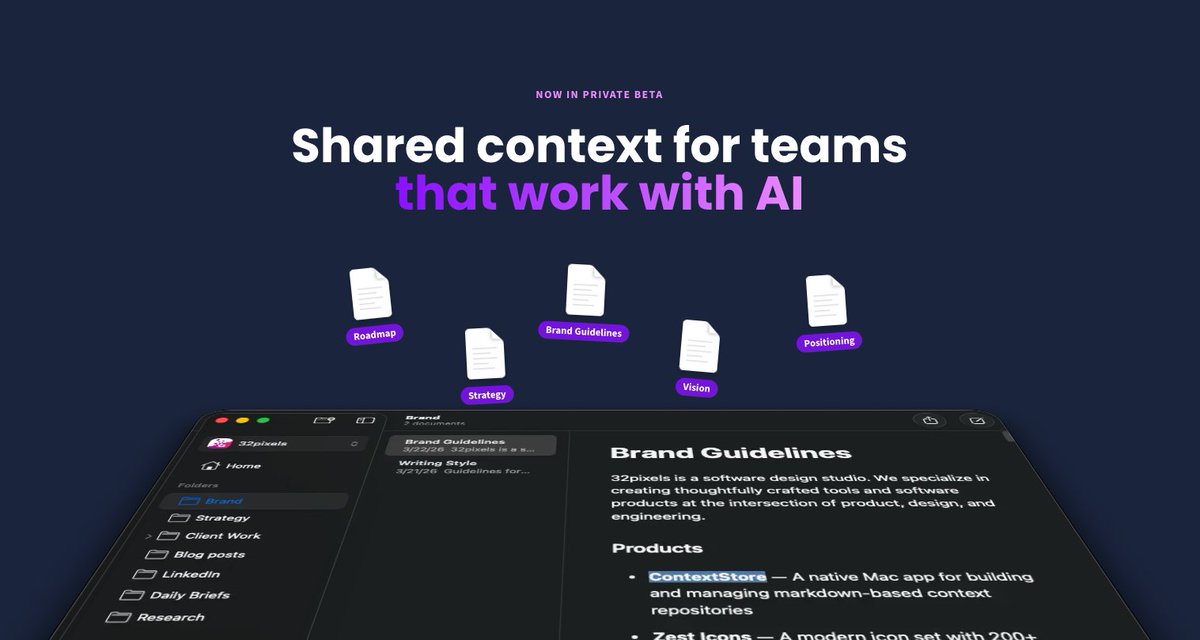
I made a native Mac app called ContextStore! It helps teams collaborate on Markdown Context Repositories together! It's in beta! Celebrate with me! 🥳 🎉🙌 https://t.co/udSL9gyT1k
#AIContext#Markdown
Introducing SubQ - a major breakthrough in LLM intelligence.
It is the first model built on a fully sub-quadratic sparse-attention architecture (SSA),
And the first frontier model with a 12 million token context window which is:
- 52x faster than FlashAttention at 1MM tokens
- Less than 5% the cost of Opus
Transformer-based LLMs waste compute by processing every possible relationship between words (standard attention).
Only a small fraction actually matter.
@subquadratic finds and focuses only on the ones that do.
That's nearly 1,000x less compute and a new way for LLMs to scale.
We were a little slow on this, but we just got a technical blog post up with more details. Please take a look!
https://t.co/tPLzi0eNJR
We have a model card coming next week, and we are happy to take requests for any specific details there.
I am happy to answer any questions here!
Code is an output. Nature is healing.
For too long we treated code as input. We glorified it, hand-formatted it, prettified it, obsessed over it.
We built sophisticated GUIs to write it in: IDEs. We syntax-highlit, tree-sat, mini-mapped the code. Keyboard triggers, inline autocompletes, ghost text. “What color scheme is that?”
We stayed up debating the ideal length of APIs and function bodies. Is this API going to look nice enough for another human to read?
We’re now turning our attention to the true inputs. Requirements, specs, feedback, design inspiration. Crucially: production inputs. Our coding agents need to understand how your users are experiencing your application, what errors they’re running into, and turn *that* into code.
We will inevitably glorify code less, as well as coders. The best engineers I’ve worked with always saw code as a means to an end anyway. An output that’s bound to soon be transformed again.
New blog post:
I almost installed Disqus out of habit. Instead I built a full comment system — auth, spam protection, email notifications — in about 3 hours with Claude.
Build vs. buy isn't what it used to be.
https://t.co/QtLd2miscd
Most of the bad output people get from AI isn't a model problem. It's a context problem.
My latest post shows that with a Context Repo:
https://t.co/71vFtKxE8W
I keep rebuilding essential these Claude skills for every project.
So I built a thing that builds things.
Quiddity is open source! One command generates /new-issue, /next-task, and /approve skills tailored to your stack.
https://t.co/wSmfdW9jv9
My /next-task skill originally handled picking a task, implementing it, opening a PR, and merging when approved. Eventually, I asked Claude to extract a sub-skill for /approve: https://t.co/lNFussdVsN
Agent Skills are giving me better results with LLMs! Here are 3 skills that form a complete loop for my dev process: /new-issue, /next-task, and /approve - https://t.co/O6o3bJwYOs
Now let's dive into making a /next-task skill with Claude.
My /next-task skill:
• Checks Linear for the highest-priority issue
• Implements the changes
• Opens a PR with a test checklist
• Merges when I say "approved"
https://t.co/mKs7r5zSmj
@wesbos I’m just using the native “Handoff” to switch between two Mac’s. I have a cheap smaller screen that sits below my large screen for the other Mac.