If you’ve ever
- thought AI protein folding is magical ✨
- wanted more than a pLDDT score 🔎
- or just think mech interp in bio is cool 🤓
then read the 🧵 👇 on our first paper towards interpretable protein structure prediction just accepted to workshops at ICLR
A First Step Towards Interpretable Protein Structure Prediction
With SAEFold, we enable mechanistic interpretability on ESMFold, a protein structure prediction model, for the first time.
Watch @NithinParsan demo a case study here w/ links for paper & open-source code 👇
@yifan_zhang_ How does this compare to LieRE and STRING which generalize from SO(d) to general Lie groups?
https://t.co/HdaAFxAZ0Q
https://t.co/LWVkQiv1sl
@zdeborova@icmlconf cool! have you guys considered extending your spectral analysis to tensor products? i’m curious given there’s machinery there for analyzing spectra with the non-linear activation fns across multiple layers.
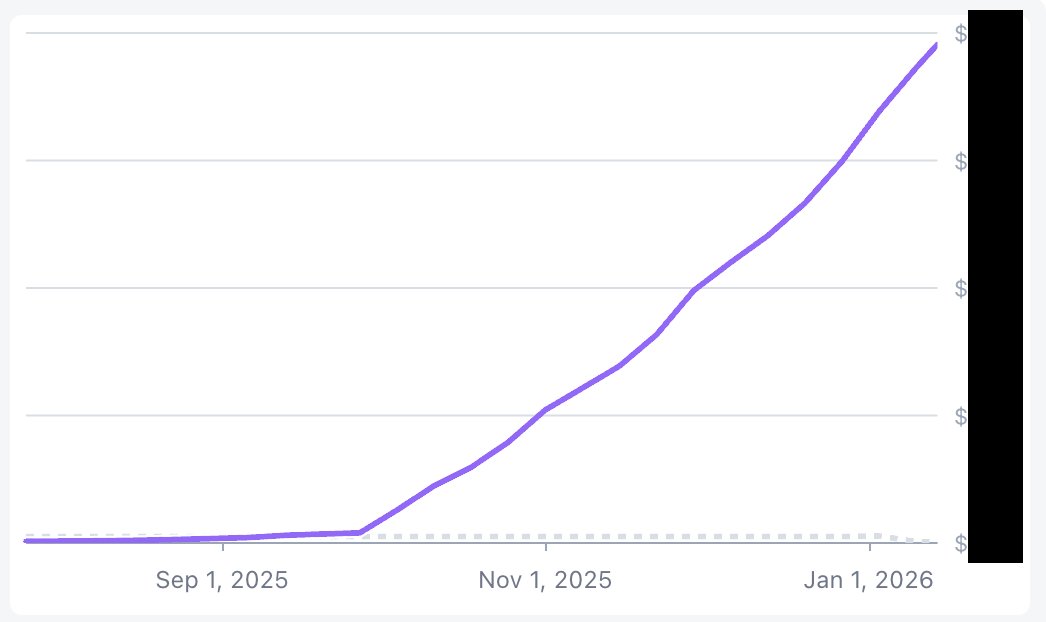
Excited to announce that @SolaAI_ has raised a $17.5M Series A led by @a16z with support from @Conviction@ycombinator, bringing total funding to $21M 🚀
From the start, we set out to reimagine human-AI interaction to push the boundaries of process automation. Our agents watch how people do tasks on-screen, then handle those tasks automatically, even in legacy tools.
Abstraction requires a tradeoff between task accuracy and compression. Binary codes => 100% accuracy. English => less accuracy, dependent on receiver. I like how the information bottleneck method rigorously describes this tradeoff, formulating it as a minimax optimization. https://t.co/Zf558vPShh
Grateful to be featured in @Forbes and to go deeper and share the vision behind @phosphorcap.
Thank you to @dasha_shunina for taking the time to understand Phosphor’s mission.
🚨 New paper alert!
Linear representation hypothesis (LRH) argues concepts are encoded as **sparse sum of orthogonal directions**, motivating interpretability tools like SAEs. But what if some concepts don’t fit that mold? Would SAEs capture them? 🤔
1/11
The YC Summer 25 application deadline is May 13th!
No better time to found & build tech that'll shape the next decade.
To pay it forward, I'm happy to review applications & mock interviews so reach out!
https://t.co/wBx0GIk9UD
@kaivu, @atticuswzf , and I were researching long horizon reasoning (with @jacobandreas). We found existing benchmarks’ hard problems often featured tricky puzzles, not tests of system understanding. So we made Breakpoint: a SWE benchmark designed to disambiguate this capability.
The YC Summer 25 application deadline is May 13th!
No better time to found & build tech that'll shape the next decade.
To pay it forward, I'm happy to review applications & mock interviews so reach out!
https://t.co/wBx0GIk9UD
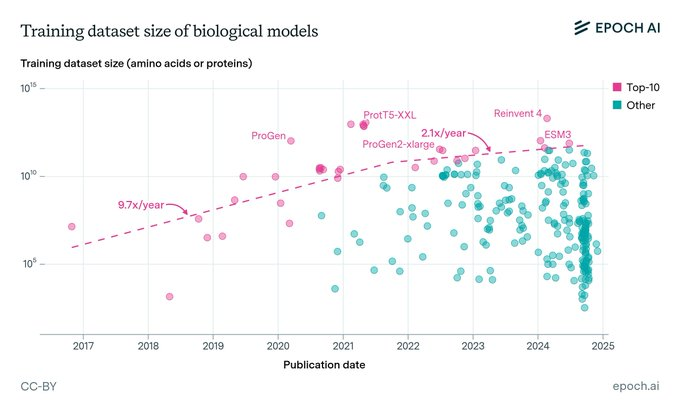
Biology’s lack of data is holding back its AI boom.
Epoch’s latest report shows explosive growth in biological model training data size from 2017–2021 (9.7×/year), but a (2.1x/year) plateau since.
AI models for biology are ready to transform science if the data can keep up.
I’m at #ICLR2025 the next few days! I’m making lots of time in my schedule to talk to researchers who might someday want to start a company. If that’s you, sign up for a YC office hours with me here. https://t.co/uUMQvPqV6C
Our paper "Everything, Everywhere, All at Once: Is Mechanistic Interpretability Identifiable?" will be presented at #ICLR2025!
It's also the first paper of my first PhD student — congrats @maximemeloux! 🎉
blog post: https://t.co/puTwN8dgYS
A short thread 🧵
Heading to ICLR in 🇸🇬 next week.
If anyone’d like to connect abt random matrix theory & Tensor Programs for mechanistic interpretability, DM me and if you’re in Singapore or SF, I’ll treat.
To put out a specific topic, I’ve been intrigued by the Free Independence Principle and Jacobian SV distribution in TP III and their implications for interpreting cross-layer computation.