🇺🇸 The US Constitution divides power in the country:
• Horizontally: making laws (legislative power), applying laws in practice (executive power) and settling disputes (judicial power) are separated.
• Vertically: the US is a federation, where 50 states have their own legislative, executive and judicial institutions that govern them.
Checks and balances is the principle that each branch of government can block or restrain the others, so that no single one holds all power.
The President can block (veto) laws, Congress confirms appointments and can sanction officials, and courts can rule laws unconstitutional.
Interest groups (lobby groups) promote their preferred policies to lawmakers, provide arguments, data and draft laws (bills).
• Over $5 billion was spent on federal lobbying in 2025, with around 13,000 registered lobbyists.
Campaign finance is giving money to candidates, which can win political favours later. The amount that can be given is limited by law.
• Since 2010, if the money is spent in support of a candidate but formally without their involvement, the spending is unlimited; this is called a Super PAC.
Federal agencies write detailed regulations that carry the force of law, adding details and specifics to the broad laws passed by Congress.
For example, the Food and Drug Administration (FDA) controls medicines and food products, while the Federal Bureau of Investigation (FBI) is the security service with broad law enforcement powers.
The Federal Reserve (Fed), the country’s central bank, was made independent of the President and Congress on purpose.
Its goal is to control general prices by changing the cost of borrowing from banks.
Other independent agencies exist, especially around finance, elections, energy, free markets and communications.
Read more in our latest report:
US Politics, explained
https://t.co/a6kVnCZMx8
Stay curious 👀
⚡️2024 ELECTIONS - Venezuelan officials declare Maduro’s victory with 51% of the votes.
Venezuela enters days of extreme uncertainty, as results are contested.
Catch up on the crisis with our deepdive:
•In May 2018, Nicolás Maduro was controversially re-elected as president of Venezuela.
•Major international players, especially the United States and the European Union, the immediate neighbours of Venezuela and many other states did not recognise the results.
•However, 16 countries have recognised Maduro as a legitimate president, including China, Russia, Iran, North Korea, Bolivia and Turkey (a NATO member).
•The National Assembly's speaker Juan Guaidó declared himself "interim president", claiming that Maduro's re-election was not valid and therefore the presidency was vacant.
•The US introduced financial sanctions in 2017, worsening and prolonging the economic crisis in Venezuela.
•In April 2019, Guaidó called for a military uprising to replace Maduro.
•Opposition leader Leopoldo Lopez was released by the head of the secret police in an effective betrayal of Maduro.
•However, key political figures such as heads of the supreme court and the armed forces did not join the coup as it was supposedly agreed.
•The 2024 presidential election took place on July 28th. Maduro won an official victory with 51% despite opposition candidate’s overwhelming win in the polls.
Full visual report is free and ad-free on out website.
Some companies are experimenting with alternative battery designs, which could potentially be cheap, sustainable and use less critical minerals, such as sodium-ion batteries.
The recent drop in the price of lithium was largely a result of an oversupply and may not be indicative of future price trend, as the demand for batteries continues to expand.
Concentration of the market is likely to remain high, as almost 50% of refining projects planned for 2023-2030 are located in China.
African suppliers, especially Zimbabwe, are projected to win over a higher share of global lithium mining by 2030.
Dependence in processing and battery manufacturing remains an issue and was recognised a national security threat by the US military.
A 2023 estimate by Bloomberg suggests the US would need an $82 billion investment to achieve battery supply chain self-sufficiency, while Europe would require $98 billion.
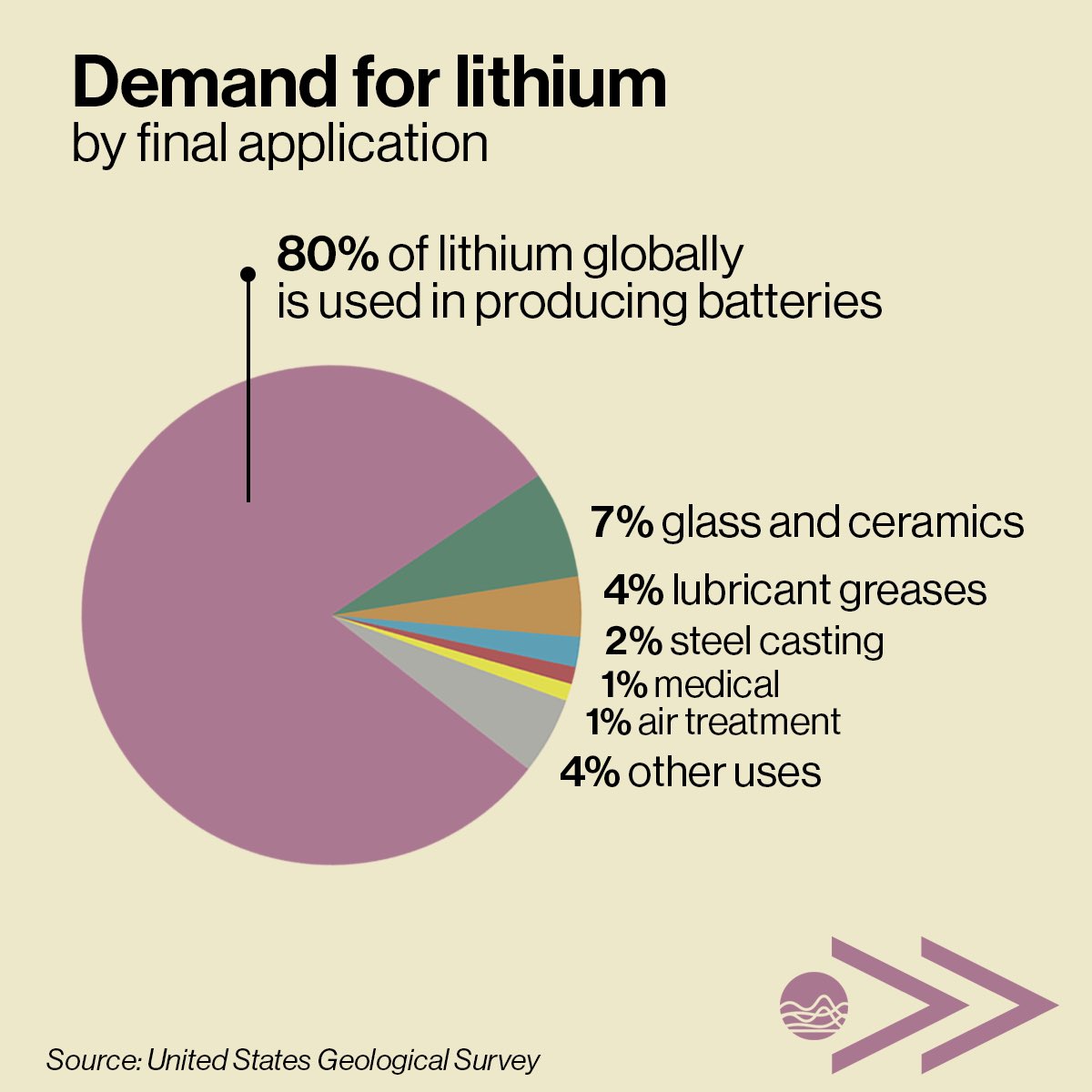
Lithium-ion batteries are currently the best available solution for energy storage, so demand for lithium increased dramatically with growing need for storing electricity.
The price of lithium carbonate steadily grew to around $20,000 per tonne until late 2021, when it shot up to $35,000 within months and in 2022 breached $70,000 per tonne.
In 2023, lithium prices dropped by as much as 80% throughout the year.
In the last decade, demand and supply grew exponentially, but the rush may just be beginning.
Climate pledges already made would require many times more lithium than is currently traded, and even more so in the Net-Zero scenario.