The market has changed dramatically over the last several years, and many people still don’t fully understand why.
Markets today are faster, more emotional, more narrative-driven, and far more manipulated by headlines, algorithms, social media amplification, fake news, political agendas, engagement farming, and nonstop information overload than ever before. Short-term price action is now constantly being distorted by noise disguised as “analysis.”
Too many traders and investors are making decisions based on fear, euphoria, clickbait, television personalities, recycled narratives, social media momentum, or emotional reactions instead of actual data, market structure, liquidity behavior, institutional positioning, earnings quality, macro trends, and forward fundamentals.
That’s why so many people continuously get chopped up, enter too late, sell too early, panic at bottoms, chase near tops, and constantly feel emotionally exhausted by the market.
The reality is that successful investing and trading today requires filtering out massive amounts of noise and focusing only on what actually matters.
That’s exactly why the models and systems I’ve built for myself, as well as for the benefit of my clients, have been working so well.
They’re designed specifically to eliminate emotional bias, ignore false narratives, identify real institutional behavior, measure forward acceleration and deterioration early, and focus on probabilities instead of opinions.
The goal has never been prediction. The goal has always been positioning.
Not reacting emotionally.
Not chasing narratives.
Not forcing trades.
Not listening to noise.
Just consistently identifying high-probability opportunities, protecting capital during deteriorating conditions, and helping people make clearer, smarter, more disciplined decisions in an increasingly distorted market environment.
And ultimately, that’s what produces better long-term results.
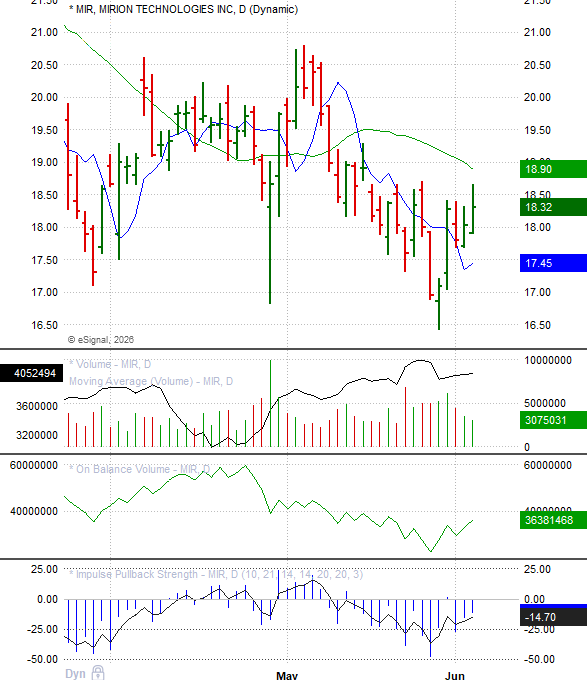
Mirion Technologies, Inc. $MIR. Interesting growth opportunity.
Mirion operates in radiation detection, measurement, monitoring, and nuclear instrumentation markets that benefit from long-duration demand cycles rather than short-term economic swings. The company sits in several attractive niches tied to nuclear power, medical applications, defense, and regulatory compliance, creating a fairly durable demand backdrop.
What makes the forward setup interesting is that the business appears to be moving through a period of improving execution while benefiting from renewed global interest in nuclear energy infrastructure. As projects advance and service revenue continues to expand, the company has an opportunity to generate better operating leverage and margin improvement than investors have historically associated with the story. The recurring service and installed-base characteristics also provide a degree of revenue durability that many industrial names lack.
From a market perspective, the stock looks like it may be attempting to emerge from a prolonged consolidation phase. Institutional sponsorship has not fully returned yet, but volume, accumulation trends, and internal momentum appear to be improving. The primary risk remains execution. Nuclear-related spending cycles can be uneven, project timing can shift, and expectations around the broader nuclear theme occasionally run ahead of actual revenue realization. Still, if management continues executing, the forward risk/reward remains favorable relative to many industrial growth peers.
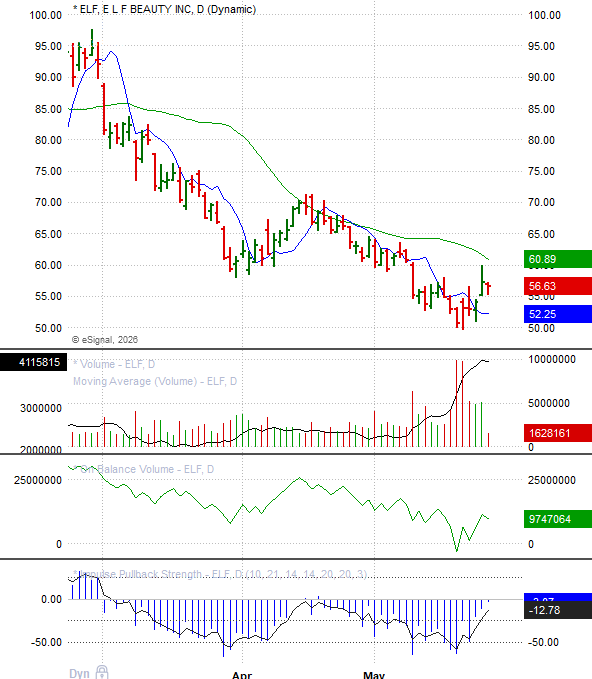
Little things make for good returns sometimes $ELF
e.l.f. continues to operate as one of the more differentiated growth stories in beauty, largely because management has consistently executed against a value-oriented product strategy while still taking share across younger demographics. The company’s ability to move quickly on trends, maintain strong retail relationships, and scale marketing efficiently has allowed revenue growth to materially outpace much larger peers for an extended period.
The forward setup is becoming more interesting here because the stock has already undergone a major valuation reset while the underlying business still appears structurally intact. Margins and operating leverage remain key variables, but if management can stabilize growth while preserving brand momentum, the earnings power could start to inflect again faster than the market currently expects.
The risk is fairly straightforward. Expectations were once priced for near-perfect execution, and any moderation in category growth, competitive pressure, or inventory normalization can create sharp multiple compression. The chart still reflects damaged institutional sponsorship overall, but the recent stabilization in volume and internal momentum suggests the selling pressure may finally be exhausting itself.