James Cameron has written & directed 3 of the top 4 highest-grossing movies of all time (Avatar, Avatar: The Way of Water, and Titanic).
Before he made movies, Cameron was a truck driver.
He didn't go to film school.
Instead, on the weekends, he would go to the library and..
"I'd pull any thesis that [University of Southern California] graduate students had written [on] anything that related to film technology," Cameron explained.
"And for the cost of xeroxing (photocopying), I [got] all these doctoral dissertations [and] build up these big binders on how everything was done."
"So I literally gave myself a full graduate course on film technology for about $120.
I didn’t have to enroll in school because it was all there in the library. I’d set it up to go in like I was on a tactical mission, find out what I needed to know, and take it all home."
Takeaway 1:
When asked what motivated him to read those big binders full of information on filmmaking, Cameron said he was just following what excited him.
"People seek out the information and knowledge they need," he said. "It's like a divining rod."
The mythologist Joseph Campbell similarly talked about how reading is like "a divining rod," a way to find what you are uniquely attracted to and meant to do.
"You’ve got to read," Campbell said. "Find [what] excites you. And if it doesn’t excite you…It’s not yours.”
Takeaway 2:
Of course, at some point, Cameron had to put the binders down and pick up a camera.
When he eventually attempted to make his first movie, Cameron said, “It was a bit like a doctor doing his first appendectomy after having only read about it."
The bestselling author and learning expert, Scott Young, has a great article with a great title, "Do The Real Thing."
"When you examine case studies of people who have had major accomplishments," Scott writes, "you expect there to be some trick or shortcut...More often, however, the strategy used is dead simple: doing the real thing."
Takeaway 3:
Leonardo da Vinci used to sign off his letters, “Leonardo da Vinci, disscepolo della sperientia” ("disciple of experience").
He used to believe that one learns best by solely "doing the real thing."
Over time, however, he evolved out of this belief and, biographer Walter Isaacson writes, "became a disciple of both experience and received wisdom."
When you examine case studies of people who have mastered their craft, you usually find they are "disciples of both experience and received wisdom."
Like Cameron, they read the library and they do the real thing.
- - -
“Those who are in love with practice without theoretical knowledge are like the sailor who goes onto a ship without rudder or compass and who never can be certain whither he is going.” — Leonardo da Vinci
Follow @bpoppenheimer for more content like this!
People assume that recycling used nuclear fuel to use in a fast reactor is a pie-in-the-sky idea.
But it's literally been done (decades ago)
-and-
it's being done right now - in partnership with INL and DOE - for our very first plant.
Soon we'll have more pictures...
♻️❤️♻️
Why do YOU think we should invest in nuclear energy?
@ENERGY's Dr. Katy Huff breaks down three reasons why we should this #EarthDay. 🌎
#InvestInOurPlanet
Pleased to finally announce the North American release of our documentary, #NuclearNow, in theaters on April 28th. It took - off and on - nearly 3 years to pull together. This is a pressing global issue, and our goal was always to show it in as many countries as possible.
Never regret a day in your life. Good days give happiness, bad days give experiences, worst days give lessons, and best days give memories.
—Professor Richard Feynman
How long a 100 Watt light bulb could run from using 1 kg of various fuels:
Wood = 1.2 days
Coal = 3.8 days
Oil = 4.8 days
Uranium* = 25,700 years
*using a breeder reactor
https://t.co/KjCVRREKsF
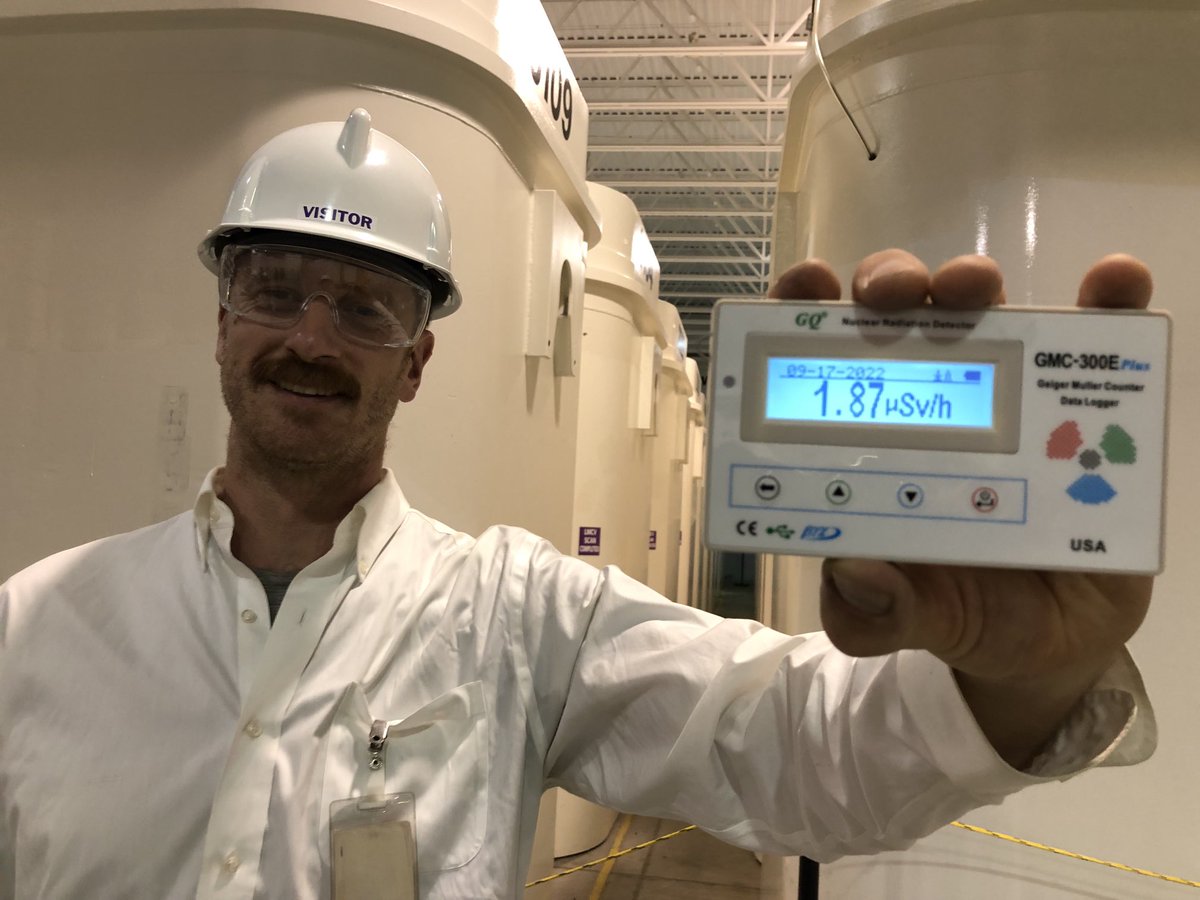
Hey Doc… Is it dangerous to stand next to nuclear waste?
Here I am surrounded on all sides by dry casks full of fresh spent nuclear fuel receiving a radiation dose rate 50% lower than I would flying in a commercial airliner.
Pretty simple engineering makes this hazard safe.
Solar panels "often contain heavy metals such as cadmium, copper, lead, selenium, and silver. The presence of those metals may cause discarded panels to exhibit the hazardous waste characteristic of toxicity, and thus be classified as hazardous waste"
So workers in California can tear apart old solar panels without any worries about exposures. Not because it's safe. But because health and safety precautions are such a nuisance.



![bpoppenheimer's tweet photo. James Cameron has written & directed 3 of the top 4 highest-grossing movies of all time (Avatar, Avatar: The Way of Water, and Titanic).
Before he made movies, Cameron was a truck driver.
He didn't go to film school.
Instead, on the weekends, he would go to the library and..
"I'd pull any thesis that [University of Southern California] graduate students had written [on] anything that related to film technology," Cameron explained.
"And for the cost of xeroxing (photocopying), I [got] all these doctoral dissertations [and] build up these big binders on how everything was done."
"So I literally gave myself a full graduate course on film technology for about $120.
I didn’t have to enroll in school because it was all there in the library. I’d set it up to go in like I was on a tactical mission, find out what I needed to know, and take it all home."
Takeaway 1:
When asked what motivated him to read those big binders full of information on filmmaking, Cameron said he was just following what excited him.
"People seek out the information and knowledge they need," he said. "It's like a divining rod."
The mythologist Joseph Campbell similarly talked about how reading is like "a divining rod," a way to find what you are uniquely attracted to and meant to do.
"You’ve got to read," Campbell said. "Find [what] excites you. And if it doesn’t excite you…It’s not yours.”
Takeaway 2:
Of course, at some point, Cameron had to put the binders down and pick up a camera.
When he eventually attempted to make his first movie, Cameron said, “It was a bit like a doctor doing his first appendectomy after having only read about it."
The bestselling author and learning expert, Scott Young, has a great article with a great title, "Do The Real Thing."
"When you examine case studies of people who have had major accomplishments," Scott writes, "you expect there to be some trick or shortcut...More often, however, the strategy used is dead simple: doing the real thing."
Takeaway 3:
Leonardo da Vinci used to sign off his letters, “Leonardo da Vinci, disscepolo della sperientia” ("disciple of experience").
He used to believe that one learns best by solely "doing the real thing."
Over time, however, he evolved out of this belief and, biographer Walter Isaacson writes, "became a disciple of both experience and received wisdom."
When you examine case studies of people who have mastered their craft, you usually find they are "disciples of both experience and received wisdom."
Like Cameron, they read the library and they do the real thing.
- - -
“Those who are in love with practice without theoretical knowledge are like the sailor who goes onto a ship without rudder or compass and who never can be certain whither he is going.” — Leonardo da Vinci
Follow @bpoppenheimer for more content like this!](https://pbs.twimg.com/media/FyDsJLPXsAIX5UE.jpg)