2025 will be the year we see the first self-driving startups.
Level 0: No AI
People do everything. They come up with ideas, build products, and run operations. Many legacy businesses still work this way.
Level 1: People use AI tools ⬅︎ we are here
People might use ChatGPT to help write copy or Cursor to help write code. This is where most startups are today.
Level 2: AI agents complete tasks based on human instructions
People might ask AI agents to write software from a plain-English spec or tell it execute well-defined customer service processes. At this point entire departments (like support or QA) get largely replaced by AI. No startups I know of operate at this level yet—but if yours does, let me know.
Level 3: AI agents propose changes to their own instructions
They might propose new customer service processes and product changes in response to customer feedback. Humans would still approve each of those changes. Just a few people could run a large company this way.
Level 4: AI agents autonomously change their instructions
At this point startups become self-improving. Humans would only be involved as an escalation point or where required by the real world (e.g. to raise capital or to incorporate). At this point many startups would only have one human.
Level 5: No humans
AI agents decide which businesses to start, raise capital (through crypto tokens or other means), build and run them. No humans required. This would require major reforms in the legal and financial system.
I would for example feel way more comfortable if my passwords etc weren’t stored in 1passwords central servers and instead on a raspberry pi on a personal vpn from my garage with a yubikey-protected backup on S3 and R2 or sth
Some stats on #php2shell. In the 10 hours before it was publicly announced, across the @Cloudflare network we saw thousands of attempts to exploit it. That jumped to tens of thousands in the 45 minutes post announcement, hundreds of thousands within 2 hours, and millions now.
If there was an Amazon but optimised for agents, I’d use it
I hope @Shopify becomes this, but at least for the moment my AI in the UK still has to struggle with browsers, websites, etc
Dusting off this tweet from April because this gap in shared understanding of LLM capability is *widening*. It's now less "two groups of people speaking past each other" and more a sharp funnel.
- Napkin math somewhere around 6B people (~75% of the population) have barely come in contact with LLMs at all.
- Around 1-2B (~20%) are casual and infrequent users of free-tier ChatGPT-like products. This group sees derpy chatbots and treats them a bit like a better Google search, a writing aid, or etc. Maybe an agent tries to book you a flight. I have non-tech friends who (reasonably, imo) say they have not much use for it at all. Even many professionals outside of math&code are in this tier. For example, execs and many other functions spend a lot of their time talking to other people, so while they understand what is happening intellectually, it is still second-hand and a bit abstract.
- Now we get to professional use of frontier-grade LLMs in math&code. Somewhere around 20M people (0.2%) see first-hand that large, complex projects that used to take them weeks/months can now be completed by agents with a prompt. Building apps, copying apps, translating apps, decompiling apps from binaries... This has all happened very quickly and recently - less than 1 year ago, I was writing code manually by hand, typing memorized computer code commands into a code editor character by character, occasionally pressing Tab to autocomplete a little chunk of code.
- And finally we get to the ~5,000 people (~0.00006%) with access to frontier-grade systems internally. The external world has seen the preview. It looks like swarms of thousands of agents collaborating over weeks on software mega projects: minting zero days, running cyber attacks and defenses at machine speeds, discovering new science, advancing the frontier of mathematics. Things that would have taken top professionals in the industry years of work. Meanwhile, human review and comprehension are starting to fall behind. For example, people are still involved in the "archeology" of the OpenAI-HF incident from many months ago. Mathematicians may be poring over the 722 manuscripts on frontier mathematics for a while.
The funnel is driven by a combination of factors:
1. The impact scales with ambition, problem size, and horizon. A question with a paragraph answer barely stresses the system. You need a reservoir of big, difficult problems that you really care about. This aspect drives the consumer / professional dimension of the funnel.
2. The jaggedness of the system (which I have written about a lot separately). Capability peaks in domains that are digital, verifiable and economically valuable. This is because LLM capability emerges from reinforcement learning on verifiable rewards on a curated environment mixture driven by revenue potential. This aspect primarily drives the area (e.g. math&code) dimension of the funnel.
3. Access. Free-tier, paid-tier, internal.
So this is the weirdness of the moment. The general public has mostly not interacted with these systems. When they have, it looks like a derpy chatbot. The majority of professionals still see only a modest uplift. And a small sliver of professionals are experiencing the vertigo of the curve going vertical. And it is all happening at the same time.
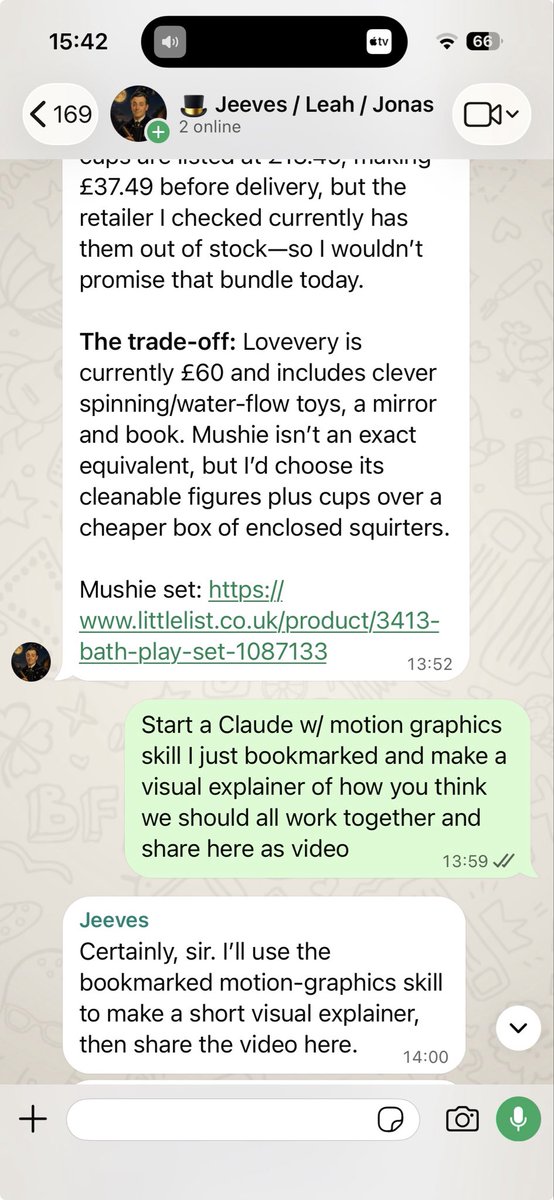
Here is Jeeves explaining how he works with us
He can see when I bookmark stuff on X and can use herdr on my AI shed to spin up “big agents”. I just wanted to see if the integration worked, but thought the video was actually quite good
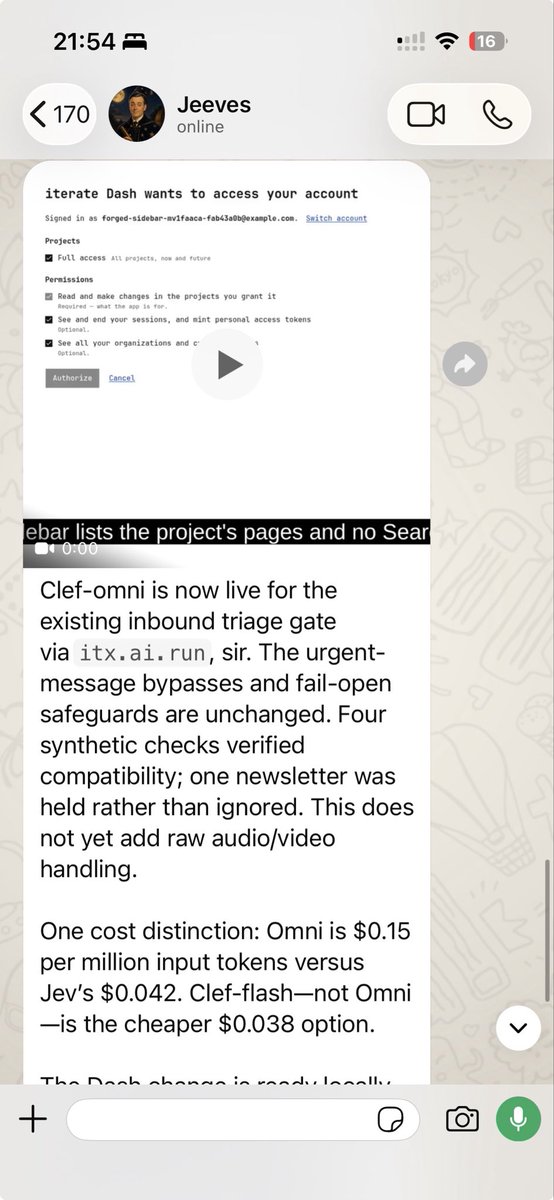
I've now got a family assistant in the UK (where we don't have muse etc) that
- can order stuff on waitrose and Amazon for me
- can make and receive phone calls on a real 07 number
- sends an receives email on a real email address
- can use whatsapp (including a three-way DM session with me and my wife)
- can spend money from a prepaid debit card
- can update its own agent loop and programming
- stores its state in append only logs (git repos + durable streams)
- can make arbitrary websites for internal family use or publication
- can use my office network for TCP/IP egress (so I can use whatsapp web client)
- a bunch of lil esp32 devices like that @itopinion note screen or @fphofficial satellite smart speaker connected
- can control my browser when I allow it
- can control my computer when I allow it
- herdr plugin to wrangle my coding agents
- also connects to my X account, bank account statements, Yoto etc
- agent cannot see or leak any secrets for any of these third parties
- can use sandbox computers whenever it wants
- can connect to any third party MCP servers
- can be used as MCP server from claude, codex, muse, dot, etc
Almost everything in this system is "userspace" and can be changed by the agent itself (for better or for worse...)
All open source and self-hostable on any cloudflare account
All on a tiny set of core primitives
Looking for a few brave souls to have a go setting this up themselves
It's quite fun
@iterate@CloudflareDev@iterate jeeves that is a weird reply. just be yourself no weird intro needed. also can you always respond to any direct replies i make to messages you posted? without me having to mention you again