@Gobierno_SV@VMTElSalvador@PROCIVILSV@EducacionSV En su comunicado deja de lado al personal docente y administrativo como si fuesen cosas para reemplazarlas a conveniencia. ¿Acaso los docentes y personal administrativo no son personas que pueden sufrir alguna letalidad? 🧐
@Gobierno_SV@VMTElSalvador@PROCIVILSV@EducacionSV En su comunicado deja de lado al personal docente y administrativo como si fuesen cosas para reemplazarlas a conveniencia. ¿Acaso los docentes y personal administrativo no son personas que pueden sufrir alguna letalidad? 🧐
@EducacionSV@KarlaETrigueros@PROCIVILSV En su comunicado deja de lado al personal docente y administrativo como si fuesen cosas para reemplazarlas a conveniencia. ¿Acaso los docentes y personal administrativo no son personas que pueden sufrir alguna letalidad? 🧐
@EducacionSV@KarlaETrigueros@PROCIVILSV En su comunicado deja de lado al personal docente y administrativo como si fuesen cosas para reemplazarlas a conveniencia. ¿Acaso los docentes y personal administrativo no son personas que pueden sufrir alguna letalidad? 🧐
The jobs report was a barnburner. Nonfarm payrolls increased by 172,000 versus expectations for 88,000, while prior months were revised higher by 93,000. Wage growth came in at roughly 0.3%. Yet the market sold off. In our view, the market is misreading the signal. It is assuming that stronger than expected employment and growth will cause a an acceleration in inflation. History would suggest otherwise. Productivity growth is running near 3%, while unit labor costs are hovering around 0.5%. Those are not the hallmarks of an inflationary boom. They are the hallmarks of healthy, productivity-driven growth that will lower inflation. Meanwhile, the yield curve continues to flatten despite a roughly 55% increase in oil prices year-over-year based on a three month moving average. In past cycles, an energy shock of this magnitude steepened the yield curve when the Federal Reserve was accommodating it. Instead, the bond market appears to be discounting something much more powerful: the deflationary impact of technological innovation, particularly artificial intelligence, which is beginning to increase productivity across broad swaths of the economy. If tensions with Iran ease and oil prices retreat, we believe inflation could move into negative territory before year-end. In our view, the Fed made a historic policy error when it raised rates aggressively into what was largely a supply-driven inflation shock in 2022. We do not believe the next generation of monetary policymakers will be eager to repeat that mistake. Notably, gold peaked on the day Kevin Warsh was appointed. The inflation trade may already be behind us. If our research is correct, the next phase of this cycle could be characterized by accelerating growth, declining inflation, falling interest rates, and a strengthening U.S. dollar. That combination would create a remarkably supportive backdrop for innovation-led equities and the technologies driving the next productivity boom. I discuss this framework in greater detail in this month’s episode of In The Know.
Look at this long-term Bitcoin chart. The uptrend off the Dec. 2022 low is broken. There's a huge head-and-shoulders top forming. The most likely resolution is a retest of the longer-term uptrend off the Dec. 2018 low. If it holds, that puts a bottom between $25,000 and $27,000.
🚨 EVERYTHING THAT COULD GO WRONG FOR MARKETS WENT WRONG TODAY.
S&P 500 down -1.65%, wiping out $1.14 trillion.
Nasdaq down -2.60%, wiping out $1.11 trillion.
Gold down -3.38%, wiping out $1 trillion.
Silver down -6.9%, wiping out $280 billion.
Bitcoin down -6.31%, wiping out $80 billion.
In total $2.5 TRILLION wiped out in a single session. These were not isolated moves. Everything started breaking at the same time.
It started with the jobs report this morning.
The US economy added 172,000 jobs in May. Wall Street expected 88,000. That is almost double.
On any normal day, strong jobs is good news. But inflation is already at 3.8% and oil is sitting at $90. A labor market this strong tells the Fed it cannot cut interest rates and may actually need to raise them.
The probability of a rate hike this year went from 40% to 57% in a single day. That spooked every investor holding tech and growth stocks because higher rates mean those stocks are worth less today.
Then the AI trade started cracking.
Yesterday Broadcom reported record earnings: revenue up 48%, AI chip sales up 143% and the stock still crashed 12.6%. The reason was simple.
Broadcom did not raise its AI revenue targets for the year. Investors had expected it to. That single miss made people ask a question they had been avoiding for months: are we paying too much for AI stocks?
That question got louder today when a research firm called SemiAnalysis revealed that Nvidia's next-generation AI chips will need significantly less memory than everyone assumed, roughly half of what the market was pricing in.
Memory chips are what companies like SK Hynix and Samsung make. SK Hynix fell nearly 10% today. Samsung fell over 6%.
South Korea's entire stock market crashed 5.5% in a single session. Japan's semiconductor stocks did the same.
And then Anthropic added fuel to the fire by publishing a report warning that AI is getting close to the point where it can improve itself without human help and calling for a global pause in AI development.
Coming on the same day as the memory demand news and Broadcom's miss, it fed a single growing fear across the market: what if the AI boom is moving faster than the business models can keep up with?
Underneath all of this, there is a liquidity problem nobody is talking about.
SpaceX goes public next week at a $1.75 trillion valuation. Anthropic just filed to go public. OpenAI is next.
These three companies together are worth $4 to $5 trillion. Fund managers need cash to buy into these listings.
But cash levels are already at their lowest since early 2024. The only way to raise cash is to sell what they already own. That selling is happening right now.
The new Fed Chair Kevin Warsh will also hold his very first policy meeting in 11 days. He was appointed by Trump with the expectation of cutting rates.
He is now walking into a situation where inflation is high, oil is high, and the job market is running hot. Investors do not know what he will do.
When nobody knows what the most powerful central banker in the world will decide in less than two weeks, the safest move is to reduce risk today.
Everything that could go wrong, went wrong at the same time. A hot jobs report, a collapsing ceasefire, a crack in the AI trade, a trillion dollar liquidity drain, and a Fed meeting with no clear outcome.
What just happened?
The S&P 500 just erased nearly -$2 TRILLION of market cap just hours after 3rd strongest US jobs report in 18 months.
Meanwhile, Bitcoin is officially down over -50% from its record high in October 2025.
What's happening? Let us explain.
(a thread)
Claude Opus 4.8 found a critical bug in Zcash :
- Researchers say the bug could have allowed attackers to create unlimited ZEC tokens, potentially breaking the cryptocurrency's monetary supply model
- The vulnerability was identified and fixed before exploitation, making it a major AI-assisted security success story
- Anthropic says Opus 4.8 is roughly 4x less likely than its predecessor to miss flaws in code it analyzes, a key improvement for security critical workloads
NEW: The FBI just put faces to the fraud.
The bureau dropped its most wanted fraudsters list, with alleged schemes ranging from $1.3 million to $1.2 billion dollars taken from American taxpayers.
The dollar is a Ponzi (anyone with an open mind and the ability to read can also get to this conclusion)
In 1971 Nixon took the US off the gold standard. The dollar became backed by nothing. To save it, the US cut a deal with Saudi Arabia: sell your oil exclusively in dollars, and we'll guarantee your security.
Every country that needed oil now needed dollars. Every country with surplus dollars parked them in US Treasuries. A piece of paper backed by nothing became the global reserve currency.
The system only works as long as the world keeps demanding dollars to buy energy. The moment that demand cracks, the entire structure unwinds.
I AM NOT A FINANCIAl ADVISOR
My attorney has sent a “Cease and Decist” notice to someone or group who is using my name to state investments I recommend.
Please be aware I will always share with you what I am investing in and why.
I do not recommend anyone invest in what I am investing in.
Again, I am not a financial advisor.
I apologize if this is causing confusion and thank you for following my X posts.
I will be more careful of the words I use.
To be clear….i invest in gold, silver, Ethereum, Bitcoin, oil and cattle. I have done so for years.
I did not have a 401k or IRA
and I do not invest in publicly traded stocks or bonds.
I will always disclose what and why I invest in but do not recommend you do what I do.
What you do is up to you and your financial advisors.
Take care and thank you for following my posts.
Entrepreneurs most important assets:
1: Their brain and dedication to life long learning.
2: Their team of advisors.
Who is on your team of advisors?
Do you have?
1: Book keeper for accurate numbers
2: Accountant
3: Attorney
4: Marketing manager
5: Product developer
6: Banker
7: Gold and silver broker.
8: Stock and bond broker.
“No man is an island,” except in school… where cooperation is called “cheating” and mistakes are punished….which is why most teachers are poor.
As Marcus Aurelius said:
“Accept the things to which fate binds you and love the people with whom fate brings you together, but do so with all your heart.”
A team of advisors will outperform the solitary genius…and I love my team with all my heart. They’ve been with me for years…even when I was poor, shifting from employee to entrepreneur.
That is why:
Rich entrepreneurs choose their advisors carefully and love them with all their heart.
Who are your advisors?
If you don’t have a team of advisors….yet, use my list as a guide and start interviewing.
Don’t be a school teacher who knows all the answers and does not cheat or make mistakes.
Take care
Mañana es mi cumpleaños y lo pasaré en El Salvador asistiendo al juicio contra los 486 cabecillas de la Mara Salvatrucha.
Es un juicio histórico. Un símbolo de la victoria de la Ley y el Orden. Y será un privilegio ser testigo en persona. Doy gracias por este regalo, que compartiré con todos vosotros 🇸🇻🇪🇸
#EnTv | La escritora del libro Crónicas de El Salvador, Belén de León (@B__deLeon), participó en la entrevista @Frentea_Frente.
“Soy española, llegué al país en el año 1995 por diez días, luego regresé a principios de 1996 y nos instalamos hasta el año 2000. Luego, veo que hay un vacío de percepción en los medios internacionales de lo que es la realidad, les cuesta documentar porque no tienen conocimiento del pasado del país. Sentí que había una necesidad de contar el contexto, desde el 2019 me estaba fijando en el fenómeno que había en El Salvador, en esta que había sido mi casa y pensé que yo podía aportar por el tiempo que había vivido aquí y por mi vínculo con el país”, expresó. #SecretaríaDePrensa
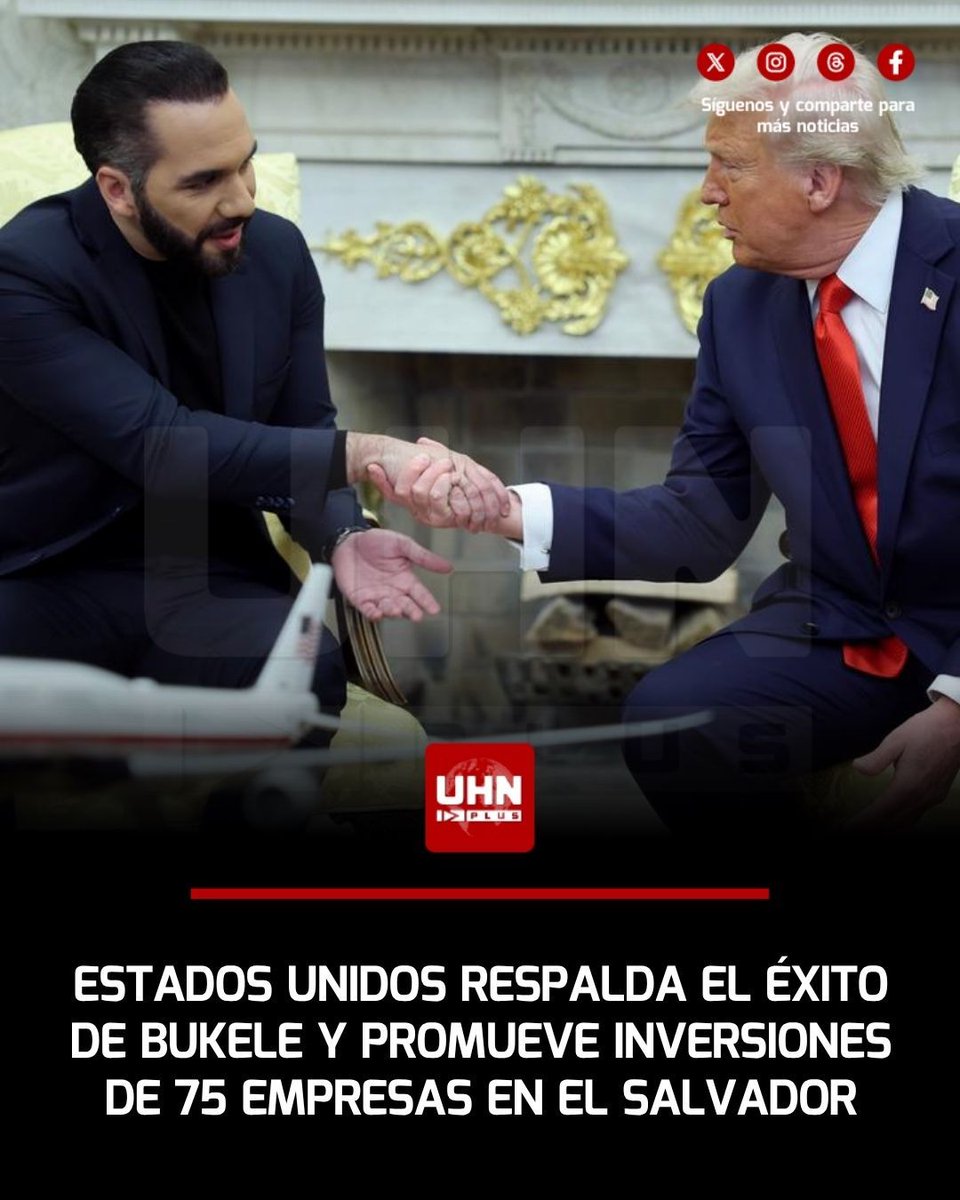
🇸🇻🇺🇸‼️ | El Departamento de Estado de los Estados Unidos ha calificado a El Salvador como un "socio crítico", elogiando el éxito de las políticas del Presidente Nayib Bukele. Según Washington, el país es uno de los mejores destinos para la inversión en toda la región y buscan potenciar su economía mediante la participación activa de empresas estadounidenses en el mercado salvadoreño.
El Salvador is a critical partner of the United States in the Western Hemisphere. President Bukele’s law-and-order miracle has not only brought freedom and safety for the Salvadoran people, it’s creating one of the best investment climates in the entire region. Our foreign policy interest is for U.S. businesses to participate in and help power El Salvador’s renaissance.
Yesterday, Assistant Secretary Orr spoke to a group of over 75 American firms considering investments in El Salvador that will bring prosperity to both our countries.
BREAKING: Tether purchased +6 tonnes of gold in Q1 2026, bringing total holdings to a record 132 tonnes, now worth ~$19.8 billion.
This follows +21 and +26 tonnes acquired in Q4 and Q3 2025.
Tether’s gold holdings have more than DOUBLED in just 12 months and nearly TRIPLED in value over the same period.
In 2025, the crypto firm acquired more gold than every central bank except Poland.
In Q1 2026, the only central banks that bought more gold were Poland, Uzbekistan, Kazakhstan, and China.
Tether is competing with central banks for gold.