worst flight of my life on @lufthansa
attendant spills ginger ale on me at takeoff. ok, accidents happen
hours later another attendant spills HOT tea on me. i get burned. clothes, seat, everything soaked
i ask for a dry seat. crew manager arrives 30 min later YELLING at me
i ask for compensation. she finger-points telling me to shut up and that she'll have me DETAINED on landing
i start crying. she takes me to the galley to offer "a solution"
the solution: a 5€ voucher to clean my clothes
i tell her i'm recording. she switches to german to keep yelling and told me that i can't record
i have video. but i'd rather not post me crying with my burnt leg out here
then on my connection flight they charged me for the carry-on that was included and approved on my previous lufthansa flight. that lady was also rude
seems like lufthansa only hires disrespectful people
worst travel experience of my life. honestly not sure what to do
@ThePeterMick The longer I code with AI the less I'm involved in the code. Need a hard cut and do some lines by myself to be up to date what's happening in the code
In der BRD hängt dein Internet (Leben) von einem Produkt namens Fritzbox ab, das aussieht, als hätte es Gisela aus der Buchhaltung mit Blümchenprofilbild designed.
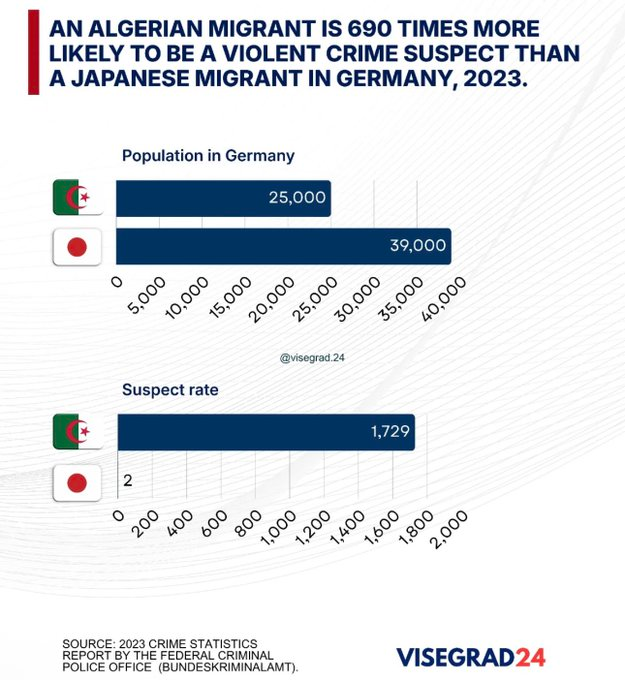
Es gibt gute und schlechte #Migration. Während fast jeder zehnte !!! Algerier in #Deutschland schwerste Gewaltverbrechen begeht, kommt so etwas bei Japanern statistisch fast nicht vor. Die illegale Asylmigration aus islamischen Ländern muss gestoppt werden! #Asyl#Islam#Messer
Flashback: A Palestinian father sends his young son toward IDF soldiers, shouting “Shoot him!” and ordering the boy to throw rocks — hoping to provoke a reaction he can film and weaponize.
He was using his own child as a disposable prop in the propaganda war against Jews.
The IDF soldier didn’t fall for the trap.
Instead, he simply gave the little boy a high-five.
This one moment perfectly exposes the moral abyss between the two sides:
One side teaches its children to hate and die.
The other chooses humanity even in the face of manipulation.
Share this. The contrast couldn’t be clearer.
I asked AI:
Who benefits financially if Europe brings in low/no income low educated non-culturally aligned welfare seekers from the third world?
"There are identifiable financial beneficiaries, and this is well-documented in immigration economics literature. Here's who actually profits:
1. Employers in low-wage sectors
- Construction, agriculture, food processing, cleaning, logistics
- Labor supply increase suppresses wages, boosting margins
- Reduces pressure to automate or improve conditions
2. Landlords & property owners
- Housing demand spikes in urban areas → rent increases
- Existing homeowners see property value appreciation
- Slum landlords and housing associations benefit most directly
3. Migration industry
- Lawyers, NGOs, translators, integration consultants
- This is a multi-billion euro industry in Germany, Sweden, Netherlands alone
- NGOs often receive per-head government funding — direct financial incentive to maximize intake
4. Retail & consumer goods
- Raw volume of consumers increases
- Governments often provide vouchers/cash that flows directly into consumption
5. Governments (short-term optics)
- GDP headline number goes up with population growth
- Politicians can claim “growth” while GDP per capita may stagnate or fall
Who Bears the Costs
- Native low-skilled workers — direct wage competition, most economically vulnerable
- Taxpayers — welfare, housing, education, healthcare, judicial costs
- Public service users — longer queues, diluted services
- Lower-middle class neighborhoods — concentrated social externalities
It’s essentially a privatization of gains, socialization of costs structure
Employers and landlords capture upside; diffuse taxpayer population absorbs downside. This is why mainstream economists who focus on aggregate GDP often support high immigration while working-class populations in receiving areas oppose it: they’re experiencing completely different economic realities.
George Borjas (Harvard) vs. Card/Peri debate covers this empirically in depth if you want the academic trail."
Claude seems to be fixing a super annoying developer problem.
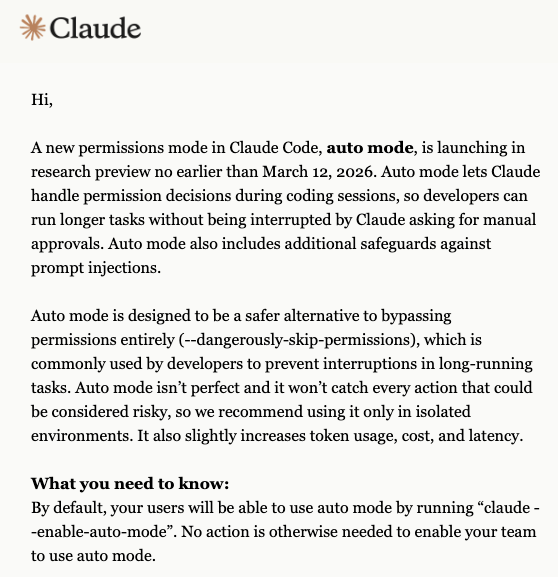
Anthropic announced a research preview feature called Auto Mode for Claude Code, expected to roll out by March 12, 2026.
The idea is simple: let Claude automatically handle permission prompts during coding so developers don’t have to constantly approve every action.
Sstops those annoying permission prompts during long coding sessions.
Before this, you had to use `--dangerously-skip-permissions` to work without interruptions.
That method worked fine but took away all your safety nets. This new auto mode gives us a smarter option.
Claude will take care of the specific permission choices on its own while still blocking threats like prompt injections.
You can finally let long tasks run without watching your screen the whole time.
Since it is still a research preview, you should run it inside isolated setups like sandboxes or containers for safety.
Expect a small jump in token usage and delay, because the model needs extra time to process the security checks.
Once available, you just type `claude --enable-auto-mode` to start.
If you manage a team and need people to manually approve actions, you can restrict this feature using Mobile Device Management tools like Jamf and Intune or through configuration files.