So let me get this straight.
Nvidia invests $30 billion in OpenAI. OpenAI in return commits massive capital to Nvidia, Microsoft, and Oracle for chips & cloud infrastructure. Microsoft also invests in OpenAI, then gets paid back through Azure spending.
Meanwhile, Oracle is building data centers and buys Nvidia chips to fill them. Nvidia also owns a stake in Coreweave while paying Coreweave for cloud capacity. Yet, Coreweave’s entire business model revolves around renting out Nvidia GPUs
The entire foundation of modern AI firms is built around using the same dollar as an investment, and a sale.
I’m genuinely sick to my stomach.
Tomorrow, October 6th at 6 PM UTC.
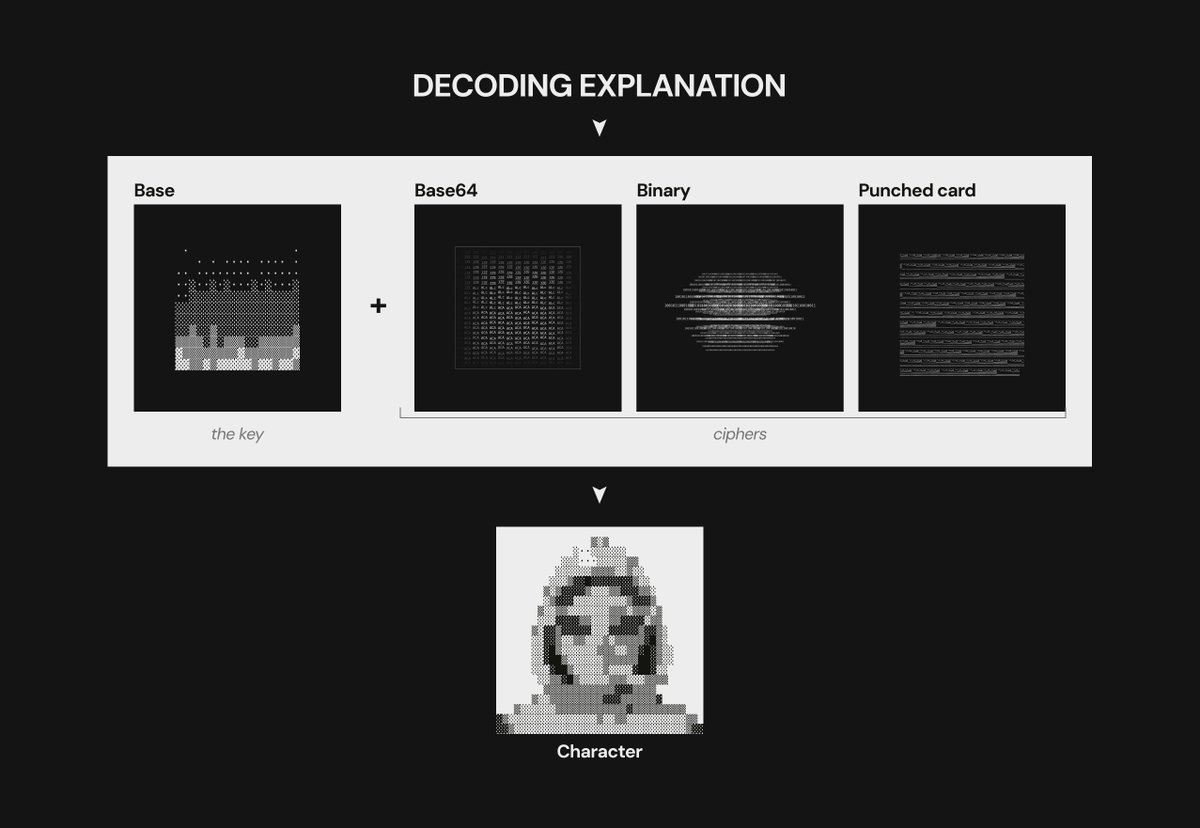
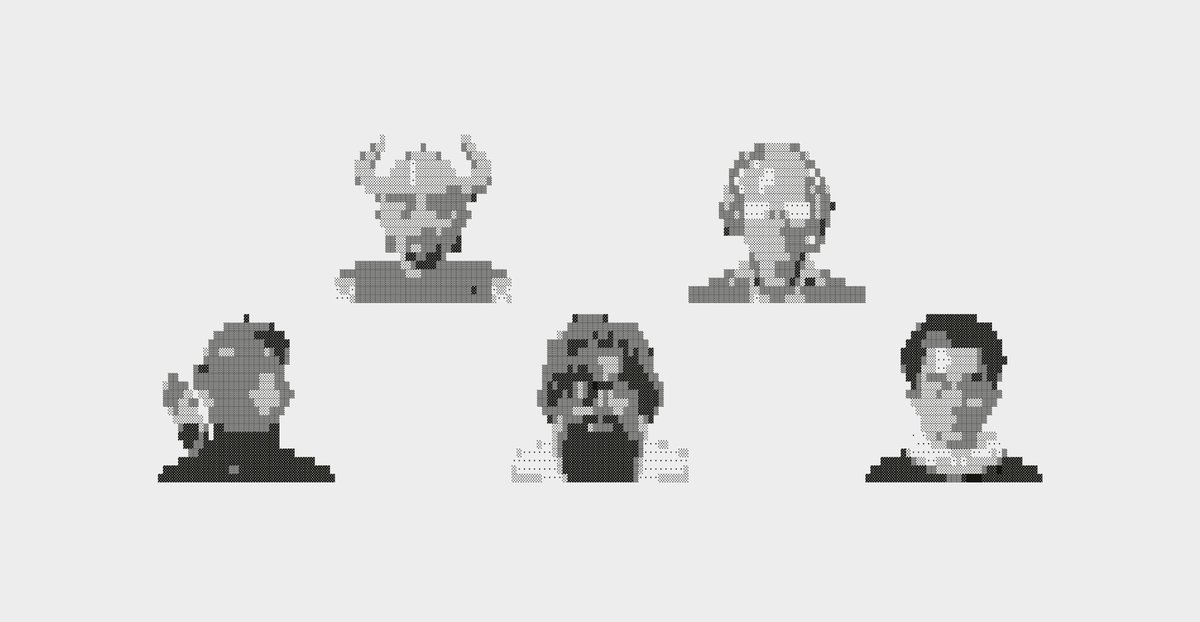
Your Cipher will decode into a character, while your key (Base) will be permanently destroyed.
A short video explains how the process will work.
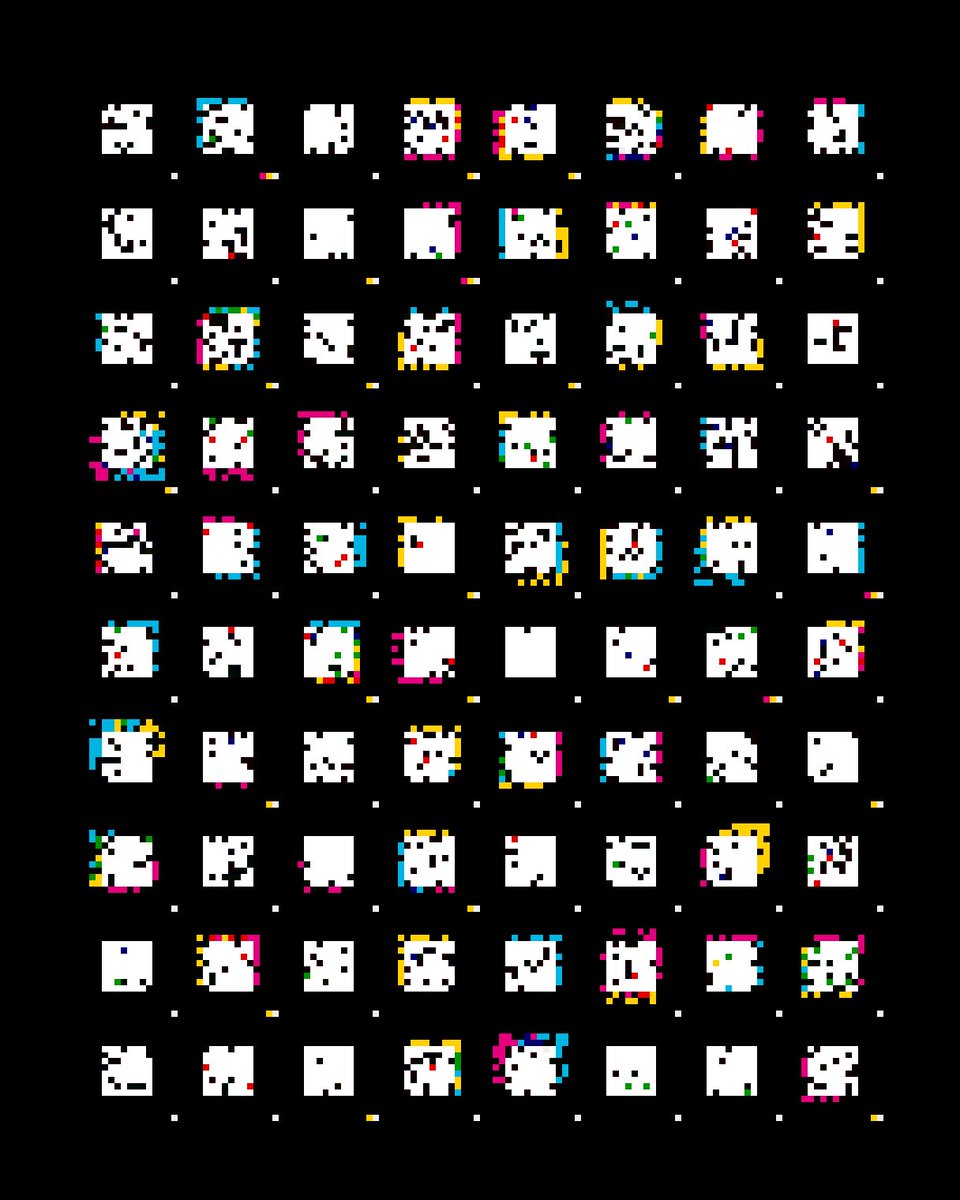
credits is an artwork about belief
each credit was created from a private payment - an $8 transaction on x money
each transaction id, originally visible only to sender and recipient, was converted to a sha-256 hash to create an artwork made of four 8x8 printing plates in cmyk (cyan, magenta, yellow and black)
the transaction id and settlement timestamp became public source data for the onchain artwork
the x money transaction settlement time (in seconds) determined which plates print - there are 15 different possible combinations of cmyk, so this process repeats 4 x per minute
if the original transaction id contained an 8, the resulting artwork metadata keeps track of each
the rarity calculation considers the color combination, the number of active pixels, the space they occupy after the plates shift, the number of 8s in the transaction id, and the registration of the plates
these qualities are measured against the completed collection and translated into a credit rating between 80 and 800
the rating measures those traits - it cannot account for every reason someone might value an image
the rating is fixed - the price is whatever someone is willing to pay
80 credits can be burned to create a statement
the collector chooses which credits to use and how to arrange them - their individual ratings are added together, and their colors become the material of the new artwork
a statement can take different visual forms without changing its rating
statements can also be overprinted - one is burned into another, combining their ink, ratings and histories
balance is the proposed next form
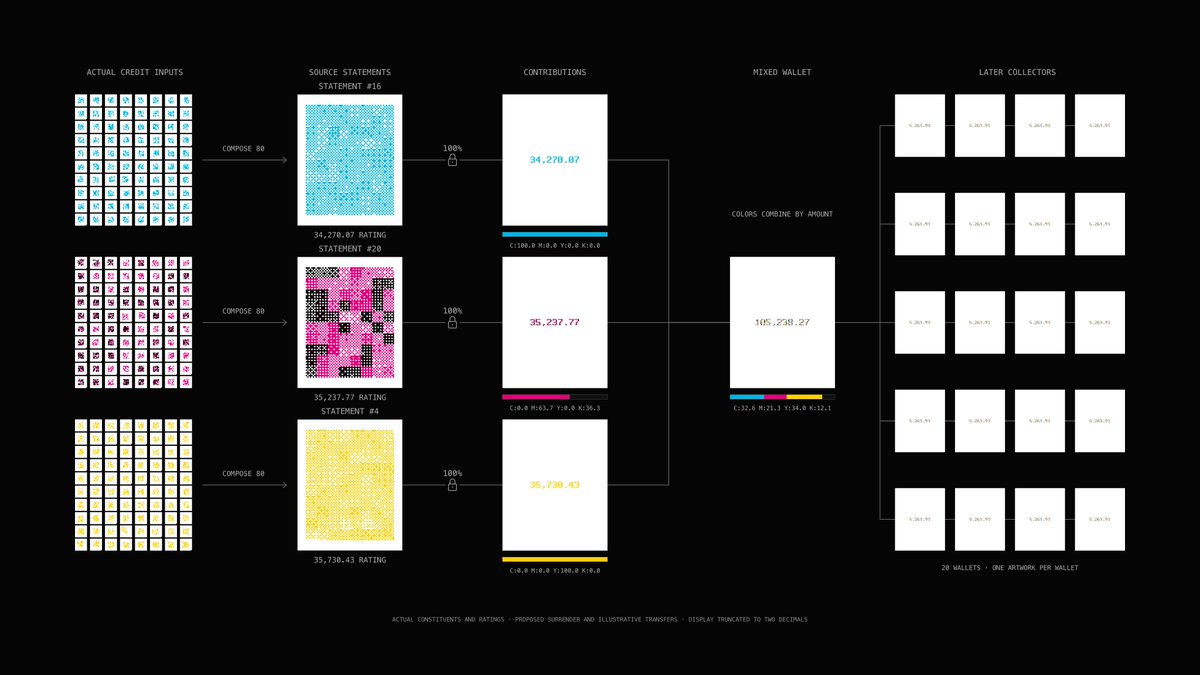
under this design, a statement can be permanently surrendered for its rating in divisible erc-20 tokens - one point becomes one balance
the statement is locked rather than destroyed - its artwork and history remain, but it can no longer be transferred
its quantity and color composition can move independently
each receiving wallet gets one non-transferable erc-721 artwork
the artwork stays with the wallet and reads its current balance of the transferable erc-20 token
the tokens move - the artwork updates
if the wallet holds nothing, the artwork remains and displays zero
when balances meet, their colors mix in proportion to the amounts received - when they split, each part carries a share of that mixture
the colors preserve an aggregate ancestry, not a traceable list of individual credits or statements
exchange custody can mix them further - a buyer may receive the exchange’s mixture rather than the particular colors a seller deposited
someone who never owned a credit or a statement can inherit their colors
credits, statements and balances can exist at the same time
some people keep the individual marks, some compose them into pages, and some surrender the page for something they can divide and exchange
others may simply prefer the balance artwork
composition reduces the number of surviving credits, overprinting reduces the number of surviving statements, and surrender moves statements out of circulation while releasing their accumulated rating as balance
the appetite for liquidity becomes one of the forces shaping all three collections
but making something divisible does not mean someone will want to buy it - actual liquidity still requires buyers and funded markets
balance offers divisibility, not a promise of demand
the market becomes a medium - its activity changes the distribution of the work, and when trading stops, that distribution remains
the price can disappear, the artwork cannot
To reveal your character through decoding, you need 2 Traces:
1 Base + 1 Cipher
Check the Method trait:
Base = Key
Base64 / Binary / Punched card = Cipher
Any Base works with any Cipher.
Next: what determines the odds.
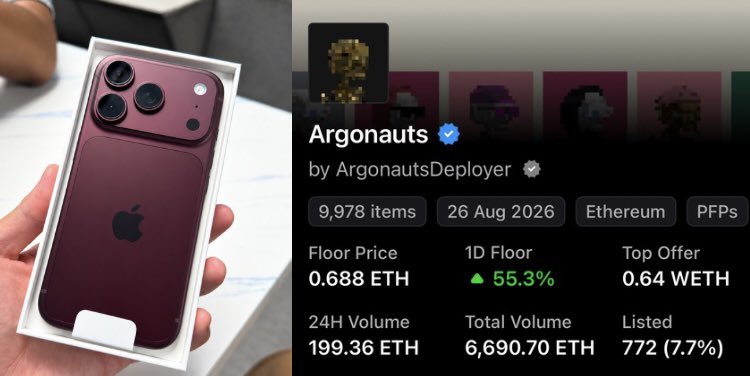
You’re spending $1,800 on an iPhone 18
I spent the same $1,800 on 3 Argonauts.
If you sell that iPhone today, you’re already looking at a loss of at least $200.
Meanwhile, my 3 Argonauts are now worth around $5,400.
That’s a $3,600 profit in just one month.
Now I can buy 2 iPhone 18 Pros with my profit and still have my initial $1,800 investment intact.
You bought a liability.
I bought an asset.
Invest in assets, not liabilities.
🔥 BURN 101 for @jackbutcher’s @vvcredits
CREDITS HAS TWO BURN LOOPS
I worked through the supply math & 80 CREDITS → 1 Statement is only the beginning
The second burn begins after the Statement exists
▷ FIRST CREDITS, THEN STATEMENTS
A Statement is a new artwork composed by burning 80 CREDITS
80 individual CREDITS
→ 1 Statement
Overprinting is a separate process
One Statement is overprinted into another, leaving one surviving Statement carrying the accumulated layers, underlying CREDIT history & Combined Credit Rating
Assembly reduces the number of loose CREDITS
Overprinting reduces the number of Statements
The history accumulates while the number of separately ownable NFTs contracts
▷ THE INVERTED EIGHT
Jack confirmed that Statements invert after 8 overprints
Here’s the derived math for a collector starting with ordinary Statements assembled from 80 CREDITS each:
1 starting Statement
+ 8 Statements overprinted onto it
= 9 base Statements involved
9 × 80 = 720 underlying CREDITS
So the clean path is:
720 CREDITS
→ 9 Statements
→ 8 overprints
→ 1 inverted Statement
The 8-overprint threshold is confirmed
The 720-CREDIT total is the math derived from that specific path
The CREDITS are burned during initial assembly
Overprinting then contracts the Statement supply
▷ WHAT PARTICIPATION COULD LOOK LIKE
10 Statements would require:
800 CREDITS burned
→ 10 Statements
100 Statements would require:
8,000 CREDITS burned
→ 100 Statements
10 inverted Statements reached through the clean 8-overprint path would require:
7,200 CREDITS burned
→ 90 Statements assembled
→ 80 overprints
→ 10 inverted Statements remaining
Every layer depends on collectors choosing to give up separately ownable works to create something more concentrated & scarce
▷ THE BULL CASE
The mechanism can contract supply at two separate levels:
Loose CREDITS disappear through Statement assembly
Statements disappear through overprinting
The inverted milestone gives collectors a visible destination requiring 9 base Statements, or 720 underlying CREDITS along the clean path
If collectors value the accumulated artwork, provenance, Combined Credit Rating & inversion milestone enough to keep merging, both supply layers can contract
👉 If both layers contract, scarcity intensifies on two fronts, fomo can follow, and the demand & burn loops can accelerate
NFA; Have fun collecting CREDITS & burning CREDITS to assemble Statements
onchain right now is basically 3-4 groups of KOLs just giga farming together lol
they vamp any good narrative with a proxima bundle which is easy to spot, you can just ask claude 99% of the time.
its just a psyop of greed, but karma always comes around