There are many more insights about social media account verification and Twitter Blue in the paper, which you can read at the link below. Credit for the project goes to stellar @PrincetonCITP researchers @madxiaodisease, @m0namon, and @anunaykul.
https://t.co/28LXa2HmcV
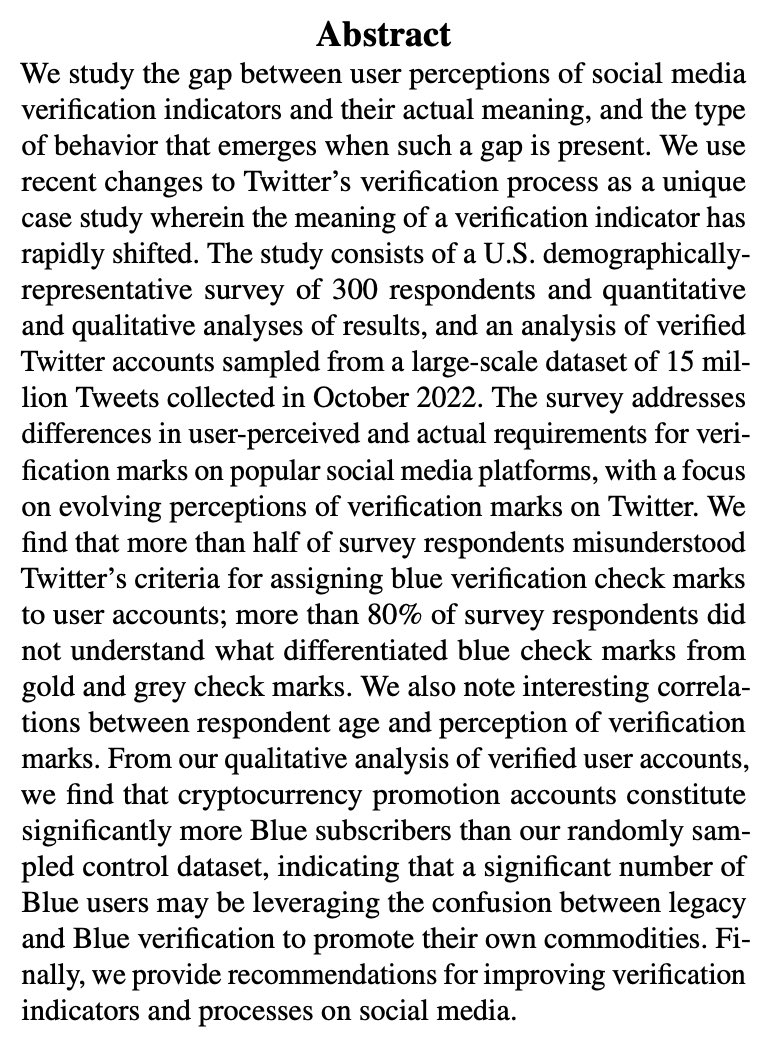
Since today is the blue check apocalypse, here’s a new research paper on Twitter’s paid account “verification.” What we learned:
1) Most people don’t understand what blue checks now mean.
2) Paid accounts are disproportionately crypto bros, Elon stans, new, and conservative.
What’s more, Twitter may be violating its 2022 consent order with the FTC. Twitter “must not misrepresent…the extent to which [it] maintains and protects the…integrity of Covered Information.” Covered Information includes names, and integrity presumably includes accuracy.
Too often, takes on Twitter’s new management start with something like “Elon can do whatever he wants, but…” That’s just not true. While the U.S. legal landscape for online content moderation provides platforms with vast discretion to set policies, it’s not unlimited discretion.
Twitter’s new ban on discussing competitors, announced during the World Cup final, raises serious legal questions. First, does CDA 230 protect such a transparently anticompetitive policy? The Ninth Circuit’s decision in Enigma v. Malwarebytes suggests no. https://t.co/PBMqX4pP8G
That’s just the U.S. law, of course. EU competition and tech regulators will not look kindly on this policy, and they have more expansive authorities. The upcoming Digital Markets Act and Digital Services Act will provide even more tools, though query if Twitter will be covered.
🚨🚨 JOB ALERT: @PrincetonCITP is hiring postdocs. Come work on projects with me! 🚨🚨
Both @jonathanmayer and I are looking for candidates interested, broadly speaking, in information integrity, platform accountability, and polarization.
Apply here: https://t.co/jjtivMbsra
Consumer deception law created a dilemma for Twitter. It could leave its Covid misinformation policy, risking liability. Or it could change the policy, mitigating liability but risking blowback from users and advertisers. Twitter chose the latter course. https://t.co/rM3H15VorM
Elon Musk just created the perfect fact pattern for consumer deception law and online content moderation.
Twitter’s policy: after five strikes for Covid misinformation, we *will* permanently ban an account.
Twitter’s practice: eh, let Marjorie Taylor Greene back on anyway.
Usually consumer deception law has no role in content moderation, because platform policies are too ambiguous & discretionary. But here, Twitter is departing from a specific & mandatory policy. Whatever you think of Musk, Greene, or the policy, it’s an interesting legal quandary.
This is why reusable research infrastructure, like @MozillaRally, is so important for platform accountability. Facebook won’t say where it collects personal data online. @themarkup found out with just a couple hundred lines of code. (I counted.) https://t.co/SBbFBs9A0O
Turns out Facebook was vacuuming up student data that was being entered on online financial aid applications.
The latest @themarkup investigation by @suryamattu@colinlecher, enabled by the tools developed by @MozillaRally.
If you’re interested in dark patterns, the UK Competition and Markets Authority just released a pair of reports that are must-read. The voluminous literature review is particularly valuable. (Disclosure: I offered suggestions on a draft.) https://t.co/ojPmXGEJQJ
🛒 When you last shopped online, did you feel pressured to buy?
We’re continuing to challenge tactics that harm shoppers or damage their trust and confidence in online markets.
#OnlineShopping#RipOffTipOff
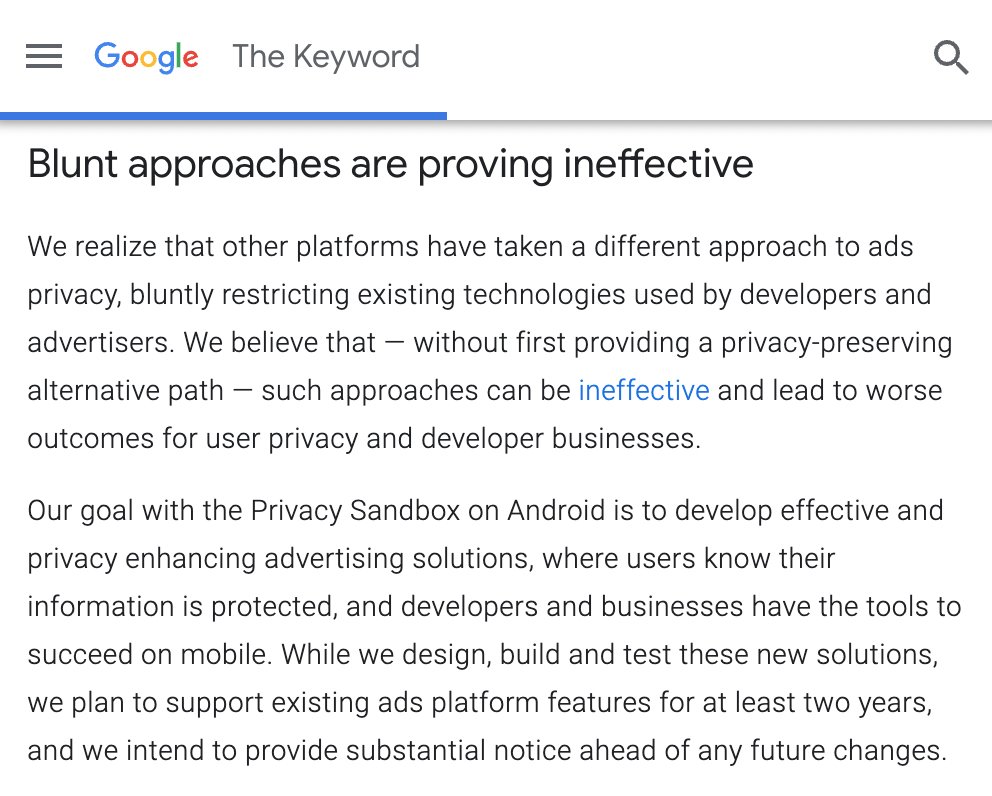
Facebook: Apple’s App Tracking Transparency is so effective that it’s costing us $10 billion in annual revenue.
Google: Apple’s App Tracking Transparency is so ineffective that we aren’t implementing it on Android.
More privacy gaslighting by Google. https://t.co/GcAnaLmAgW
If FTC wanted to put Apple under a data privacy order, this could be an easy case. FTC has previously brought deception claims for broken opt outs. Apple is already fixing the bug, but FTC needs consent orders to make fines available in future enforcement. https://t.co/BgFG9xEtMC
@OrinKerr@Riana_Crypto Warshak’s reasoning is relevant. If stored account contents are analogous to a private space, a compelled intrusion into that space is a search.
The cases that come to mind are Crist (CSAM hash checks without any warrant), Mann (exceeding warrant scope), and Schlingoff (same).
@OrinKerr@Riana_Crypto I’ve been mulling over this issue. It’s a tougher argument post-Warshak. There’s no REP in the CSAM (like Caballes), but compelling a service to look into account contents might be a search (like Jardines). Lower courts haven’t bought similar arguments for device hash searches.