Football intelligence & applied AI. Designing systems that turn information into decisions. Former @kaagent • @nkdomzale. MSc Sport Management. American.
Brighton's in-house data provider (StarLizard) is totally classified. My assumption is that it captures some unique variation/distillation of xT (expected threat) that signals a strong value judgment of the player's ability.
Someone like Eiran Cashin would rank extremely high in that dataset because he has an exceptional passing range, despite what I would consider "deal-breaking" weaknesses.
The fundamental difference at Brighton is that the data's opinion is weighted far more than human opinion.
More on StarLizard.
The signal I’m getting from this is that Bloom is doubling-down on his proprietary model’s moat despite what I predict will be a disruptive next few years in the data analytics landscape.
Brighton's in-house data provider (StarLizard) is totally classified. My assumption is that it captures some unique variation/distillation of xT (expected threat) that signals a strong value judgment of the player's ability.
Someone like Eiran Cashin would rank extremely high in that dataset because he has an exceptional passing range, despite what I would consider "deal-breaking" weaknesses.
The fundamental difference at Brighton is that the data's opinion is weighted far more than human opinion.
I profiled Ayto as a system and process builder based on his work at Arsenal.
It’s bizarre that he was hired in the first place if Tony Bloom is doubling-down on his StarLizard model and methodology.
🚨 Jason Ayto’s departure was caused by fundamental differences over Tony Bloom’s data-dominated recruitment operation.
Ayto was accustomed at Arsenal to data, video analysis and scouts out in the field, all playing more or less equal parts in signing a player. The different approaches were discussed at length when Ayto was appointed.
It gradually became clear over the months leading up to the summer transfer window that Brighton’s overriding focus on data would be an insurmountable sticking point for both parties. They will not budge on their methods, which Ayto found too restrictive.
The decision did not come as a total surprise to him.
[@AndyNaylorBHAFC]
#bhafc
@noahzender Excellent book choice - my physical copy of Lila is filled with notes.
Curious to know what your highlight > evergreen note ratio is and if that's changed since digitizing the slipbox? My bar is high, but mainly because I have to digitally transcribe what was physically written
This is the shift I anticipate happening in the next era of data analytics, on both an individual and organizational level.
Intuition will become the edge when data is fully commoditized, but intuition won't develop without a deep understanding of the fundamentals.
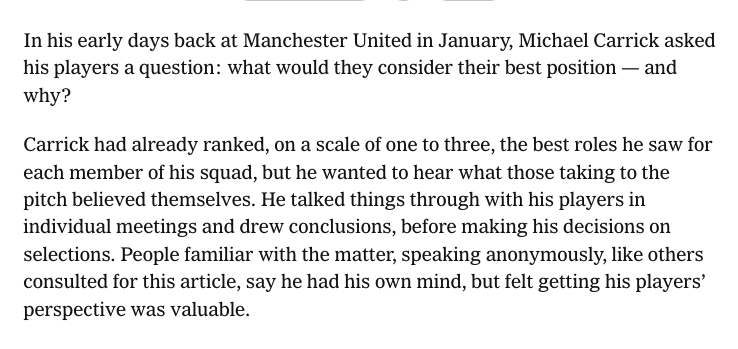
Carrick's first initiative as Amorim's successor was to improve his understanding of each player by testing his own evaluation against each player's self-understanding, not so he could decide who fits into his team idea, but to develop the team idea based on a deeper understanding of each individual.
Individual understanding should come before tactical ideology.
Deciding on a team's tactical idea occurs between two ends of a top-down vs bottom-up spectrum:
– Top-down is the coach's team idea imposed on the players.
– Bottom-up is the team idea emerging from the players. The coach maps individual qualities first, and the playing style comes second.
The bottom-up approach requires intensive diagnostic work before the team idea can exist. Building upward from the individual requires first knowing the individual's action capacities and predispositions in detail. The team idea that emerges from this process is better calibrated to the players.
Carrick's approach also touches on my belief that a player's self-knowledge can be a competitive advantage. A player who can articulate their strengths and the situations that express them is giving the coach raw material to build the team from. As a player, you should know how to put yourself in positions and situations that maximize your best qualities. As a coach, you should facilitate each player's self-awareness of their best qualities.
Current events at Man United remind me of a few Jason Wilcox podcast quotes from Nov 2025 that now seems completely incoherent:
"Ruben's got a clear idea. It's a lot more flexible than people give it credit for"
"We're really clear. Myself, Ruben, Omar, the ownership. Really clear on the direction of travel"
"We're very clear on the profiles... the brief will come from myself and Ruben... a lot of debate and discussion"
My read: The friction has always been there. A recruitment strategy built on the (supposed) alignment between two people who see the game differently is a fundamental misalignment. JW is skeptical of system-specific team-building. RA is uncompromising. That's the bottleneck. Everything downstream is corrupted.
My assumption: JW has always pushed for a more flexible approach. RA perhaps verbally agreed (hence the JW quotes) but never followed through. Finally RA gives in and his pride is damaged (hence the MANAGER not coach quote). It is untenable now.
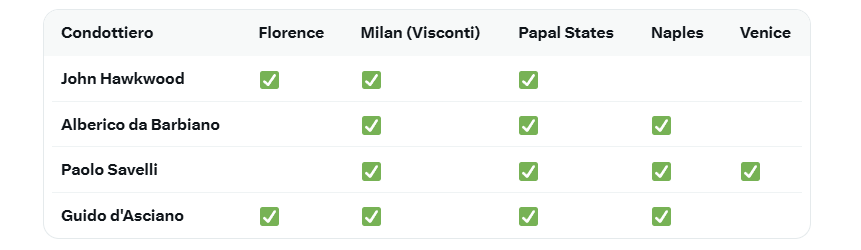
Italian top coaches switching jobs between the same few top Italian teams is hilariously similar to 14th century mercenary commanders in Italy switching allegiances between the same small pool of powerful states in the peninsula.
The 14th Century condottieri carousel:
Michael Carrick is touching on a key recruitment principle: Generalists reduce the dependency on signing specific profiles.
When you are building a team around players who adapt to their teammates' qualities, you are free to pursue the best players at the best value. Not the one specific profile you assume will complement another player in the team.
Building a team around players that require highly specific conditions in order to perform means every future signing must fit into a narrow complementary profile designed to enhance the specialist players.
I think that is a naive way of squad building. Generalists adapt their game to complement their teammates and that adaptability is what gives the club room to recruit on overall quality rather than specific fit.
The #1 killer of creativity is a weak knowledge base. The #1 unlock is having knowledge so fully ingrained that manipulating it takes no conscious effort, freeing up all your brainspace for higher-level thought.
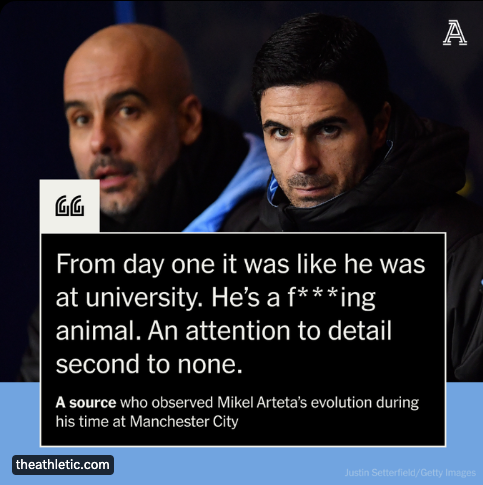
I chuckled at this Pep anecdote but realized it illustrates why Pep is both an innovator and a leader.
Strong opinions, weakly held. Pride would've let that session run and prevented the better idea from emerging.
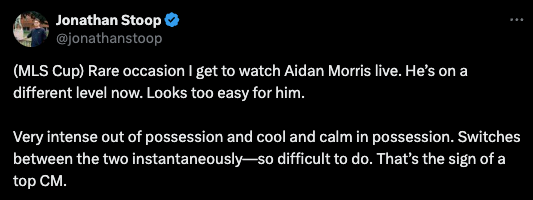
"...cool and calm on the ball, energetic and intense off of it –– is a great indicator of scalability."
This is his key quality that I saw first watching him at IU and his career has been in upward trajectory since, I expect it will continue.
https://t.co/ZqDUOgkcZj
Great to see Aidan Morris' career progress accordingly.
More evidence that a player's ability to remove themselves from the game's emotional momentum –– cool and calm on the ball, energetic and intense off of it –– is a great indicator of scalability.
I was initially worried that the Championship might be a bit too 'disconnected' and chaotic for his profile but he's started well. I'm sure he's getting an excellent education (either directly or indirectly) from Michael Carrick.
Aidan Morris is unfortunate to miss out on the World Cup with the USMNT, to the surprise of those who regularly watch the EFL Championship. He was in flow during the playoff final.
Creative passes like these in tight space are impressive.





![BrightonBubble's tweet photo. 🚨 Jason Ayto’s departure was caused by fundamental differences over Tony Bloom’s data-dominated recruitment operation.
Ayto was accustomed at Arsenal to data, video analysis and scouts out in the field, all playing more or less equal parts in signing a player. The different approaches were discussed at length when Ayto was appointed.
It gradually became clear over the months leading up to the summer transfer window that Brighton’s overriding focus on data would be an insurmountable sticking point for both parties. They will not budge on their methods, which Ayto found too restrictive.
The decision did not come as a total surprise to him.
[@AndyNaylorBHAFC]
#bhafc](https://pbs.twimg.com/media/HJ9-5NqXIAAOlkm.jpg)