Everyone is covering Terafab as a chip factory.
It is not a chip factory.
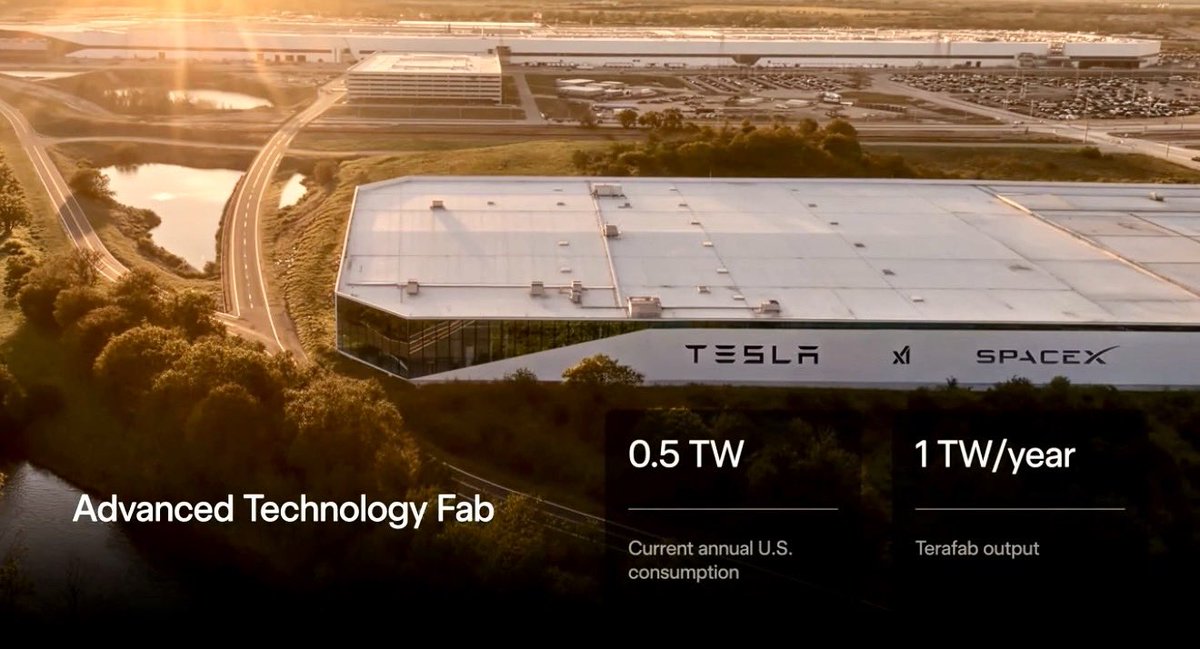
Last night in Austin, Elon unveiled a facility that makes masks, fabricates chips, and tests them inside a single building with a nine-month recursive improvement cadence. No such loop exists anywhere else on Earth. Then he told you 80% of the output goes to space. Then he showed you a 100-kilowatt AI satellite with solar panels and radiators, scaling to megawatt range. Then he said Optimus plus photovoltaics will be the first von Neumann probe, a machine capable of replicating itself from raw materials found in space.
Nobody connected the sequence.
Terafab produces 1 terawatt per year of compute. The entire United States consumes 0.5 terawatts of electricity. Musk is building a single factory whose output in AI silicon exceeds twice the power consumption of the country it sits in. And he is sending 80% of it off-planet because Earth literally cannot power what he is building.
Follow the mechanism. Terafab seeds the chips. Starship launches Optimus robots and solar arrays at 100 million tons per year. The robots mine lunar and asteroid regolith for silicon, iron, and nickel. They 3D-print more robots. They fabricate more solar panels. They assemble more AI satellites. Each satellite runs hotter-burning D3 chips designed specifically for vacuum, where free radiative cooling eliminates the thermal constraints that strangle every terrestrial data center on the planet. The nodes replicate. The replication is exponential.
This is a Dyson Swarm bootstrap hidden inside a semiconductor announcement.
The math is public. The Sun outputs 3.828 times 10 to the 26th watts. A 2022 paper in Physica Scripta calculated that 5.5 billion satellites at 290 kilograms each, robotically manufactured from Mars resources, capture enough solar energy to meet all of Earth’s power needs within 50 years. A 2025 paper in Solar Energy Materials calculated a partial swarm capturing 4% of solar output yields 15.6 yottawatts, roughly a billion times current human civilization’s total energy budget. Musk just announced the factory that builds the chips that go inside the satellites that replicate themselves forever.
92% of advanced logic chips are fabricated in Taiwan. One factory in Austin does not fix that. But one self-replicating system seeded by that factory, launched by the only company with reusable heavy-lift rockets, assembled by the only humanoid robot in mass production, and powered by the only star within reach, does not fix a supply chain. It obsoletes the concept of supply chains entirely.
The market priced this as a $20 billion capex story about semiconductor independence.
The actual announcement was the engineering blueprint for Kardashev Type II.
Humanity sits at 0.73 on the Kardashev scale. 18 terawatts. The distance between here and harnessing a star is not a technology gap. It is a recursion gap. And recursion is exactly what a single building in Austin that makes its own masks, builds its own chips, tests its own chips, and launches the output into orbit on its own rockets was designed to close.
Every civilization that makes it past this point never looks back.
Introducing the Google Workspace CLI: https://t.co/8yWtbxiVPp - built for humans and agents.
Google Drive, Gmail, Calendar, and every Workspace API. 40+ agent skills included.
Elon Musk: “I am not working on a phone. I can tell you where I think things will go, which is that we’re not going to have a phone in the traditional sense. What we’ll call a phone will really be an edge node for AI inference with some radios to connect. Essentially, you’ll have AI on the server side communicating with AI on your device—formerly known as a phone—and generating real-time video of anything you could possibly want. There won’t be operating systems or apps in the future; it’ll just be a device that’s there for the screen and audio, and to put as much AI on the device as possible.”
(via Joe Rogan Experience Podcast)
the current state of HBM for AI chips is increasingly similar to the choice of avoiding carbon fiber in building Starship - it could be way more scalable to just use steel (DRAM) instead
@SawyerMerritt You can fit more total RAM on the board if you use “normal” memory than high-bandwidth memory and it is super cheap.
Maybe high-bandwidth memory is still the right choice, but using HBM isn’t the slam dunk many people think it is.
Latest OpenAI numbers from the FT:
800m users, 5% paying (40m).
$13bn in ARR.
Implies a $325 annual ARPU, or $27/month per paying user.
70% of rev from subscriptions, rest is API.
$8bn loss in H1, prob $20bn run rate loss now? So basically spending $3 for each $1 in revenue.
@bcherny@sdrzn you really should take a look at the angry users here:
https://t.co/RpHclCpEXG
https://t.co/ZIs3ezX481
something's definitely wrong on Anthropic's side.
what's most interesting to me in Sonnet 4.5 and Claude Code 2.0 is the model will literally pause its reply right in the middle, call additional tools for more context, then continue answering
it feels like a real-human to me
tried Codex today just to immediately uninstall it after asking GPT-5-High a simple architectural question only to receive a big sloppy response while Claude answered perfectly











![jonathanykh's tweet photo. "[✻] [✻] [✻] · 3 guest passes at /passes"
what's this? https://t.co/39LckU6IOv](https://pbs.twimg.com/media/G7eEKxMbkAAtgOI.jpg)